What makes a country more than just land on a map? One big answer is its ideals, the shared beliefs about how people should live together. When the United States was being founded, people argued, protested, wrote, debated, and cooperated because they believed certain ideas mattered deeply. Those ideas included freedom, equality, the rule of law, respect, and taking part in public life. Even though people in the founding era did not always live up to these ideals, the ideals themselves helped shape the nation.
Think about a game with no rules, no fairness, and no teamwork. It would quickly fall apart. A country can feel the same way. The people who helped found the United States believed that a government should protect rights, follow laws, and listen to citizens. They also believed that citizens had responsibilities, such as helping their communities and participating in public decisions.
These beliefs are called civic ideals. They are not just old words from long ago. They still matter in classrooms, neighborhoods, and towns today. When people speak respectfully at a meeting, follow rules fairly, help others, or stand up for justice, they are putting civic ideals into action.
Civic ideals are important beliefs about how citizens and government should act in a community or nation. These ideals include freedom, rule of law, equality, civility, cooperation, respect, responsibility, and civic participation.
The founding of the United States was not one single moment. It was a long process shaped by many people. Some were famous leaders, and others were ordinary colonists. Some acted alone by writing or speaking out. Others acted together in meetings, protests, and conventions. Both kinds of actions help us understand what the nation valued.
Civic ideals guide the way citizens and leaders should behave, as [Figure 1] shows through a web of ideas connected to community life. They are like a set of shared goals for public life. An ideal is something people believe is important and worth striving for, even if they do not reach it perfectly every time.
At the founding of the United States, civic ideals helped answer big questions. Should people have a voice in government? Should leaders have limits? Should laws apply to everyone? Should citizens work together for the common good? These questions led to important actions and documents that shaped the country.
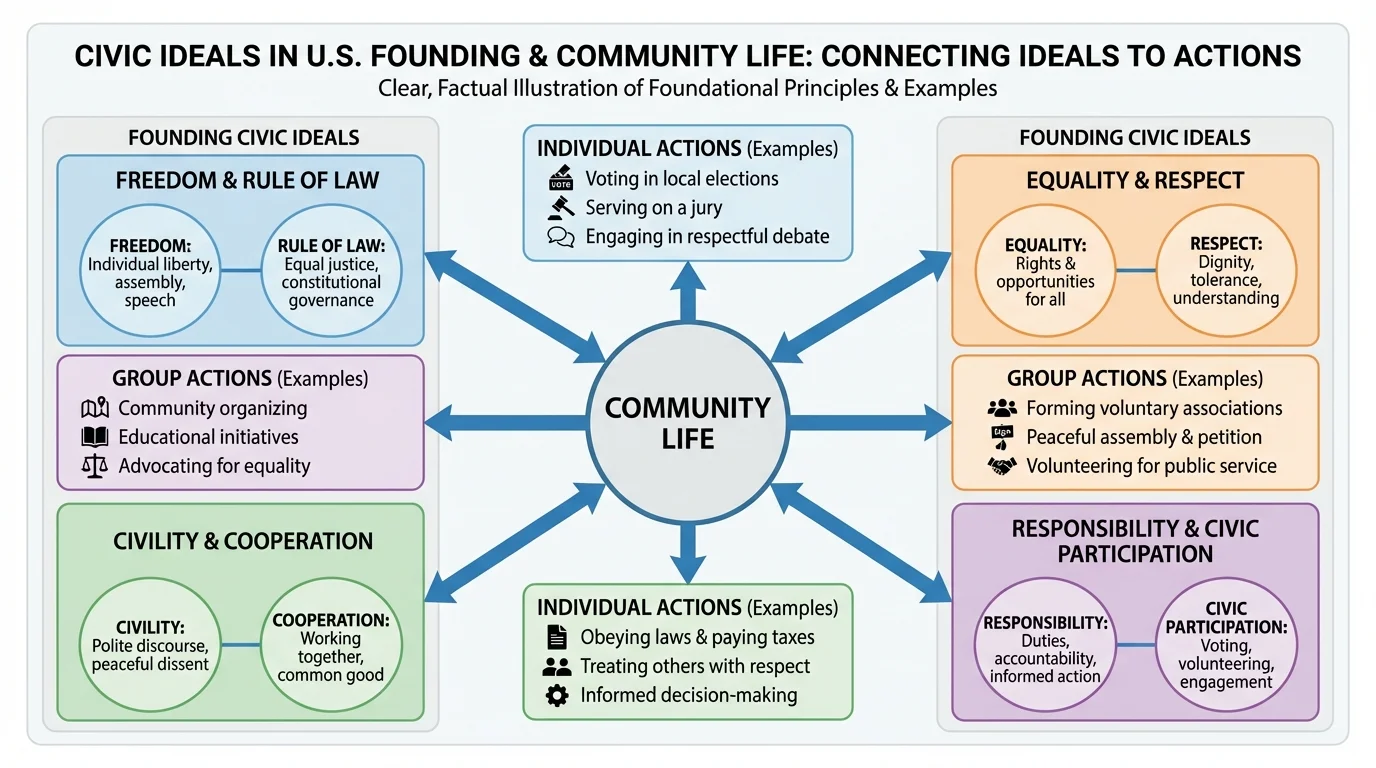
Some ideals worked together. For example, freedom without responsibility can cause harm, and participation without civility can lead to angry conflict instead of helpful discussion. The founders and the public had to balance rights with duties.
The word civic comes from a word related to citizens and cities. It reminds us that citizenship is about how people live together, not only what they do alone.
It is also important to remember that the founding era included unfairness and exclusion. Enslaved people, many women, and Native Americans were denied rights and equal treatment. This means the ideals were powerful, but they were not fully shared with everyone. Later generations kept pushing the country to better live up to them.
Freedom means having the right to think, speak, worship, and act without unfair control, as long as those actions do not take away the rights of others. In the founding era, many colonists believed Britain was limiting their freedom by taxing them without giving them representation in Parliament.
A clear group action showing freedom was the way colonists organized protests against British policies. The Boston Tea Party in 1773 is one example. A group of colonists protested taxation by dumping tea into Boston Harbor. They believed they should not be forced to pay taxes without a voice in government.
A strong individual action showing freedom was Patrick Henry's speeches calling for liberty. He spoke boldly for the idea that people should not quietly accept unfair control. Writers such as Thomas Paine also used words as powerful tools. In his pamphlet Common Sense, Paine argued that the colonies should be independent and free to govern themselves.
Freedom also appeared in religion. Many colonists wanted the freedom to worship in their own way. In some colonies, people pushed for greater religious liberty, and later the Bill of Rights protected freedom of religion, speech, and the press.
The rule of law means that laws, not the personal wishes of rulers, should govern a country. It also means that everyone, including leaders, should follow the law. This ideal was very important during the founding because colonists feared the abuse of power.
A group action that showed rule of law was the writing of colonial charters, state constitutions, and later the United States Constitution. These documents were created to set rules for government. The Constitution explained how power would be divided and limited. That helped prevent one person or one group from controlling everything.
An individual action showing rule of law was James Madison's work in helping design the Constitution. He supported a system with checks and balances so that each branch of government would have limits. George Washington also supported the rule of law when he gave up power after serving as president instead of trying to rule for life. That peaceful example showed that leaders must follow the system, not rise above it.
Why rule of law matters
If one leader can ignore the rules whenever he or she wants, people's rights are not safe. Rule of law protects citizens by making government follow agreed-upon rules. It creates order, fairness, and trust.
The rule of law is still important today. Schools, towns, and countries all work better when rules are clear, fair, and applied consistently. As we saw earlier in [Figure 1], rule of law connects with other ideals because fairness and participation depend on it.
Equality means that people should be treated fairly and should have equal worth. The Declaration of Independence famously stated that "all men are created equal." This was a powerful idea, but at the time it was not fully carried out. Many people were excluded from political rights and equal treatment.
A group action connected to equality was the writing of the Declaration of Independence itself. The document declared a bold principle that people have rights. Even though the nation did not fully follow this ideal at first, the words became a standard that later reformers used to demand more justice.
An individual action connected to equality was Abigail Adams writing to her husband John Adams and asking him to "remember the ladies." She wanted women to be considered when laws were made. Another important example is the way enslaved and free African Americans spoke, wrote, and resisted injustice by insisting that the words about liberty and equality should apply to them too.
Equality in the founding era was often more of a goal than a reality. Understanding that difference is important. It helps us see both the promise of the founding ideals and the work that remained unfinished.
"We hold these truths to be self-evident, that all men are created equal..."
— Declaration of Independence
That statement became one of the most important ideas in American history. It challenged people in every generation to ask whether the nation was truly living up to its words.
Civility means speaking and acting in a polite, thoughtful way, especially when people disagree. Respect means showing that others matter and that their rights and opinions deserve consideration. These ideals may sound simple, but they are essential in a democracy.
A group action showing civility and respect was the way delegates met at the Constitutional Convention in 1787. They disagreed on many issues, including how states should be represented and how power should be shared. The debates were serious and sometimes tense, but the delegates kept working, listening, and compromising.
An individual action showing civility was Benjamin Franklin's role at the Constitutional Convention. Franklin encouraged people to cooperate and accept compromise even when no plan was perfect. He understood that public decisions often require calm discussion rather than stubborn refusal.
Respect also includes respecting the rights of others. During the founding, newspapers, pamphlets, and speeches gave people ways to share ideas. Respectful disagreement helped citizens argue about the future of the nation without always turning to violence.
Cooperation means working together toward a shared goal. Responsibility means doing your duty and being accountable for your actions. The founding of the United States required both.
A group action showing cooperation was the First Continental Congress in 1774. Delegates from different colonies met to discuss a common response to British actions. The colonies had different interests, but they worked together because they believed unity was necessary.
Another group example was local committees of correspondence. These groups shared information from colony to colony. They helped people stay informed and coordinate responses. Cooperation allowed the colonies to act more like partners than isolated places.
An individual action showing responsibility was George Washington accepting leadership of the Continental Army and continuing through difficult years of war. He took on a heavy duty, not for personal comfort, but because he believed the cause mattered. Ordinary soldiers and citizens also showed responsibility by making sacrifices, serving, supporting the war effort, and helping their communities.
Examples of civic ideals in action
Step 1: Group action for cooperation
The First Continental Congress brought delegates together from several colonies to discuss shared problems and make plans.
Step 2: Individual action for responsibility
George Washington accepted difficult leadership during the Revolution and followed civilian control of government after the war.
Step 3: Why these examples matter
They show that a nation is built by both organized groups and individuals willing to serve the common good.
Cooperation and responsibility remain linked. A community works best when people not only care about their own rights but also help meet shared needs.
Civic participation means taking part in the life of a community and government. This can include voting, speaking at meetings, signing petitions, serving on juries, staying informed, and helping solve public problems.
A group action showing civic participation was the tradition of town meetings in New England. Colonists gathered to discuss taxes, local rules, and community decisions. This gave people practice in self-government before the United States became independent.
Petitions were another group action. Colonists signed and sent statements to leaders asking for change. These petitions showed that people believed citizens should be heard.
An individual action showing civic participation was a person publishing a newspaper article, speaking at a public meeting, or serving in a local government role. Mercy Otis Warren, for example, wrote political plays and essays that influenced public opinion. Her writing helped citizens think about power, liberty, and government.
Civic participation does not always mean agreeing. Sometimes it means joining a debate, asking hard questions, and helping a community choose wisely. Participation gives people a voice, but it also requires listening and learning.
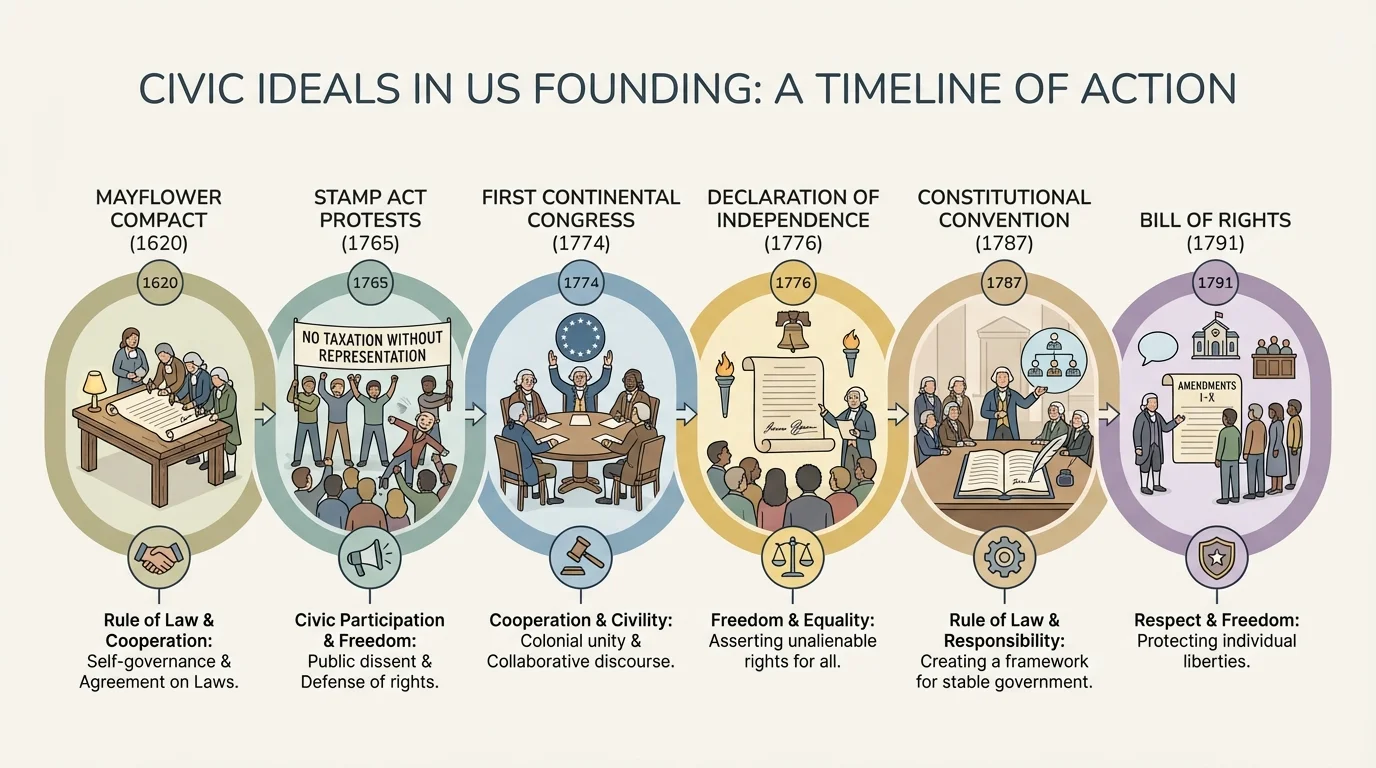
The founding era included many events that reflected different civic ideals, and [Figure 2] traces several of them in order. Looking at these events as a timeline helps us see how ideas developed over time rather than all at once.
The Mayflower Compact in 1620 showed early self-government and cooperation. Colonists agreed to make decisions together for the good of the colony. Much later, protests against the Stamp Act in 1765 showed resistance to unfair taxation and a demand for representation. The First Continental Congress in 1774 showed cooperation among colonies. The Declaration of Independence in 1776 expressed freedom and equality as central ideals. The Constitutional Convention in 1787 showed civility, compromise, and responsibility. The Bill of Rights in 1791 protected important freedoms.
Several key figures stood out in these events. Thomas Jefferson helped write the Declaration of Independence. James Madison helped shape the Constitution. George Washington modeled responsible leadership. Benjamin Franklin encouraged compromise. Abigail Adams spoke up for women's rights. Mercy Otis Warren used writing to influence public debate.
| Ideal | Group Action Example | Individual Action Example |
|---|---|---|
| Freedom | Boston Tea Party protest | Patrick Henry speaking for liberty |
| Rule of law | Writing the Constitution | Washington giving up power after serving |
| Equality | Declaration of Independence | Abigail Adams urging fair treatment |
| Civility | Debates at the Constitutional Convention | Franklin supporting compromise |
| Cooperation | First Continental Congress | Citizens serving together for the cause |
| Respect | Listening to opposing views in public debates | Writers considering the rights of others |
| Responsibility | Communities supporting public needs | Washington leading with duty |
| Civic participation | Town meetings and petitions | Mercy Otis Warren writing on public issues |
Table 1. Examples of civic ideals shown through both group and individual actions in the founding era.
When we compare events this way, we can see that the founding was built on action as much as words. Speeches, meetings, petitions, military service, writing, and lawmaking all played a part.
Rights and responsibilities go together. A citizen may have the right to speak, but also the responsibility to speak truthfully and respectfully. A citizen may have the right to participate, but also the duty to stay informed.
We can also use [Figure 2] to notice that civic ideals developed step by step. Early agreements led to protests, protests led to independence, and independence led to building a new government.
[Figure 3] The same ideals still matter today and show how actions from the founding era compare with actions people take in modern communities. The details may change, but the values remain familiar. Town meetings connect to school board meetings and city council meetings. Petitions connect to writing letters or gathering signatures for a cause. Public speeches connect to students sharing ideas in class or citizens speaking at community events.
Freedom today includes speaking your views and practicing your religion. Rule of law includes following fair rules in school and society. Equality means treating people fairly and standing against discrimination. Civility and respect mean listening even when opinions differ. Cooperation means working with others on shared problems. Responsibility means doing your part. Civic participation means taking action to improve the community.
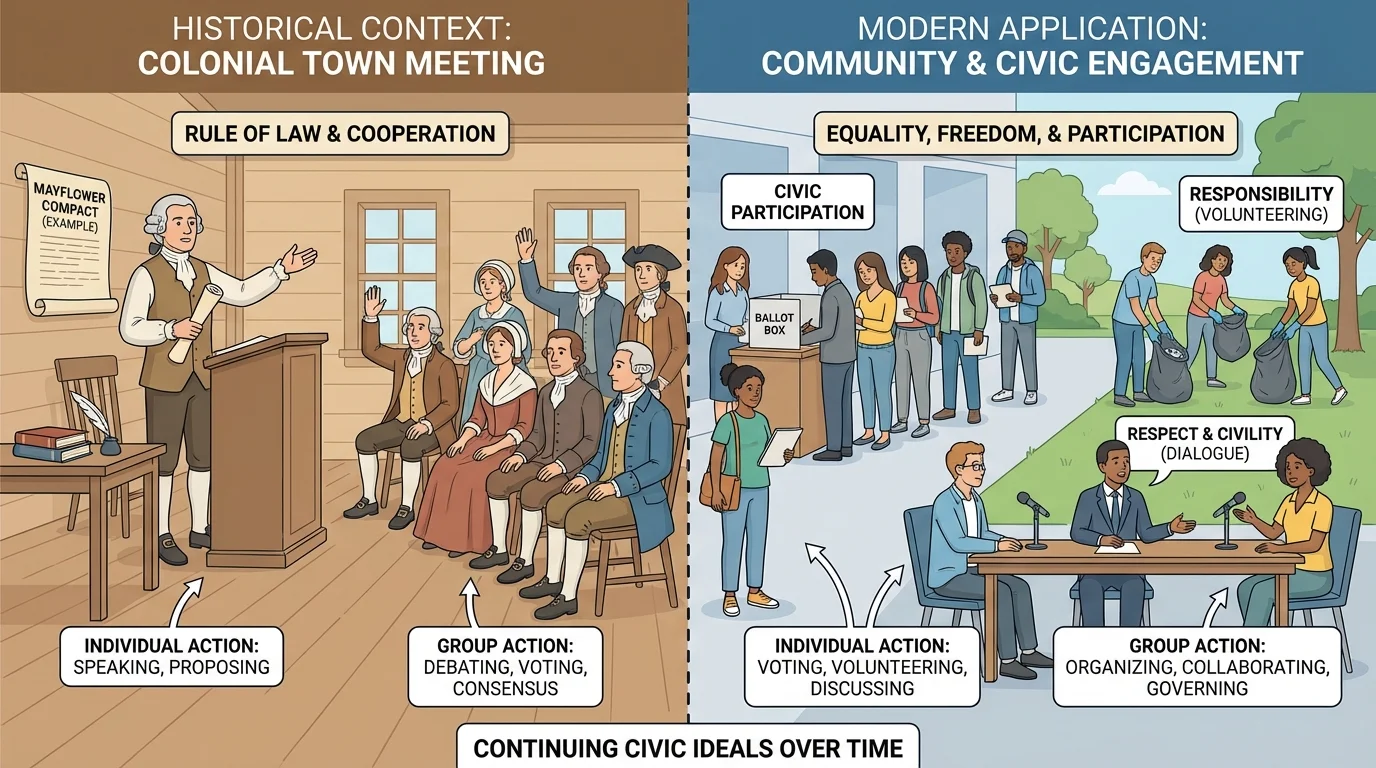
For a fifth-grade student, civic ideals can appear in very real ways. Joining a class discussion respectfully shows civility. Helping with a service project shows responsibility and cooperation. Following classroom rules fairly reflects rule of law. Speaking up when something is unfair connects to equality. Learning about issues and sharing ideas thoughtfully is an early form of civic participation.
The founding of the United States teaches an important lesson: democracy depends on what people do. It depends on citizens who care about freedom, fairness, law, respect, and the common good. It also depends on people being willing to improve the nation when it falls short of its ideals.
That is why the founding era is still worth studying. It gives us examples of brave individuals and determined groups, but it also gives us a challenge. Each generation must decide whether its members will live by these civic ideals and help the country grow closer to them.
When we look back at events and people from the founding period, we see that citizenship is active. It is not just about belonging to a country; it is about helping shape it.
