What if you woke up tomorrow and were told you could not share your opinion, join a club, choose your religion, or ask the government to fix a problem? That would feel unfair very quickly. In the United States, people are protected by important freedoms called rights. These rights are a big reason citizenship matters. They help people live with freedom, safety, and fairness, and they give citizens a voice in their government.
Being a citizen is more than living in a country. Citizenship means being a member of a community and a nation. It includes belonging, participating, and being protected by the law. One of the strongest foundations of citizenship is the idea that each person has certain rights that the government must respect.
These rights matter because they protect people as individuals. A person may have different beliefs, ideas, traditions, or opinions from others. In a free country, people do not have to all think alike. Individual rights help make that possible. They allow people to worship freely, speak up, gather peacefully, and be treated fairly under the law.
Individual rights are freedoms and protections that belong to each person. Citizenship means being a legal member of a country, with rights, duties, and a role in public life. A democracy is a form of government in which the people help rule, usually by voting and participating in civic life.
Without rights, citizenship would be weak. People could be ignored, silenced, or treated unfairly. With rights, citizenship becomes active and meaningful. Citizens can express ideas, question leaders, work for change, and help shape their communities.
Individual rights are not prizes the government hands out only when it feels generous. They are basic protections that limit government power. In the United States, many of these protections are written in the Constitution. This is important because it means leaders must follow the law, not just their own wishes.
Some rights protect freedom. Others protect fairness. Some rights help people participate in government. Together, they create a system where citizens are not powerless. A student may not vote yet, but that student still has rights such as freedom of expression, equal treatment, and legal protections.
When we talk about rights as a foundation of citizenship, we mean that rights support the entire idea of being a citizen. They help answer important questions: Can people speak? Can they believe what they choose? Can they ask for change? Can they expect fair treatment? In the United States, the answer is meant to be yes.
The Constitution is the highest law of the United States. It sets up the government and limits its power. As shown in [Figure 1], one key part of this protection comes from the Bill of Rights, which lists important rights that belong to people.
The Bill of Rights is the name for the first ten amendments to the Constitution. These amendments were added to make sure the new national government could not take away basic freedoms. They include freedom of religion, freedom of speech, freedom of the press, freedom of assembly, and the right to petition the government.
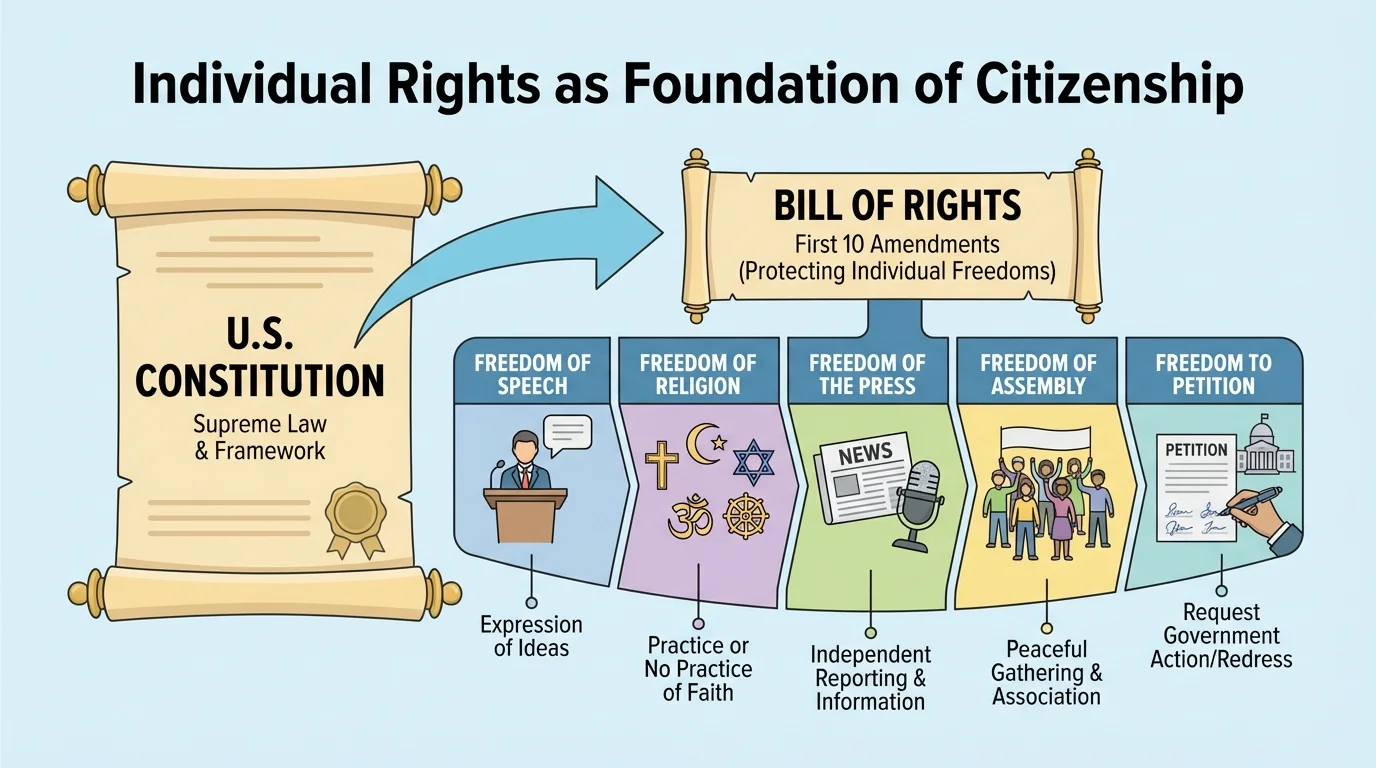
Other amendments added more protections over time. The Constitution was not perfect at the start, and the nation has changed and improved through amendments, laws, and court decisions. This shows that the development of rights in the United States is still unfolding.
Some later amendments ended slavery, guaranteed equal protection of the laws, and protected voting rights for more groups of people. These changes helped make citizenship fairer and more complete for millions of Americans.
The Bill of Rights was added in 1791 because many people worried that the new government might become too powerful. Writing rights into the Constitution helped protect people from that danger.
The Constitution does not only give structure to government. It also sends a message: government exists to serve the people, and the people have rights that must be respected. That idea is at the center of citizenship.
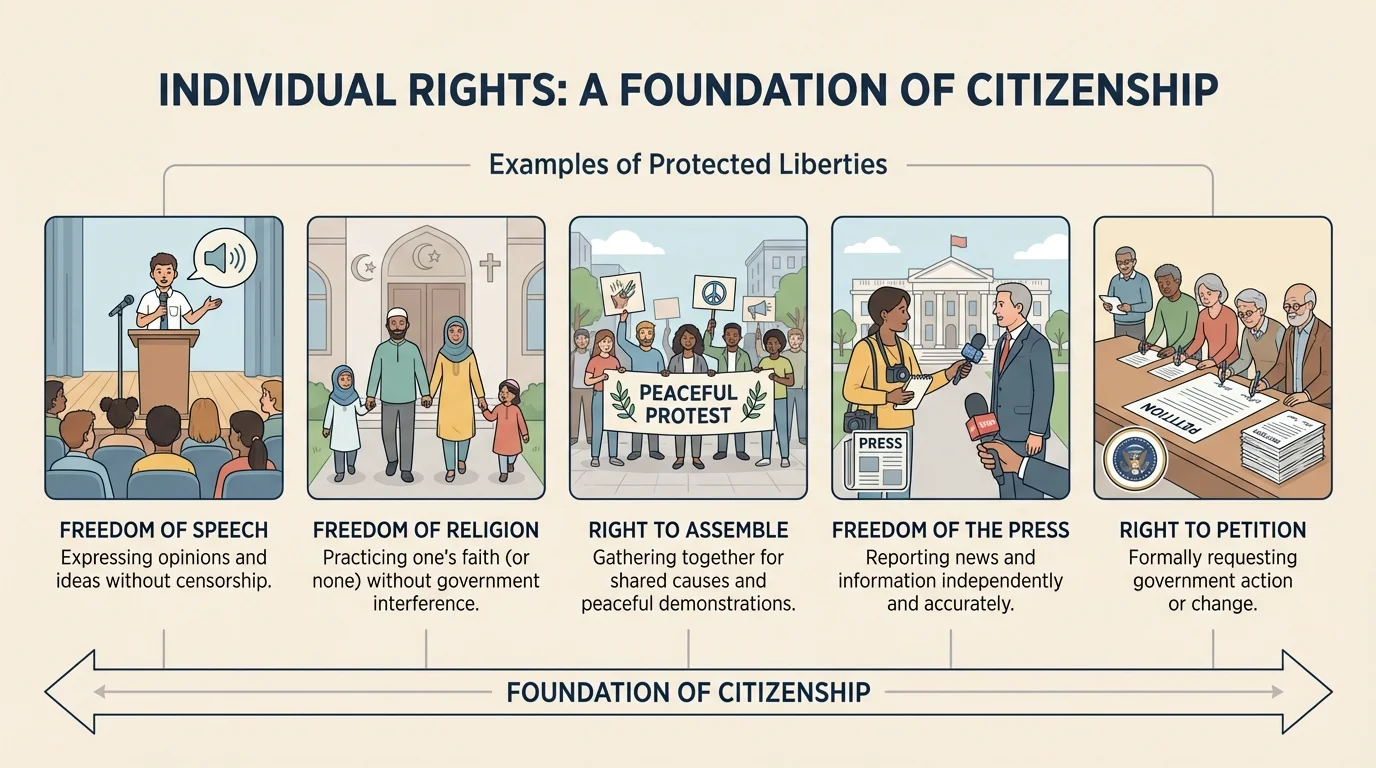
Some of the most well-known rights are the five freedoms in the First Amendment, and [Figure 2] illustrates how these freedoms appear in everyday life. These rights are especially important because they allow people to think, speak, gather, and act on their beliefs.
Freedom of religion means people can practice a religion or choose not to practice one. The government cannot force everyone to follow one religion. This matters in a country where people come from many traditions and beliefs.
Freedom of speech means people can share ideas and opinions. This includes agreeing, disagreeing, asking questions, and speaking out about problems. For example, if a community wants a safer crosswalk near a school, citizens can speak at a town meeting to ask leaders for changes.
Freedom of the press protects newspapers, magazines, television news, and other media that share information. A free press helps people learn what the government is doing. Citizens can make better choices when they are informed.
Freedom of assembly means people can gather peacefully in groups. They may meet for worship, clubs, town halls, parades, or protests. Peaceful assembly helps people work together on causes they care about.
The right to petition means people can ask the government to fix a problem or change a law. A petition may be a letter, a signed request, or a speech to leaders. If students ask for cleaner parks or safer sidewalks, they are using a right connected to citizenship.
Another important right is due process. This means the government must follow fair legal steps before taking away a person's life, liberty, or property. In simpler words, the rules must be fair, and the government cannot punish people however it wants.
Equal protection means the law should treat people fairly and not favor one group over another without sufficient justification. This idea became especially important after the Civil War and continues to matter in cases about race, gender, disability, and other issues.
The right to vote, also called suffrage, is another major example of an individual right connected to citizenship. Voting gives citizens the power to choose leaders and influence laws. Not everyone was allowed to vote at first, but over time more Americans gained this right.
People also value privacy-related rights. The Constitution does not list every privacy right in one simple sentence, but Americans generally expect the government to respect personal space, personal information, and private choices. This is another way individual liberty is protected.
Everyday examples of rights
These situations show how rights work in real life.
Step 1: A local newspaper reports that a city forgot to repair a broken playground. This is an example of freedom of the press because journalists inform the public.
Step 2: Neighbors attend a peaceful meeting to ask for a new stop sign. This uses freedom of assembly and the right to petition.
Step 3: A family attends worship services of its choice. This shows freedom of religion.
Step 4: A person accused of a crime must have a fair trial. This reflects due process.
Each right protects a different part of freedom, but together they help citizens live with dignity and participate in public life.
Rights are powerful, but they are not a free pass to harm others. Citizenship includes responsibilities as well as freedoms. People should use rights in ways that respect the rights of others and support the common good.
For example, freedom of speech does not mean a person can make threats or spread lies that hurt others. Freedom of assembly means gathering peacefully, not violently. The right to vote carries the responsibility to learn about issues and candidates. Rights and responsibilities work together like two sides of the same coin.
Why rights need responsibility
A democracy works best when people use freedom wisely. Rights protect the individual, while responsibilities help protect the community. When citizens listen, obey just laws, stay informed, and participate respectfully, they strengthen both freedom and citizenship.
Respect is part of this balance. A citizen may disagree strongly with someone else's ideas, religion, or political choices. Even so, both people still have rights. Protecting rights means protecting them even when we do not agree.
Individual rights are not only big ideas in old documents. They appear in ordinary life all the time. Students use freedom of expression when they share an opinion respectfully in class. Families use religious freedom when they follow their beliefs. Communities use assembly and petition when they gather to ask leaders for change.
Think about school and community rules. Schools may set limits to keep learning safe and orderly, but students still have rights. They may read, discuss issues, and express ideas in appropriate ways. In many cases, students learn citizenship by practicing respectful expression and participation at school.
Rights also matter online. People share opinions, read news, and join groups on digital platforms. But online citizenship still requires responsibility. A person should not bully, threaten, or spread harmful false information. Good citizenship includes using freedom carefully in both face-to-face and digital spaces.
When people see a problem, rights give them tools to respond. They can write letters, attend meetings, contact leaders, organize peacefully, and vote when they are old enough. As we saw earlier in [Figure 2], rights are not only ideas on paper; they are actions citizens take in real communities.
Even important rights can raise difficult questions. What happens when one person's choices affect another person's safety? What happens when free speech is used in a harmful way? In real life, rights sometimes need balancing.
In the United States, rights are broad but not unlimited. Laws and courts help decide where the limits are. For example, people may express opinions, but they may not use speech to make direct threats. People may gather peacefully, but they may not destroy property or hurt others. The goal is to protect liberty while keeping order and safety.
This balancing process can be challenging. Citizens may disagree about what is fair. That is why courts, lawmakers, and the Constitution are so important. They provide rules and methods for solving disputes. This is another way rights support citizenship: they create peaceful ways to handle conflict.
Good citizens do not only ask, "What are my rights?" They also ask, "How can I protect the rights of others?" That question helps a democracy stay strong.
Understanding limits does not weaken rights. Instead, it helps explain how a free society works. People can enjoy liberty while still living together under law.
As [Figure 3] shows, rights in the United States have been protected and expanded over time. This did not happen automatically. Many people worked, protested, argued in court, wrote laws, and demanded fair treatment.
At first, many Americans did not enjoy the full rights of citizenship. Enslaved people were denied freedom. Women could not vote. Native Americans faced unfair treatment and the loss of land. African Americans faced segregation and discrimination even after slavery ended. The history of rights includes both great ideals and serious failures.
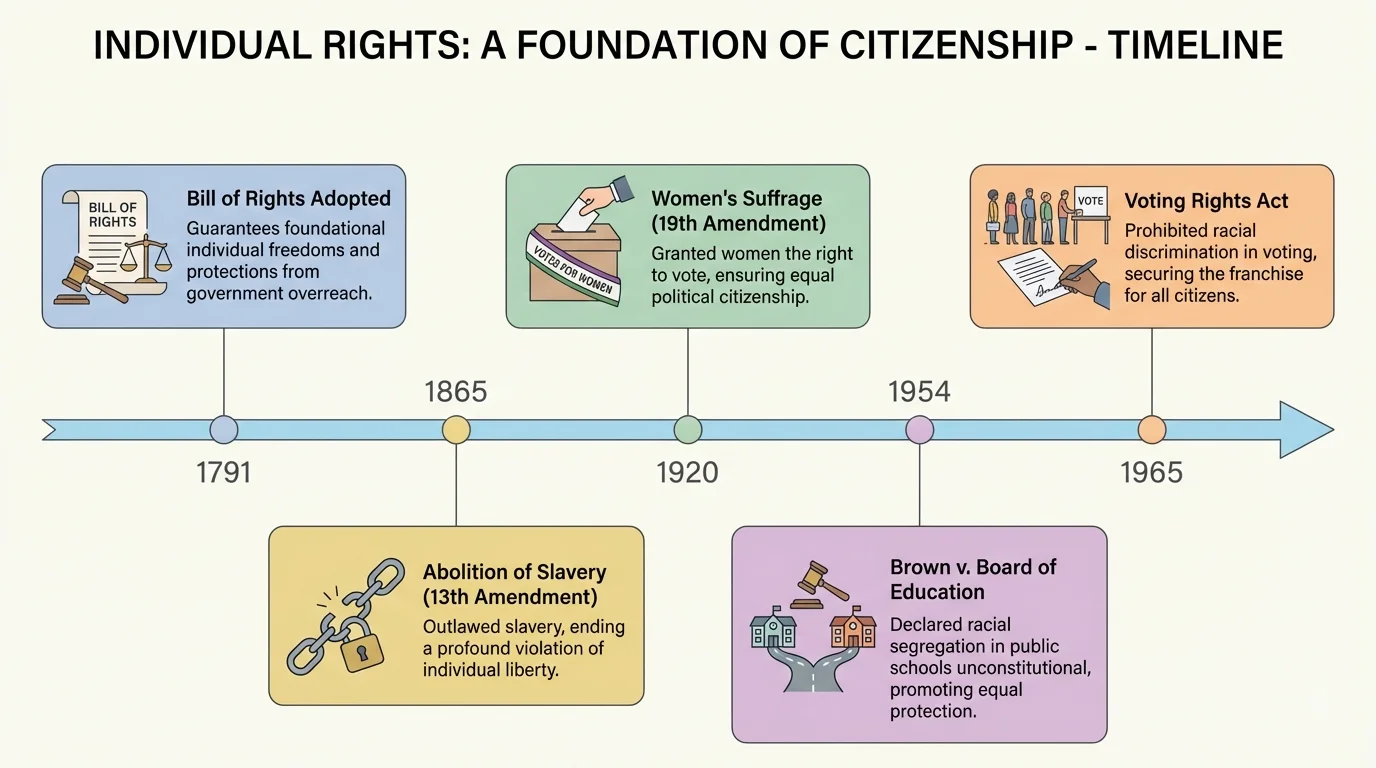
Important changes came through major events and brave individuals. The abolition of slavery was a huge step toward freedom. The Fourteenth Amendment strengthened ideas of citizenship and equal protection. The Nineteenth Amendment protected women's voting rights. The civil rights movement challenged segregation and unfair laws.
Key figures helped push the nation toward its promises. Frederick Douglass spoke against slavery and for equal rights. Susan B. Anthony fought for women's suffrage. Rosa Parks challenged segregation. Martin Luther King Jr. called for justice through nonviolent action. Thurgood Marshall argued important civil rights cases in court.
| Event or Figure | Why It Matters for Rights |
|---|---|
| Bill of Rights | Protected basic freedoms like speech, religion, press, assembly, and petition. |
| Abolition of slavery | Ended legal slavery in the United States. |
| Fourteenth Amendment | Strengthened citizenship and equal protection under the law. |
| Nineteenth Amendment | Protected women's right to vote. |
| Brown v. Board of Education | Helped strike down school segregation. |
| Voting Rights Act | Fought unfair barriers that blocked voting. |
Table 1. Major events and developments that expanded or protected individual rights in U.S. history.
When we look back at these events, we see that citizenship has become stronger when rights have become more equal. The timeline makes clear that democracy grows when more people are fully included.
"Injustice anywhere is a threat to justice everywhere."
— Martin Luther King Jr.
This history matters because it reminds us that rights must be protected, not taken for granted. Each generation has a role in preserving freedom and fairness.
Individual rights are a foundation of citizenship because they help define what it means to belong to a free nation. A citizen is not simply someone who lives under government rules. A citizen is a person with protections, a voice, and a place in public life.
Rights support participation. Citizens can speak, gather, read news, worship freely, and vote. Rights support fairness. People can expect equal treatment and fair legal processes. Rights support dignity. Each person matters as an individual, not just as part of a crowd.
When citizens know their rights, they are better able to protect themselves and others. When they use rights responsibly, they help their communities. When they defend rights for everyone, they strengthen democracy itself.
That is why individual rights are not just one topic in civics. They are part of the base that supports the whole structure of citizenship in the United States.
