What if one government made every rule for every town, school, road, and park in the whole country? That might sound simple at first, but it would also give a huge amount of power to one place. The writers of the Constitution wanted something more effective. They created a system that gives some power to the whole nation and some power to the states. This careful balance helps the United States stay united while also letting each state handle many local needs.
The Constitution is the nation's basic plan of government. It explains how government should work and what powers different parts of government have. One of its most important jobs is balancing power between the national government, which serves the entire country, and the governments of the states, which serve the people in each state.
Federalism is a system in which power is divided between a central, or national, government and state governments. Instead of one level of government controlling everything, both levels have important jobs.
National government means the government of the entire United States. State government means the government of one state, such as Florida, Texas, or Ohio.
Long before the Constitution was written, the United States had a weaker national government under a plan called the Articles of Confederation. That system made the states very powerful, but it made it hard for the country to act together. Leaders saw that the nation needed a stronger central government, but they did not want to erase the states. The Constitution was their answer: a stronger national government, but not an all-powerful one.
The system of federalism divides power into three main groups, as [Figure 1] shows: powers of the national government, powers of the state governments, and powers they share. This arrangement keeps either level from doing every job alone. It also gives people more than one level of government to protect their rights and solve problems.
Think of it like a team sport. A team works best when players have different jobs. One player guards, another passes, another scores, but they all work toward the same goal. In federalism, the national and state governments have different responsibilities, but both are part of one country.
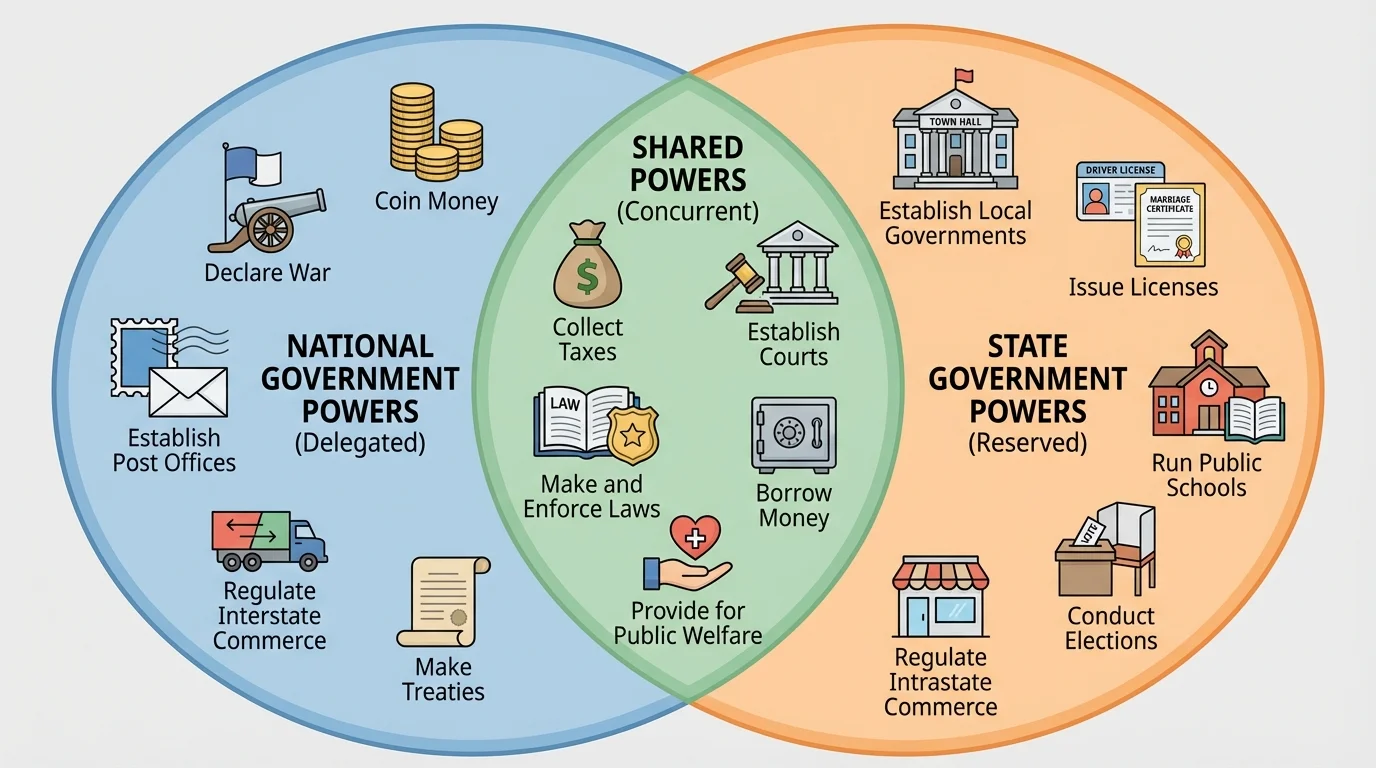
The Constitution does not divide power by accident. It lists some powers for the national government and leaves others to the states. It also allows some powers to be shared. This structure helps balance national unity with local control.
The powers given specifically to the national government are often called enumerated powers, or delegated powers. These are powers written in the Constitution. Many of them are found in Article I, Section 8.
For example, the national government can coin money, which means it makes the nation's currency. If every state printed its own money, buying and selling across the country would become very confusing. The national government can also declare war, raise an army and navy, make treaties with other countries, and regulate trade between states and with other nations.
These jobs make sense for the national government because they affect the whole country. Defense, foreign relations, and national trade need one united plan. If each state made its own separate foreign policy, other countries would not know how to work with the United States as one nation.
Example: Why the national government controls money
Step 1: Picture every state making a different kind of dollar.
Step 2: A family from one state travels to another and tries to buy food or gas.
Step 3: Stores might refuse the money or charge confusing exchange rates.
By giving the national government the power to coin money, the Constitution helps the whole country use one reliable system.
The national government also has implied powers. This means it can do some things that are not listed word for word if those actions are needed to carry out its listed powers. For example, if Congress has the power to collect taxes and regulate trade, it may create systems and offices needed to do those jobs.
The states keep many powers of their own. These are often called reserved powers. They are not given to the national government, so they stay with the states.
State governments usually handle education, local government, state roads, public safety, and many parts of elections. States give driver's licenses, organize local schools, create rules for many businesses inside the state, and help manage police and fire protection.
This part of the balance is important because states are closer to local communities. A farming state, a desert state, and a densely populated state may have different needs. State governments can make choices that fit the people who live there.
For example, schools are largely run by states and local communities. The national government may pass some laws or provide some funding, but state governments often decide learning standards, graduation rules, and how schools are organized. That means education can be shaped to fit each state while still being part of the larger country.
States even have their own constitutions. Each state constitution sets up that state's government, but it cannot go against the United States Constitution.
States also play a major role in elections. They help run voting places, print ballots, count votes, and set many election procedures. Even though the president serves the whole country, the election process still depends greatly on the states.
Some powers belong to both levels of government. These are called concurrent powers. Shared powers help both levels meet people's needs.
Both the national and state governments can collect taxes, make laws, borrow money, and set up courts. This may seem unusual, but shared powers allow each level of government to do its job. States need taxes to pay for schools and roads. The national government needs taxes to pay for defense and other national programs.
For example, you might see taxes connected to your state and to the federal government. A state may use tax money for state parks or local services, while the national government may use tax money for the military, national parks, or interstate highways.
| Type of Power | Who Has It | Examples |
|---|---|---|
| Enumerated powers | National government | Coin money, declare war, make treaties |
| Reserved powers | State governments | Run schools, issue licenses, manage local government |
| Concurrent powers | Both national and state governments | Tax, borrow money, make laws, create courts |
Table 1. The table compares powers of the national government, powers of the states, and powers shared by both.
Sometimes the national government and a state government disagree. What happens if both pass laws about the same issue? The Constitution answers this with the Supremacy Clause.
The Supremacy Clause says that the Constitution, federal laws made under it, and treaties made under it are the supreme law of the land. That means if a state law conflicts with a valid federal law, the federal law wins. This rule helps the country act as one nation instead of fifty separate ones.
However, this does not mean the national government can do anything it wants. Federal laws must still follow the Constitution. If a national law breaks the Constitution, courts can strike it down. So the Constitution stays above both the states and the national government.
Why the Supremacy Clause matters
Without a highest law, every disagreement could turn into confusion. One state might ignore a national rule, while another state might follow it. The Supremacy Clause creates a clear answer when the Constitution gives the national government authority to act.
This balance is important. States are not powerless, but they cannot override lawful national powers. At the same time, the national government must stay inside the limits set by the Constitution.
The Tenth Amendment protects the role of the states. It says that powers not given to the United States by the Constitution, and not forbidden to the states, are reserved to the states or the people.
This amendment matters because it reminds everyone that the national government has limited powers. It is strong, but it is not unlimited. If a power is not handed to the national government by the Constitution, it usually stays with the states or with the people.
The Tenth Amendment helps preserve local control. States can respond to local needs, try different ideas, and solve problems in ways that fit their communities. A law that works well in one state may not be the best choice for another. Federalism allows room for these differences.
Remember that the Constitution was designed to prevent too much power from gathering in one place. Dividing power between national and state governments is one way it protects freedom.
This is one reason states are sometimes called "laboratories of democracy." They can try different solutions. If one state finds a strong way to improve roads, health programs, or school systems, other states may learn from it.
The Constitution does more than divide power between levels of government. It also divides power inside the national government among three branches. When questions about federalism arise, the branches help keep the balance, as [Figure 2] explains through the path a dispute can take from a law to a court decision.
Congress writes laws. The president carries out laws. The judicial branch, including the Supreme Court, interprets laws and the Constitution. If state and national governments argue over who has the power to do something, courts may decide the answer.
The Supreme Court is especially important in these disputes. It can decide whether a state law conflicts with the Constitution or whether the national government has gone beyond its powers. In this way, the Court acts like a referee for constitutional questions.
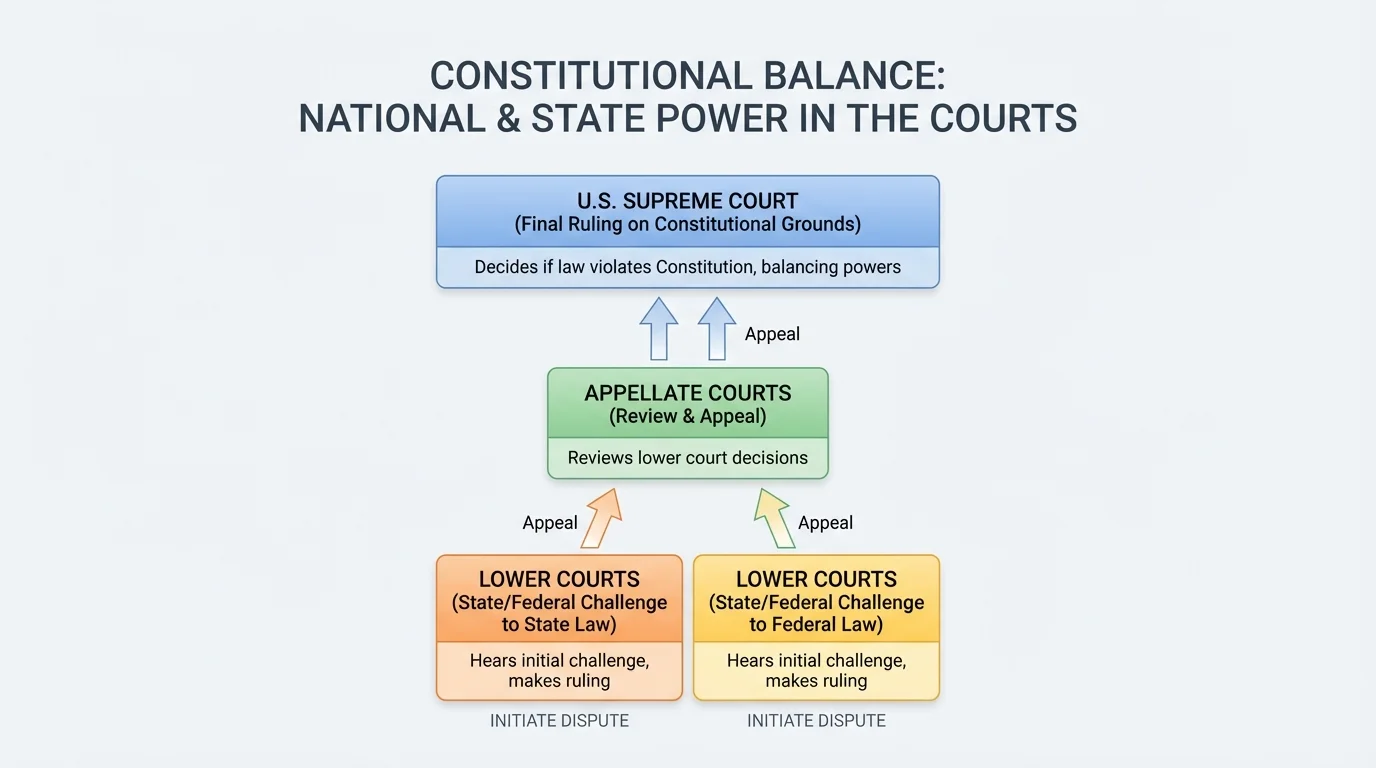
Over time, Supreme Court cases have shaped the meaning of federalism. Some decisions have strengthened national power. Others have protected state power. This shows that balancing power is not always easy. It is an ongoing part of American government.
When people disagree about whether a rule should be made by a state or by the national government, the Constitution does not leave the answer to guesses. The branches, especially the courts, help interpret the rules.
[Figure 3] highlights common examples involving schools, roads, money, defense, and elections. You can see the balance of power in daily life. Federalism is not just an idea in a textbook. It shapes the places you go and the rules you follow.
Consider roads. Your city and state often manage local roads and highways. But the national government may help pay for major interstate highways that connect states. That means different levels of government work together.
Consider natural disasters. If a hurricane hits a state, local and state governments usually respond first with police, firefighters, shelters, and emergency workers. But the national government may send money, supplies, and trained teams when the disaster is too large for the state to handle alone.
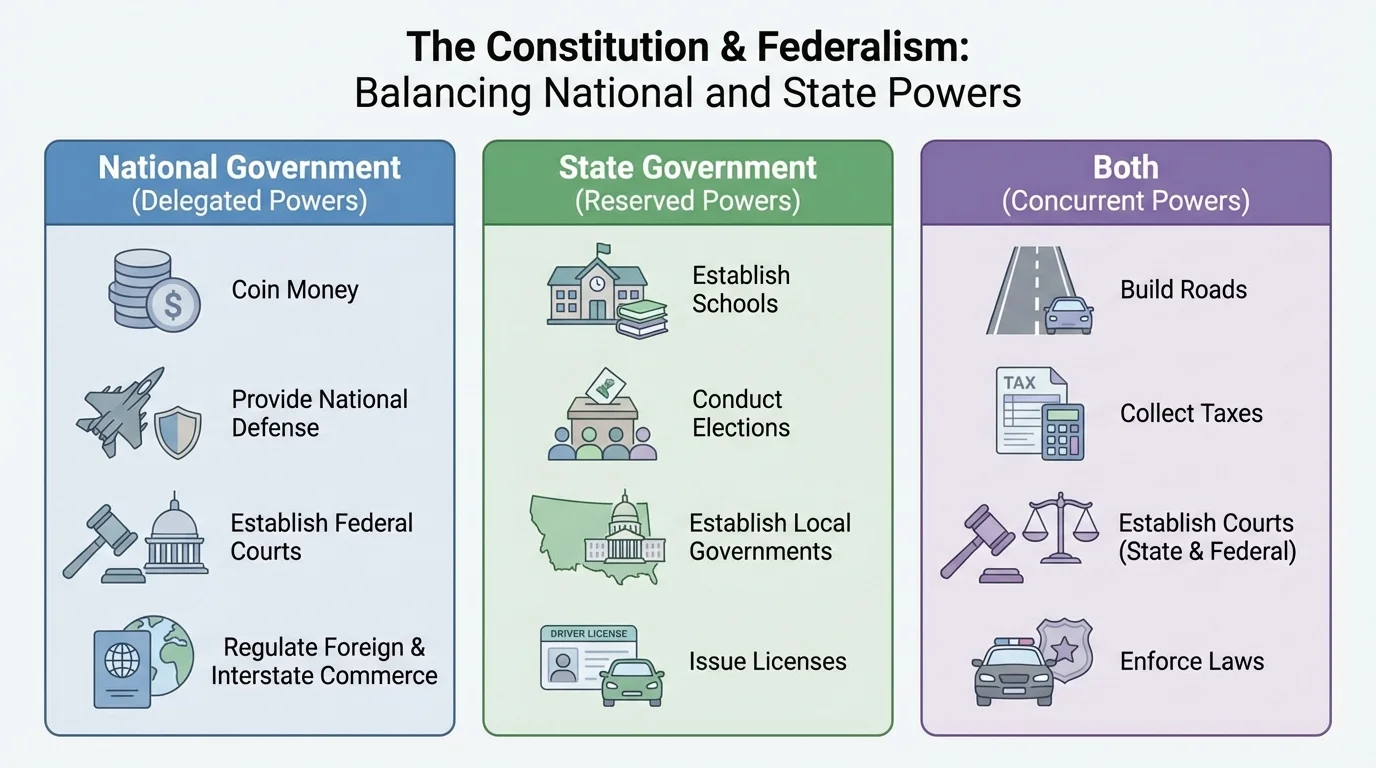
Consider schools. States and local communities run most schools, but the national government may protect students' rights and provide funding for certain programs. This means both levels may be involved, but in different ways.
Consider defense. A state has a governor and may have a National Guard unit, but defending the entire country from foreign attack is mainly a national job. One state cannot run the nation's military policy by itself.
Consider voting. States run much of the election process, but the Constitution and federal laws protect voting rights across the nation. That helps make elections both local and national at the same time.
Example: A new school rule and a national law
Suppose a state creates a school policy. Later, the national government passes a law protecting student rights in a way that conflicts with that state policy.
Step 1: People compare the state policy to the federal law and the Constitution.
Step 2: If the laws conflict, a court may review the issue.
Step 3: If the federal law is constitutional, the Supremacy Clause means the federal law takes priority.
This example shows how balance does not mean equal power in every situation. It means each level has power in the areas the Constitution allows.
Even when one level has final authority, cooperation is still important. Many public problems are too large for only one government to solve well. Federalism allows teamwork as well as limits.
Balancing power protects freedom. If one government controlled every part of life, it could become too powerful. By dividing authority, the Constitution makes it harder for any one level to take over everything.
Balancing power also helps government work better. National leaders can handle issues that affect the whole country, such as defense and foreign relations. State leaders can focus on local needs, such as schools, transportation, and community safety.
Another reason this balance matters is that it gives citizens more ways to participate. People can vote in local, state, and national elections. They can speak to city leaders, state lawmakers, or members of Congress. In a federal system, government is not just in one faraway place. It exists at several levels, closer to everyday life.
The Constitution's plan is not always simple, and disagreements still happen. But that is part of the design. The system creates space for debate, problem-solving, and adjustment. It keeps the country united while respecting the importance of the states.
"The powers not delegated to the United States by the Constitution, nor prohibited by it to the States, are reserved to the States respectively, or to the people."
— Tenth Amendment
When you see a school calendar set by your state, use money printed for the whole country, or travel on roads supported by different levels of government, you are seeing the Constitution's balance of power in action. Federalism helps the United States be both one nation and a group of states with their own important responsibilities.
