Some histories are carved in stone. Some are painted into folding books. Some are carried in songs, speeches, and stories remembered for generations. Across the Western Hemisphere, people have found many ways to record the past. When we study history, we do not look only for what was written down on paper. We also listen for what communities have carefully remembered and passed on.
History is the story of people, places, and events over time. But different cultures have different ways of preserving those stories. Some use writing systems, calendars, carvings, maps, or official records. Others use speaking, chanting, storytelling, and ceremony. A culture does not need to record history in only one way for its memories to matter.
In the Western Hemisphere, which includes North America, Central America, South America, and the Caribbean, many societies recorded important events before and after contact with Europeans. Indigenous peoples, European settlers, enslaved Africans and their descendants, and later nations all kept history in forms shaped by their own traditions. To understand the past fairly, historians try to include all of these voices.
Primary source is a source created during the time being studied or by someone who experienced the event. Examples include letters, speeches, carvings, codices, songs, and eyewitness accounts.
Secondary source is a source created later by someone who studies and explains the past using primary sources. Examples include textbooks, biographies, and documentaries.
When historians study the past, they ask questions such as: Who made this source? When was it made? Why was it made? What does it tell us? What might be missing? These questions help us analyze evidence instead of simply accepting every source at face value.
A primary source can be written, spoken, visual, or even physical. A treaty signed by leaders is a primary source. So is a story told by an elder about events remembered in the community. A carved monument, a court record, and a recorded interview can all be primary sources if they come directly from the people or time being studied.
A secondary source helps explain the meaning of primary sources. For example, a historian may compare a Maya inscription, a Spanish explorer's letter, and an oral tradition from a local community. The historian then writes an article or book explaining what happened. That article is a secondary source.
Sometimes students think written sources are always better than oral sources. Historians know that is not true. Every source has strengths and limits. A written record may preserve exact words, dates, or names, but it may also leave out people with less power. An oral account may preserve community memory, values, and details that were never written down. Good history uses both whenever possible.
Many cultures in the hemisphere created written or recorded forms of history through stone inscriptions, painted books, and handwritten documents. These written records include carved monuments, bark-paper books, legal documents, letters, newspapers, church records, and government laws.
One important kind of written record is the codex, a folded book used in parts of Mesoamerica. Maya and Aztec peoples used codices to record information such as tribute, calendars, rulers, ceremonies, and important events. Some codices were destroyed during the colonial period, but the ones that survive help historians learn about life before and after European contact.
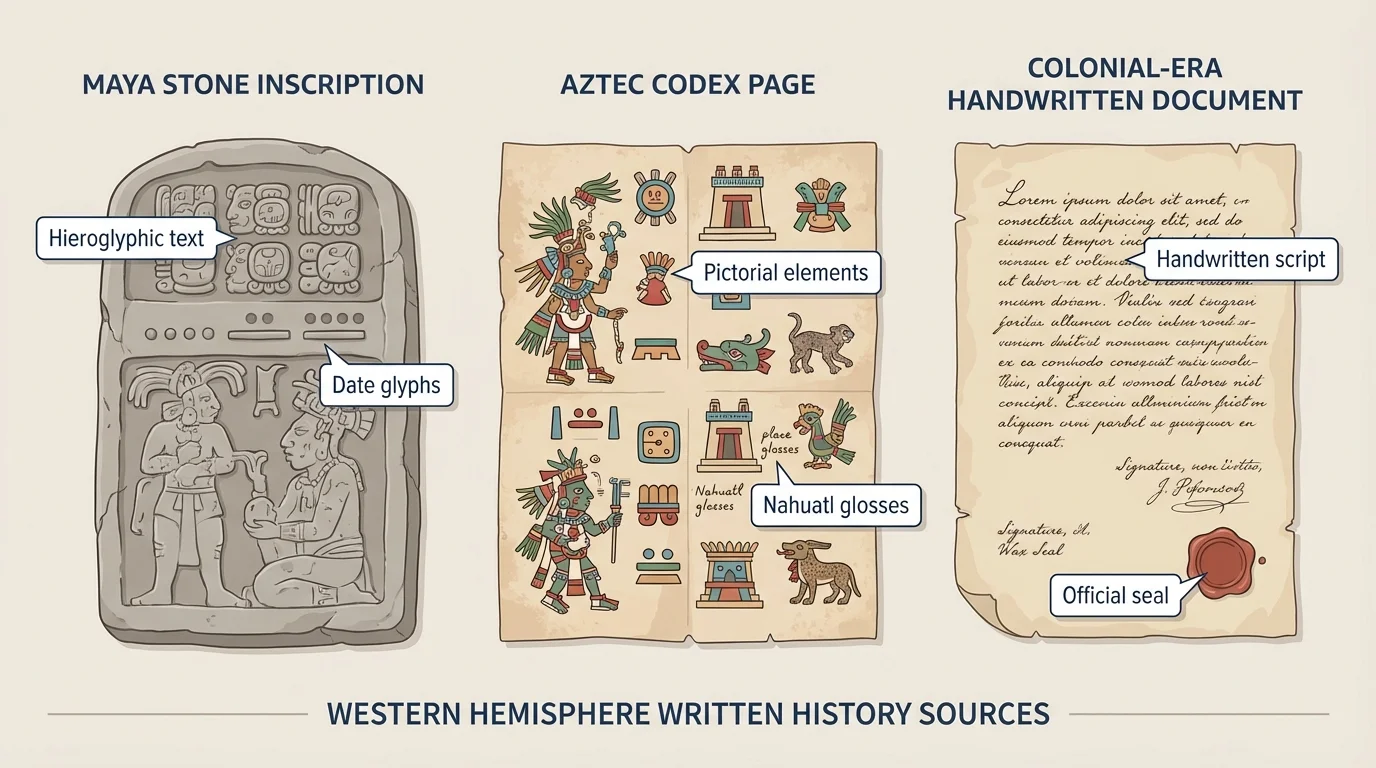
The Maya also carved records into stone stelae and temple walls. These inscriptions often named rulers, battles, alliances, and dates. Because Maya writing combined symbols for sounds and whole ideas, scholars have worked for many years to decode it. This has helped reveal detailed histories of Maya city-states.
After Europeans arrived, written records increased in number. Spanish, French, English, Portuguese, and later American colonies produced maps, tax lists, mission records, military reports, journals, and newspapers. These sources can be very useful, but they often reflect the viewpoint of officials, colonizers, or wealthy people. Historians must ask whose voices are loud in these sources and whose voices are missing.
Even within colonial records, there are valuable clues about many groups. A court case might include statements from Indigenous people, free Black residents, enslaved people, or women whose own writings were not preserved. A baptism register or ship log may reveal movements of families and communities. A newspaper may show what leaders wanted the public to believe at that time.
Some of the surviving Maya books are so rare that only a few pre-colonial examples remain today. That means each one is an extremely important source for understanding Maya science, religion, and history.
Written sources do not have to be books. A carved stone, painted wall, treaty document, or engraved metal plaque can also preserve historical information. What matters is that people intentionally recorded something they wanted remembered.
Oral tradition is one of the oldest ways people preserve history, and [Figure 2] illustrates how knowledge moves from one generation to the next through speaking and listening. In oral traditions, stories, speeches, songs, poems, and family histories are remembered and shared over time. This is not random gossip. In many communities, people are trained to remember important details accurately.
[Figure 2] Oral tradition can record migrations, agreements, origins, major leaders, natural disasters, and lessons about how a society should live. In some cultures, the right to tell certain histories belongs to specific people, such as elders, spiritual leaders, or storytellers. The way a story is told may also follow rules, ceremonies, and special times of year.
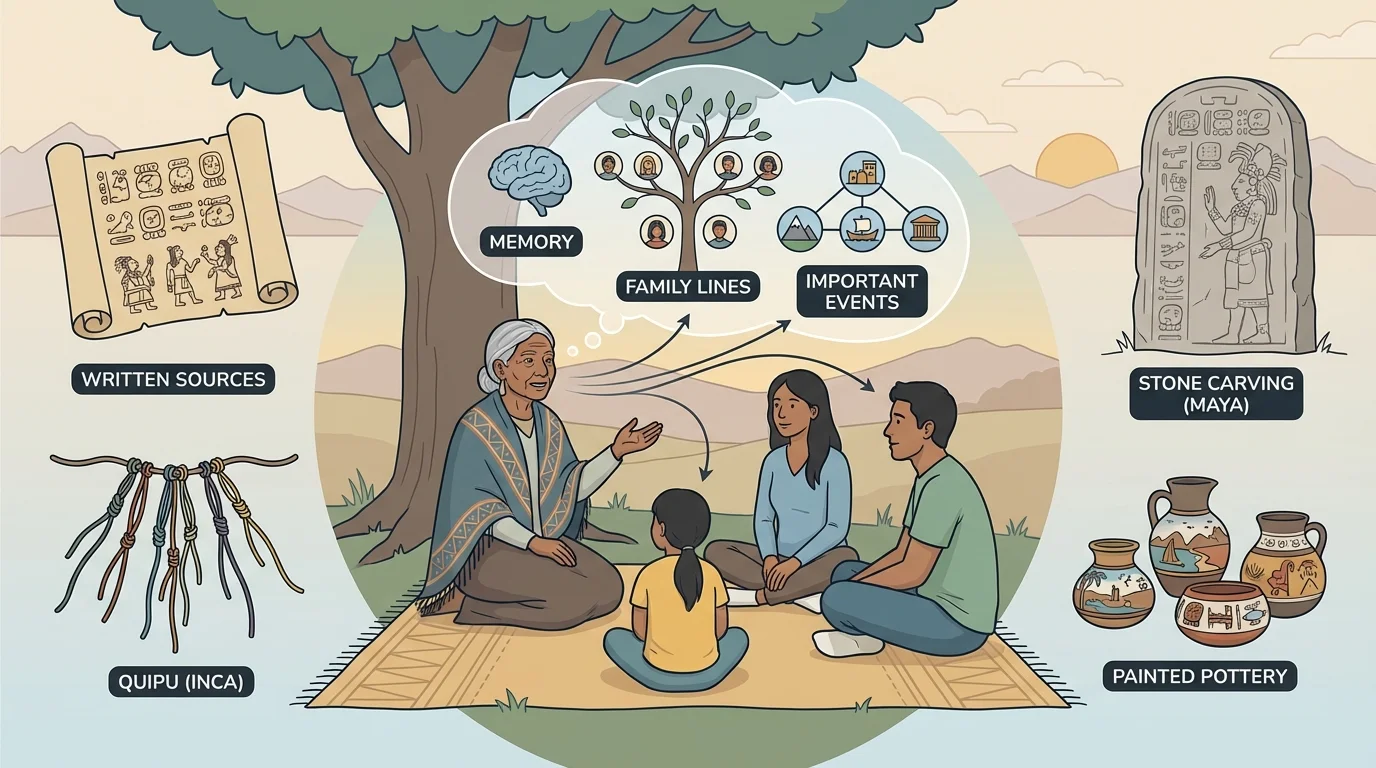
In North America, many Indigenous nations preserved history through spoken narratives. These accounts can include memories of movement across regions, the founding of communities, or treaties and conflicts. Oral histories are especially important in places where colonizers ignored or suppressed Indigenous writing systems and languages.
In the Caribbean and Latin America, oral traditions also grew in African-descended communities. Enslaved Africans and their descendants preserved memory through folktales, music, naming practices, proverbs, and spoken family history. These traditions helped people maintain identity even under brutal systems that tried to erase their past.
Oral histories continue into the present. A recorded interview with a grandparent about migration to a new country, a veteran's memories of war, or a tribal elder's explanation of a treaty can become an important source for future historians. Spoken history is not less meaningful because it is heard instead of read.
Why oral history is reliable in a different way
Some oral accounts change small details over time, just as written copies can contain mistakes. But oral traditions often preserve what a community believes is most important: relationships, causes, values, and major events. Historians check oral accounts against archaeology, written records, geography, and other evidence. When several kinds of evidence point in the same direction, our understanding becomes stronger.
Listening carefully to oral sources also teaches respect. If we only trust history written by powerful groups, we miss the experiences of people who were pushed aside. Oral tradition helps bring those voices back into the story.
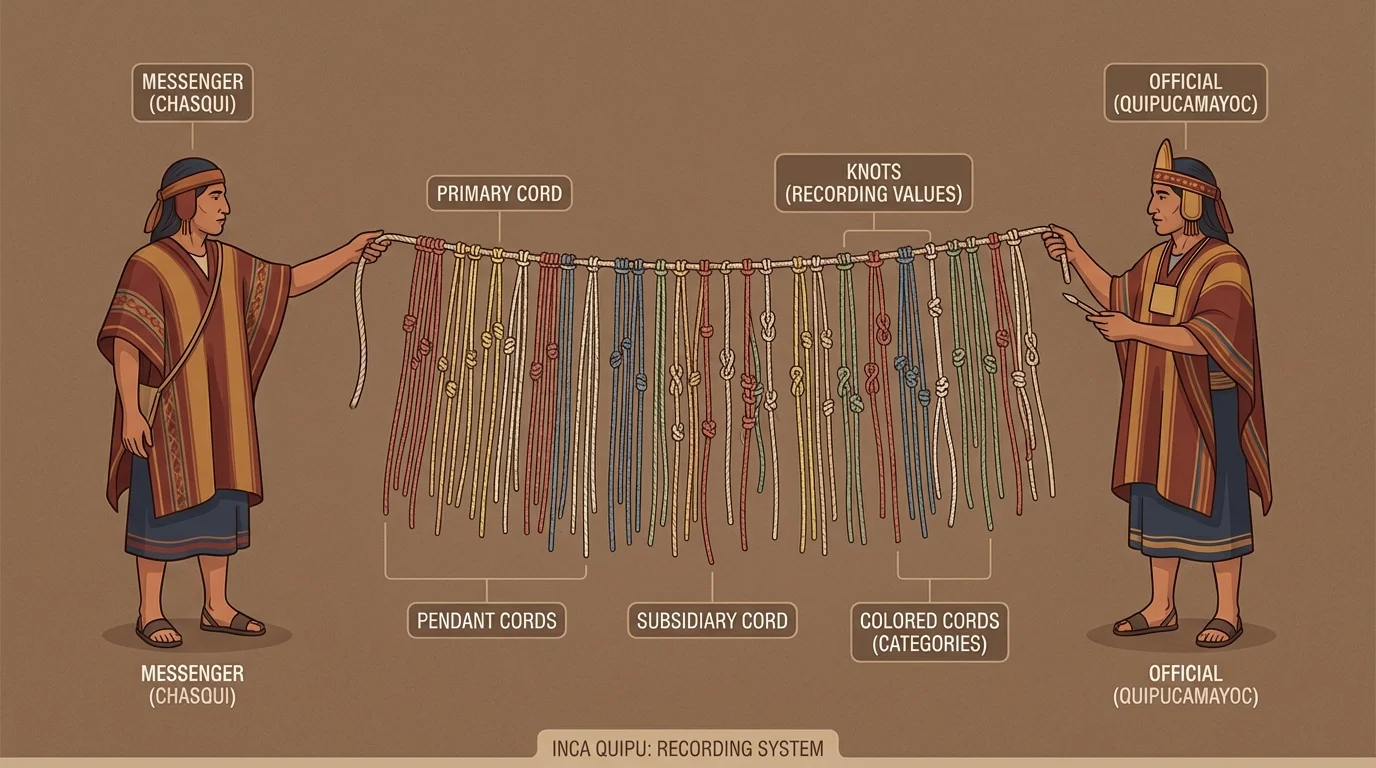
[Figure 3] Different cultures in the Western Hemisphere used different systems to record the past, and this reminds us that not every historical record looks like alphabetic writing on a page. Some records combine symbols, pictures, knots, memory aids, and spoken interpretation.
Maya: Maya rulers recorded dynasties, ceremonies, and battles in stone inscriptions and codices. Because many inscriptions include dates, historians can build timelines of rulers and city events. These records are primary sources created by the Maya themselves, although they often focus on kings and elites.
Aztec: Aztec history was preserved in painted codices and oral accounts. After the Spanish conquest, some Indigenous scribes and elders worked with colonial writers to record earlier traditions. This means historians may find Aztec history in both Indigenous-style documents and Spanish-language writings shaped by interviews.
Inca: The Inca Empire did not rely on alphabetic writing in the same way many other cultures did. Instead, officials used quipu, systems of knotted cords, to record information. Quipu could track numbers such as tribute or supplies, and scholars continue to study how much historical detail it may have held. Oral explanation was important because people trained to read quipu helped interpret the information.
Haudenosaunee: The Haudenosaunee, also called the Iroquois Confederacy, preserved political memory and law through oral tradition. Speeches and ceremonial retellings helped pass on the history of the Great Law of Peace. This shows that government and law can be preserved orally as well as in writing.
Taíno and early Caribbean peoples: Much of what we know about Taíno life comes from archaeology and early European writings, because colonization caused enormous destruction. Yet historians also study surviving cultural memory, language traces, and later community traditions to recover Indigenous Caribbean history.
African Caribbean communities: Stories, songs, and oral memory preserved accounts of resistance, survival, family connections, and cultural traditions. In some places, spoken memory keeps alive the history of maroon communities, which were settlements founded by people who escaped slavery.
These examples show that there is no single correct format for recording history. Different societies chose methods that fit their languages, beliefs, materials, and political systems.
Historians learn the most when they compare different kinds of evidence together. This process is called corroboration, which means checking whether different sources support the same conclusion.
For example, a written colonial report may describe a battle in one way, while an oral tradition in the local community describes it differently. An archaeologist may then find evidence at the site that supports part of each account. Historians do not simply pick the source they like best. They compare evidence, consider bias, and build the most accurate explanation possible.
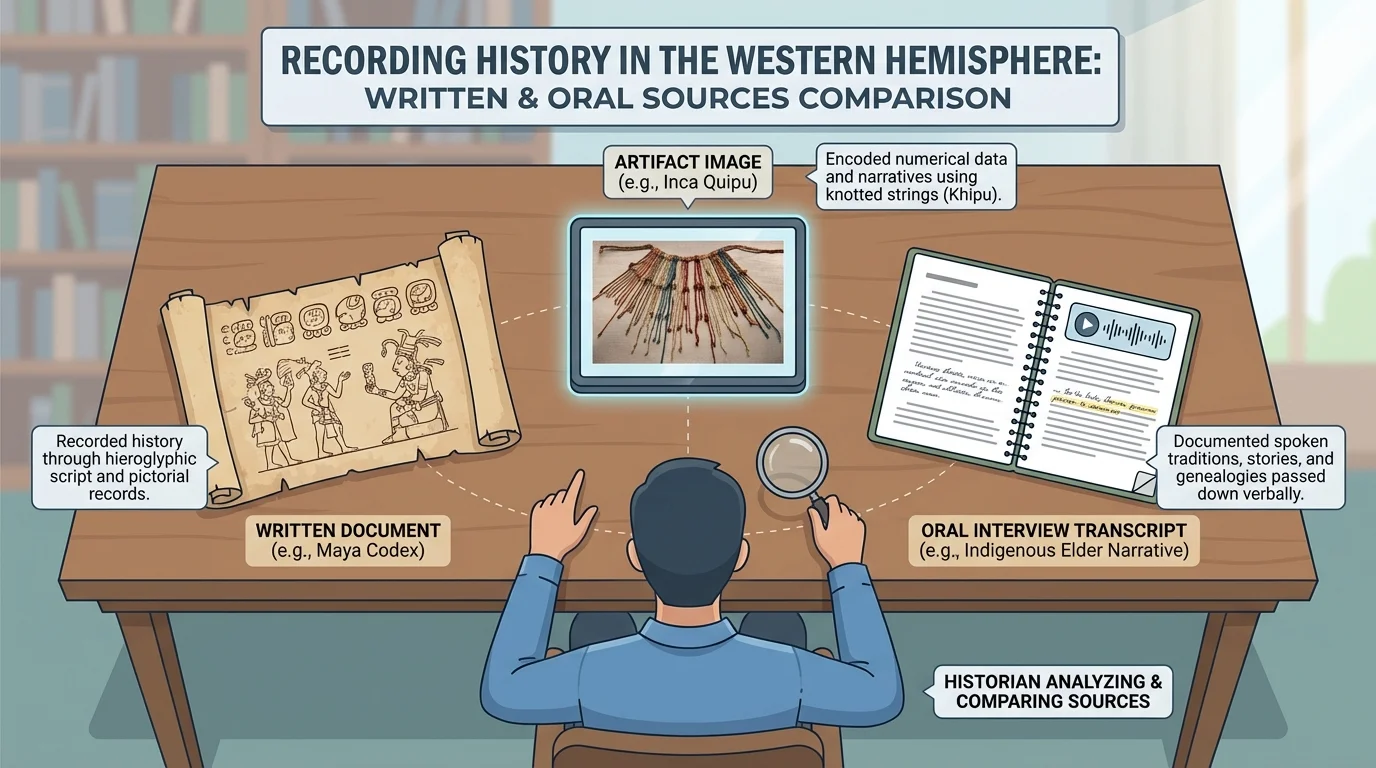
Bias means a source reflects the beliefs, goals, or limits of the person who created it. A ruler's inscription may exaggerate victory. A conqueror's journal may insult the people being conquered. A family story may highlight courage and overlook mistakes. Bias does not make a source useless. It means we must read or listen carefully.
Point of view matters too. A missionary, a trader, a community elder, and a soldier may all describe the same event differently because they experienced it from different positions. Looking at more than one point of view helps students ask better historical questions.
| Type of source | Strengths | Limits |
|---|---|---|
| Written source | Can preserve exact wording, dates, names, and official decisions | May reflect only literate or powerful groups |
| Oral source | Can preserve community memory, values, and experiences not written down | May change in wording over time and depends on careful transmission |
| Artifact or inscription | Provides physical evidence from the past | May need interpretation and may not explain itself fully |
| Secondary source | Combines evidence from many sources | Depends on the historian's choices and interpretation |
Table 1. Comparison of common source types historians use to study the Western Hemisphere.
As seen earlier in [Figure 1], written records come in many forms, not just books. And as shown in [Figure 2], oral tradition carries history through people and communities. Historians become stronger investigators when they know how to work with both.
Case study: learning from more than one source
A historian wants to understand an agreement between an Indigenous nation and a colonial government.
Step 1: Read the written treaty text.
The treaty may list promises, land boundaries, and signatures.
Step 2: Listen to oral histories from the Indigenous community.
These may explain how the agreement was understood, remembered, and passed down.
Step 3: Compare both with later events.
If later actions broke the treaty promises, that helps historians judge what really happened.
Using only one source would leave out important parts of the story.
This kind of comparison is especially important in the Western Hemisphere because contact, conquest, migration, slavery, and nation-building brought many cultures together. Their records overlap, disagree, and sometimes correct one another.
When you investigate a source, start with simple but powerful questions. Who created it? When? Where? Why? For whom? What does it say directly, and what does it only suggest? What other sources could confirm or challenge it?
Suppose you read a Spanish explorer's letter describing a Caribbean island. Ask whether the writer was trying to impress a king, gain money, or justify conquest. Then compare that letter with archaeology, Indigenous accounts, and later research. This helps you move from just reading a source to interpreting it.
Suppose you hear an oral history about a community's migration. Ask who tells the story and how they learned it. Is the story part of a ceremony or family teaching? What place names, landmarks, or events appear in it? Those details can sometimes connect with maps, climate evidence, or written records.
History is not only about memorizing dates. It is about using evidence to answer questions about people and events. Sources are clues, and historians are investigators.
Students should also notice what is missing. If most written records in an area were made by colonizers, then Indigenous voices may be harder to find in writing. If a community depended mostly on oral tradition, historians must know how to listen respectfully and work with that kind of evidence.
For a long time, some people treated written records as the only "real" history. Today, historians understand that this idea is too narrow. Communities across the Western Hemisphere have always remembered the past in many forms. If we ignore oral tradition, we ignore important human knowledge.
Respecting different recordkeeping traditions also helps repair unfairness in history. Powerful groups often controlled printing presses, governments, and archives. Other groups protected memory through stories, performances, and community teaching. Both belong in the study of the past.
Later in an investigation, [Figure 4] still matters because it shows the historian's job clearly: compare, question, and connect sources. A strong historical explanation does not depend on one voice alone. It grows stronger when evidence from many people and traditions is brought together.
"The past is never dead. It's not even past."
— William Faulkner
That idea fits this topic well. History is alive in documents, monuments, songs, community memory, and the questions we continue to ask. By studying both written and oral sources, we gain a richer and more truthful view of the Western Hemisphere.
