Two people can describe the same event and make it sound almost like two different stories. That is not just true in sports, family arguments, or news reports. It is also true in history. When historians study the Western Hemisphere, they ask not only, "What happened?" but also, "Who is telling this story, and whose voice is missing?"
History becomes much stronger when we gather information from many perspectives. A letter written by a soldier, an oral history shared by an elder, a government law, a newspaper article, a protest poster, and a modern history book may all help answer the same question. But each source gives only part of the picture. To understand the past fairly, we must gather, organize, synthesize, and critique information before deciding whether we have enough evidence to answer a question.
People in the past did not all experience events in the same way. A European explorer, a Taíno community member in the Caribbean, an enslaved African, a Mexican American labor activist, a Japanese American child during World War II, and a member of a religious minority might all have lived through the same time period but seen very different realities.
This is why historians study perspective, or the point of view from which someone understands events. Perspective is shaped by a person's community, identity, experiences, language, beliefs, and goals. It does not mean one person is always truthful and another is always lying. It means each source may show one part of a larger story.
Historical question is a question about the past that can be answered by studying evidence. Evidence is information from sources that helps support an answer. Perspective is the point of view from which a person or group understands events.
When we study groups such as Indigenous People, Latinos, African Americans, Asian Americans, Native Hawaiian and Pacific Islander people, LGBTQ communities, and religious minorities, we also need to remember that no group thinks exactly the same way. There are often different opinions within each group. Historians should avoid treating any community as if it had only one voice.
A strong historical investigation usually begins with a clear question. For example, a student might ask, "How did Indigenous people in the Caribbean respond to Columbus's arrival?" or "How did Japanese American families respond to incarceration during World War II?" To answer questions like these, historians look for primary sources and secondary sources.
[Figure 1] A primary source comes from the time being studied or from someone directly connected to it. Examples include diaries, speeches, photographs, court records, oral histories, maps, songs, and objects. A secondary source is created later and explains or interprets the past, such as a textbook, documentary, encyclopedia article, or historian's book.
Both kinds of sources matter. A primary source can bring us close to the event, but it may be limited or one-sided. A secondary source can compare many pieces of evidence, but it depends on how carefully the historian worked. Good history uses both.
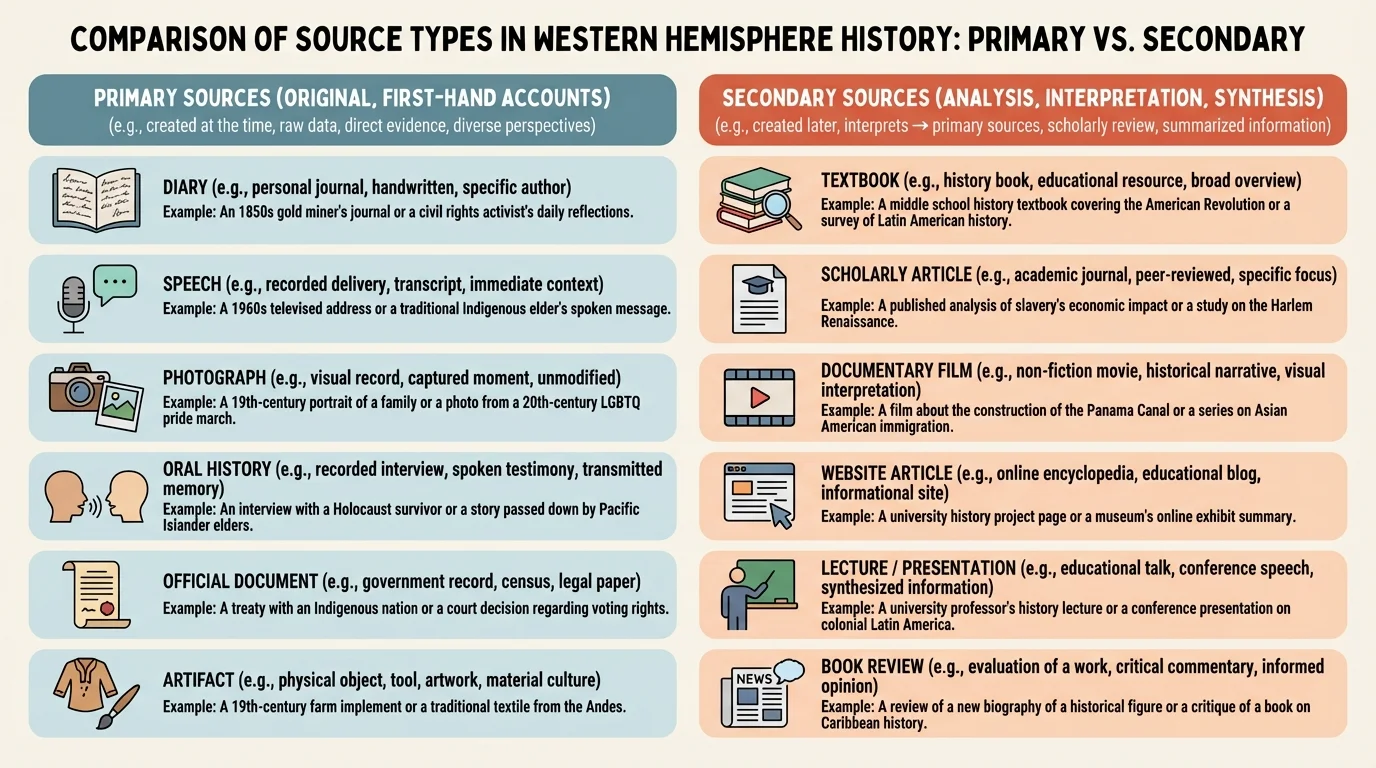
Suppose you are studying the building of railroads in the western United States. You might use photographs of Chinese immigrant workers, payroll records, newspaper articles from the time, and a modern book about railroad labor. If you use only one source, your answer may be weak. If you use several sources, your answer becomes more complete.
Oral histories are especially important in many communities. Some historical knowledge was passed down by speaking and listening long before it was written in books.
That matters across the Western Hemisphere, especially when written records were created mostly by powerful groups. Indigenous histories, African American family stories, and community memories from many immigrant groups may preserve information that official records ignored.
Gathering information means searching carefully and widely. Historians do not stop after finding the first article or document. They ask, "Whose voices are here?" and "Whose voices are missing?" A question about the Spanish conquest, for example, should not be answered only with Spanish records. It should also include Indigenous accounts, archaeology, and later interpretations by historians from different backgrounds.
Consider the history of the Caribbean after 1492. A European ship journal may describe land, resources, and trade. A Taíno perspective may show loss, violence, survival, and resistance. African perspectives become essential when slavery expands in the region. Later, religious leaders, women, and mixed-heritage communities add more voices. The more perspectives we gather, the closer we get to a fuller answer.
Gathering from diverse groups also means looking inside groups. Not all settlers agreed with conquest. Not all African Americans had the same ideas about resistance. Not all Latinos shared the same political goals. Not all members of religious minorities responded to discrimination in the same way. Historians must ask who is speaking for a group and whether other members disagreed.
Looking for missing voices
Sometimes the people most affected by an event left fewer written records because they were denied education, pushed out of power, or prevented from publishing their views. Historians then search for other evidence such as oral histories, objects, songs, artwork, legal records, or reports written by others that still contain clues about those communities.
This careful search helps us avoid a narrow story. If we only study presidents, generals, and lawmakers, we miss how ordinary people lived. If we only use official documents, we may miss voices that were silenced on purpose.
Once historians gather many sources, they need a system to sort them. Without organization, evidence becomes confusing. A useful method is to group sources by date, type, author, topic, and perspective.
[Figure 2] For example, a student researching Columbus's first voyage might create categories such as: ship logs, Indigenous oral traditions, government records, later textbooks, museum exhibits, and modern historical essays. Another set of categories could track viewpoints: Spanish, Taíno, later Caribbean historians, and archaeologists.
Organizing also helps historians compare sources. If two accounts disagree, that does not mean one must be thrown away immediately. Instead, historians ask why they differ. Was one written much later? Was one written for a king, a newspaper audience, or a family member? Was the writer trying to persuade, defend, remember, or protest?
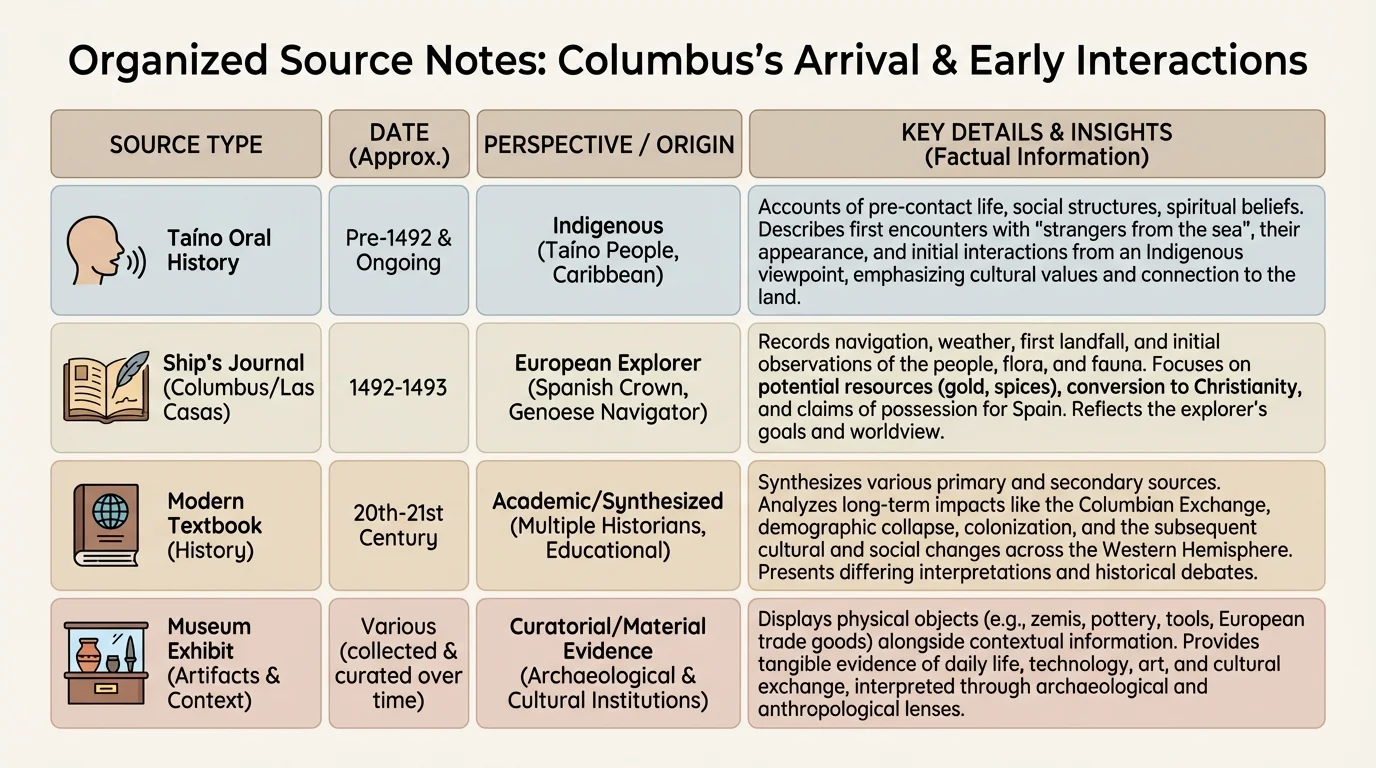
A simple organizer can include these questions: Who created the source? When? Why? What does it say? What perspective does it show? What information does it leave out? This kind of sorting turns a pile of sources into a useful evidence set.
| Question to Ask | Why It Helps |
|---|---|
| Who created it? | Shows whose point of view you are reading. |
| When was it made? | Helps place the source close to or far from the event. |
| Why was it made? | Reveals purpose, such as informing, persuading, or recording. |
| Who was the audience? | Helps explain the writer's choices and tone. |
| What is missing? | Shows limits and missing voices. |
Table 1. Questions historians use to organize and examine sources.
Good organization also makes it easier to return to evidence later. When students lose track of where a fact came from, it becomes hard to judge whether that fact is reliable.
To synthesize information means to combine details from several sources into a stronger understanding. This is different from copying one source or listing facts one after another. Synthesis means putting pieces together and noticing patterns.
Suppose several sources discuss the Underground Railroad. A freedom seeker's narrative might describe danger and courage. A map could show routes into free states or Canada. A newspaper might reveal public arguments over slavery. A historian's book might explain the role of free Black communities and abolitionists. When these sources are synthesized, they show that escape was not one simple journey but part of a larger network of people, laws, risks, and hopes.
Case study: Answering a question through synthesis
Question: How did free Black communities help people escaping slavery?
Step 1: Gather different kinds of evidence.
Use personal narratives, letters, church records, newspaper reports, and a secondary source by a historian.
Step 2: Look for repeated ideas.
Several sources mention shelter, food, directions, money, and warnings about slave catchers.
Step 3: Combine the evidence.
Instead of saying only that people escaped, conclude that free Black communities often built support networks that made escape more possible and more organized.
Step 4: Check what is still missing.
Ask whether women, children, and different regions are represented equally in the evidence.
Synthesis helps historians move from separate details to a supported answer. It also prevents oversimplified stories. A single source might suggest one hero changed everything, while a wider set of evidence may show many communities working together.
To critique information means to examine it carefully, not just accept it. Historians critique sources by checking reliability, purpose, audience, evidence, and bias. Bias does not always mean a source is useless. It means the source has a particular viewpoint or interest that must be understood.
For example, a government report on Native boarding schools may use official language that hides suffering. A student who critiques that report asks: What is the report trying to prove? Who wrote it? What words does it avoid? What do letters from students or family members reveal that the report does not?
Critiquing also means checking whether a source is accurate. Did the author witness the event? Did they rely on rumor? Are there facts that can be confirmed in other sources? As we saw with source types in [Figure 1], no single source automatically gives the whole truth.
Good readers already ask whether information makes sense and whether a source seems trustworthy. Historical thinking builds on that skill by adding questions about time, place, audience, and missing perspectives.
Another important part of critique is noticing silence. If a textbook about westward expansion talks mostly about settlers but says little about Native nations, Mexican communities, or Chinese laborers, the textbook may be incomplete even if some of its facts are correct.
History becomes clearer when we apply these skills to real questions. One well-known example involves Columbus and the peoples of the Caribbean. Older textbooks often praised exploration and trade. More recent historians also ask what happened to the Taíno and other Indigenous peoples after contact. By comparing ship logs, Indigenous knowledge, archaeology, and later scholarship, historians build a more honest answer that includes conquest, disease, resistance, and survival.
A second example comes from African American history in the United States. If we ask, "How did people resist slavery?" we should not look only at famous leaders. We should gather narratives by formerly enslaved people, plantation records, anti-slavery newspapers, court cases, and church documents. These sources reveal many forms of resistance: learning secretly, preserving family ties, slowing labor, escaping, organizing, writing, and fighting for freedom.
A third example involves Japanese Americans during World War II. Government orders and military language often presented incarceration as a security measure. But letters, photographs, oral histories, and artwork from imprisoned families reveal fear, unfairness, boredom, resilience, and protest. A fuller answer appears only when multiple perspectives are used.
"History is not the past. It is the story we tell about the past based on evidence."
A fourth example concerns rights movements in the late twentieth century. If historians ask how LGBTQ people and allies pushed for change, they should gather protest flyers, newspaper coverage, interviews, court decisions, and personal accounts. They should also note differences within the movement by race, gender, class, region, and strategy. Some activists demanded rapid change through protest, while others worked through courts, schools, or local community groups.
These case studies show that historical answers become stronger when more than one community is heard. They also remind us that people within the same broad group may disagree sharply.
Dates alone do not explain history, but chronology helps historians see change over time. A timeline can help place events in order and connect causes and effects across the Western Hemisphere.
[Figure 3] If we study one source without context, we may misunderstand it. A speech during war sounds different when we know the fears of that time. A protest sign in 1969 means more when we know what rights people lacked then. A law about immigration matters more when we know who was being excluded and why.
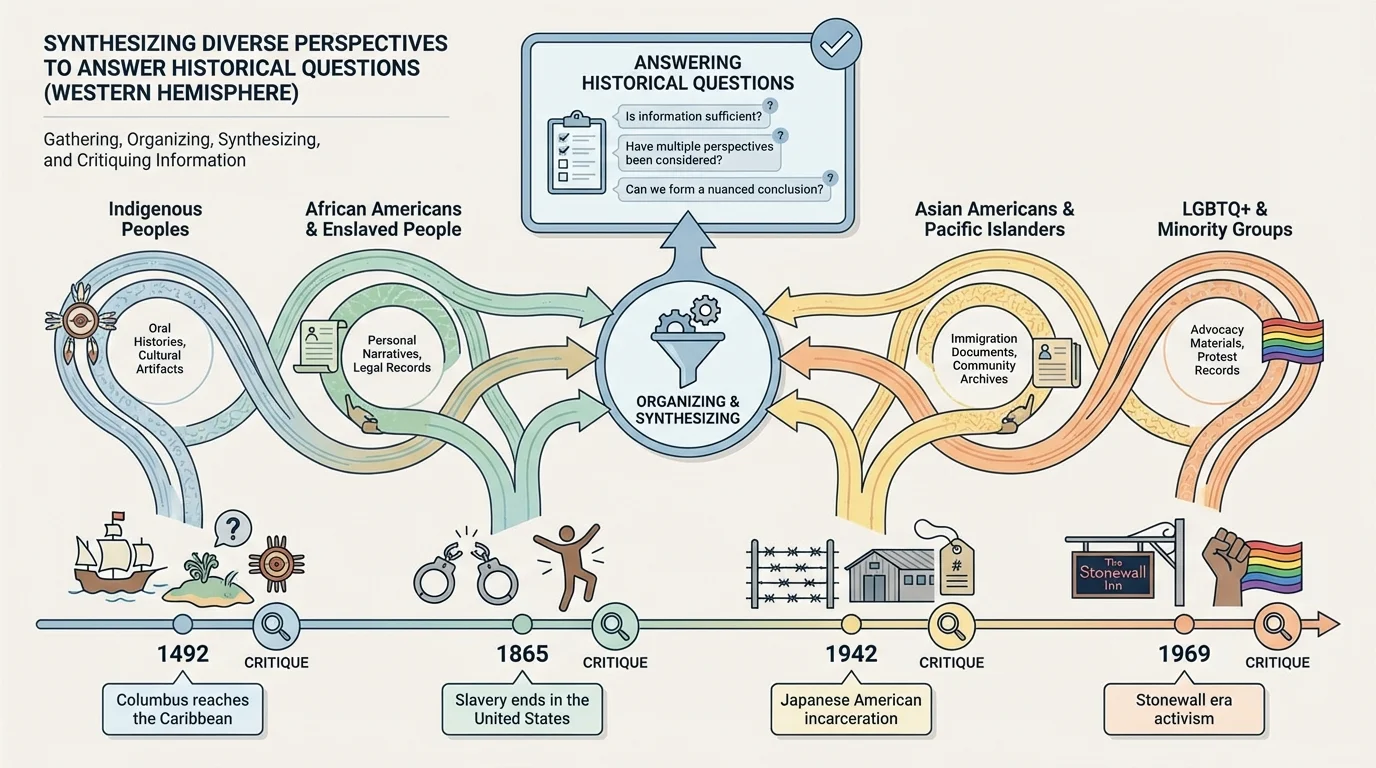
Timelines also help students avoid mixing together events that happened far apart. For example, the end of slavery in the United States in 1865, Japanese American incarceration in 1942, and later LGBTQ rights activism took place in very different contexts. Yet a timeline lets us compare how governments, citizens, and communities responded to injustice in each era.
When students return to evidence charts like the one in [Figure 2], they can add dates and see whether a source was written during the event or long after it. That helps them judge memory, distance, and reliability.
One of the most important historical skills is knowing when the evidence is not sufficient. Historians sometimes must say, "We do not know yet," or "This answer is incomplete." That is not weakness. It is honesty.
Information may be insufficient for many reasons. There may be too few sources. The sources may all come from one side. The sources may disagree in major ways. Key voices may be missing. The sources may tell us about leaders but not ordinary people, or about adults but not children.
For example, if a student tries to answer, "How did all Indigenous people respond to European colonization?" the question is too broad. Indigenous nations across North America, Central America, South America, and the Caribbean had different experiences and responses. A better question would focus on a specific people, place, and time period.
How historians decide evidence is sufficient
Evidence is more likely to be sufficient when it comes from multiple source types, includes different perspectives, matches the time and place of the question, and can be checked against other evidence. Historians still stay open to new discoveries that may change earlier conclusions.
Sometimes new evidence changes history writing. Newly studied letters, newly recorded oral histories, or a fresh reading of old records can reveal voices that earlier historians overlooked.
Studying diverse perspectives requires respect. We should not treat communities as if they are just examples in a chart. These are real people whose lives, beliefs, and struggles matter. Careful historians use respectful language, avoid stereotypes, and recognize that identities can overlap. A person might be both Indigenous and Christian, or both Latino and LGBTQ, or both Asian American and part of a religious minority.
This matters because history is not only about the powerful. It is also about families, neighborhoods, workers, students, artists, elders, and activists. The Western Hemisphere has always included many peoples whose experiences connect, clash, and change over time.
When students gather, organize, synthesize, and critique information from many perspectives, they do more than answer a school question. They practice fairness. They learn to test claims. They become better at seeing complexity instead of settling for a single simple story.
