More than 50 million Indigenous people live in the Americas today, and they belong to thousands of nations, communities, and language groups. That fact surprises many students because history is often told as if Indigenous Peoples were all the same. They were not, and they are not. From the Arctic to the Andes, from the Caribbean to the Great Plains, Indigenous societies created governments, trade routes, farming systems, stories, and technologies that fit their own lands and beliefs.
The Western Hemisphere includes North America, Central America, South America, and the Caribbean. Across this vast area lived and still live many Indigenous Peoples, meaning the original peoples of a place and their descendants. It is important to use the plural form, Peoples, because there is no single Indigenous culture. The Haudenosaunee in the Northeast, the Maya in Mesoamerica, the Quechua-speaking peoples of the Andes, the Taíno of the Caribbean, and the Diné in the Southwest all have distinct histories.
Each group developed in a particular environment. Some lived in forests, some in deserts, some on islands, and some high in the mountains. Because of this, they built different kinds of homes, wore different clothing, and found different ways to grow food or hunt. Their uniqueness came from their languages, values, arts, spiritual beliefs, and relationships with the land.
Interdependence means groups rely on one another in different ways. Power dynamics are the ways power is shared, controlled, or fought over between people or groups. Sovereignty means the right of a people or nation to govern itself.
At the same time, Indigenous Peoples were never completely isolated. They traded, shared ideas, formed alliances, married across communities, and sometimes fought wars. In other words, they were both unique and connected.
Long before Christopher Columbus crossed the Atlantic in 1492, Indigenous societies had already built rich civilizations across the hemisphere, as [Figure 1] shows through major regions and cultural centers. Some communities were small and mobile, moving with the seasons. Others built large cities with temples, roads, marketplaces, and systems of government.
In Mesoamerica, the Maya developed writing, mathematics, astronomy, and impressive cities such as Tikal and Chichén Itzá. The Mexica, often called the Aztecs, built the city of Tenochtitlán on an island in Lake Texcoco. In the Andes, the Inca created a vast empire connected by roads and bridges. In North America, Cahokia near present-day St. Louis became a major city with large earthen mounds. The Ancestral Pueblo peoples built homes into cliffs and stone communities in the Southwest.
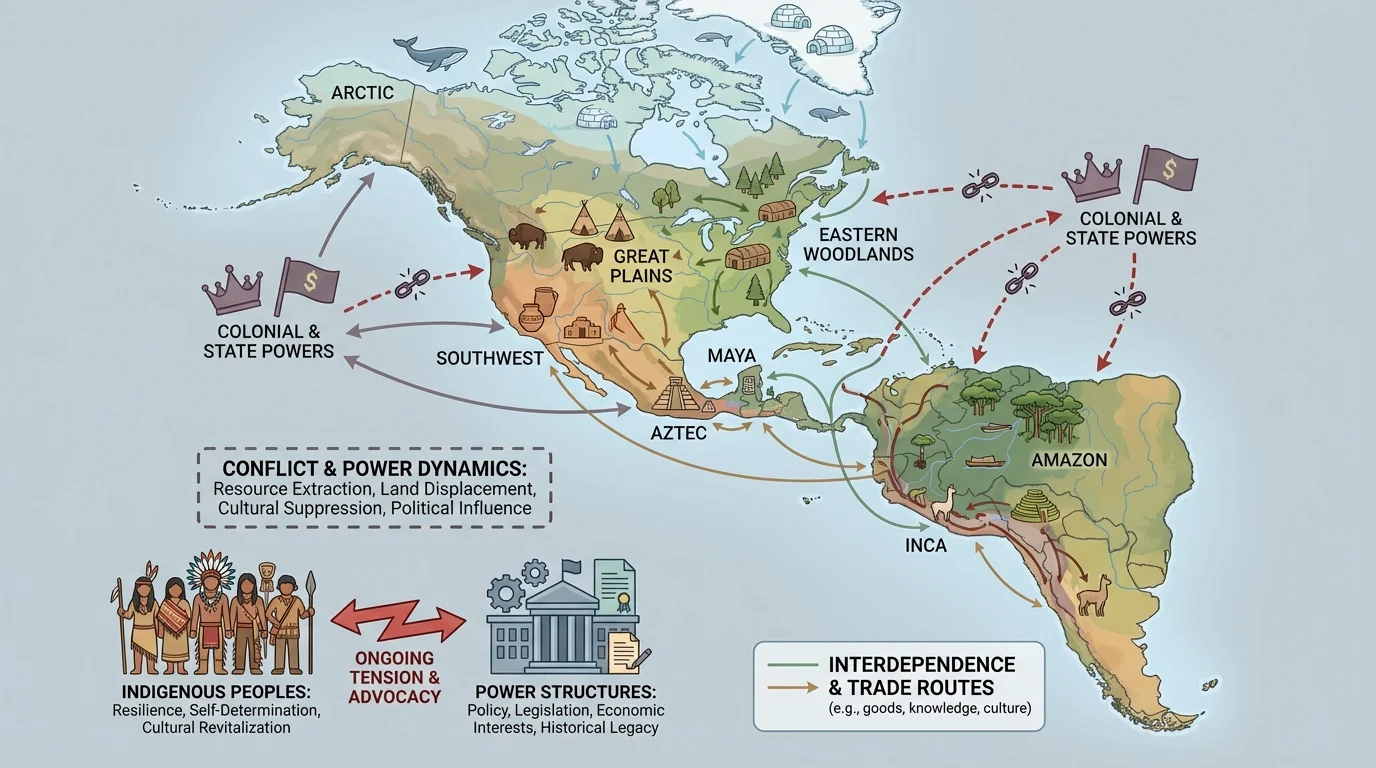
These societies were sophisticated in ways that do not always look like modern technology. For example, many Indigenous farmers developed crops that now feed the world, including maize, potatoes, beans, squash, tomatoes, and cacao. Engineers in the Andes built terraces into steep mountainsides. In the Amazon, communities shaped forests and soils to improve farming. Many nations had systems of law and leadership, and some, such as the Haudenosaunee Confederacy, built political alliances among several nations.
Primary sources help historians study this period. Archaeological remains, codices, oral traditions, tools, buildings, and artworks all provide evidence. Secondary sources, such as history books and articles written later, help explain those findings. But historians must be careful: for a long time, many secondary sources focused too much on European viewpoints and ignored Indigenous voices.
[Figure 2] One of the strongest examples of connection among Indigenous societies is trade network. Communities exchanged goods over long distances. Trade was not only about objects. It also spread ideas, farming methods, artistic styles, and sometimes religious beliefs.
Shells from coasts traveled inland. Turquoise from the Southwest moved to other regions. Obsidian, copper, feathers, cacao, and textiles were exchanged through complex routes. Maize spread across much of the hemisphere and became a major food source in many places. Through these exchanges, groups depended on one another for materials they could not easily get at home.
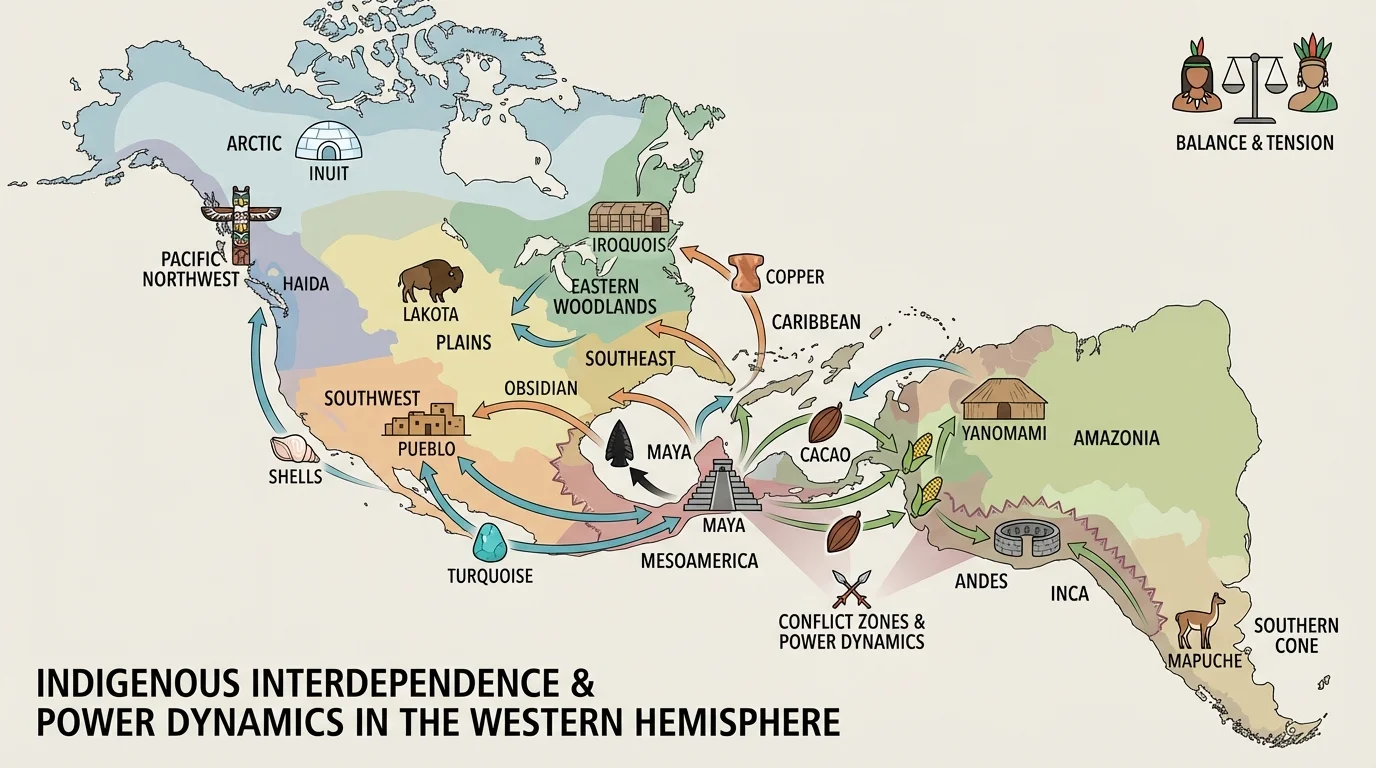
Interdependence also appeared in diplomacy and alliances. Nations sometimes worked together for defense or trade protection. The Haudenosaunee Confederacy joined several nations under a common political structure while allowing each nation to keep its identity. In the Andes, roads connected distant areas and allowed the movement of food, labor, and messages. These links made large societies possible.
Why interdependence mattered
No community has every resource it needs. A desert people may have minerals or woven goods, while a coastal people may have fish or shells. Trade and alliances reduce risk. If one area faces drought, war, or crop failure, connections with other communities can help people survive. Interdependence makes societies stronger, but it can also create conflict when groups compete over trade routes or resources.
Interdependence did not mean everyone agreed. Indigenous nations sometimes fought one another, just as nations do today. Competition over land, tribute, or political influence could lead to war. Still, even rivals often had rules for diplomacy, peace-making, exchange, or marriage ties. That mixture of cooperation and conflict is part of a realistic view of history.
Even while connected, Indigenous societies kept distinct identities. Some were matrilineal, meaning family lines were traced through mothers. Some were patrilineal, tracing descent through fathers. Some worshiped through ceremonies tied to agriculture, while others focused on hunting cycles, water, or mountain spirits. Languages were also highly diverse. Before colonization, hundreds of language families and thousands of languages were spoken in the Americas.
Homes reflected geography. Arctic peoples used snow houses for temporary winter shelters and also built structures from sod, whalebone, or animal skins. Great Plains peoples used tipis because they were portable. In the Eastern Woodlands, longhouses fit larger family groups. In the Andes, stone construction worked well in mountain environments. Foodways differed too: salmon was central in parts of the Pacific Northwest, cassava in parts of the Caribbean and South America, and maize in many regions.
Art, music, dance, and storytelling carried knowledge across generations. Oral tradition was and remains a powerful way to teach history, values, and identity. A story might explain where a people came from, how to treat the natural world, or why a ceremony matters. These traditions are not myths in the sense of being "fake." They are important records of memory and belief.
Many foods found in grocery stores around the world today were first developed by Indigenous farmers in the Americas, including corn, potatoes, tomatoes, peanuts, and chocolate.
The cultural regions on [Figure 1] help show this diversity, but no map can capture everything. Different groups in the same broad region could still have very different languages, customs, and political systems.
When Europeans arrived, the balance of power changed sharply, as [Figure 3] illustrates through the spread of colonial settlements, missions, and armed control. Spanish, Portuguese, French, English, and Dutch empires wanted land, labor, gold, trade routes, and political power. Their arrival caused huge changes for Indigenous Peoples.
One major reason was disease. Smallpox, measles, and influenza spread rapidly because Indigenous populations had no previous exposure to these illnesses. In many places, disease killed large numbers of people before they could even understand what was happening. This weakened communities and made it easier for colonizers to seize land.
Colonization also involved military violence, forced labor, and religious pressure. Colonizers built forts, missions, plantations, and towns on Indigenous land. They often claimed the land belonged to a European king or queen, even though Indigenous nations already lived there. Some colonizers forced people to work in mines or fields. Others tried to replace Indigenous religions and languages with Christianity and European languages.
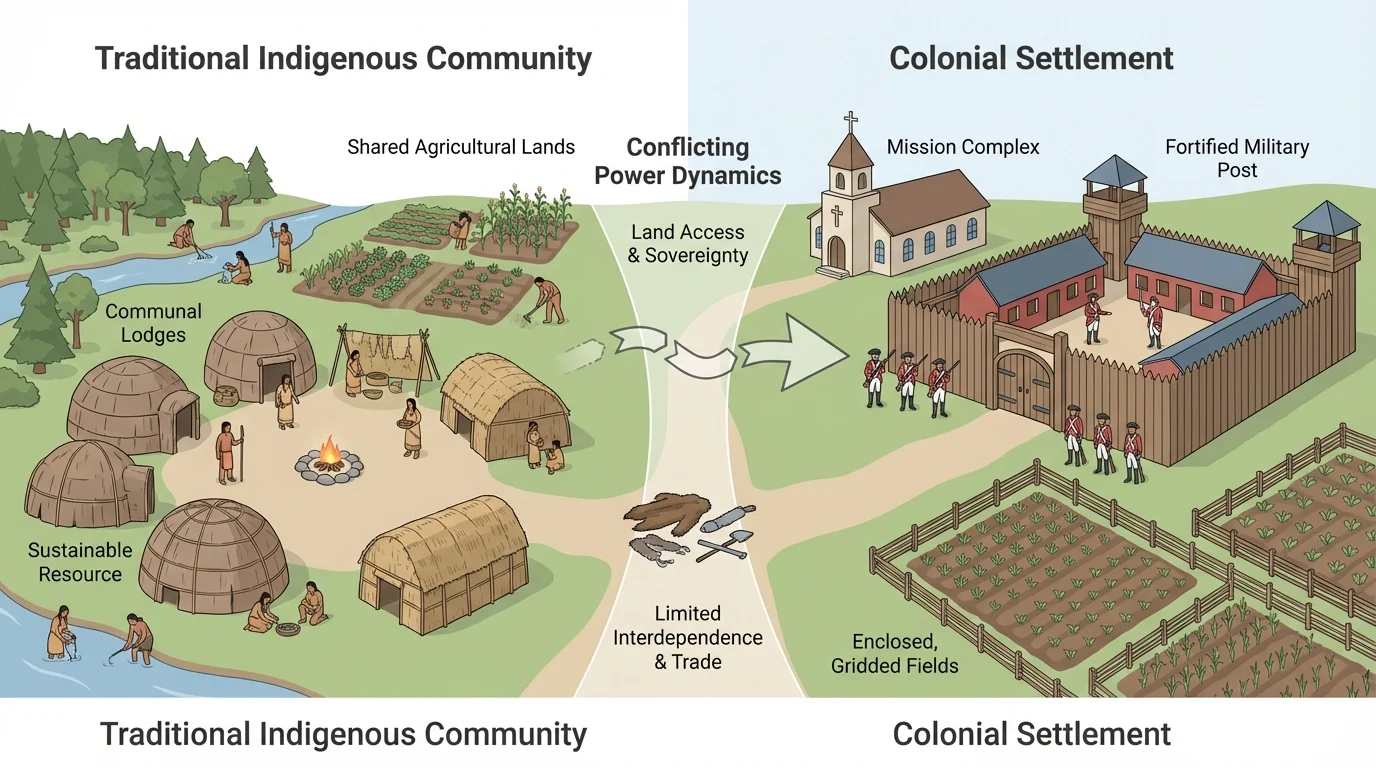
These are examples of colonization and changing, unequal power dynamics. European empires had guns, ships, and support from distant governments. They also wrote laws that treated Indigenous lands as available to take. Indigenous Peoples, however, were not powerless. They negotiated, adapted, resisted, and survived.
| Before colonization | After colonization began |
|---|---|
| Indigenous nations controlled their own lands. | European empires claimed control over large territories. |
| Trade and alliances existed mainly among Indigenous groups and some early newcomers. | Trade was increasingly controlled by colonial powers. |
| Many languages and spiritual traditions flourished openly. | Many languages and traditions were suppressed or attacked. |
| Political authority came from Indigenous leaders and councils. | Colonial governors, soldiers, missionaries, and settlers tried to replace Indigenous authority. |
Table 1. Comparison of major changes in power before and after colonization began.
Indigenous resistance took many forms. Some communities fought battles. Others used diplomacy, moved to safer places, preserved traditions in secret, or made strategic alliances. Resistance was not only military. Keeping a language alive or continuing a ceremony could also be a form of resistance when outsiders tried to erase Indigenous identity.
There are many important examples. In the Caribbean, Taíno resistance began soon after Spanish invasion. In the Andes, leaders such as Túpac Amaru challenged Spanish rule. In North America, leaders such as Pontiac, Tecumseh, and Osceola resisted U.S. expansion. During the Pueblo Revolt of 1680, Pueblo peoples in the Southwest drove the Spanish out of the region for a time.
Case study: the Pueblo Revolt
Step 1: Colonizers tried to control Pueblo communities.
Spanish authorities forced labor, demanded tribute, and attacked Pueblo religious practices.
Step 2: Pueblo leaders organized resistance.
Popé and other leaders united different Pueblo communities to act together.
Step 3: The revolt succeeded for a time.
In 1680, Pueblo forces pushed the Spanish out of New Mexico for about 12 years.
This event shows both interdependence among Indigenous groups and conflict with those in power.
In later centuries, governments in the United States, Canada, and parts of Latin America used new methods of control. These included forced removal from homelands, treaty violations, reservation systems, and boarding or residential schools. In many of these schools, children were punished for speaking their own languages or practicing their cultures. The goal was assimilation, forcing Indigenous people to adopt the dominant culture.
Assimilation policies were deeply harmful because they attacked family bonds, identity, and memory. Yet Indigenous communities survived and worked to recover languages, ceremonies, and local control. Survival itself is one of the most important parts of this history.
The story did not end in the past. Indigenous nations still live across the hemisphere, and many continue to defend their lands, cultures, and political rights. Current conflicts over land, water, mining, forests, oil pipelines, and sacred places show that power struggles are still real, as [Figure 4] displays in a modern setting. Governments and corporations often want access to natural resources, while Indigenous communities argue that these places are part of their heritage, survival, and sovereignty.
For example, some Native nations in the United States have challenged pipeline projects that threaten water sources. In the Amazon, Indigenous communities have protested deforestation and mining. In Canada and Latin America, land claims and court cases continue over treaty rights, resource extraction, and self-government.
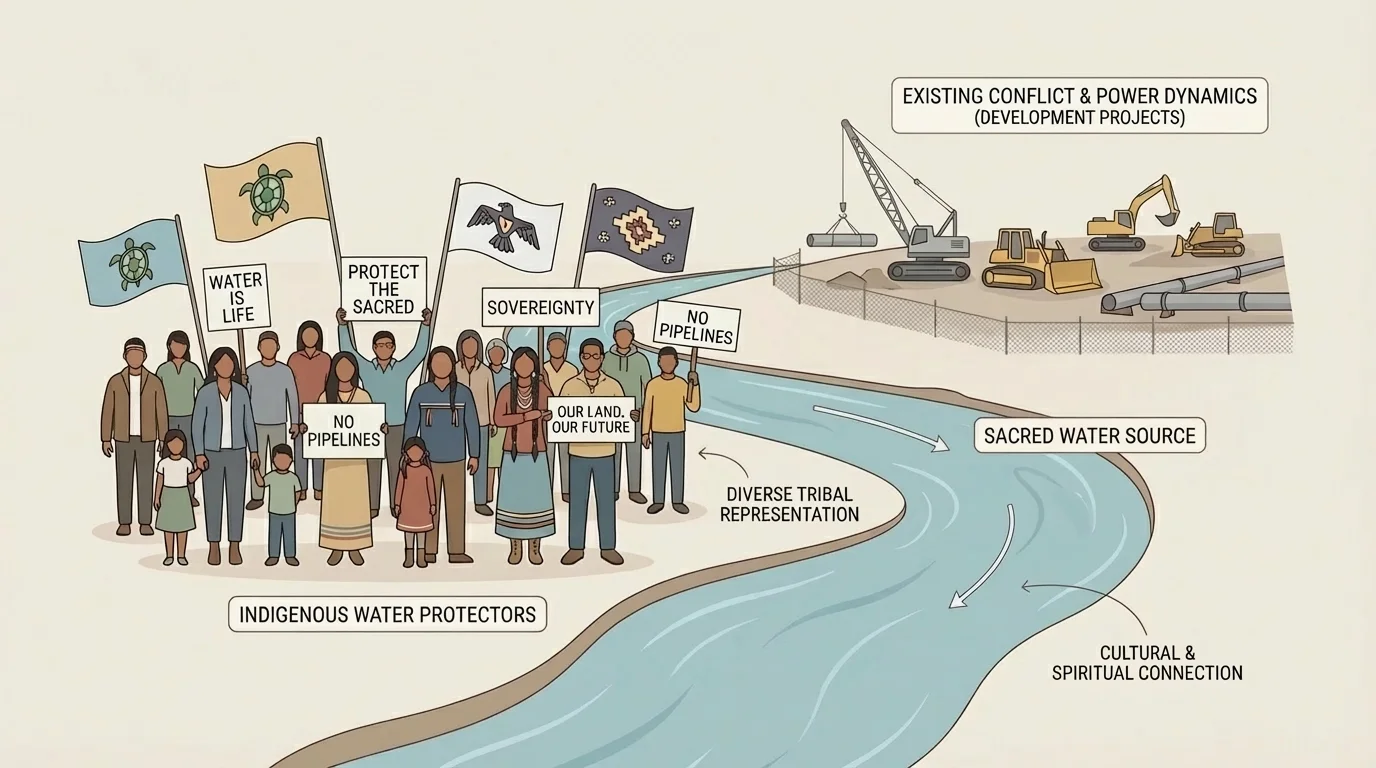
These modern struggles connect to older patterns we saw in [Figure 3]. Powerful governments and corporations may still try to control Indigenous lands, but Indigenous leaders organize protests, use courts, build alliances, and speak to the world through media. Some communities run schools that teach traditional languages. Others manage museums, cultural centers, or environmental programs based on Indigenous knowledge.
"We are still here."
— A phrase often used by Indigenous activists and communities to affirm survival, continuity, and presence
It is also important to avoid thinking of Indigenous Peoples only through conflict. Indigenous artists, scientists, athletes, writers, and political leaders contribute to modern life in every country of the Western Hemisphere. Their communities are not just surviving; they are shaping the future.
To study this topic fairly, historians use many kinds of evidence. Primary sources include oral histories, treaties, letters, artifacts, maps, buildings, and recordings from people close to the events. Secondary sources are later explanations written by historians or scholars. Both are useful, but both must be questioned carefully.
For a long time, many textbooks relied mainly on European records. That can be a problem because people in power often describe events in ways that support themselves. If a colonizer writes that land was "empty" or "unused," historians must compare that claim with Indigenous oral tradition, archaeology, and other evidence. Perspective matters.
The map of trade routes in [Figure 2] reminds us that Indigenous societies were connected and organized long before European empires tried to dominate them. Looking back at these connections helps correct the false idea that history only began when Europeans arrived.
When studying history, ask three questions: Who created this source? Why was it created? Whose voice might be missing? These questions help you notice bias and see power more clearly.
Understanding Indigenous history means holding two big ideas at once. Indigenous Peoples are deeply unique, with distinct cultures and histories, and they are also deeply interdependent, connected through trade, alliances, and shared experiences. Their history also includes a long struggle against outside powers that tried to control land, labor, and identity. That struggle continues, but so does Indigenous strength, creativity, and sovereignty.
