If every person on Earth used money in exactly the same way, stores, jobs, and trade would look almost identical everywhere. But they do not. In some places, people save money in banks and use cards or phones to pay. In other places, families still trade goods, share resources, or depend more on land and community than on cash. That difference tells us something important: money is useful, but how people view money depends on what resources they have, what they value, and what they have experienced.
Money seems simple because we use it often. We buy food, pay for transportation, and save for things we want. Yet money is really part of a bigger system. A society must answer basic questions: What should be produced? Who should do the work? Who should get the goods and services? Different societies answer these questions in different ways.
In one community, land may be the most important resource because families grow crops and raise animals. In another, technology and factories may be more important. In another, oil, natural gas, or minerals may shape the whole economy. Because resources are different, people's jobs, spending habits, and ideas about wealth can be different too.
Resources are things people use to meet their needs and wants, such as land, water, forests, minerals, tools, and workers' skills.
Scarcity means there is not enough of everything for everyone to have all they want.
Society is a group of people living together with shared systems, rules, and ways of life.
Even the idea of being "rich" can change from place to place. In a city with many stores and services, people may think about money, property, and business success. In a rural village, people may value fertile land, healthy animals, strong family connections, and access to water just as much as cash. These are all ways societies think about resources.
Scarcity, as shown in [Figure 1], is one of the most important ideas in economics. People have many needs and wants, but resources are limited. A family may want better housing, more food choices, school supplies, and transportation, yet it has only a certain amount of time, money, and energy to use.
This means societies must make trade-offs. A trade-off happens when choosing one thing means giving up another. If a government spends more money building roads, it may have less money for parks or libraries. If a farmer uses land to grow corn, that same land cannot be used at the same time to grow rice.
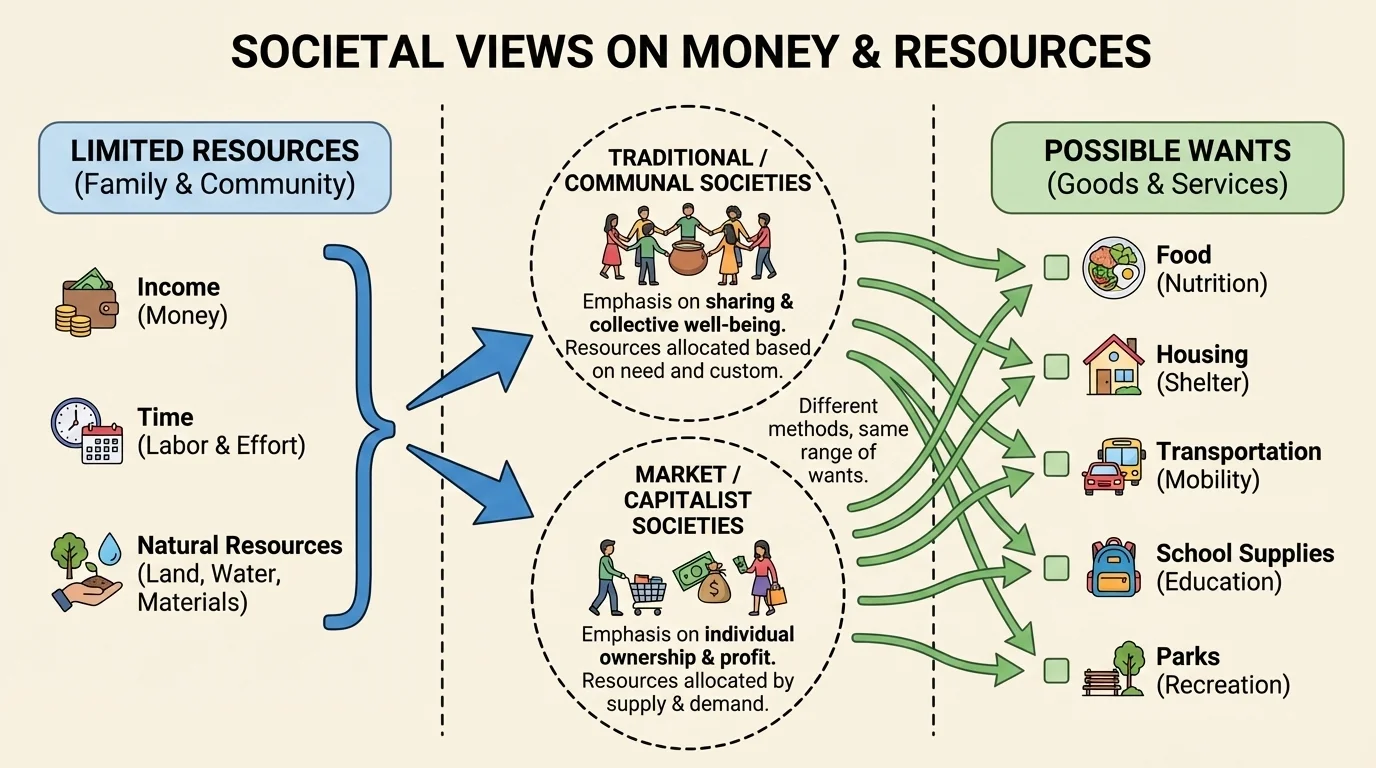
Scarcity does not mean a society has nothing. It means choices have to be made. Even wealthy countries face scarcity. They may have more money or technology, but they still have limits on time, labor, energy, and natural resources.
People often divide their choices into needs and wants. Needs are things required for survival and safety, such as food, water, shelter, and clothing. Wants are things that improve comfort or enjoyment, such as a new game system, designer shoes, or an expensive phone case. Different societies may agree on some needs, but they may not agree on every want. Values help shape these decisions.
Why scarcity leads to systems
Because resources are limited, societies create systems for deciding how goods and services are produced and shared. These systems are not random. They develop from geography, history, beliefs, government choices, and the experiences of the people who live there.
Think about water. In a region with plenty of fresh water, people may not think about it often. In a dry region, water can become one of the most valuable resources of all. Families, farmers, and governments may spend large amounts of money and effort to store, transport, and protect it. The same resource has a different meaning in different places.
Money is anything people accept in exchange for goods and services. Today, it may be paper bills, coins, bank balances, or digital payments. Money helps societies in several important ways.
First, money works as a medium of exchange. This means people can use it to buy and sell without directly trading one item for another. Second, money is a store of value. People can save it and use it later. Third, money is a unit of account. It helps measure value so prices can be compared more easily.
Before money was widely used, many people depended on barter. Barter is trading goods or services directly. For example, a fisher might trade fish for vegetables from a farmer. Barter can work, but it is harder than using money because both people must want what the other person has at the same time.
Real-world example: barter versus money
Step 1: In a barter system, Ana has eggs and wants shoes.
Step 2: The shoemaker may not want eggs. The shoemaker might want wood instead.
Step 3: Ana would need to trade eggs for wood first, then trade wood for shoes.
Step 4: With money, Ana can sell eggs for cash and use that money to buy shoes directly.
Money makes exchange faster and more flexible.
Still, not every society depends on money in exactly the same way. In some communities, sharing food, labor, or tools remains just as important as cash. A person may be respected not because they own the most money, but because they contribute the most to the group.
[Figure 2] To deal with scarcity, societies organize economic life in different ways. The four main types often taught are traditional economy, market economy, command economy, and mixed economy. The comparison helps show that each system answers economic questions differently.
A traditional economy is shaped by customs and habits. People often do work that families have done for generations, such as farming, fishing, or herding. Decisions may be based on community traditions rather than prices or government orders.
A market economy is based largely on individual choice. People and businesses decide what to buy, sell, and produce. Prices help guide decisions. If many people want a product, businesses may make more of it.
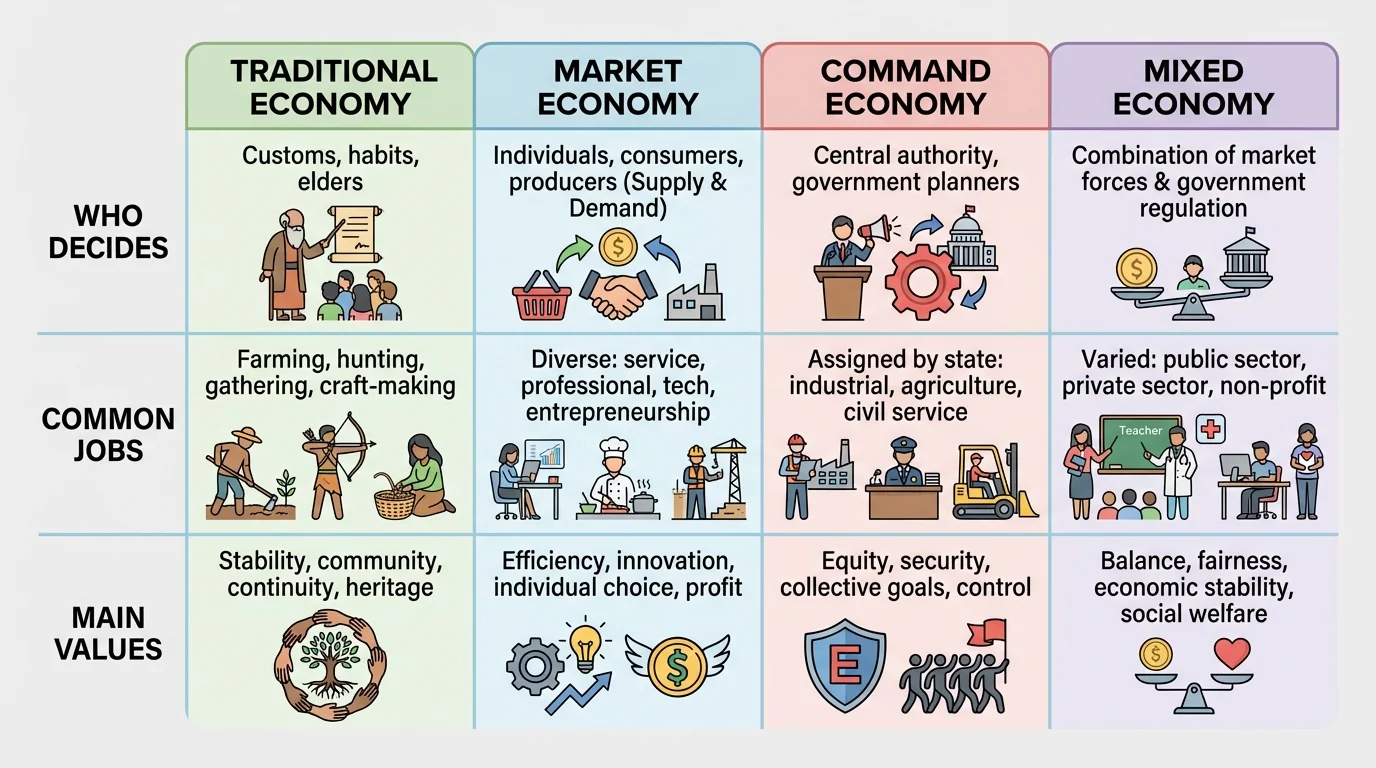
A command economy is one in which the government makes many major economic decisions. It may decide what factories produce, how much workers are paid, or how resources are distributed. Leaders may choose this system when they want strong control over major industries.
A mixed economy combines parts of market and command systems. Many modern countries are mixed economies. Individuals and businesses make many choices, but the government also creates rules, provides services, and manages some resources.
None of these systems exists in a perfectly pure form everywhere. Real societies are shaped by history and need. A country recovering from war might use more government control. A nation with a long history of private business may use more market choices. As we saw earlier in [Figure 1], scarcity pushes all societies to make decisions, but the system they use depends on their values and experiences.
| Economic system | Who makes many decisions? | Main influence | Possible example of daily life |
|---|---|---|---|
| Traditional | Families or communities | Customs and tradition | Jobs passed down through generations |
| Market | Individuals and businesses | Prices and choice | Stores competing to sell products |
| Command | Government | Central planning | State deciding major production goals |
| Mixed | Individuals, businesses, and government | Combination of choice and rules | Private companies with public schools and roads |
Table 1. Comparison of major economic systems and who plays the biggest role in decision-making.
Geography matters a great deal. A society near oceans may depend on fishing, shipping, or ports. A society with fertile soil may develop strong farming communities. A region rich in minerals may build mines and factories. These patterns appear clearly in [Figure 3], which connects regions to important resources and common economic activities.
Natural resources influence jobs, trade, and even transportation. A mountainous area may find it harder to build roads than a flat plain. A place with forests may produce lumber and paper. A dry country may spend heavily on irrigation systems to support agriculture.
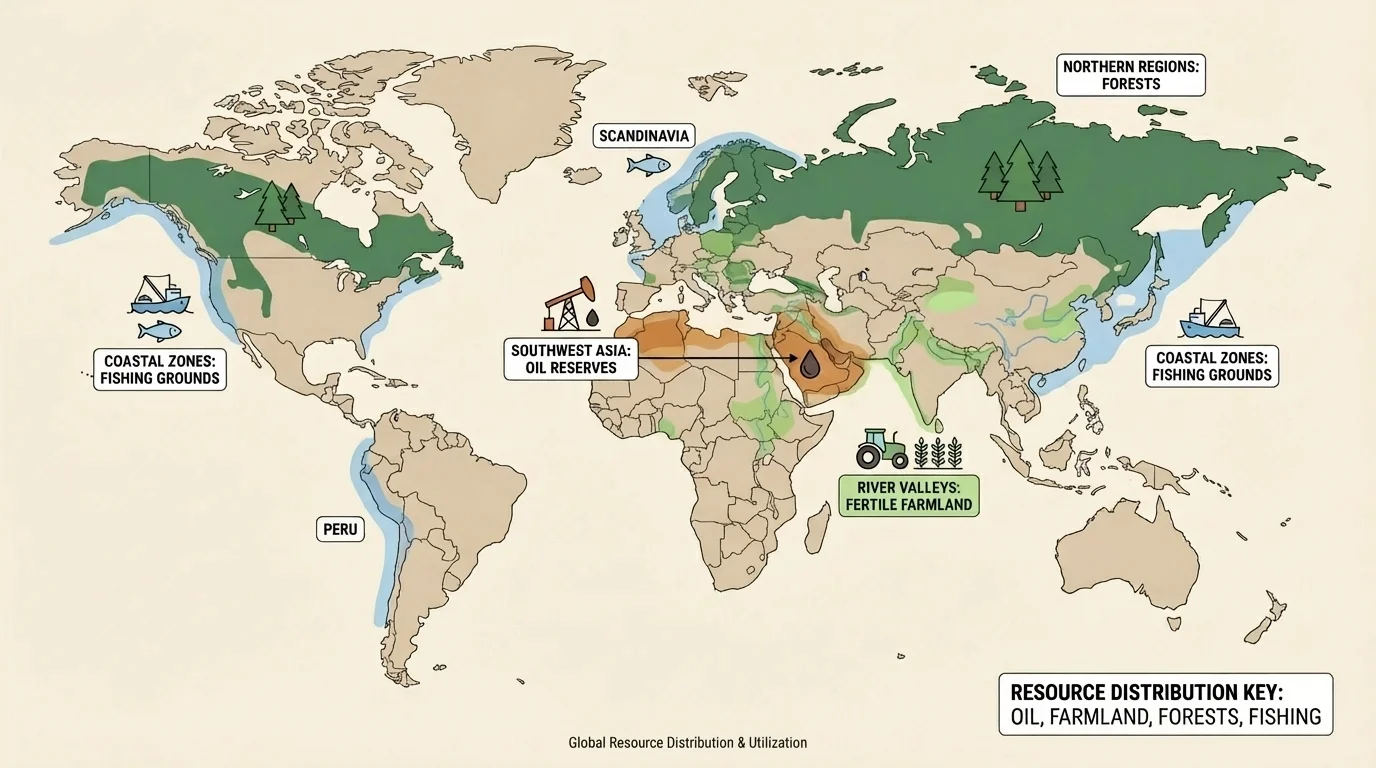
Access to resources can create opportunities, but it can also create challenges. If a country depends too much on one resource, such as oil, its economy may become unstable when prices change. If a region loses fertile soil or clean water, people may have to change jobs, move away, or import more food.
Human resources are important too. Human resources are the skills, knowledge, and labor people bring to work. A country with many trained doctors, engineers, teachers, and builders has valuable resources even if it lacks large amounts of oil or gold. In many places, education becomes one of the most important investments a society can make.
Some countries have few major natural resources but still build strong economies through education, technology, trade, and skilled workers. This shows that resources are not only things found in the ground.
For example, Japan has limited land for farming and few large energy resources compared with some countries, yet it has developed strong industries through technology, manufacturing, and human skill. In contrast, a country with many natural resources may struggle if wealth is not managed fairly or wisely.
Money is never only about buying things. It also reflects what people believe is important. Some societies strongly value individual success and personal ownership. Others place greater importance on sharing, family responsibility, or community support.
In some places, adults may expect children to begin helping earn income at a young age. In other places, families may focus more on education first, believing that school will lead to better opportunities later. Both choices involve values, long-term planning, and the use of limited resources.
"People make economic choices, but those choices are shaped by what they care about most."
Religion and culture can also shape how money is used. Some traditions encourage saving and careful spending. Others place strong importance on giving to people in need. In many communities, celebrations, weddings, funerals, and holidays involve major spending because social relationships matter deeply.
Governments also show values through budgets. When a government spends more on schools, hospitals, or public transportation, it is making a statement about priorities. Since money is limited, increasing spending in one area often means less spending in another. This is another example of trade-offs.
No society has every resource it wants. That is why trade is so important. As [Figure 4] shows, places often exchange what they have in abundance for what they need from somewhere else. A country with large wheat farms may export grain. Another may export computers, clothing, or cars.
An import is a good or service brought into a country from another place. An export is a good or service sold to another place. Trade allows societies to specialize, which means focusing on producing certain goods or services well.
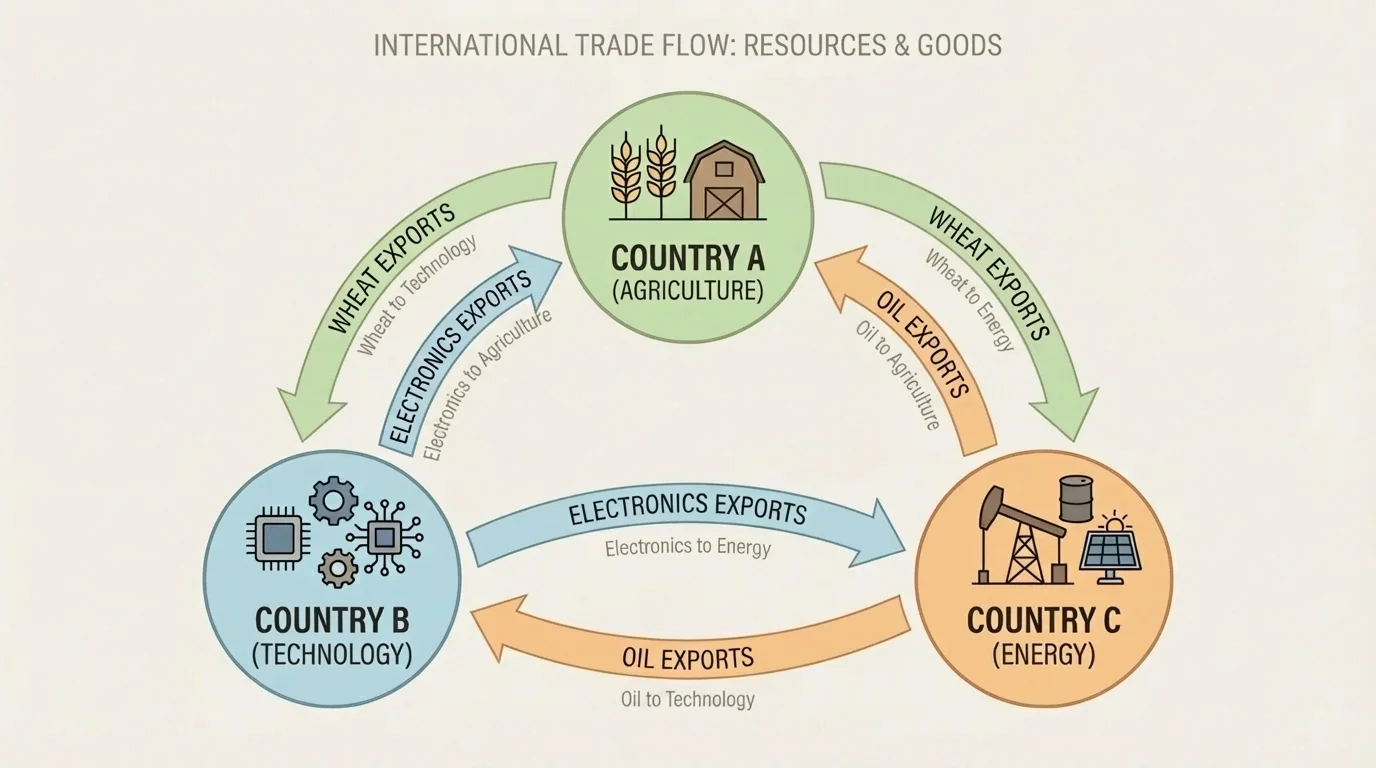
Specialization can make production more efficient. If one region has rich soil and a good climate for coffee, it may produce coffee well. Another region with advanced factories may produce machines. By trading, both can benefit.
Trade can also create problems. If a country depends too much on imported food or fuel, it may be hurt when supplies are interrupted. If workers in one place are paid very little, trade may raise questions about fairness. So societies do not only ask, "Can we trade?" They also ask, "Is the trade helpful, safe, and fair?"
Later, when we compare case studies, the trade flows in [Figure 4] help explain why a place rich in one resource may still need many goods from elsewhere. Having one valuable resource does not mean having everything.
Consider a farming village where most families grow food, raise animals, and trade locally. Money is useful, but daily life may depend just as much on rainfall, fertile land, tools, and cooperation. If a family helps another family harvest crops, they may be repaid with labor later instead of cash. In this society, resources and relationships are tightly connected.
Now consider a wealthy city in a market-based country. Many people work for wages, buy food in stores, pay rent, and use banks. Here, money may play a larger everyday role because people depend less on producing their own food and more on buying what they need. Jobs, prices, and business competition become very important.
Case study comparison
Step 1: In a rural farming community, land and water may be the most valuable resources.
Step 2: In an industrial city, transportation, factories, electricity, and skilled workers may matter more.
Step 3: In an oil-rich country, energy exports may bring in large amounts of income.
Step 4: In a community with strong traditions of sharing, social support may be just as important as cash income.
These examples show that money matters, but it does not mean the same thing in every society.
Another example is a country with major oil reserves. Oil exports may bring in large amounts of money, allowing the government to build roads, schools, or hospitals. But if the country relies too heavily on oil, it may face trouble if prices fall or the resource begins to run out. Natural wealth does not automatically solve scarcity.
Some Indigenous communities have long traditions of sharing land and resources rather than treating everything as private property. In such communities, respect, responsibility, and balance with nature may guide decisions. This is a reminder that economic life is shaped by culture as much as by cash.
Different societies also face questions about fairness. Who gets access to clean water? Who owns land? Who benefits from natural resources? Who has the chance to get an education and a good job? These are economic questions because they involve the distribution of limited resources.
Inequality means resources, income, or opportunities are not shared equally. Some inequality exists in many societies, but very large differences can create serious problems. People with too few resources may struggle to get food, healthcare, transportation, or education.
Why fairness matters in economics
An economy is not only about producing goods. It is also about how people live. A society may produce a lot of wealth, but if many people cannot meet basic needs, leaders and citizens may debate whether the system is working well.
Another challenge is inflation, which means prices rise over time. If the price of bread, fuel, or school supplies goes up quickly, the same amount of money buys less than before. A family that could once afford several items may now have to cut back. Inflation changes how people use money and can make scarcity feel even stronger.
Governments try many ways to address scarcity and fairness. They may collect taxes to pay for schools and roads, create laws for workers, support farmers, protect resources, or provide aid to people in need. These policies affect everyday life, even if students do not always notice them right away.
These ideas are not far away or only for adults. Students make economic choices too. If you have a small allowance or a limited amount of time after school, you face scarcity. Choosing to spend money on snacks may mean saving less for a book, game, or sports item. Choosing to spend time on one activity means less time for another.
Families also make economic decisions constantly. They compare prices at stores, decide when to save, choose whether to repair or replace items, and think about transportation, food, and housing. In a household budget, every choice shows priorities. The same is true for schools deciding how to use money for teachers, technology, books, arts, and sports.
When you notice these choices, you begin to understand a big truth: economics is really about people solving problems. As we saw in [Figure 2], societies build systems to make decisions. As [Figure 3] shows, resources are not spread evenly across the world. And as [Figure 4] reminds us, trade connects places that need one another.
Different societies view and use money and resources in different ways because they do not all live in the same environments, share the same histories, or hold the same values. Some depend more on markets, some more on government planning, some more on tradition, and most on a mixture of all three. Understanding those differences helps us see why economic choices are never only about numbers. They are also about land, culture, power, fairness, and human experience.
