If a government says, "You belong," that can open doors to voting, legal protection, land rights, travel documents, and public services. A key point is this: throughout history, many people who lived in a place for generations were denied citizenship, while others were invited in more easily because of where they came from. In the Western Hemisphere, ideas about citizenship have never been simple. They have been shaped by power, identity, laws, and the question of who gets to decide who belongs.
Citizenship is more than a piece of paper. In many countries, it means a person is a legal member of a nation. Citizenship often includes rights, such as the right to vote or receive legal protection, and responsibilities, such as obeying laws, serving on a jury in some countries, or helping the community.
In civics, citizenship matters because it affects participation in government. In democracies, citizens may vote, run for office, speak out, and work to change laws. In other systems, citizens may have fewer ways to influence government directly. Even when two countries both call someone a citizen, the experience of citizenship can be very different.
Citizenship is legal membership in a country or nation.
Naturalization is the process through which a person born in one country becomes a citizen of another country.
Quota is a limit set by a government on the number of people from a certain place who may enter a country.
Citizenship can also involve identity. A person may feel loyalty to a nation, a local community, an Indigenous nation, or more than one of these at the same time. That is one reason this topic is so important: citizenship is about law, but it is also about belonging.
The first time we see the word citizenship in history, it does not always mean exactly what it means today. In some ancient and early modern societies, only certain men had full political rights. Women, enslaved people, and many others were excluded. In the Western Hemisphere, ideas about citizenship developed in colonial empires, Indigenous nations, republics, and modern states. Each system had its own rules about membership and participation.
Think of a team. Being on the team may mean you wear the uniform, follow the rules, and get to play in games. But who chooses the team? Who gets cut? Who never even gets invited to try out? Governments have often treated citizenship in similar ways. Sometimes they used fair rules. Sometimes they used unfair rules based on race, ancestry, language, gender, or wealth.
Citizenship as law and citizenship as belonging
A government may legally recognize someone as a citizen, but that person may still face discrimination. On the other hand, a person may deeply belong to a community or nation even if a government refuses to recognize that status. This difference helps explain why conflicts over citizenship have been so powerful across the Western Hemisphere.
Because of this, historians study not only who had citizenship on paper, but also who was able to use it in everyday life. Could people vote safely? Could they hold office? Could they own property? Could they move freely? These questions show that citizenship is connected to real power.
Long before the modern countries of the Western Hemisphere existed, Indigenous Peoples had their own governments, territories, laws, and systems of belonging. Some lived in confederacies, some in nations with councils, and some in other forms of organized government. This matters because, as [Figure 1] shows, a person could already belong to an Indigenous nation and not see outside citizenship as the most important form of membership.
When European empires and later settler governments expanded, they often ignored Indigenous sovereignty. Sovereignty means the authority of a people or state to govern itself. Many governments in North America treated Indigenous Peoples as separate from citizenship when that separation helped the government control land and rights. At other times, governments tried to force citizenship on Indigenous peoples in order to weaken tribal or national identity.
In the United States, many Native Americans were not recognized as U.S. citizens for much of the country's history. In 1924, Congress passed the Indian Citizenship Act, which granted U.S. citizenship to Native Americans born in the United States. But even after that law, many Native people still faced barriers to voting because some states used unfair rules to keep them from the polls.
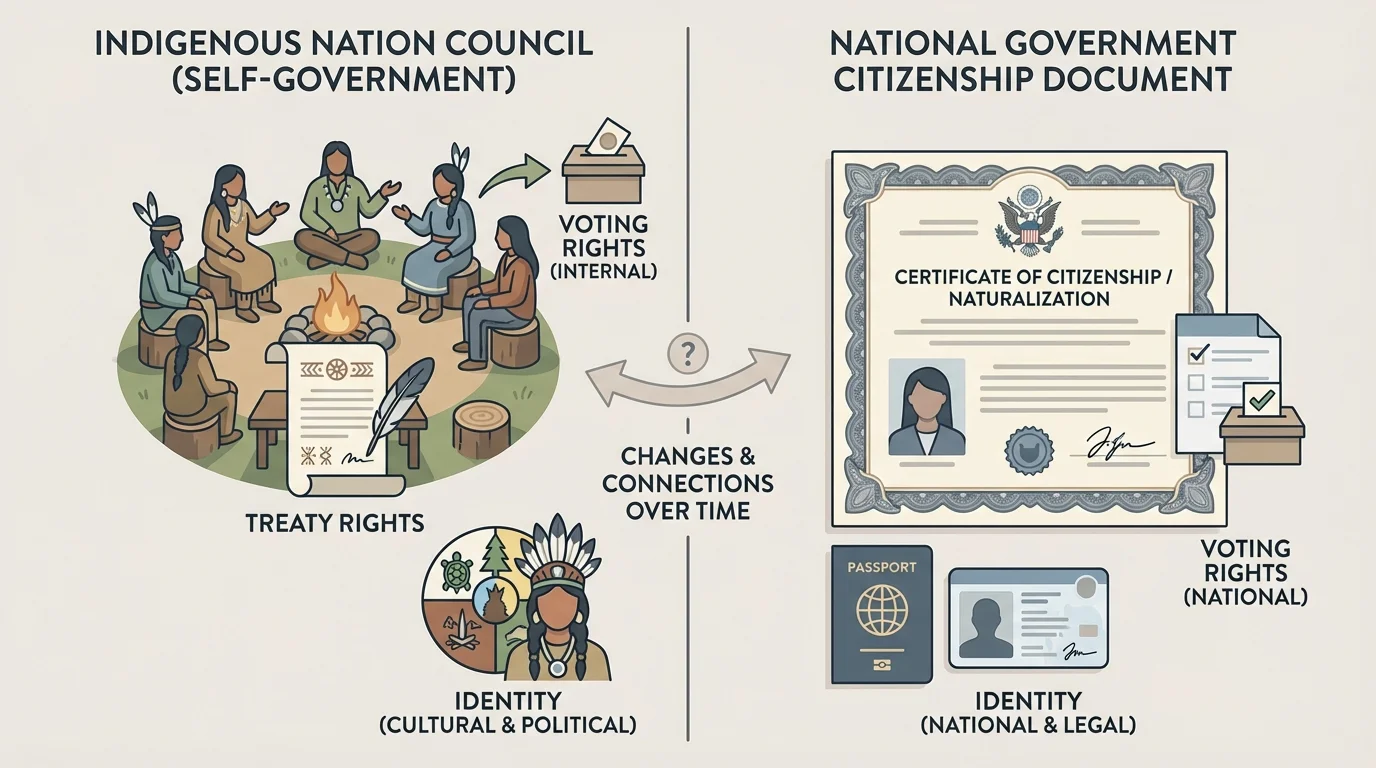
Citizenship was not always desired in the same way by Indigenous communities. Some Indigenous leaders wanted citizenship rights because those rights could help protect people from exclusion and allow participation in national politics. Others worried that accepting outside citizenship might be used to erase treaty rights, land claims, or membership in their own nations. In Canada, for example, First Nations peoples had a complicated relationship with Canadian citizenship. For a long time, government policies pushed assimilation, meaning pressure for minority groups to give up their own cultures and become more like the dominant group.
That pressure could appear in schools, land laws, and rules about status. Some policies suggested that to be fully included in the state, Indigenous people had to give up parts of their own political identity. This created a painful choice that should never have been forced: join fully on the state's terms, or protect Indigenous identity while being excluded from rights enjoyed by others.
The Haudenosaunee Confederacy, also called the Iroquois Confederacy, developed a sophisticated system of government long before the United States was founded. This reminds us that Indigenous political traditions were not "less developed"; they were organized in their own ways.
Later, movements for Indigenous rights pushed governments to recognize that people can hold more than one kind of political identity. Citizenship in a country and belonging to an Indigenous nation are not always the same thing. Understanding that difference is essential to understanding citizenship in the Western Hemisphere.
Countries in the Western Hemisphere have often welcomed immigrants, but not all immigrants were treated equally. In many periods, leaders claimed they were protecting jobs, culture, or national security. Yet immigration laws often showed clear preferences, as [Figure 2] explains, by making it easier for some groups to enter and harder for others.
A quota system sets limits on immigration. Governments may decide how many people can come in one year and may also divide those numbers by country or region. On paper, that may sound neutral, but quotas can be designed to favor certain populations. For example, in the United States during the 1920s, national-origin quotas gave preference to immigrants from northern and western Europe and sharply limited immigrants from southern and eastern Europe. Immigration from Asia was also heavily restricted.
These choices shaped families and neighborhoods for decades. If one group had a high quota, more families from that region could reunite and settle. If another group had a low quota, people might wait years or be prevented from entering at all. Laws like these did not just count people; they reflected ideas about which immigrants were considered "desirable."
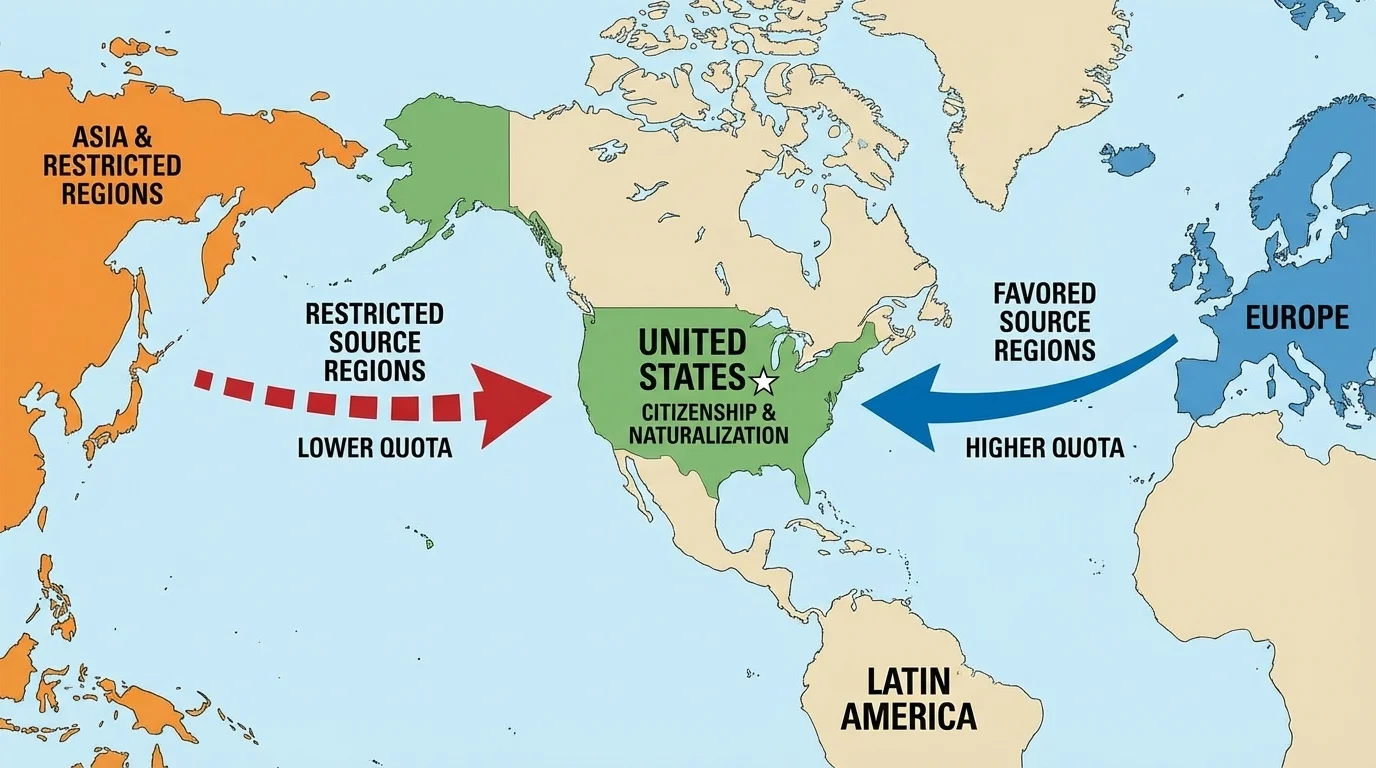
Other countries in the hemisphere also had preferences. Some Latin American countries encouraged immigration from Europe in the nineteenth and early twentieth centuries. At times, governments believed European immigrants would help economic development or change the country's population in ways leaders preferred. Those beliefs often carried racial bias.
Immigration rules can change when societies change. Wars, economic crises, labor shortages, and civil rights movements all influenced policy. In the United States, the Immigration and Nationality Act of 1965 ended the old national-origin quota system. That change opened the door for more immigrants from Latin America, Asia, and other regions. The population of the country changed in major ways after that.
Case study: How quota preferences affect real families
Suppose two families in the same year both hope to move to a country. One family comes from a nation with a large quota, while the other comes from a nation with a very small quota.
Step 1: The government accepts more applications from the first family's country.
This means the first family has a better chance of being admitted sooner.
Step 2: The second family faces a long waiting list or rejection.
Even if both families work hard and follow the rules, the law treats them differently because of where they were born.
Step 3: The result shapes communities.
Over time, some neighborhoods grow quickly because many relatives can join each other, while other families stay separated for years.
This is why quota systems are not just numbers. They influence people's lives, opportunities, and sense of belonging.
We can see that migration is tied to geography, law, and power at the same time. A border is not only a line on a map; it is also a place where governments decide who may enter and under what conditions.
Not everyone is born a citizen of the country where they live. The process of becoming a citizen later is called naturalization. Naturalization rules may sound fixed, but they have changed a great deal over time, as [Figure 3] illustrates through major turning points.
In the early United States, naturalization was limited by race. The Naturalization Act of 1790 allowed "free white persons" to become citizens. That meant many people were excluded from naturalization because of racist laws. Over time, these rules changed. After the Civil War and through later legal developments, eligibility gradually expanded, though not all restrictions disappeared at once.
Requirements have also changed in other ways. Governments may require a certain number of years of residence, proof of good moral character, an oath of loyalty, language knowledge, or a test about history and government. Some countries make the process easier for children, spouses, or people with parents from that country. Others have stricter rules.
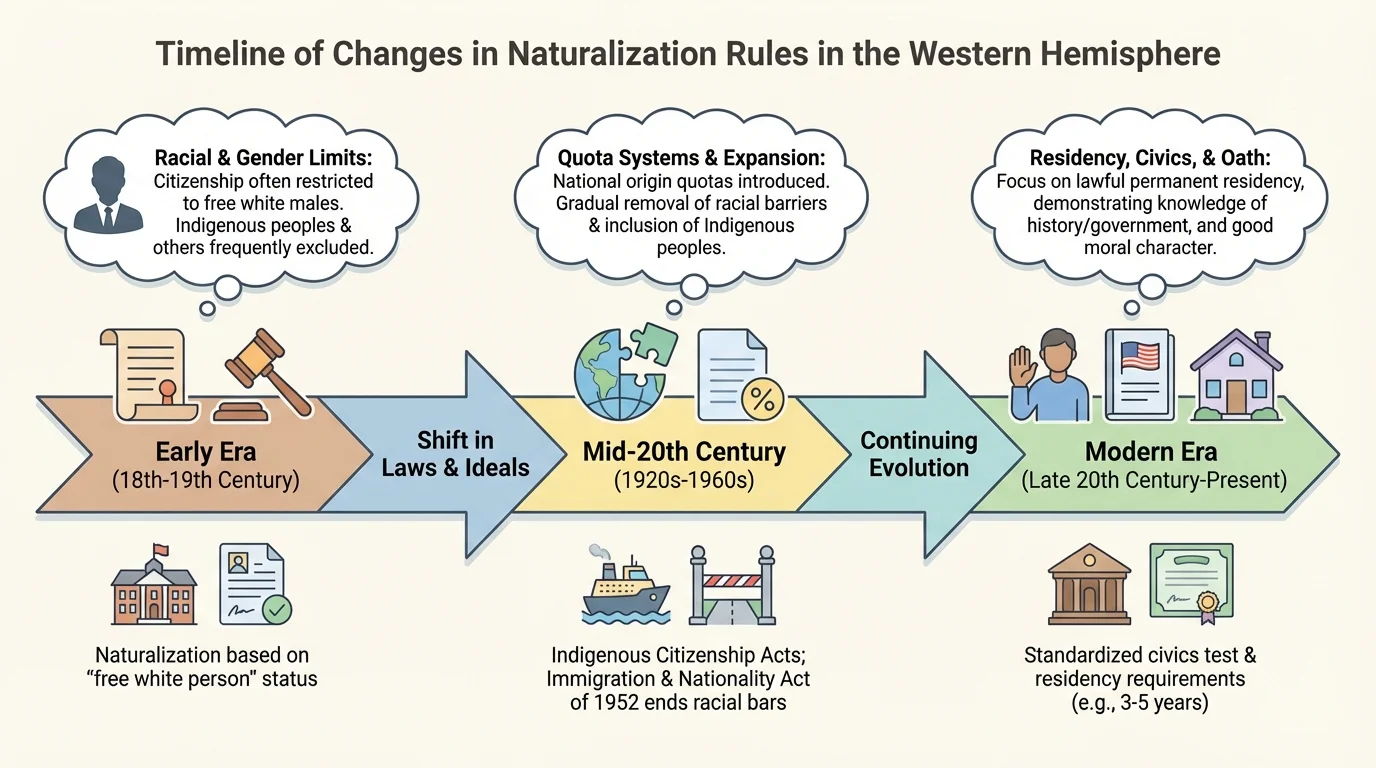
In the United States today, many lawful permanent residents may apply for citizenship after meeting residency requirements, usually after several years. Applicants often complete forms, attend interviews, and take tests about English and civics. But this system grew out of many earlier laws, some of which were unfair and exclusionary.
Across the Western Hemisphere, naturalization systems differ. Canada has residency, language, and citizenship knowledge requirements. Mexico, Brazil, and Argentina also have legal pathways to citizenship, but the details vary. Some countries have been more open to dual citizenship, while others once forced people to choose only one national identity.
Why naturalization rules change
Naturalization rules often change because societies change their ideas about fairness, identity, security, and equality. A rule that once excluded people by race or origin may later be seen as unjust. New laws may expand citizenship to groups that were previously pushed out.
This timeline makes an important point: citizenship laws are created by people, so they can also be changed by people. That means civic action, court decisions, protests, and new laws all matter.
When we compare different countries and time periods, a pattern appears. Governments often used citizenship to decide who had access to power. Sometimes citizenship expanded over time, becoming more inclusive. At other times, governments narrowed membership and excluded people they did not trust or value equally.
In Indigenous nations, belonging was often connected to kinship, community, treaty relationships, and nationhood. In settler states such as the United States and Canada, citizenship became tied to national law and often to ideas about race. In parts of Latin America, newly independent countries had to decide who counted as a citizen after colonial rule ended. Those choices could include some groups while ignoring others, especially Indigenous and Afro-descendant communities.
| Place or system | How membership was understood | Main challenge |
|---|---|---|
| Indigenous nations | Belonging through nation, community, family ties, and political traditions | Outside governments ignored or weakened sovereignty |
| United States in earlier periods | Citizenship defined by national law, often with racial limits | Many groups were excluded from full rights |
| Canada in earlier periods | Citizenship tied to the state, with pressure on Indigenous peoples to assimilate | State recognition often came with loss of autonomy |
| Latin American republics | Citizenship expanded after independence, but not always equally | Social class, race, and regional inequality shaped participation |
Table 1. Comparison of how different systems in the Western Hemisphere understood citizenship and its challenges.
This comparison helps us understand that citizenship is never just one thing. It can be a legal category, a source of rights, a tool of exclusion, or a way to claim justice. People have fought to gain citizenship, and people have also fought to protect forms of belonging that existed before modern states.
Today, citizenship still affects civic participation. Citizens may vote, serve in public office, join public debates, and influence laws. Noncitizens may also contribute to society in many ways, such as working, paying taxes, helping communities, and speaking out, even if they cannot vote in national elections.
Modern debates continue over immigration, border control, refugee policy, Indigenous sovereignty, and voting rights. These debates are not only about law. They are about fairness and about who has a voice in government. A healthy civic system asks whether people are being included justly and whether rights are truly protected.
"Citizenship is not a license that expires upon misbehavior."
— A principle often associated with constitutional democracy
For students, this topic matters because it shows that civic participation depends on rules made by governments, but those rules can be questioned and improved. The history of citizenship in the Western Hemisphere teaches that rights are not always shared equally at first. People and communities often have to organize, speak up, and demand recognition.
Looking across time, we can see both change and continuity. The big change is that many countries have moved toward broader citizenship rights than they had in the past. The continuity is that arguments over belonging, equality, and political power have never fully disappeared.
