Why do people in different countries vote, protest, write laws, or demand rights in such different ways? The answer often begins with ideas. Long before a law is written or an election is held, people debate big questions: Who should have power? What rights should people have? What should a government do? Across the Western Hemisphere, which includes North America, Central America, the Caribbean, and South America, these political ideas have connected nations for centuries.
A political idea is a belief about government, power, rights, and citizenship. Political ideas matter because they help shape the rules a country follows. For example, if people believe government should protect freedom of speech, they may support laws that allow open debate. If people believe one leader should have most of the power, the government may become more authoritarian.
Political ideas do not stay in one place. They move across borders through books, speeches, newspapers, trade, migration, wars, revolutions, and now the internet. That means the history of one nation often connects to the history of another. A revolution in one place may inspire reform in another. A protest movement in one country may influence activists in nearby countries.
Democracy is a system in which the people have power, usually through voting and representation. Civic participation means the ways people take part in public life, such as voting, serving on juries, joining groups, speaking out, or working to improve their communities. Authoritarian governments concentrate power in one leader or a small group and often limit citizens' freedoms.
Because the Western Hemisphere includes many types of governments and many cultures, it is a good region for seeing how political ideas interact. Some countries strongly protect elections and free speech. Others have experienced dictatorships, restricted voting, or military rule. The region shows both the power of democratic ideals and the challenges of putting them into practice.
Several major ideas have shaped nations across the hemisphere. One is liberty, the idea that people should have freedom to think, speak, worship, and make choices about their lives. Another is equality, the belief that people deserve equal treatment under the law. A third is popular sovereignty, meaning government gets its power from the people.
Another important idea is the rule of law. This means everyone, including leaders, must obey the law. In places where the rule of law is strong, leaders cannot simply ignore the constitution whenever they want. Courts, legislatures, and citizens help keep power limited. When the rule of law is weak, corruption and unfair treatment often grow.
The Western Hemisphere has also been shaped by ideas about republic government. In a republic, citizens choose representatives to make laws and decisions. Many countries in the hemisphere, including the United States, Mexico, Brazil, and Argentina, are republics. However, being a republic does not automatically guarantee full freedom or equal rights. The way a republic works depends on whether citizens can truly participate and whether institutions are fair.
Ideas can support one another or clash. Liberty and equality often work together, but sometimes people disagree about how to balance them. For example, a government may promise liberty but fail to provide equal rights to all citizens. Another government may claim to support equality while limiting freedom of speech. Political history often grows out of these tensions.
Political ideas are not just words in old documents. They affect real life. They help decide who can vote, who can run for office, how schools are funded, whether newspapers can criticize leaders, and whether citizens can peacefully protest. That is why studying ideas is really a way of studying how people live together in a country.
Across the hemisphere, political changes often happen in connected waves, as [Figure 1] illustrates through the spread of ideas among different regions. Think of political ideas as patterns that are adapted in new settings. One nation may begin with a set of ideas about freedom and rights, and another nation may adapt those ideas to fit its own needs and struggles.
In the late 1700s and early 1800s, Enlightenment ideas from Europe helped inspire many people in the Americas. Thinkers wrote that government should protect natural rights and should be based on the consent of the governed. These ideas influenced leaders in the British colonies that became the United States. They also influenced people in Latin America who wanted independence from Spain and Portugal. At the same time, the Haitian Revolution showed that ideas of liberty could be pushed further by enslaved people demanding freedom and equality for themselves.
Ideas did not move in only one direction. The United States influenced other regions, but events in Haiti and Latin America also influenced the hemisphere. Haiti's successful revolution frightened slaveholders in some countries and inspired freedom movements in others. Latin American independence movements showed that European empires could be challenged across a large region.
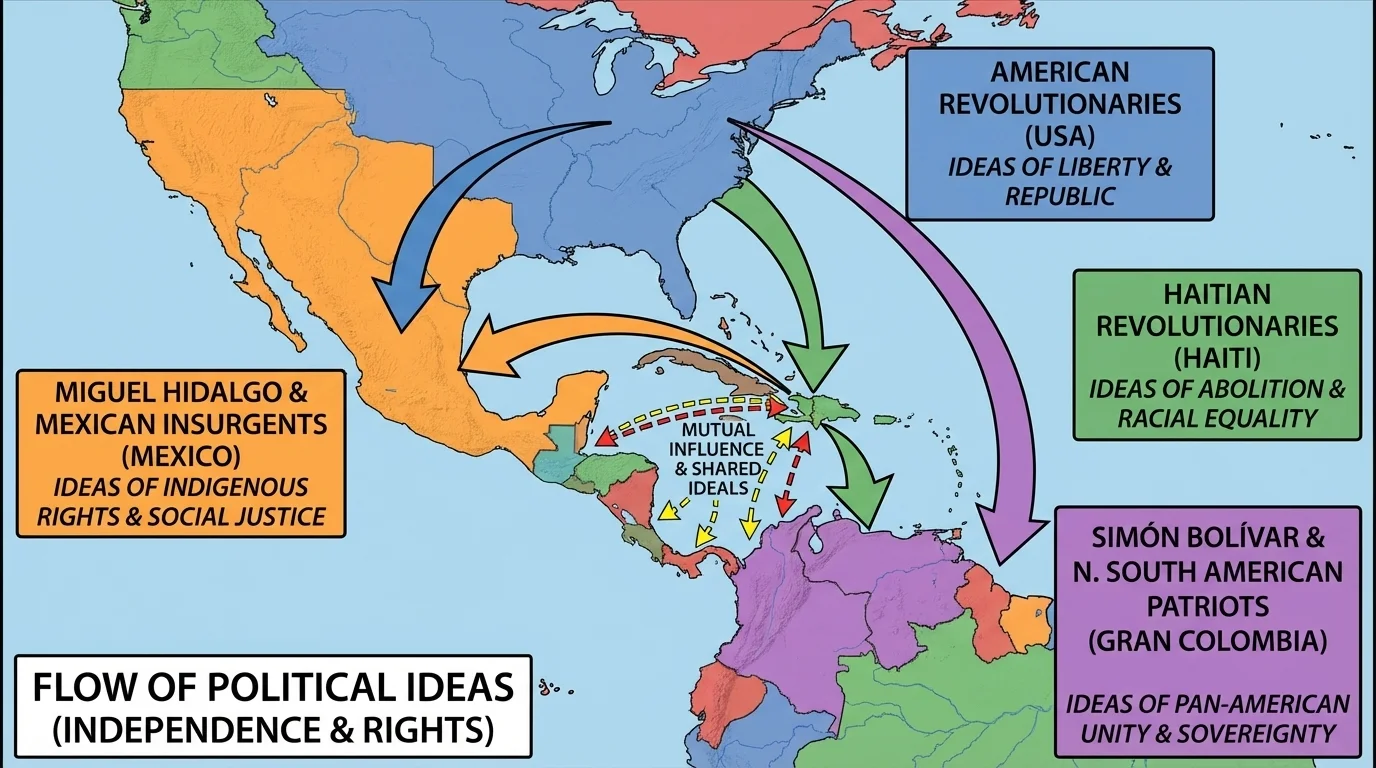
National leaders borrowed ideas, but they changed them. Some supported strong central governments. Others preferred more power for local regions or states. Some wanted broad voting rights. Others wanted voting limited to wealthy men. This shows that political ideas are interconnected, but they are not identical everywhere.
Even today, ideas move quickly across borders. Social media allows people in one country to watch elections, protests, and court decisions in another. Young people in the hemisphere see how others fight for voting rights, Indigenous rights, women's rights, and anti-corruption reforms. The connections shown earlier in [Figure 1] still matter because ideas continue to travel across the Americas.
Political history is not made by ideas alone; it is also shaped by leaders who explain, spread, and challenge those ideas, as [Figure 2] shows across different time periods. Some leaders wrote famous documents. Others led revolutions. Others organized workers, women, or poor citizens to demand change.
Thomas Jefferson helped express ideas about natural rights and government by consent in the United States. The Declaration of Independence argued that people have rights and that governments should serve the people. However, the country did not fully live up to those words. Enslaved people, women, and many others were denied equal rights. This gap between ideals and reality became a major issue in U.S. history.
Toussaint Louverture was a key leader of the Haitian Revolution. He helped turn the language of liberty into a powerful demand for the end of slavery. His leadership showed that political ideas about freedom could not belong only to wealthy landowners or colonial elites. In Haiti, enslaved people insisted that freedom had to include them too.
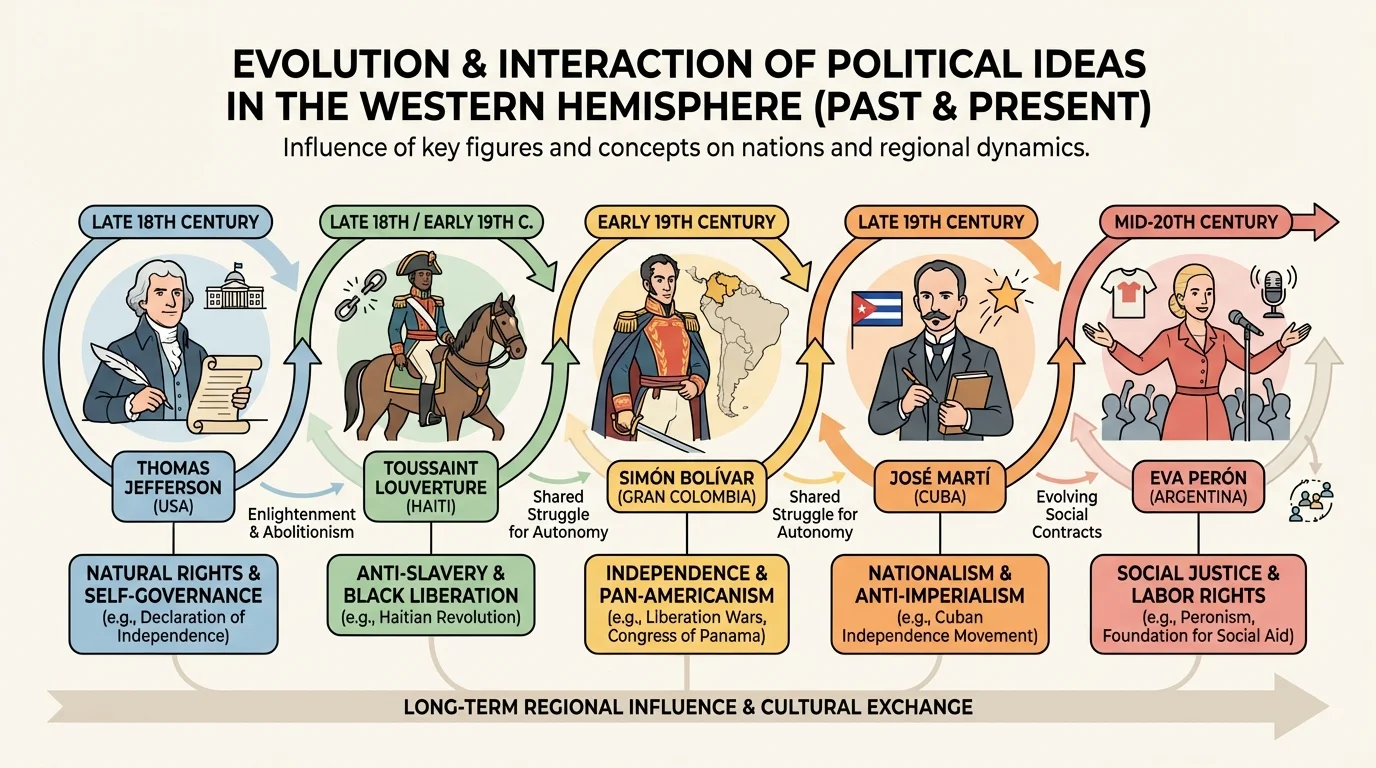
Simón Bolívar became one of the most important leaders in South American independence movements. He helped free several countries from Spanish rule, including Venezuela, Colombia, Ecuador, Peru, and Bolivia. Bolívar believed in independence and republican government, but he also worried that new nations might become unstable without strong leadership. His ideas reveal an important tension: people may want freedom from empire while still disagreeing about how much power a central government should have.
José Martí of Cuba wrote passionately about independence, national identity, and freedom from foreign control. He believed citizens should build a nation based on dignity and justice. His writing connected ideas about liberty with pride in Latin American culture and resistance to domination by stronger powers.
Eva Perón in Argentina became influential in a different way. She spoke for workers and poor citizens and supported women's political participation, including women's suffrage in Argentina. Her influence reminds us that political ideas are not only about independence from empire. They are also about how citizens are treated inside a country and whether all groups are included in public life.
These leaders did not all agree. Some focused on independence, some on anti-slavery, some on social welfare, and some on national identity. Yet they were interconnected because each responded to big political questions about power, rights, and the role of ordinary people in government. Looking back at [Figure 2], we can trace how later leaders built on earlier struggles instead of starting from nothing.
"The end of all political association is the preservation of the natural rights of man."
— From the era of Atlantic revolutions
This kind of statement mattered across the hemisphere because many people asked a follow-up question: Whose rights? Political change often happened when excluded groups insisted that the promises of freedom and equality must apply to them as well.
Important people matter, but social movements and organized groups often create the strongest long-term change. A social movement is a large effort by many people to bring political or social change. In the Western Hemisphere, many different groups have fought to expand rights and participation.
Indigenous peoples have defended land, culture, and self-government for centuries. In countries such as Bolivia, Guatemala, Mexico, and Canada, Indigenous groups have worked to protect languages, gain political recognition, and influence national laws. Their political ideas often emphasize community, shared responsibility, and respect for ancestral land. These ideas sometimes challenge governments that are built mostly on European traditions.
Enslaved and formerly enslaved people were also powerful political actors. Their resistance shaped abolition movements throughout the hemisphere. The fight against slavery was not only about personal freedom. It also challenged systems that gave legal and political power to some people while denying humanity to others.
Women's movements pushed for voting rights, access to education, fair laws, and greater representation. In many countries of the hemisphere, women won suffrage only after long campaigns. This shows that democratic ideas often expand step by step as more citizens demand inclusion.
Labor unions and worker organizations fought for safer workplaces, fair pay, and better treatment. These groups influenced politics in countries such as Mexico, Argentina, Chile, and the United States. They often supported laws about working hours, pensions, and public benefits. Their work connected political ideas to everyday life, because government decisions affected jobs, food prices, housing, and family security.
Civil rights groups challenged racial discrimination and unequal treatment. In the United States, the Civil Rights Movement fought segregation and barriers to voting. In other parts of the hemisphere, groups have also fought racism, police abuse, and unequal access to education or justice. These efforts show that civic participation includes marches, petitions, court cases, speeches, and organizing communities—not only voting.
Some of the most important political changes in the Americas began with people who were denied power by law. Enslaved people, women, workers, and Indigenous communities often changed governments by demanding that nations live up to their own promises.
Groups can influence nations even when they do not control the government. By protesting, publishing arguments, building coalitions, and persuading the public, they can pressure leaders to change laws. This is a major part of civic life in democratic systems.
Citizens do not participate in the same way everywhere. The type of government affects what people can do, as [Figure 3] makes clear when comparing democratic and authoritarian systems. In a strong democracy, citizens usually have the right to vote, criticize leaders, join political parties, and receive information from a free press. In an authoritarian system, these rights may be limited or controlled.
Many countries in the Western Hemisphere are constitutional democracies or republics. They often have written constitutions, elections, and separate branches of government. In these systems, civic participation can include voting, campaigning, contacting elected officials, attending public meetings, volunteering, and joining interest groups.
However, not every nation in the hemisphere has always protected these freedoms. Some countries have experienced dictatorships or military governments. Under those conditions, elections may be unfair, newspapers may be censored, and protest may be dangerous. Citizens may still participate, but often at greater risk.
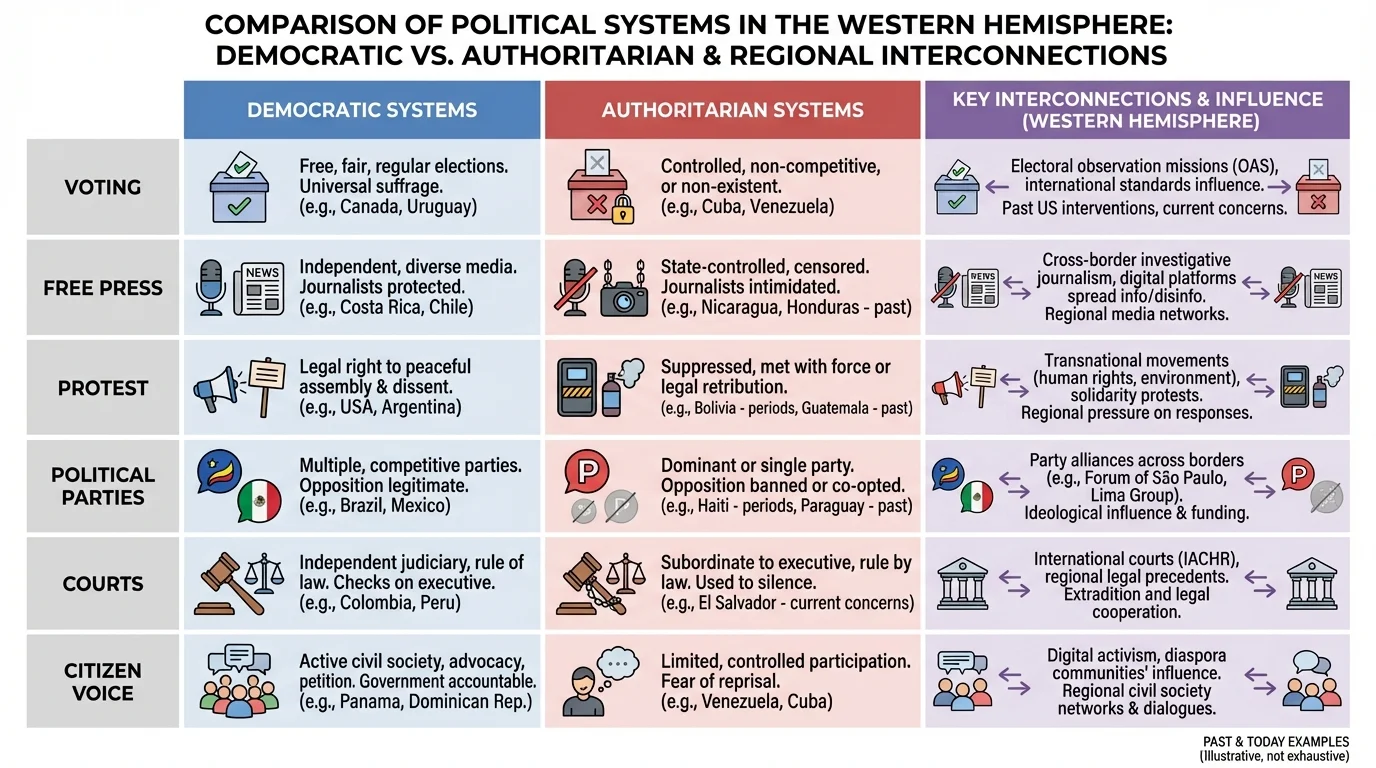
This difference matters because political ideas and government systems shape one another. If a government believes citizens should actively guide public life, it will likely protect participation. If rulers fear losing power, they may limit participation. So, civic participation is both a right and a sign of how open a government is.
For example, in countries with free elections, people can remove leaders by voting. In more authoritarian systems, change may happen through protest, outside pressure, or internal conflict instead. The comparison in [Figure 3] helps us see why the same political idea, such as liberty, may lead to very different realities depending on the system of government.
| Government feature | More democratic systems | More authoritarian systems |
|---|---|---|
| Voting | Regular, competitive elections | Limited, controlled, or unfair elections |
| Free press | News can criticize leaders | Media is censored or controlled |
| Protest | Usually legally protected | Often restricted or punished |
| Political parties | Multiple parties compete | One party or tightly controlled parties |
| Citizen voice | Broader participation in public life | Narrow participation, power held by few |
Table 1. Comparison of civic participation in more democratic and more authoritarian systems in the Western Hemisphere.
Even within democracies, civic participation is not always equal. Some citizens may face barriers because of poverty, discrimination, geography, or misinformation. That is why debates over voting rights, media freedom, and fair representation continue today.
Many current political debates in the Western Hemisphere have deep historical roots. Questions about who counts as a full citizen, who has access to power, and how much authority a government should have did not disappear after independence movements ended. They continue today in debates over immigration, Indigenous rights, racial justice, corruption, and economic inequality.
In some countries, citizens argue over whether governments should provide more social services, such as health care and education, or keep government smaller. In others, people debate how to balance public safety with individual rights. These disagreements are normal in political life because different groups value ideas like order, liberty, equality, and tradition in different ways.
Young people are part of this story too. Even before they can vote, they can learn, discuss issues, evaluate information, and participate in community life. Civic participation begins with understanding how systems work and how ideas influence decisions. Knowing the past helps people recognize why current conflicts exist.
Case study: Voting rights and expanding democracy
One pattern across the hemisphere is that voting rights often widened over time rather than appearing all at once.
Step 1: Early governments often limited voting to a small group, such as property-owning men.
Step 2: Excluded groups, including workers, women, Indigenous people, and racial minorities, organized and demanded inclusion.
Step 3: Laws changed in many countries, allowing more citizens to participate.
This example shows that democratic ideals become stronger when citizens push governments to match their principles.
When people protest corruption, defend a free press, or call for fair elections today, they are continuing a long tradition in the Western Hemisphere. Their actions connect to earlier struggles for independence, abolition, suffrage, and civil rights.
The nations of the Western Hemisphere do not exist in isolation. They influence one another through trade, migration, diplomacy, international organizations, sports, and culture. Political ideas spread in all of these ways. A court ruling in one country may be discussed in another. An election outcome in one region may affect neighboring countries. A human-rights movement can inspire activists far away.
Regional organizations also reflect political ideas. Groups of nations sometimes work together to support democracy, solve disputes, or respond to crises. At the same time, nations may disagree about how much outside influence is acceptable. Some emphasize cooperation; others stress national sovereignty and independence.
This makes the hemisphere a web of connections. The ideas of liberty, equality, representation, and justice move across that web, but so do ideas about strong leadership, nationalism, and state control. Sometimes these ideas support one another, and sometimes they clash. Understanding politics in the hemisphere means noticing both patterns: connection and difference.
Government systems are more than names on a chart. What matters is how power is used, whether rights are protected, and how citizens participate. Two countries may both call themselves republics, but their civic life can be very different.
When we study significant people and groups in the Western Hemisphere, we see that nations are shaped by constant interaction. Leaders influence movements. Movements influence laws. One country's revolution inspires another country's reform. Old ideas appear again in new forms. That is why the past is still alive in today's debates about citizenship, rights, and power.
