Who gets to shape a country's rules? At many moments in history, the answer seemed to be "only a few people." But the real story of the Western Hemisphere is much bigger. Across North, Central, and South America and the Caribbean, people from many backgrounds spoke out when laws were unfair, when land was taken, when workers were mistreated, or when communities were excluded. Their actions helped change schools, voting rights, labor rules, immigration policies, and even international discussions about human rights.
In civics, people study how citizens and communities participate in public life. That includes voting, joining organizations, speaking at meetings, protesting, writing newspapers, going to court, and working together to persuade leaders. Different groups often saw the same policy very differently. A law that helped one group could harm another. Because of that, history is not only about what governments decided. It is also about how ordinary people reacted and pushed back.
Civic participation is the way people take part in public life to improve their communities or influence government decisions. A policy is a plan, law, or rule made by a government or other authority. Rights are freedoms and protections that people should have.
When we study diverse communities, we learn that people did not simply accept every decision made by leaders. They formed alliances, challenged unfair treatment, and created new ideas about justice. Some worked within government systems by voting and holding office. Others used marches, strikes, speeches, petitions, and court cases. Many did both.
People's views are shaped by their experiences. A farmer, a factory worker, a tribal leader, a student, and a business owner may all think differently about the same issue. In the Western Hemisphere, questions about land, labor, race, language, citizenship, and power have often divided societies. Hearing many voices helps citizens better understand what is fair and what should change.
Governments in the Western Hemisphere also differ. Some countries have federal systems, where power is shared between national and local governments. Others are more centralized. But in all of them, civic participation matters. Communities can influence school rules, city decisions, court rulings, national laws, and even international agreements. The examples below show that people from diverse backgrounds were not only affected by policy. They also influenced it.
Sovereignty means the right of a people or nation to govern itself. [Figure 1] For Indigenous peoples, this idea has been extremely important through land-based struggles across the Western Hemisphere. Native nations and communities often viewed government policies through the lens of survival: Would this law protect their land, language, and traditions, or would it take them away?
In the United States, many Indigenous nations signed treaties with the federal government. These treaties were supposed to be binding agreements, but they were often broken. During the 1800s, policies such as Indian removal forced communities from their homelands. The Cherokee, Muscogee, Choctaw, Chickasaw, and Seminole were among the nations affected. The Cherokee removal route became known as the Trail of Tears. Indigenous peoples perceived these policies not as progress, but as injustice and dispossession.
Indigenous communities reacted in many ways. Some used diplomacy and legal arguments. Some resisted militarily. Others focused on preserving culture and rebuilding community life after forced movement. Throughout the 1900s, especially in the 1960s and 1970s, Native activism grew stronger in public view. Groups such as the American Indian Movement protested broken treaties, poor living conditions, and lack of respect for tribal self-rule.
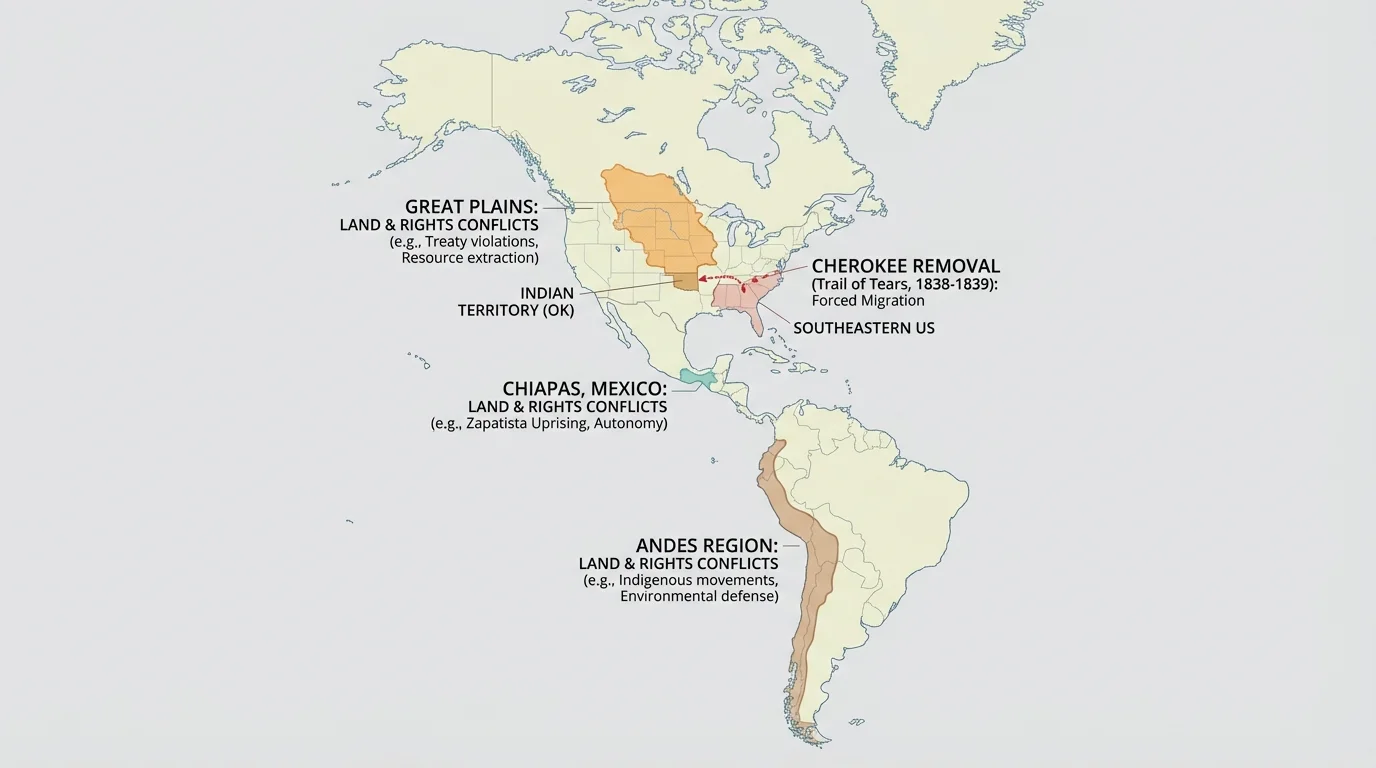
These movements influenced policy. In the United States, the Indian Self-Determination and Education Assistance Act of 1975 gave tribes more control over programs affecting their communities. That did not solve every problem, but it showed that organized civic action could change government practice. Later, Indigenous activists also helped shape international thinking about human rights and Indigenous rights.
In Mexico, Indigenous communities also demanded greater respect. In 1994, the Zapatista movement in Chiapas drew attention to poverty, inequality, and Indigenous rights. Although this movement began after many earlier struggles, it showed a familiar pattern: communities spoke out because national policies did not seem to protect them. In the Andes, Indigenous people in countries such as Bolivia and Ecuador organized politically for land rights, language recognition, and stronger representation in government. Their activism influenced constitutions, elections, and debates over natural resources.
As we see again later in the lesson, [Figure 1] connects places that are far apart but share common issues: land, self-government, and respect. Indigenous peoples did not all react in the same way, yet many insisted that policy should not erase their identity.
Many countries in the Western Hemisphere now recognize Indigenous languages or cultural rights in law, but those changes happened only after long struggles by communities demanding to be heard.
These examples remind us that civic participation is not only about elections. It can include defending treaty rights, preserving language, challenging land seizures, and insisting that governments honor agreements.
[Figure 2] The history of African Americans in the United States is a long struggle against slavery, discrimination, and unequal treatment under the law across major turning points. African Americans often perceived national policies by asking a direct question: Does this nation live up to its promise of liberty and equality?
During slavery, enslaved African Americans resisted in both open and hidden ways. Some escaped, some rebelled, some preserved family and culture under terrible conditions, and many supported abolition, the movement to end slavery. Abolitionists such as Frederick Douglass and Sojourner Truth used speeches and writing to influence public opinion. Harriet Tubman helped enslaved people escape through the Underground Railroad. Their actions shaped national debate before and during the Civil War.
After slavery ended, the Reconstruction era brought major constitutional changes, including the 13th, 14th, and 15th Amendments. These measures ended slavery, defined citizenship, and aimed to protect voting rights. But many Southern states later created segregation laws, often called Jim Crow laws, that kept African Americans separated and unequal in schools, transportation, housing, and public life.
African Americans reacted with determination. Journalists such as Ida B. Wells exposed lynching. Organizations such as the NAACP challenged segregation in court. Teachers, students, ministers, veterans, and ordinary families all participated. During the modern Civil Rights Movement, leaders such as Martin Luther King Jr., Rosa Parks, Fannie Lou Hamer, and many others used boycotts, marches, speeches, and voter registration drives to pressure the government.
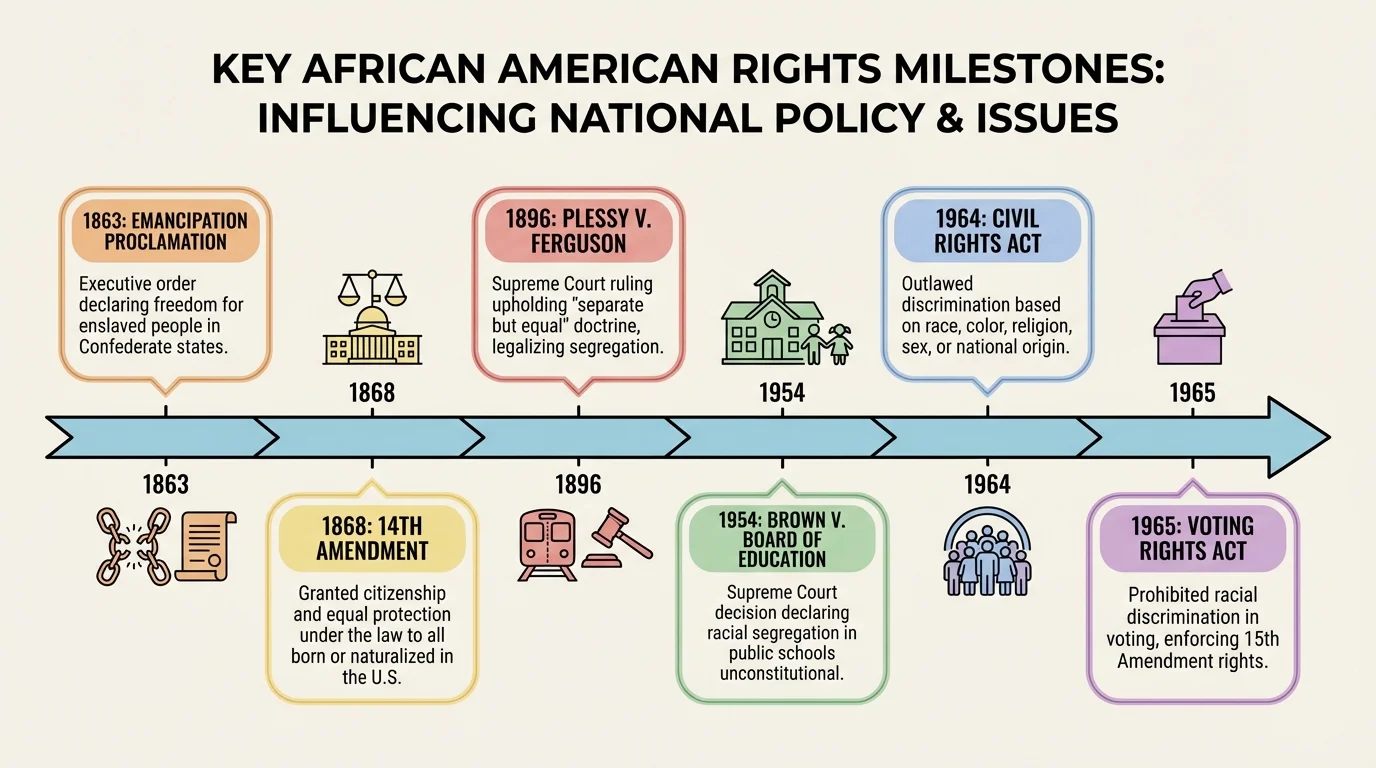
These efforts changed national policy. The Supreme Court decision in Brown v. Board of Education in 1954 declared school segregation unconstitutional. The Civil Rights Act of 1964 outlawed many forms of discrimination. The Voting Rights Act of 1965 protected voting rights. These were not gifts from leaders alone. They were influenced by years of organized civic participation.
African American activism also influenced international issues. During the Cold War, the United States wanted to present itself as a defender of freedom. Civil rights activists pointed out the contradiction between that image and racial discrimination at home. Their criticism mattered globally because other nations were watching. In this way, local protests in cities and towns also became part of international discussions about democracy and human rights.
"Injustice anywhere is a threat to justice everywhere."
— Martin Luther King Jr.
Later, the ideas seen in [Figure 2] continued into new movements for fair housing, criminal justice reform, and equal opportunity. The pattern is clear: people saw injustice, organized, and pushed the nation to change its laws.
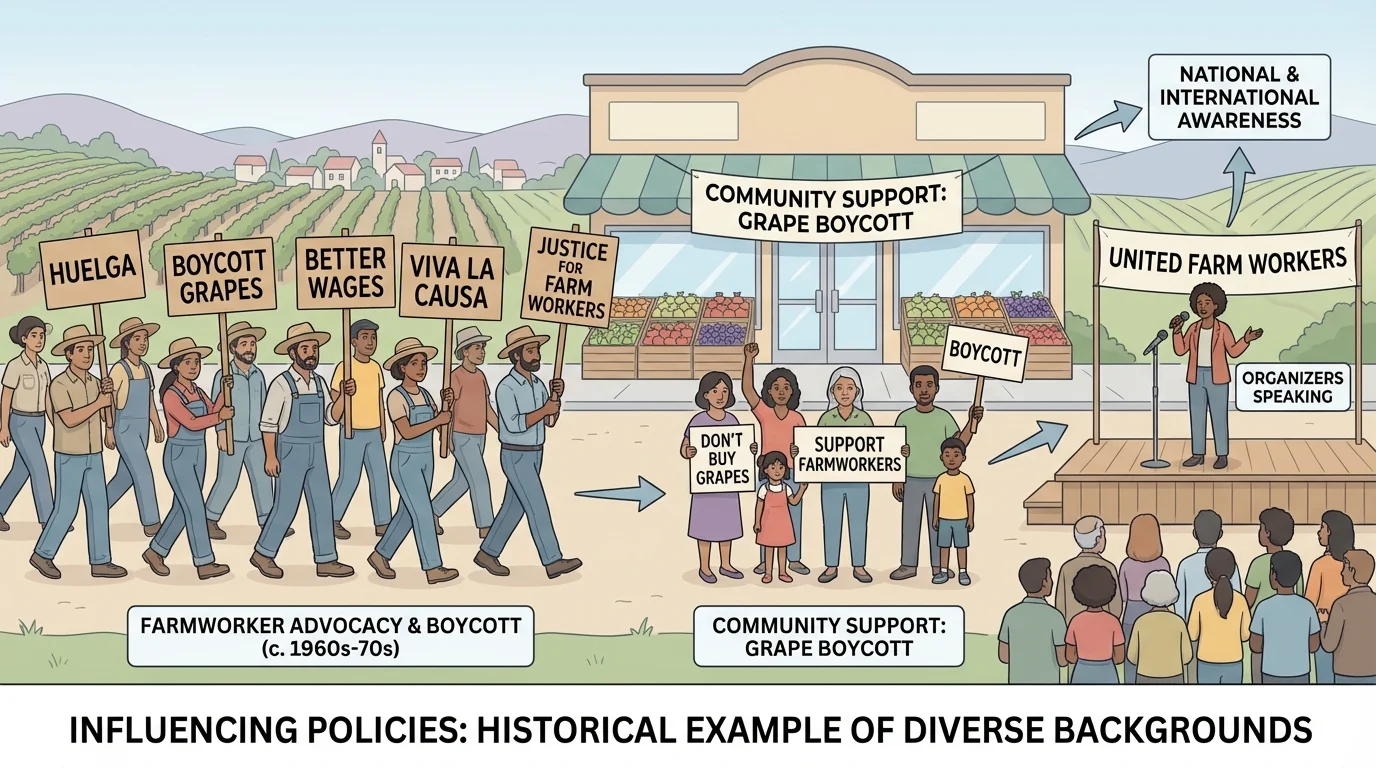
Boycott is a powerful civic tool in which people refuse to buy or use something in order to force change. [Figure 3] Latino communities across the Americas and within the United States used this and many other methods to respond to unfair treatment. Their concerns often involved labor, education, language, citizenship, and immigration.
Mexican Americans in the United States faced discrimination in schools, housing, and jobs. In the 1940s, the Mendez family challenged school segregation in California. The case Mendez v. Westminster helped end segregation of Mexican American students in several California school districts and influenced later school equality cases.
Farmworkers, many of them Mexican American and Filipino, faced low pay and difficult working conditions. Leaders such as César Chávez and Dolores Huerta helped organize the United Farm Workers. They believed workers deserved dignity, safety, and fair wages. Through strikes, marches, and consumer pressure, they influenced public attention and labor policy, as [Figure 3] shows in the farmworker movement.
One famous strategy was the grape boycott of the 1960s and 1970s. Consumers across the country were asked not to buy grapes until growers negotiated with workers. This linked ordinary shoppers to labor rights. It also showed that people without government office could still affect national policy debates by organizing peacefully and persistently.
Puerto Rican activists also raised important questions about citizenship, migration, and economic opportunity. Puerto Ricans are U.S. citizens, yet many communities faced poverty and discrimination. Leaders and community groups pushed for better schools, jobs, and housing. Across Latin America, labor and Indigenous movements often overlapped, especially where land use and economic inequality were major concerns.
Immigration became another major policy issue. Latino communities did not all agree on every immigration question, but many argued that laws should respect family unity, worker rights, and human dignity. Civic participation included marches, legal advocacy, student activism, and voter outreach. These efforts influenced debates at city, state, and national levels.
Case study: The grape boycott
This example shows how a community can influence policy even without holding government office.
Step 1: Identify the problem
Farmworkers labored in harsh conditions for low pay and had little power when dealing with growers.
Step 2: Organize people
Workers formed unions, held meetings, marched, and asked supporters to join their cause.
Step 3: Use civic action
Consumers joined a boycott by refusing to buy grapes. This created economic pressure on growers.
Step 4: Influence policy and public opinion
The movement helped win contracts and increased national attention to labor rights, showing that organized people can push institutions to change.
When we think back to [Figure 3], the marchers represent more than one protest. They show a larger idea: civic participation can connect workers, families, churches, students, and consumers into one movement.
[Figure 4] The term exclusion refers to keeping people out or denying them full participation. Asian American history in the Western Hemisphere includes many examples of both unfair exclusion and powerful resistance through different policies and later responses.
In the United States, Chinese immigrants helped build railroads and worked in mining, agriculture, and businesses. Yet anti-Chinese prejudice grew. The Chinese Exclusion Act of 1882 restricted Chinese immigration and made life harder for Chinese communities. This was one of the clearest examples of national policy based on race and nationality. Chinese Americans and their allies challenged these ideas through legal cases, community organizations, and journalism.
During World War II, after Japan attacked Pearl Harbor, the U.S. government incarcerated many Japanese Americans in camps. About two-thirds were U.S. citizens. The government claimed national security, but the policy was driven largely by fear and racism. Japanese Americans reacted with resilience, legal resistance, military service, and later campaigns for justice.
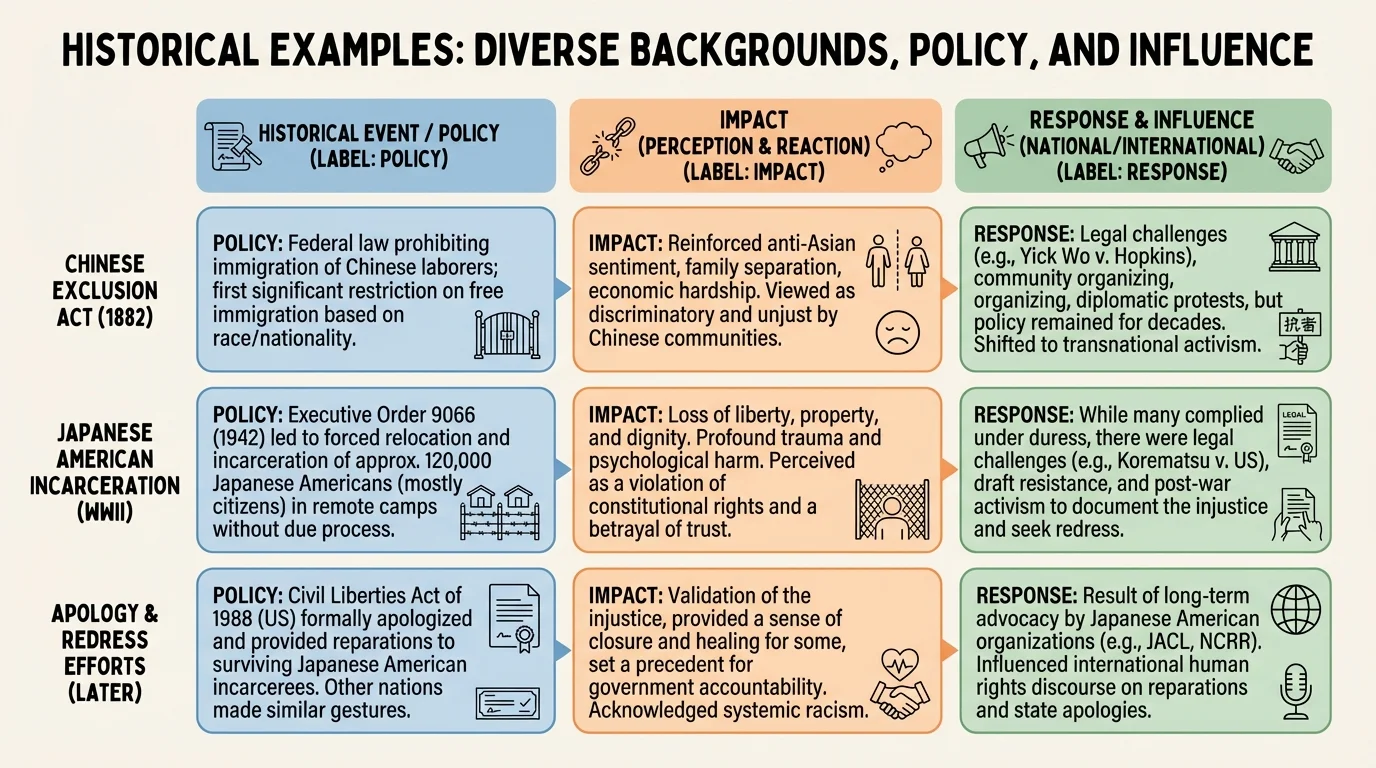
Decades later, Japanese American activists won an official apology and redress through the Civil Liberties Act of 1988. This showed that communities can continue seeking justice long after the original harm. It also reminded the nation that fear should not override constitutional rights.
Filipino workers were also important in labor activism, especially in agriculture. Larry Itliong and Filipino farmworkers played a major role in the Delano grape strike, joining with Mexican American workers. This is an excellent example of cooperation across communities. Different groups sometimes had different histories, but they could unite around shared goals.
The comparison in [Figure 4] makes an important point: a government policy can deny rights in one era, and later public action can force that same government to admit its mistake. That is a major lesson in civics.
Activism means organized action to bring about social or political change. One of the most important ideas in this topic is that change often starts locally. A school protest, a community newspaper, a tribal council decision, a labor strike, or a neighborhood meeting can grow into a national movement.
Different methods worked in different situations. Court cases were useful when communities challenged unfair laws. Marches and boycotts drew public attention. Voting and running for office helped communities gain direct influence. Newspapers, radio, television, and later digital media helped local stories travel farther. When many people heard about injustice, leaders were more likely to respond.
How civic participation changes policy
Public pressure can change policy in several ways. It can persuade lawmakers to pass new laws, push judges to reconsider old legal rules, influence elections, and shift public opinion. Sometimes change happens quickly after a major protest or court case. Other times it takes many years of steady effort.
These movements also affected international ideas. Civil rights in the United States influenced human rights conversations around the world. Indigenous rights movements helped shape international declarations. Labor struggles raised questions about fair treatment across borders. Migration issues connected countries because policies in one nation often affected families in another.
For example, when African American leaders criticized segregation, other countries noticed. When Indigenous activists demanded recognition, international organizations listened. When Latino and Asian American workers joined labor campaigns, they highlighted global questions about wages and dignity. The Western Hemisphere is connected, so ideas and movements often cross borders.
Although African American, Latino, Asian American, and Indigenous communities had different histories, some patterns appear again and again. First, many perceived policies by asking whether those policies protected or harmed their communities. Second, they reacted through organized action rather than silence. Third, their efforts influenced laws, court decisions, and public understanding.
There were also differences. Indigenous activism often centered on land, treaties, and self-government. African American activism strongly challenged slavery, segregation, and voting restrictions. Latino activism often focused on labor, education, discrimination, and immigration. Asian American activism often responded to exclusion, incarceration, and unequal citizenship treatment. These categories can overlap, but they help us compare how different issues shaped different movements.
| Group | Major Concerns | Common Reactions | Examples of Influence |
|---|---|---|---|
| Indigenous Peoples | Land, treaties, self-government, culture | Diplomacy, protest, legal action, community organizing | Greater tribal control, recognition of rights, international attention |
| African Americans | Slavery, segregation, voting rights, equal protection | Abolition, boycotts, marches, court cases, voting drives | Civil rights laws, voting protections, desegregation |
| Latino Communities | Labor rights, school equality, immigration, housing | Strikes, boycotts, lawsuits, marches, voter outreach | Labor contracts, school desegregation changes, policy debate |
| Asian Americans | Exclusion, incarceration, discrimination, labor rights | Legal challenges, organizing, coalition building, redress campaigns | Apologies, compensation, broader civil rights protections |
Table 1. Comparison of major concerns, reactions, and policy influence among several communities in the Western Hemisphere.
Another important similarity is coalition building. Communities often worked with allies from different backgrounds. Churches, unions, students, lawyers, journalists, and neighborhood groups supported many of these efforts. Democracy works best when people listen to one another and act together.
Historians learn about these events by studying primary sources and secondary sources. A primary source is something created at the time of an event, such as a speech, photograph, letter, law, diary, poster, or newspaper article. A secondary source is something written later to explain the past, such as a textbook or history article.
For this topic, a primary source might be a civil rights speech, a farmworker protest sign, a treaty, a court opinion, or a letter from an incarceration camp. A secondary source might be a historian's book explaining what happened and why. Both types matter. Primary sources help us hear voices from the past. Secondary sources help us connect many pieces of evidence into a bigger story.
When reading any source, ask who created it, when it was made, what point of view it shows, and what information might be missing. These questions help you judge evidence carefully.
Studying many sources helps us avoid a one-sided view. It reminds us that national and international policies affected real people, and that those people often fought hard to be included in decisions that shaped their lives.
