A decision made in one country can affect millions of people far beyond its borders. A law about immigration in the United States can shape families in Mexico and Canada. A vote about protecting the Amazon rainforest can matter to people across the entire world. A hurricane in the Caribbean can quickly become a political issue about safety, money, and international help. Politics is not only about leaders in capitals. It is about how people live, what rights they have, and how they try to make change happen.
A political issue is a public question about power, laws, rights, resources, or government decisions. Political issues matter because governments make choices that affect schools, jobs, health, safety, land, and freedom. Some issues stay important for a long time, while others rise quickly because of a crisis or major event.
In the Western Hemisphere, which includes North America, South America, and the Caribbean, political issues have been shaped by colonization, independence, slavery, migration, trade, war, environmental problems, and struggles for rights. To understand these issues clearly, students need to look at them from more than one angle. A country may see a problem as a national matter, while the rest of the world may see the same problem as a global one.
National perspective means looking at an issue from the point of view of one country and its needs, laws, and people.
Global perspective means looking at an issue from the point of view of many countries and the wider world.
Civic participation is the way people take part in public life, such as voting, protesting, volunteering, contacting leaders, or joining community groups.
Political issues are often connected to the type of government a country has. In a democracy, citizens usually have more legal ways to speak out, vote, and organize. In an authoritarian system, leaders may limit speech, elections, or protests. This affects how people can respond to political problems.
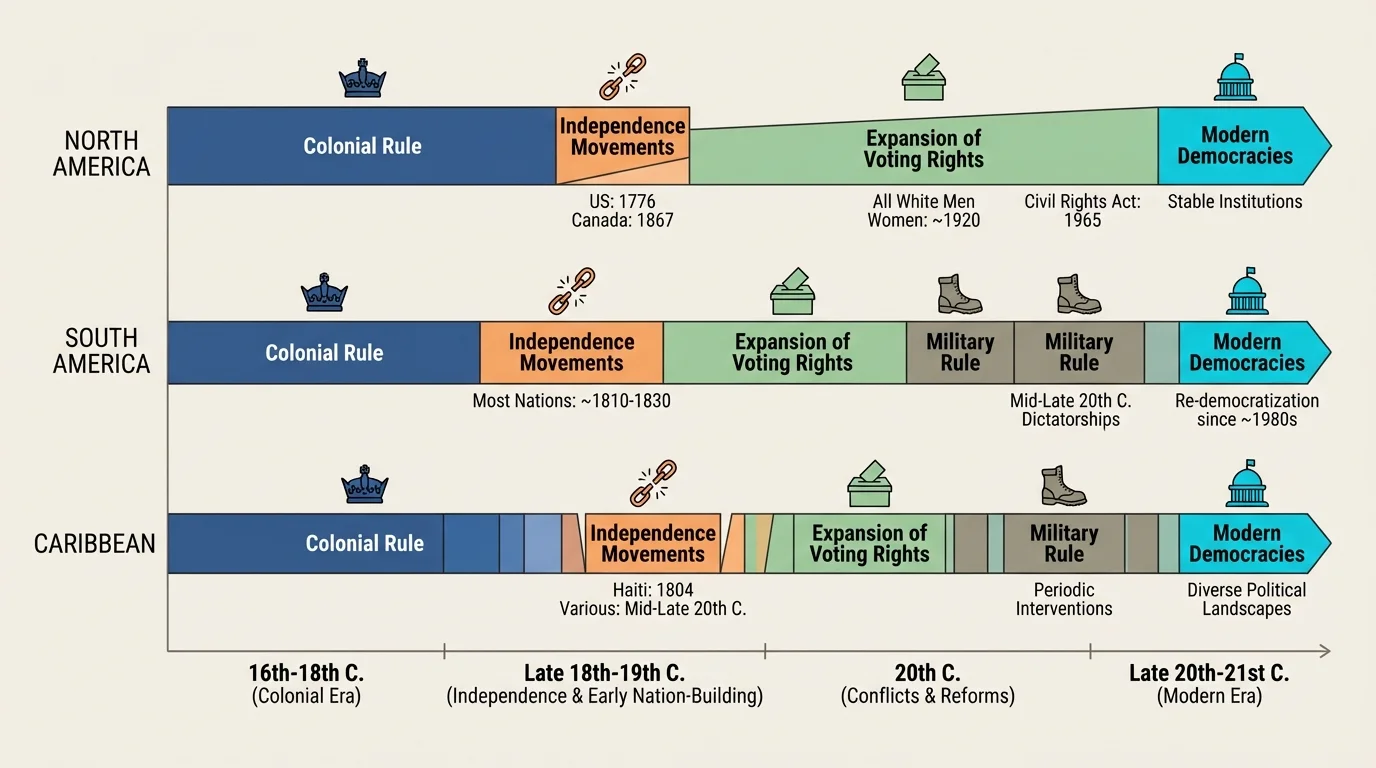
When historians and civics students study politics, they ask how issues change over time, as [Figure 1] shows through major turning points across the Americas. Some struggles, such as demands for fair treatment and equal rights, appear again and again in different centuries. Other issues grow from new inventions, new trade systems, or new environmental challenges.
Looking over time helps us notice continuity and change. Continuity means some things stay the same. Change means some things become different. For example, many countries in the Americas moved from colonial rule to independence, but after independence they still faced questions about who could vote, who held power, and whose voices were ignored.
Cause and effect also matter. A revolution can cause a new government. A war can lead to new borders. An economic crisis can cause protests. A natural disaster can push leaders to ask for international help. Political issues do not appear out of nowhere. They grow from events, choices, and conflicts.
Primary and secondary sources help people study political change. A primary source is a record from the time being studied, such as a speech, a law, a letter, or a newspaper from that period. A secondary source is something created later, such as a textbook or documentary that explains the past. Both types can help students understand political issues more deeply.
North America includes Canada, the United States, Mexico, and countries nearby, and many of its political issues cross borders, as [Figure 2] illustrates through migration routes and shared regional concerns. Even when each nation has its own laws, the countries influence one another through trade, culture, travel, and international agreements.
In the United States, major political issues over time have included voting rights, civil rights, immigration, the role of the federal government, and the rights of Indigenous peoples. For many years, not all groups could vote equally. Women gained voting rights nationally in the early twentieth century. African Americans fought against laws and practices that limited their rights. The Civil Rights Movement showed how protests, court cases, speeches, and organized action can shape a country.
Canada has faced important political issues involving bilingualism, Indigenous rights, self-government, and the relationship between the provinces and the national government. Some First Nations, Inuit, and Métis communities have called for justice, land rights, and recognition after years of harmful government policies. Canada is also a constitutional monarchy with a parliamentary system, which means its government works differently from the presidential system in the United States and Mexico.
Mexico has experienced political struggles over land, fairness, corruption, and economic opportunity. The Mexican Revolution in the early twentieth century challenged inequality and dictatorship. In more recent years, migration, trade with the United States and Canada, and violence connected to criminal groups have all become major political issues.
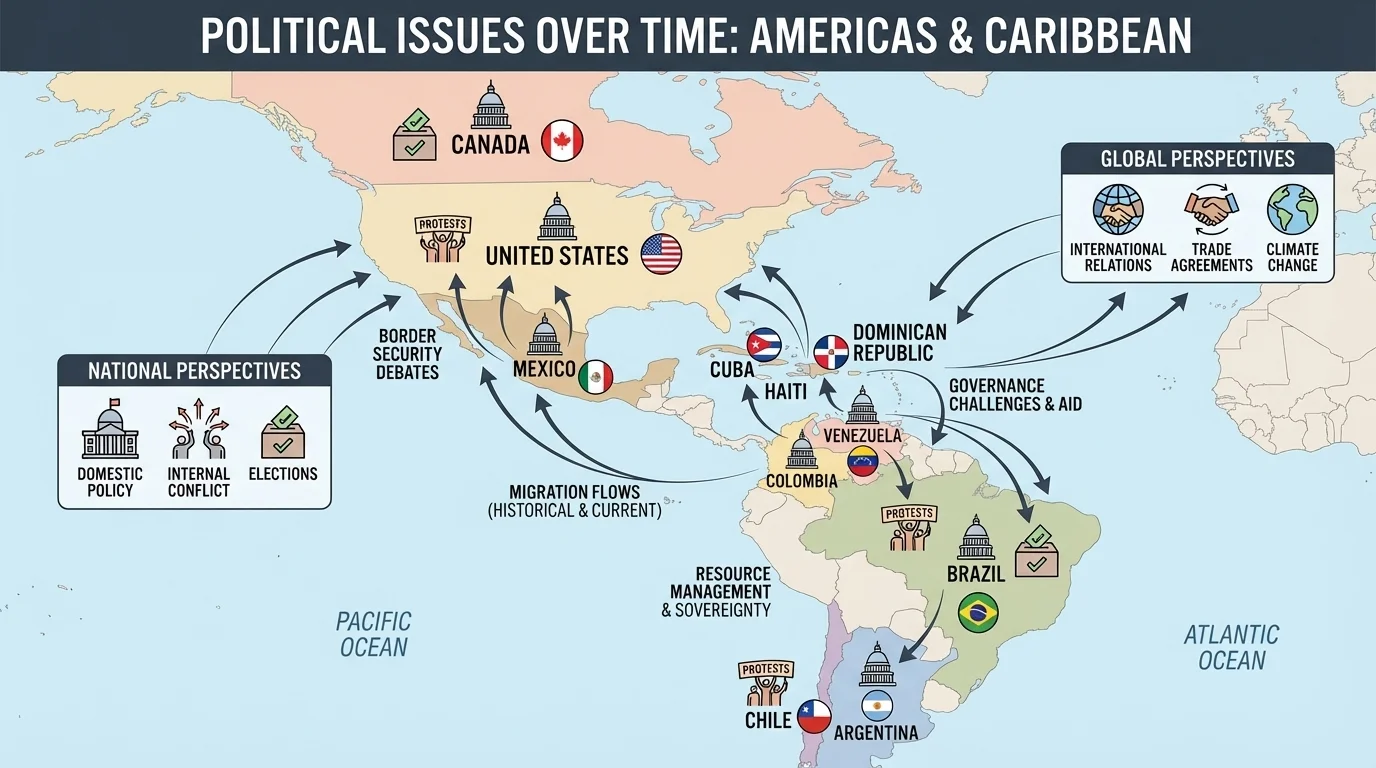
Migration is a strong example of national and global perspectives. A national perspective may focus on border laws, jobs, and security. A global perspective may focus on human rights, family connections, refugee safety, and economic causes that push people to move. As seen again in [Figure 2], migration links countries rather than keeping their political questions separate.
Case study: Voting rights in the United States
Step 1: Identify the issue.
Who gets to vote is a political issue because voting gives people a voice in government.
Step 2: Look over time.
At first, voting was limited to fewer groups. Over time, laws and amendments expanded voting rights.
Step 3: Compare perspectives.
Nationally, the issue concerns fair elections and representation. Globally, many people see voting rights as part of human rights and democracy.
Step 4: Notice civic participation.
People marched, gave speeches, filed court cases, and pushed leaders to change unfair systems.
This example shows that political issues are not just arguments between leaders. They often involve ordinary citizens who organize and demand change.
South America has a long history of colonial rule, independence movements, democratic hopes, and periods of dictatorship. Countries such as Brazil, Argentina, Chile, Venezuela, Colombia, Peru, and others each have their own history, but many also share regional patterns.
Land, natural resources, and wealth have shaped many South American political issues, and [Figure 3] highlights how geography and resources connect politics across the continent. In some places, a small group controlled much of the land and power. In other places, workers and farmers pushed for reform. Debates over oil, mining, farming, and forests still affect politics today.
During the nineteenth century, many South American colonies fought for independence from Spain or Portugal. Leaders such as Simon Bolivar became important figures in these struggles. Independence brought freedom from colonial rulers, but it did not solve every problem. New countries still had to build governments, write constitutions, and decide how much power different groups should have.
In the twentieth century, some South American countries experienced military rule. In these periods, the military or strong leaders sometimes took control, limited freedoms, and punished opposition. Later, many countries returned to democracy. This history helps explain why many people today care deeply about free elections, freedom of speech, and protection from abuse of power.
The Amazon rainforest is a strong example of a political issue with both national and global perspectives. Countries such as Brazil may focus on jobs, land use, farming, and national development. The global perspective includes climate, biodiversity, and the idea that damage to the rainforest affects the whole planet. This is why leaders, scientists, Indigenous communities, and international groups often disagree about what should happen there.
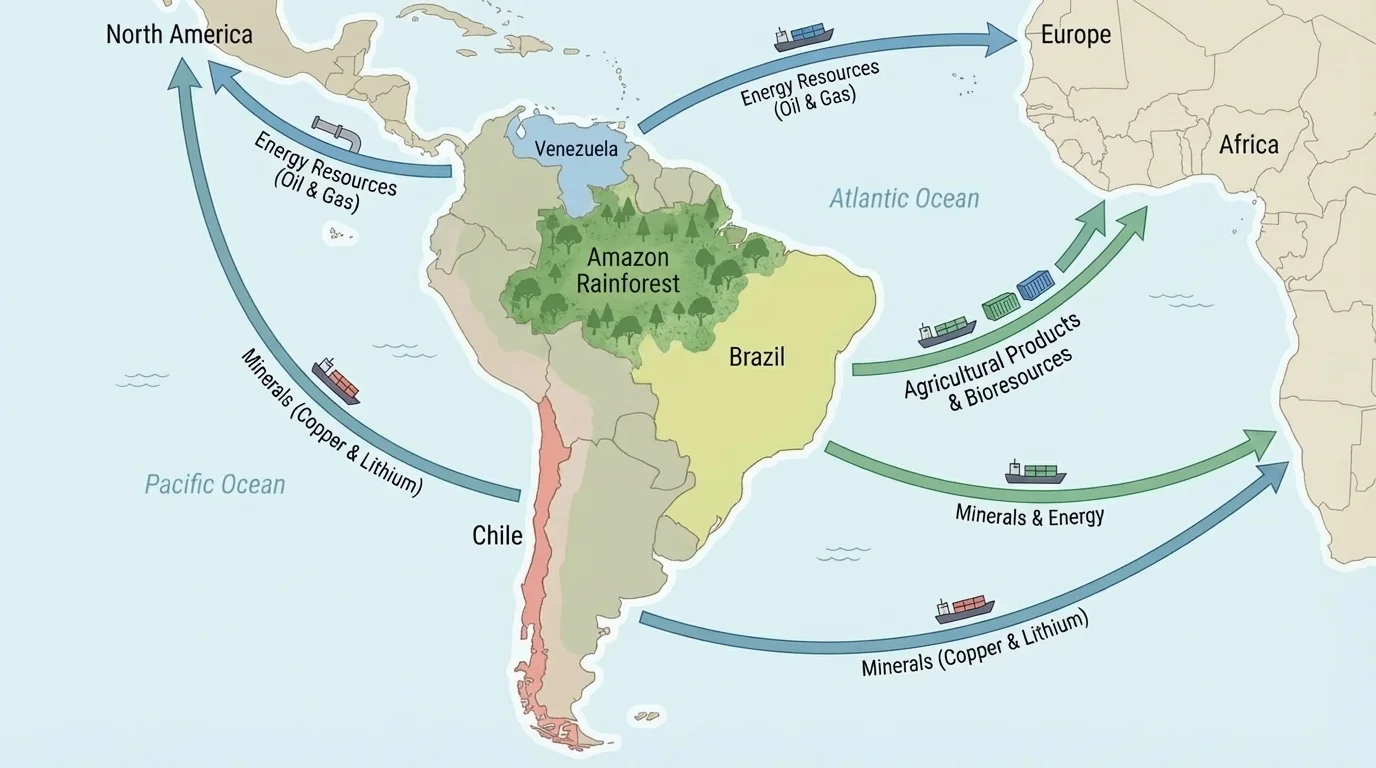
Trade also connects South America to the world. If a country exports oil, copper, soybeans, or other resources, foreign demand can shape its politics. A fall in world prices can create economic stress at home. A rise in demand can increase wealth but may also cause conflict over land and the environment.
The Amazon rainforest spreads across several countries, not just one. That means political decisions made in one part of the region can affect people, plants, animals, and climate far beyond that country's borders.
South America also shows how citizens participate in different ways. People vote, join political parties, organize labor unions, march in streets, and use the media to share opinions. In some times and places, these actions have been encouraged; in others, they have been restricted.
The Caribbean may look like a group of small islands on a map, but it has played a huge role in world politics. Geography shapes many of its political issues, as [Figure 4] shows with islands, migration routes, and hurricane paths. Caribbean nations have often faced questions about colonial power, independence, trade, tourism, migration, and disaster response.
Many Caribbean islands were once colonies controlled by European empires. Because of this history, the region was deeply shaped by slavery, plantation economies, and struggles for freedom. The Haitian Revolution was one of the most important political events in world history because enslaved people successfully fought for independence and created Haiti. This event frightened slaveholding societies elsewhere and inspired freedom movements.
Cuba provides another major example. The Cuban Revolution changed the country's government and its relationship with the United States. During the Cold War, Cuba became part of a global conflict between the United States and the Soviet Union. The Cuban Missile Crisis showed how a political issue in the Caribbean could threaten the whole world.
Puerto Rico has a different political story because it is a territory of the United States rather than an independent nation. People debate what status Puerto Rico should have in the future. This shows how political identity, citizenship, and representation can become long-term issues.
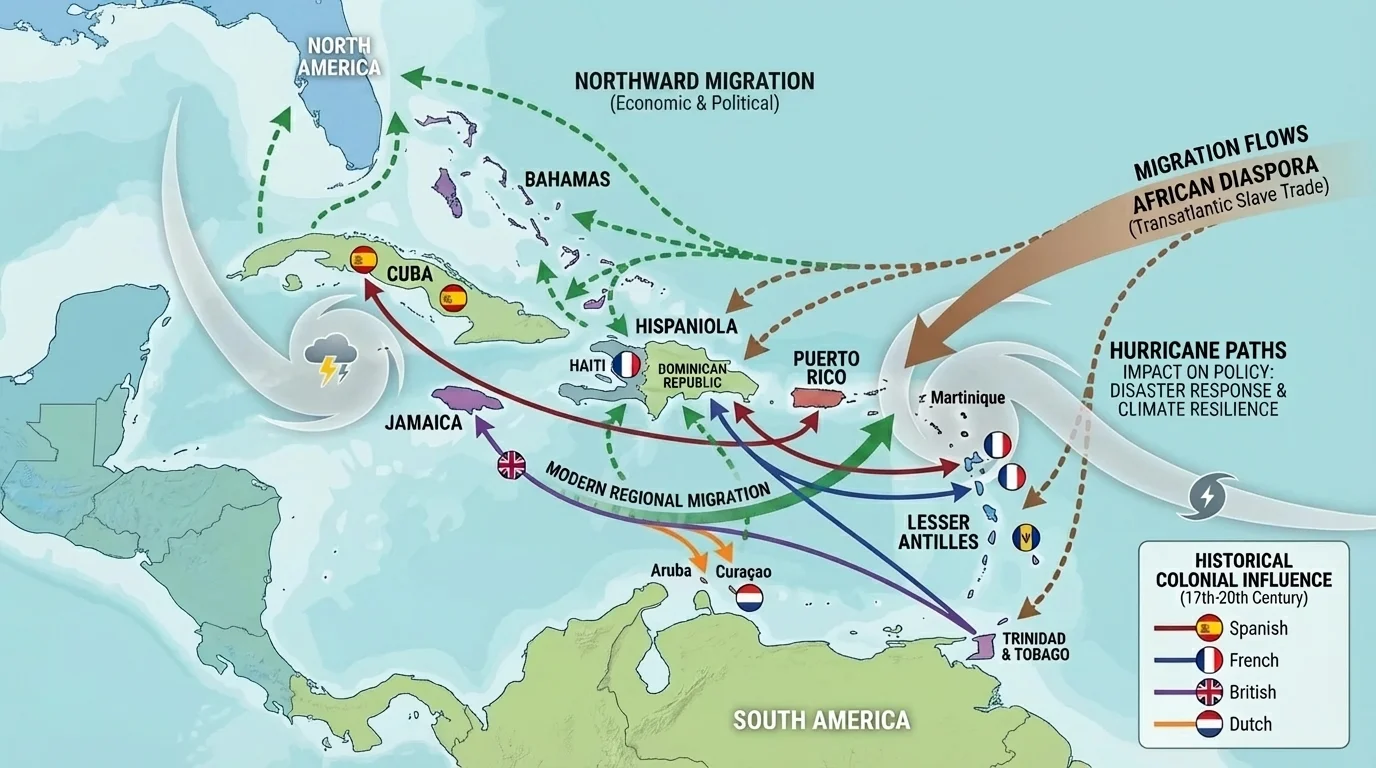
Natural disasters are especially important in Caribbean politics. Hurricanes can destroy homes, roads, schools, and power systems. After a disaster, governments must make decisions about emergency aid, rebuilding, and international support. A national perspective may focus on local needs and leadership. A global perspective may focus on shared responsibility, climate change, and humanitarian help.
Migration is also significant in the Caribbean. Some people move because of jobs, some because of political unrest, and some because of disasters. As we can see in [Figure 4], these movements connect the Caribbean with North America, South America, and Europe.
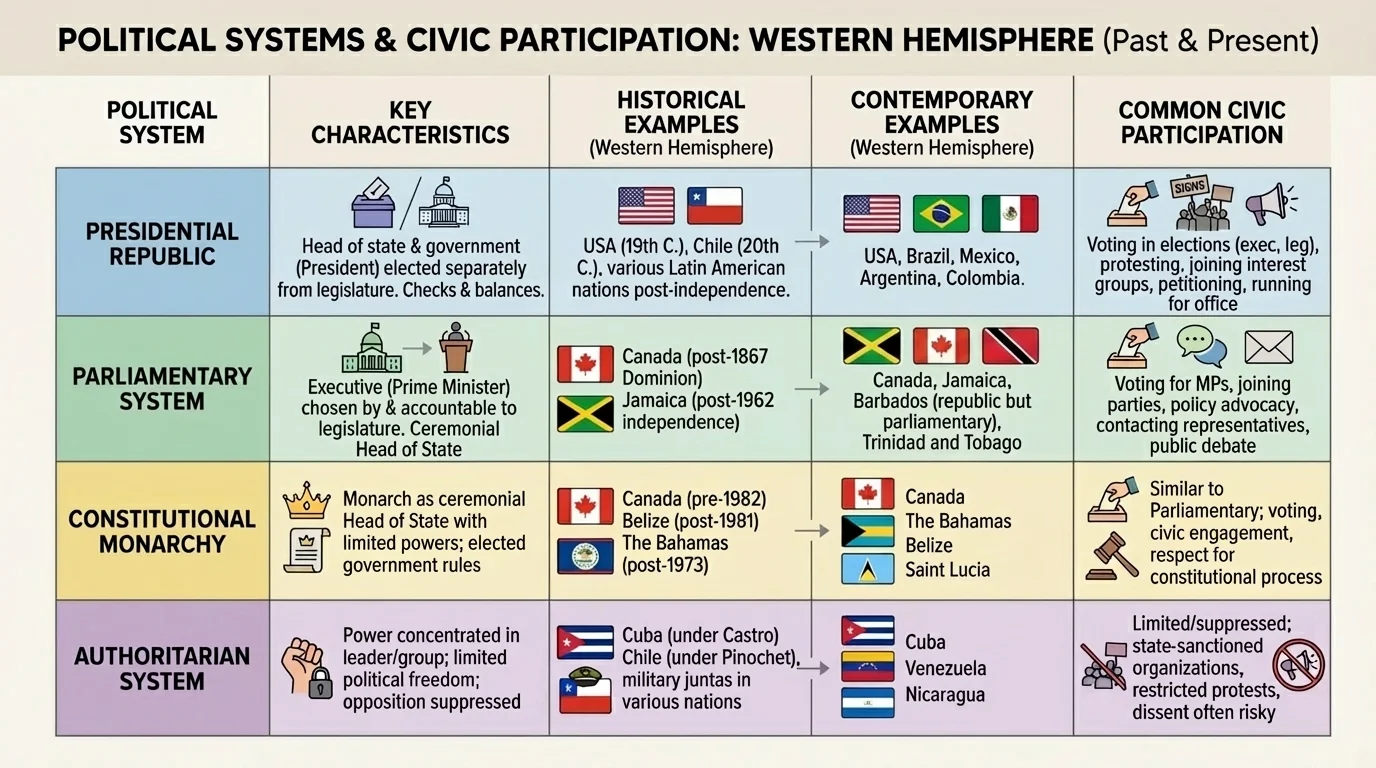
[Figure 5] Countries in the Western Hemisphere do not all use the same kind of government. Comparing them side by side, as [Figure 5] presents, helps explain why civic participation can look different from one country to another.
Some countries are democracies, where citizens vote for leaders and usually have protected rights. Some are presidential republics, such as the United States and many Latin American countries, where a president leads the executive branch. Some, such as Canada and several Caribbean nations, use parliamentary systems, where the executive leader comes from the legislature. Some countries have had authoritarian periods, when leaders limited freedoms and real opposition was weak or dangerous.
| System | Example | Who leads? | How citizens participate |
|---|---|---|---|
| Presidential republic | Mexico | President elected separately | Voting, parties, protests, civic groups |
| Parliamentary system | Canada | Prime minister from parliament | Voting, parties, petitions, public debate |
| Constitutional monarchy | Jamaica | Elected government under a monarch | Voting, public action, community groups |
| Authoritarian system | Cuba in some periods | Power concentrated in limited leadership | Participation may be more restricted |
Table 1. Comparison of selected governmental systems in the Western Hemisphere and common forms of civic participation.
The kind of government matters, but citizens still find ways to act. In democracies, people often have more legal protection to vote and speak freely. In less open systems, people may still participate, but they may face greater risks. That is why civic participation must be studied together with rights and government structure.
A national perspective asks, "What is best for this country?" A global perspective asks, "How does this affect the wider world?" Neither question should be ignored. A strong analysis often includes both.
Consider trade. A country may want to protect local workers and businesses. At the same time, it may depend on selling goods to other countries. Now think about climate change. A government may focus on national energy needs, but global observers may focus on pollution and long-term environmental effects for all people.
Immigration, natural resources, public health, and disaster relief all work this way. One issue can look very different depending on who is affected and what scale we are using. The Amazon example from [Figure 3] is a clear reminder that some political questions cannot be understood by looking at one country alone.
How perspectives change understanding
When students compare national and global perspectives, they often discover that political issues do not have simple answers. Leaders must balance local needs, rights, money, safety, history, and international pressure. Good analysis asks who benefits, who is harmed, and whose voice is missing.
This way of thinking helps students avoid oversimplified answers. It also builds empathy, because people in different places may experience the same issue in very different ways.
The Panama Canal is one example of how geography and global trade connect politics. The canal made travel and shipping faster between oceans, which brought great economic importance to Panama. But it also raised political questions about control, foreign influence, and national sovereignty. What seemed like a transportation project was also a political struggle over power.
The Cuban Missile Crisis is another example. Nationally, Cuba, the United States, and the Soviet Union all had their own goals. Globally, the crisis mattered because it brought the world close to nuclear war. A local map location became the center of an international emergency.
The Haitian Revolution also matters long after it ended. It changed power in the Caribbean, challenged slavery, and influenced how other countries thought about freedom and rebellion. This is another example of the pattern shown in [Figure 1], where one event affects later political debates over time.
Case study: The Amazon rainforest
Step 1: Identify the national perspective.
Leaders may focus on jobs, roads, farming, and economic growth.
Step 2: Identify the global perspective.
Scientists and other nations may focus on climate, biodiversity, and long-term environmental effects.
Step 3: Identify different groups.
Indigenous peoples, farmers, businesses, environmental groups, and government leaders may all want different outcomes.
Step 4: Analyze over time.
Past land-use choices influence current debates, and today's decisions will affect the future.
This case study shows that analyzing political issues means asking more than one question at a time.
Citizens participate in public life in many ways. Voting is important, but it is not the only form of action. People can attend meetings, join organizations, sign petitions, contact leaders, raise awareness online, volunteer in their communities, and take part in peaceful protests.
Young people also participate, even before they can vote. Students can learn about issues, discuss them respectfully, follow reliable news, and support community projects. Civic participation begins with paying attention and caring about the common good.
Different governmental systems shape participation. In more open democracies, civic life often includes many voices and public debate. In more restrictive systems, people may have fewer safe ways to disagree. That difference is one reason why government structure matters so much in civics.
"The price of freedom is eternal vigilance."
— A principle often linked to civic responsibility
This idea means that rights and freedoms need protection. Citizens cannot assume that fair government will continue automatically. They must stay informed and involved.
To analyze political issues well, students should ask careful questions. What happened first? Who had power? Who did not? What changed over time? What stayed the same? Was the issue mostly national, or did it also have global effects?
Students should also compare evidence. A government speech, a protest poster, a newspaper article, and a later textbook may describe the same event differently. That is why using both primary and secondary sources matters. Good thinkers examine point of view, bias, and missing voices.
Across North America, South America, and the Caribbean, political issues have never stood still. They have been shaped by history, geography, citizenship, and global connections. Understanding them helps students become stronger readers of the world and more thoughtful participants in civic life.
