Every day, people follow rules they did not invent themselves: school policies, traffic laws, game rules, and community expectations. But who makes the bigger rules for a country, and how do people know those rules are fair? That question sits at the center of government. Across the Western Hemisphere, from Canada to Argentina, countries have built governments in different ways. Even so, many of them share important ideas about power, rights, laws, and the role of the people.
A government is the system a society uses to make laws, provide order, protect people, and solve public problems. Without government, communities would struggle to decide how to keep roads safe, protect rights, collect taxes, or respond to emergencies. Government does not just control people; at its best, it also serves them.
Citizens are affected by government in direct ways. Governments decide who can vote, how leaders are chosen, what freedoms people have, and what services are provided. Schools, public parks, police protection, and many health programs depend on decisions made by government. That is why understanding government systems helps citizens understand their own place in society.
Government is the organized system that makes and enforces laws for a country or community.
Citizen means a legal member of a country who has rights and responsibilities.
Rule of law means that everyone, including leaders, must obey the law.
Constitution is a written plan for government that explains powers, limits, and rights.
In the Western Hemisphere, many governments are based on the idea that power should not belong to only one ruler forever. Instead, people have developed systems meant to share power, limit leaders, and protect liberty. These foundational principles did not appear all at once. They developed over centuries.
One key idea is rule of law. Under this principle, laws apply to everyone, not just ordinary people. If leaders can ignore laws whenever they want, citizens lose protection. Rule of law creates fairness and stability.
Another major principle is limited government. This means the government has power, but that power has boundaries. Leaders cannot do whatever they wish. A constitution, courts, and elections may all help limit government power. This protects people from abuse.
A third principle is representation. In a representative system, citizens choose people to speak and decide for them in government. This is especially useful in large countries where every citizen cannot meet to vote on every law. Representation connects people to power.
Another foundational idea is consent of the governed. This principle says government should get its authority from the people. If government exists only by force, it lacks true legitimacy. Elections are one way citizens give or withdraw consent.
Rights are also essential. Many governments in the Western Hemisphere recognize freedoms such as speech, religion, press, and assembly. These rights allow citizens to express opinions, organize groups, and question leaders. A government that protects rights usually gives citizens more ways to participate in public life.
Why these principles matter together
Foundational principles work like parts of the same machine. Rule of law keeps power fair, limited government prevents abuse, representation gives people a voice, and rights protect freedom. When these ideas support one another, citizens usually have more security and influence. When one part breaks down, government often becomes less fair or less democratic.
These ideas may sound modern, but many came from older civilizations and important historical documents. Over time, people in the Americas adapted those ideas to fit their own societies.
Modern government in the Americas grew from many earlier ideas across centuries. Ancient Greece contributed the idea of citizens taking part in government, especially in Athens, where some people voted directly on public decisions. Ancient Rome added ideas about republics, written law, and elected officials.
Later, in medieval England, the Magna Carta, signed in 1215, challenged the idea that a king had unlimited power. It helped establish the idea that even rulers must obey the law. This did not create modern democracy right away, but it marked an important step toward limited government.
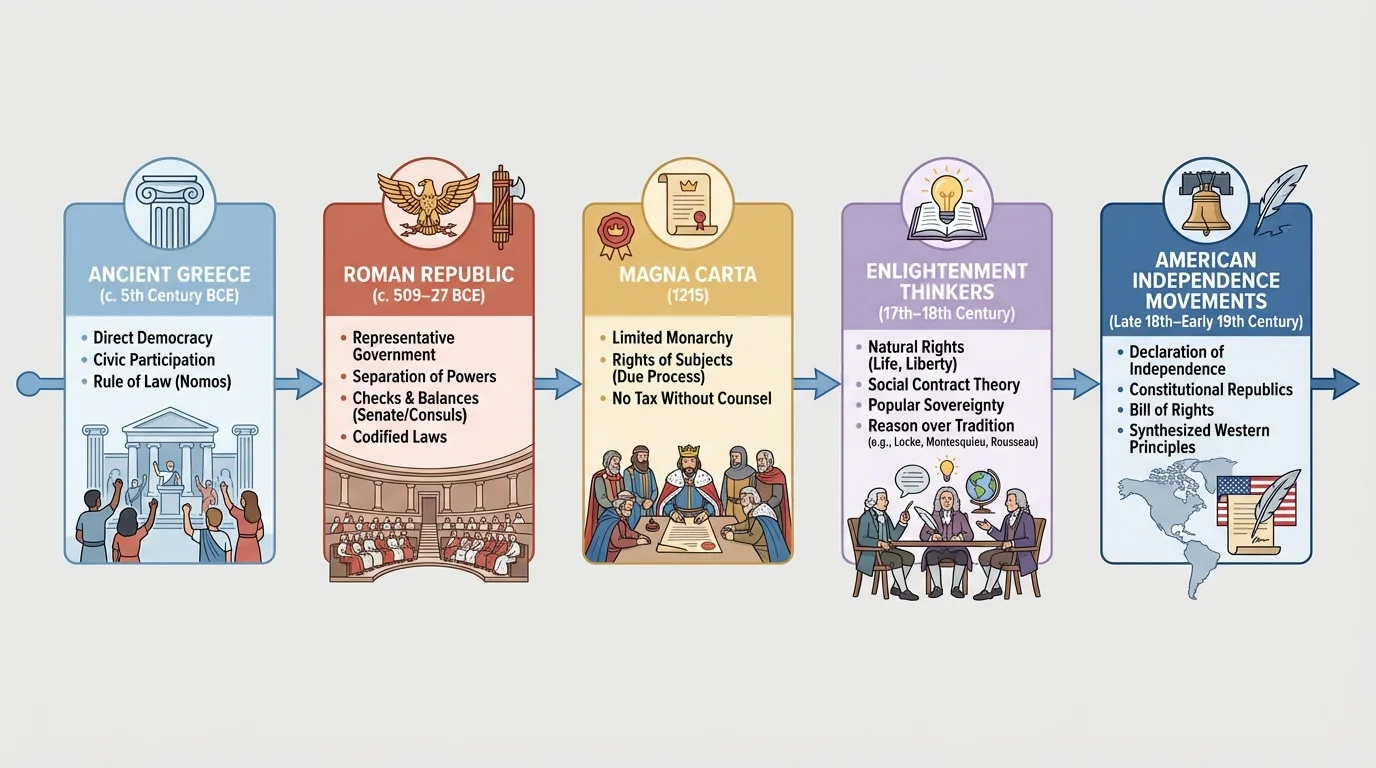
During the 1600s and 1700s, Enlightenment thinkers added powerful new ideas. John Locke argued that people have natural rights, including life, liberty, and property. He also said governments exist to protect those rights and should be based on the consent of the governed. Montesquieu supported the separation of powers, the idea that government power should be divided so that no one part becomes too strong.
These ideas crossed the Atlantic and influenced leaders in the Americas. Colonists, revolutionaries, and reformers used them to argue against unfair rule. That is why a document written in England or a theory developed in Europe could shape constitutions in North and South America.
Religious traditions, local customs, and Indigenous political practices also mattered. Some Indigenous nations had councils, agreements, and systems for shared decision-making long before European colonization. Government development in the Western Hemisphere was not based on only one source. It came from many traditions meeting, clashing, and changing over time.
The Magna Carta was written more than 800 years ago, but people still study it because it helped spread the idea that rulers should not have unlimited power.
The long path in [Figure 1] helps explain why modern governments often combine old ideas, such as written law from Rome and limits on rulers from England, with newer democratic ideas from the Enlightenment.
When European colonies were established in the Americas, many were ruled by distant kings. However, distance made local decision-making necessary. Colonists created assemblies and town meetings to deal with taxes, roads, trade, and local laws. These experiences gave many settlers practice in self-government.
In British North America, colonial assemblies helped people become used to electing representatives. Over time, disputes over taxes and authority led many colonists to argue that government should not rule without the people's approval. This idea became central to the American Revolution.
After independence, the United States created a Constitution that set up a federal republic. It divided power among branches and between national and state governments. This model influenced other countries, though each developed in its own way.
Latin American independence movements in the early 1800s also drew on ideas of liberty, popular sovereignty, and constitutional rule. Leaders such as Simón Bolívar and José de San Martín helped fight for independence from Spain. Yet building stable governments after independence was difficult. Some countries experienced republics, military rule, civil wars, or frequent constitutional changes.
Case study: Why independence did not create the same government everywhere
Step 1: Many colonies wanted freedom from distant rulers.
People in the Americas often believed local citizens should have more control over taxes, trade, and leadership.
Step 2: New nations needed to decide how to organize power.
They had to choose who could vote, how leaders would be selected, and how much power national governments would hold.
Step 3: Different histories led to different systems.
Some countries developed stronger democratic institutions, while others struggled with conflict, unequal power, or military control.
Shared ideas about freedom did not automatically produce identical governments.
This history matters because the Western Hemisphere includes countries that value elections and constitutions but still differ in how power is shared and how strongly rights are protected.
Countries in the region organize power in different ways. Many are democracies, meaning citizens take part in choosing leaders. Many are also republics, where representatives are elected and no king or queen serves as head of state. But even among democracies, government structures can vary.
In a presidential system, the president usually serves as both head of state and head of government. The president is often elected separately from the legislature. The United States, Mexico, and Brazil use presidential systems. This can create strong separation between branches.
In a parliamentary system, the executive leader, often called a prime minister, comes from the legislature. Canada uses a parliamentary system within a constitutional monarchy. That means Canada recognizes a monarch as the formal head of state, but elected officials run the government according to a constitution and democratic rules.
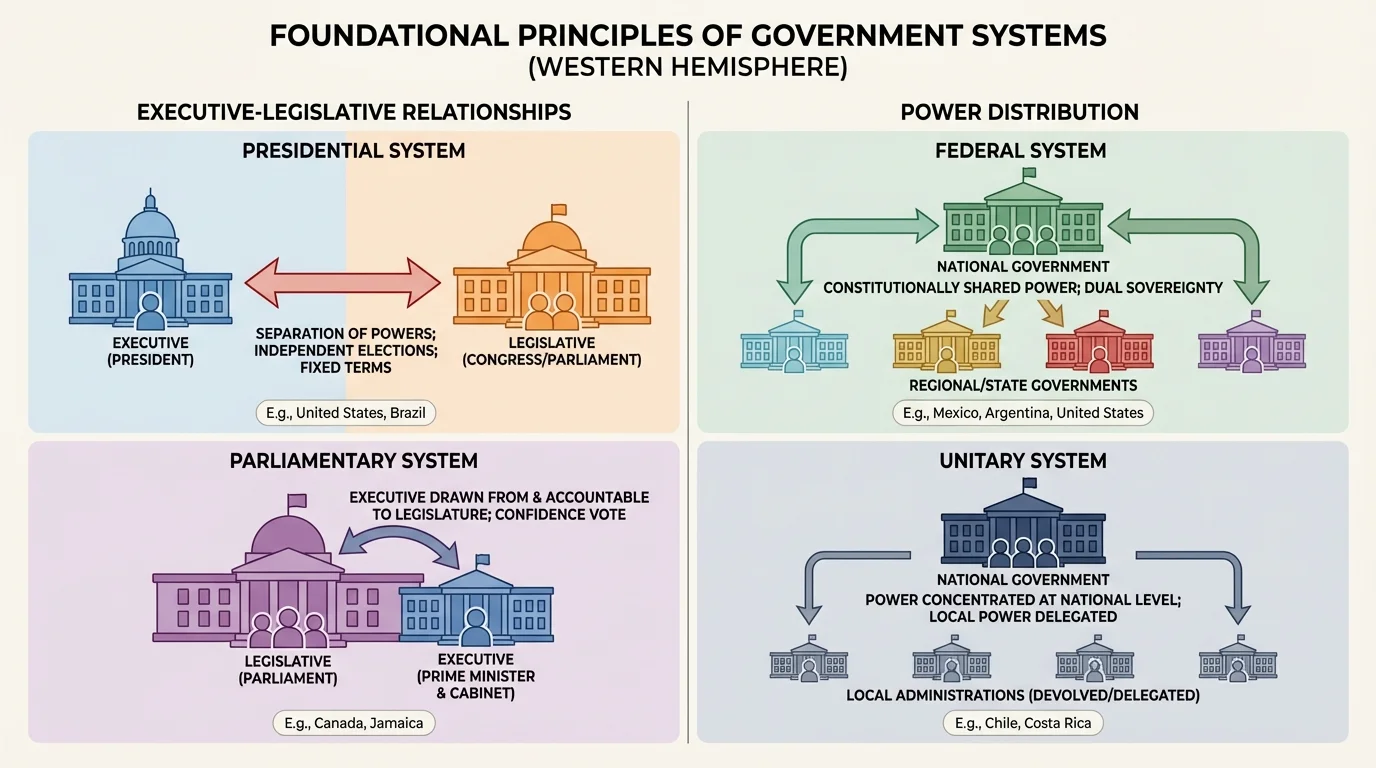
Some countries are federal, while others are unitary systems. In a federal system, power is shared between a national government and smaller political units such as states or provinces. In a unitary system, the national government holds most of the power, though local governments may still exist.
The chart in [Figure 2] makes it easier to compare these structures. For example, a country can be both democratic and federal, or democratic and unitary. Government systems are built from more than one feature.
| System or Feature | Main Idea | Example in the Western Hemisphere |
|---|---|---|
| Democracy | Citizens choose leaders and participate in government | Canada, Mexico, Brazil, United States |
| Republic | Elected representatives govern | United States, Mexico, Brazil |
| Constitutional monarchy | A monarch is symbolic, while elected leaders govern under a constitution | Canada |
| Presidential system | President leads the executive branch | United States, Mexico, Brazil |
| Parliamentary system | Prime minister leads government through the legislature | Canada |
| Federal system | Power is shared between national and regional governments | United States, Canada, Mexico, Brazil |
| Unitary system | Most power belongs to the national government | Many countries in Latin America use stronger central authority |
Table 1. Comparison of major government structures and features found in the Western Hemisphere.
Not every country in the Western Hemisphere fully protects democratic principles. Some governments limit opposition parties, restrict free speech, or tightly control elections. When that happens, citizens often have less influence over government decisions.
Government systems matter because they shape daily life. In a system with free elections, citizens can vote leaders out of office. In a system with an independent court system, people may challenge unfair laws. In a system with protected rights, journalists can report on government mistakes and citizens can protest peacefully.
Citizens also have responsibilities. In many countries, people are expected to obey laws, pay taxes, serve on juries when required, and stay informed about public issues. A healthy government system depends not only on leaders but also on citizens who participate.
Earlier studies of communities and rules help here: whenever a group creates rules, it must decide who has power, how decisions are made, and how fairness is protected. National governments solve those same problems on a much larger scale.
When governments become less accountable, citizens may struggle to make their voices heard. Corruption, unfair elections, censorship, and unequal law enforcement can weaken public trust. That is why transparency and accountability are important features of strong government systems.
Checks and balances are one way to increase accountability. This idea means parts of government can limit one another. For example, a legislature may make laws, an executive may enforce them, and courts may review them. If one branch overreaches, another can respond. This makes it harder for power to gather in one place.
The Western Hemisphere includes countries with shared principles and important differences. Looking at specific countries helps reveal how foundational principles can appear in different forms.
United States: The United States is a democratic republic with a presidential and federal system. Its Constitution separates powers among three branches and protects many individual rights. Citizens vote in elections for local, state, and national offices.
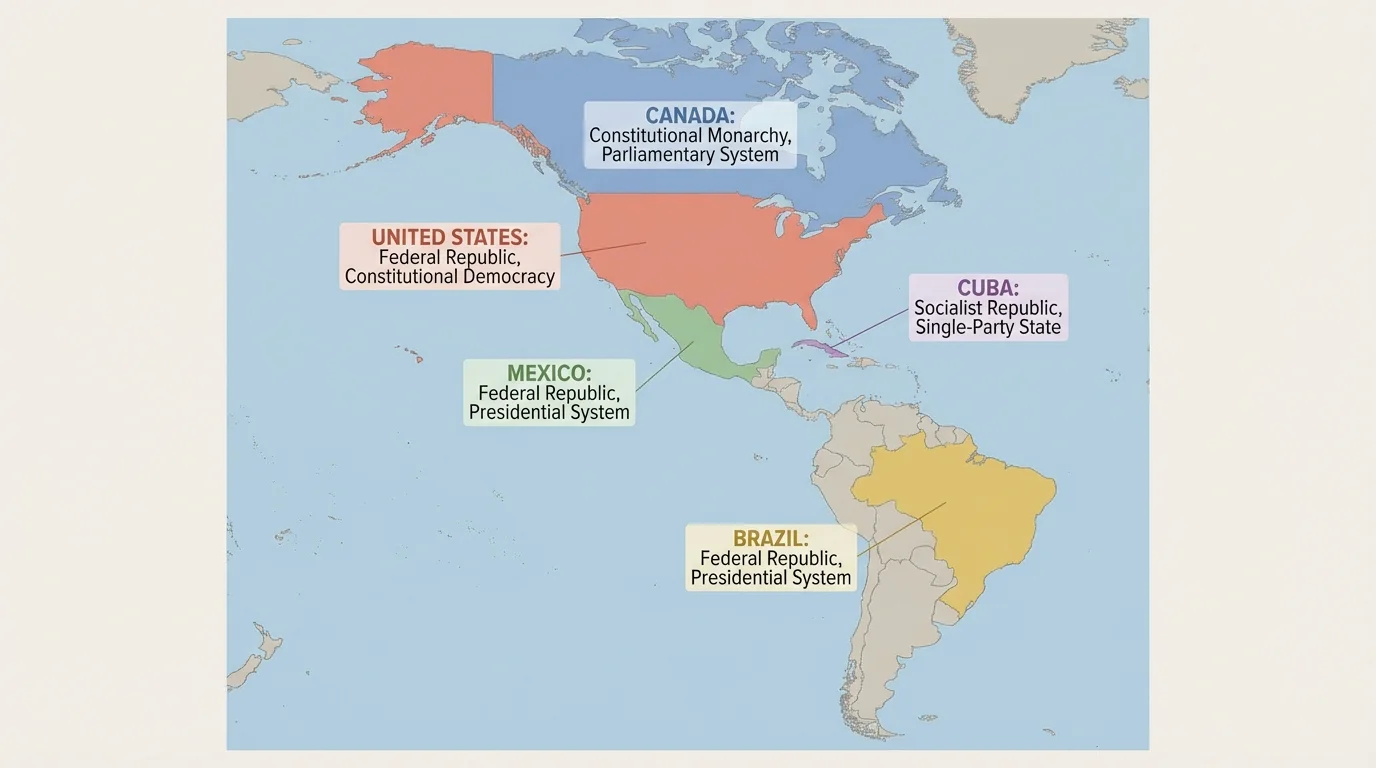
Canada: Canada is a parliamentary democracy and constitutional monarchy with a federal structure. Citizens elect members of Parliament, and the prime minister leads the government. Canada also has provinces with their own powers.
Mexico: Mexico is a federal republic with a presidential system. It has a written constitution and elected leaders. Like many nations, it has worked over time to strengthen democratic practices and political competition.
Brazil: Brazil is a federal republic and presidential democracy. It has experienced periods of democracy and dictatorship in its history. Its modern government includes elections, a constitution, and division of powers.
Cuba: Cuba is an example of a country where the government system differs sharply from many others in the hemisphere. Political power is highly centralized, and citizens have fewer opportunities for open political competition than in multiparty democracies. Comparing Cuba with other countries helps students see how government structure affects participation and rights.
The regional pattern on [Figure 3] shows that nearby countries can still have very different systems. Geography alone does not determine government. History, culture, conflict, reform, and public action all matter.
Government systems are not frozen in place. They change when people demand reform, when constitutions are rewritten, or when leaders gain or lose power. In many countries of the Western Hemisphere, the right to vote expanded slowly. At first, voting was often limited by property, race, or gender. Over time, reform movements pushed governments to include more citizens.
Movements for civil rights, women's rights, labor rights, and Indigenous rights have all shaped governments in the region. These struggles show that foundational principles such as equality and liberty are powerful, but they are not always applied fairly at first. Citizens often have to work to make governments live up to their own ideals.
"Governments are instituted among Men, deriving their just powers from the consent of the governed."
— Declaration of Independence
Military coups, dictatorships, corruption, and unfair elections have interrupted democratic government in some countries. Yet many people in the Western Hemisphere have continued to fight for constitutional rule, fair representation, and civil liberties. This ongoing effort is part of the region's history.
A country may have a constitution on paper but still struggle in practice. For example, if laws are ignored, if judges are not independent, or if only a small group holds real power, citizens may not fully enjoy their rights. Strong government systems need both good rules and faithful enforcement.
Foundational principles of government are not just ideas from the past. They affect whether people can speak freely, vote fairly, receive equal treatment under the law, and trust public institutions. They help answer big questions: Who has power? Where does that power come from? What limits should there be? How can citizens influence decisions?
When students learn about government systems in the Western Hemisphere, they are also learning how societies try to balance freedom and order. A government must be strong enough to make laws and protect people, but limited enough to respect rights. That balance is difficult, and different countries solve it in different ways.
Understanding these systems also prepares citizens for real life. News stories about elections, protests, court rulings, and new laws make more sense when people know the principles behind them. Government may seem distant, but it shapes daily life in classrooms, neighborhoods, and nations.
