Two countries can be neighbors, speak similar languages, and still treat their citizens very differently. In one place, people may vote freely, criticize leaders, and help choose new laws. In another, the government may limit speech, control elections, or give more power to a small group. That is why studying government matters: it helps us understand who has power, how rules are made, and how ordinary people are affected every day.
A system of government is the way a country organizes power and makes decisions. In the Western Hemisphere, which includes North America, Central America, the Caribbean, and South America, countries use different systems. Some are strong democracies. Some are constitutional monarchies. Others have had periods of dictatorship or authoritarian rule. Each system shapes what citizens can do, what rights they have, and whether all groups are treated fairly.
Governments do many jobs. They make laws, provide public services, protect the country, settle disputes, and try to maintain order. Schools, roads, police, courts, and public health programs all connect to government decisions. Even things that seem personal, like freedom of speech or the right to vote, depend on how a government is set up.
The relationship between a government and its citizens is one of the most important ideas in civics. Citizens usually have rights, such as freedom, protection under the law, or voting. They also often have responsibilities, such as obeying laws, serving on juries in some countries, or paying taxes. But these rights and responsibilities are not exactly the same in every country. They depend on the kind of government in place.
Citizen means a legal member of a country who has certain rights and duties. Government is the group or system that makes and enforces rules for a country. Power in civics means the ability to make decisions and influence what happens in society.
When governments are fair and accountable, citizens often have ways to participate and be heard. When governments are unfair or too powerful, citizens may have fewer choices and less protection. This is why people in many countries have worked for centuries to expand voting rights, limit government power, and make laws more equal.
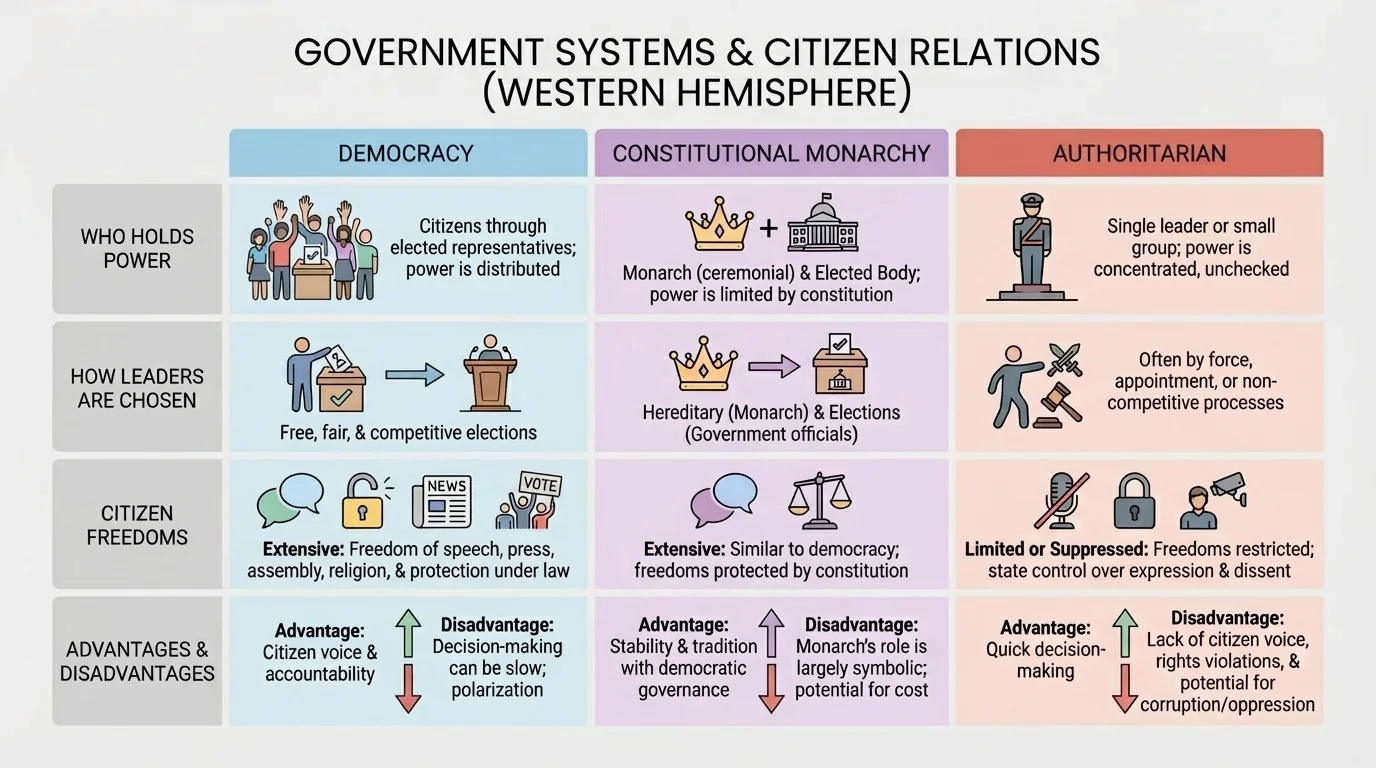
One useful way to compare systems, as shown in [Figure 1], is to ask three questions: Who holds power? How are leaders chosen? What freedoms do citizens have? These questions help us see the difference between democratic and non-democratic systems.
A democracy is a government in which the people have a voice in choosing leaders and shaping laws. In a representative democracy, citizens elect people to represent them. Many countries in the Western Hemisphere use this system. Democracies usually include elections, political parties, constitutions, and protections for rights.
A republic is a form of government in which citizens choose leaders and the country is not ruled by a king or queen. Many democracies in the Americas are republics. The United States, Mexico, Brazil, Argentina, and many others are democratic republics.
A constitutional monarchy has a king or queen, but the monarch's power is limited by a constitution and elected officials. Canada and several Caribbean countries, such as Jamaica and Belize, are examples. In these countries, citizens vote for representatives, and the monarch is not the main decision-maker in daily government.
An authoritarian government is a system in which power is held by one leader or a small group, and citizens have limited political freedom. Elections may be controlled, opposition may be restricted, and criticism of the government may be punished. Authoritarian systems can still have laws and institutions, but citizens usually have less influence over government decisions.
Some countries in the Western Hemisphere have changed systems over time. A nation may move from colonial rule to independence, from dictatorship to democracy, or from democracy to authoritarian rule. Government is not always fixed forever. History shows many examples of change.
Several countries in the Western Hemisphere became independent in the 1800s, but gaining independence did not automatically create equal rights for all people. In many places, voting was first limited to men with property or wealth.
This is important because a country can call itself free while still excluding many citizens from real power. A government's name matters less than its actual rules, institutions, and treatment of people.
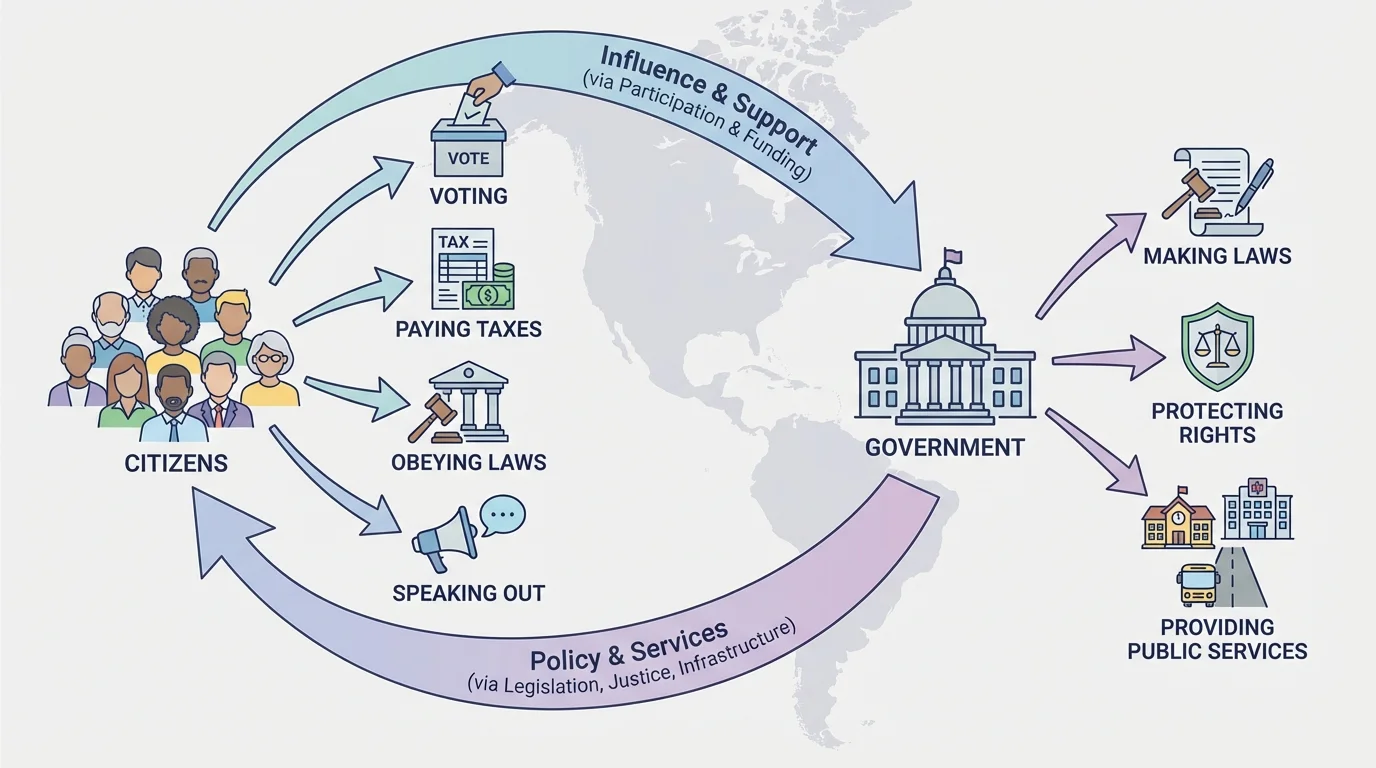
[Figure 2] The connection between citizens and government works in both directions. Governments expect citizens to follow laws, pay taxes, and sometimes serve the public in other ways. In return, governments are supposed to protect rights, provide services, and promote safety and order.
In democracies, citizens usually have more ways to participate. They can vote, join political parties, speak publicly, write to leaders, protest peacefully, and sometimes run for office. This does not mean democracies are perfect, but it does mean citizens usually have legal tools to influence change.
Governments also affect citizens through services. Public schools educate children. Road systems help people travel and trade. Police and courts try to keep order and settle conflicts. Health programs may provide vaccines or emergency help. These services are funded partly by taxes paid by citizens and businesses.
At the same time, governments can limit citizens. They can ban certain actions, punish crimes, and create rules for safety. In a fair system, these limits are balanced by laws that protect individual rights. In an unfair system, the government may use laws mainly to control people rather than to protect them.
Limited government and the rule of law mean that leaders are supposed to follow the law, not stand above it. In systems with limited government, constitutions, courts, and elections help prevent one person or group from gaining too much power. The rule of law means laws apply to everyone, including leaders.
This idea is a major difference between democratic and authoritarian systems. In a strong democracy, citizens can challenge leaders in court, vote them out of office, or criticize them in the media. In an authoritarian state, these actions may be difficult or dangerous. The same relationship pattern seen in [Figure 2] can exist in many countries, but the balance of power is very different depending on the system.
Many countries in the Western Hemisphere are democracies, though they may organize government in different ways. The United States has a federal system, meaning power is shared between a national government and state governments. Citizens vote for local, state, and national leaders. The Constitution limits government power and protects many rights.
Canada is a democracy and a constitutional monarchy. Citizens vote for members of Parliament and provincial leaders. Although Canada recognizes the British monarch as head of state, elected officials run the government. This shows that a country can be both democratic and a monarchy if the monarch's power is limited.
Costa Rica is often recognized for its stable democracy. It has regular elections and strong civic institutions. It also made the unusual choice to abolish its military in 1948 and focus more national resources on education and health. This demonstrates how a government's choices can affect citizens' daily lives.
In democratic systems, citizens usually enjoy freedom of speech, freedom of the press, and the right to vote. But even democracies may not treat all citizens equally. Some groups may have more money, stronger political connections, or better access to education. That can give them more influence than others.
Case study: Voting rights and fairness
Consider a country where all adult citizens are legally allowed to vote.
Step 1: Look at the law.
The law says every adult citizen has the same right to vote.
Step 2: Look at real life.
If some communities have fewer polling places, less transportation, or less access to information, voting becomes harder for them.
Step 3: Compare legal equality and actual equality.
Even when a democracy promises equal rights, some citizens may still face disadvantages because of poverty, discrimination, or geography.
This shows why it is important to study not only what a government says, but also how it works in practice.
Throughout the Americas, many democratic countries have worked over time to expand participation. Women, Indigenous peoples, Afro-descendant communities, and poor citizens often had to struggle for fuller rights. Democracy grows stronger when more people are included.
Not every government in the Western Hemisphere has offered the same level of freedom. Cuba is often discussed as an example of a one-party state, where political competition is limited. The government provides some services, such as health care and education, but citizens have fewer opportunities to choose among competing political parties or openly oppose national leaders.
In the twentieth century, several Latin American countries experienced military dictatorships. In countries such as Chile, Argentina, and Brazil during certain periods, military leaders or authoritarian governments limited elections, censored speech, and punished opponents. In these systems, citizens had fewer rights to participate in politics.
This does not mean every citizen experienced the system in the same way. Some people supported authoritarian governments because they promised order or economic stability. Others suffered greatly, especially political opponents, journalists, activists, and minority groups. Government systems can protect some people while harming others.
"Eternal vigilance is the price of liberty."
— A well-known civic principle
This idea matters because rights can weaken if citizens cannot defend them. When governments control media, ban protests, or silence critics, it becomes harder for people to challenge unfair treatment or demand change.
One of the most important questions in civics is not just what type of government a country has, but who benefits from it. In many countries across the Western Hemisphere, systems of government have historically favored wealthy landowners, business elites, military leaders, or people from dominant racial or ethnic groups.
For example, during colonial times and long after independence, Indigenous peoples in many parts of the Americas were often excluded from power. Afro-descendant communities also faced slavery, segregation, discrimination, and political exclusion. Women in nearly every country had to fight for the right to vote and hold office. Poor citizens often had less access to education, legal help, and political influence.
Even in modern democracies, advantages are not always shared equally. Wealthier citizens may donate more money to campaigns, hire lawyers, or move to areas with better schools and services. Poorer communities may have less representation or fewer resources. So a democratic system can still create unequal outcomes if power is concentrated in practice.
| System or Condition | Possible Advantages | Possible Disadvantages |
|---|---|---|
| Democracy | Voting rights, greater freedom, more ways to influence leaders | Some groups may still have less access or less influence |
| Constitutional monarchy | Elected government with stable traditions and legal limits | Can still have unequal political power among social groups |
| Authoritarian government | Leaders may act quickly and promise order | Limited freedom, weak citizen voice, unfair treatment of opponents |
| Unequal society under any system | Privileged groups may gain access to wealth and influence | Marginalized groups may face discrimination and exclusion |
Table 1. Comparison of how systems and social conditions can create advantages and disadvantages for different citizens.
Young people can understand this by thinking about a classroom. If every student is told they may speak, but only a few are ever listened to, then the rule is not working equally. Governments can also look fair on paper while being unfair in daily life.
Earlier civics learning about fairness, equality, and rules still matters here. A fair rule is not enough by itself; people also need fair access to the benefits and protections of that rule.
This is why citizens often push for civil rights laws, fair elections, anti-discrimination protections, and equal access to public services. Government systems affect real lives, not just political charts.
We can compare governments by asking specific questions. Can citizens vote in free elections? Are there multiple political parties? Can people criticize leaders without punishment? Are courts independent? Are laws applied equally? Do all groups have real access to rights?
These questions help us move beyond simple labels. A country might hold elections, but if the media is tightly controlled or opponents are threatened, the system is less democratic than it appears. On the other hand, a democracy with active courts, free press, and broad participation usually gives citizens more power.
The comparison chart in [Figure 1] remains useful here because it highlights the same three features again: who has power, how leaders are chosen, and what freedoms people have. These are strong clues about how citizens will be treated.
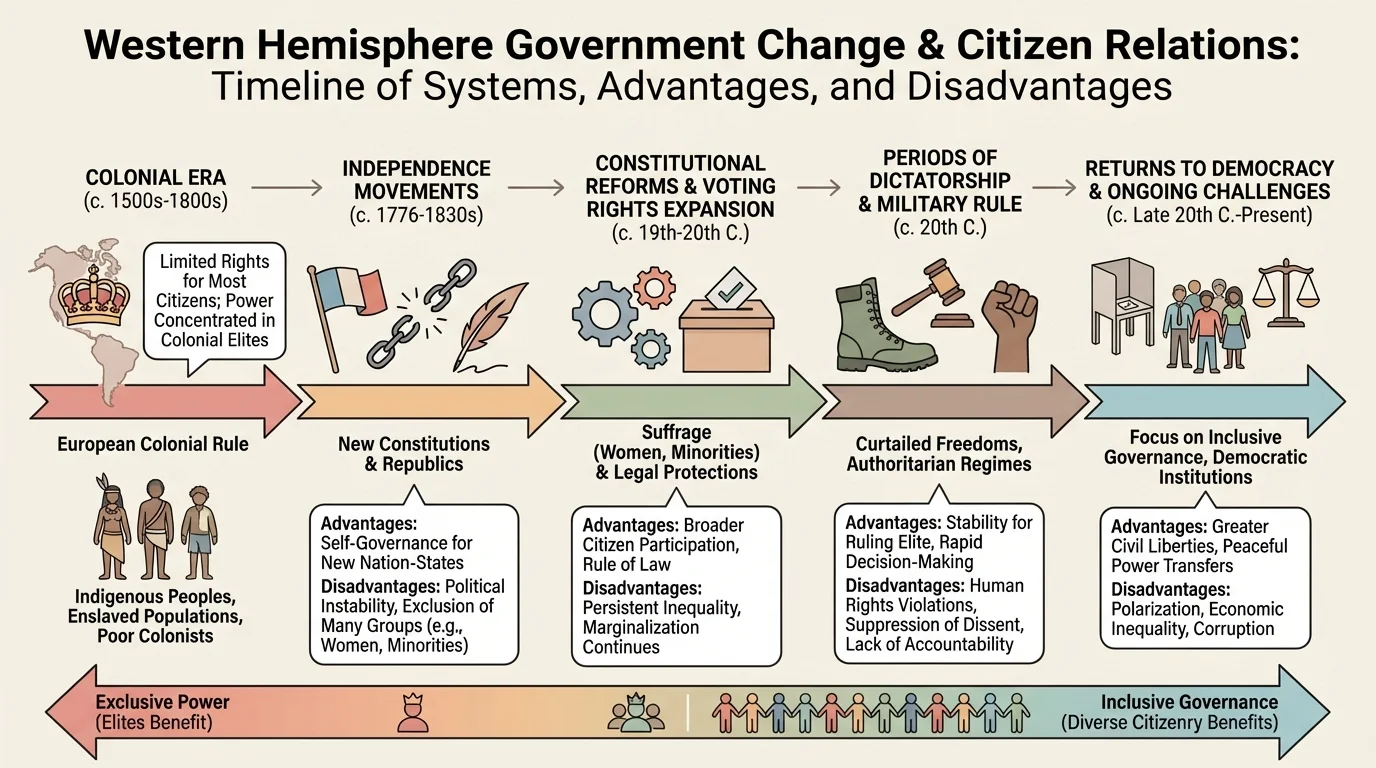
Systems of government in the Western Hemisphere have changed many times, and [Figure 3] traces this pattern across major events. Colonies became independent countries. Some democracies expanded rights over time. Some nations experienced coups, revolutions, or dictatorships and later returned to democracy.
One reason systems change is that citizens demand reform. They may protest unfair laws, push for new constitutions, or organize movements for voting rights and equality. Leaders may also change systems by force, especially in times of crisis, war, or economic trouble.
For example, women gained voting rights at different times across the hemisphere. That change did not happen automatically. It came from long campaigns, public pressure, and changing ideas about equality. In many countries, Indigenous and Afro-descendant groups also fought for fuller citizenship and recognition.
Constitutions are important in these changes. A constitution is a written plan for government that explains powers, rights, and limits. When a constitution is rewritten or amended, the relationship between government and citizens can change.
Some changes increase freedom, while others reduce it. A new law might protect voting rights, or a new ruler might limit the press. History does not move in only one direction. Citizens often have to keep working to protect their rights.
Government change over time is often the result of conflict between ideas about power. Some groups want broader participation and equal rights. Others want to keep power in the hands of a smaller group. The history of the Western Hemisphere includes both struggles.
Looking back at [Figure 3], we can see that rights in the region were expanded step by step, not all at once. This helps explain why different countries today still have different political systems and different levels of equality.
Even though sixth graders may not yet vote in national elections, they are already part of civic life. They see rules, leadership, fairness, and participation at school and in their communities. Learning about government helps them ask smart questions: Who made this decision? Who benefits? Who is left out? What rights do people have?
An informed citizen pays attention, checks facts, listens to different viewpoints, and cares about fairness. This matters in every system of government, but it is especially important in democracies, where citizens are expected to participate and hold leaders accountable.
Understanding the Western Hemisphere means understanding both its progress and its problems. Many countries have expanded rights and built democratic institutions. At the same time, many citizens still face disadvantages because of poverty, race, ethnicity, gender, language, or political beliefs. Systems of government shape these experiences in powerful ways.
