A single bowl of noodles can tell a story about world history. Wheat first spread across regions, cooking methods traveled, spices crossed seas, and ideas about food moved with merchants and migrants. By the time a meal reaches a modern table, it may connect China, India, the Middle East, East Africa, and Europe. That is one reason historians study the Eastern Hemisphere: it reveals how people developed distinct cultures while also depending on one another in powerful ways.
The Eastern Hemisphere includes Africa, Asia, Europe, and surrounding regions. Across these lands, people built kingdoms, cities, religions, trade routes, and knowledge systems. They spoke different languages, practiced different customs, and organized their societies in different ways. Yet they were not isolated. Goods, beliefs, inventions, stories, and even diseases moved from place to place. To understand this complicated past, historians examine evidence carefully.
History is not just a list of dates. It is an investigation based on evidence. Historians ask questions such as: How did people live? What did they value? How did different societies affect each other? To answer these questions, they study records left behind and interpretations written later.
Because no one source tells the whole story, historians compare many kinds of evidence. A royal inscription might praise a ruler's victories but ignore failures. A traveler's diary might describe a city vividly but misunderstand local customs. A modern historian may explain events clearly but depends on surviving evidence, which can be incomplete. Good historical thinking means reading carefully, comparing sources, and noticing perspective.
Primary source means evidence created during the time being studied or by someone who directly experienced it, such as a letter, law code, coin, diary, artifact, or inscription.
Secondary source means a later explanation or interpretation of the past, such as a textbook, documentary, biography, or historian's article.
Perspective is the point of view shaped by a person's background, goals, beliefs, and experiences.
These ideas matter because history is built from human voices, and human voices are never perfectly neutral. A merchant, a monk, and a conqueror may all describe the same event differently. Instead of seeing that as a problem, historians treat it as a clue.
When historians sort evidence, as [Figure 1] illustrates, they first ask whether a source comes directly from the time period or whether it is a later interpretation. A primary source might be a Chinese government record from the Han dynasty, a West African oral tradition, a Roman coin, or a traveler's journal written on the road. A secondary source might be a modern book explaining why those sources matter.
Neither type is automatically better. Primary sources bring us close to the past, but they can be limited or biased. Secondary sources can connect many pieces of evidence, but they depend on the historian's choices and interpretation. Students of history need both.
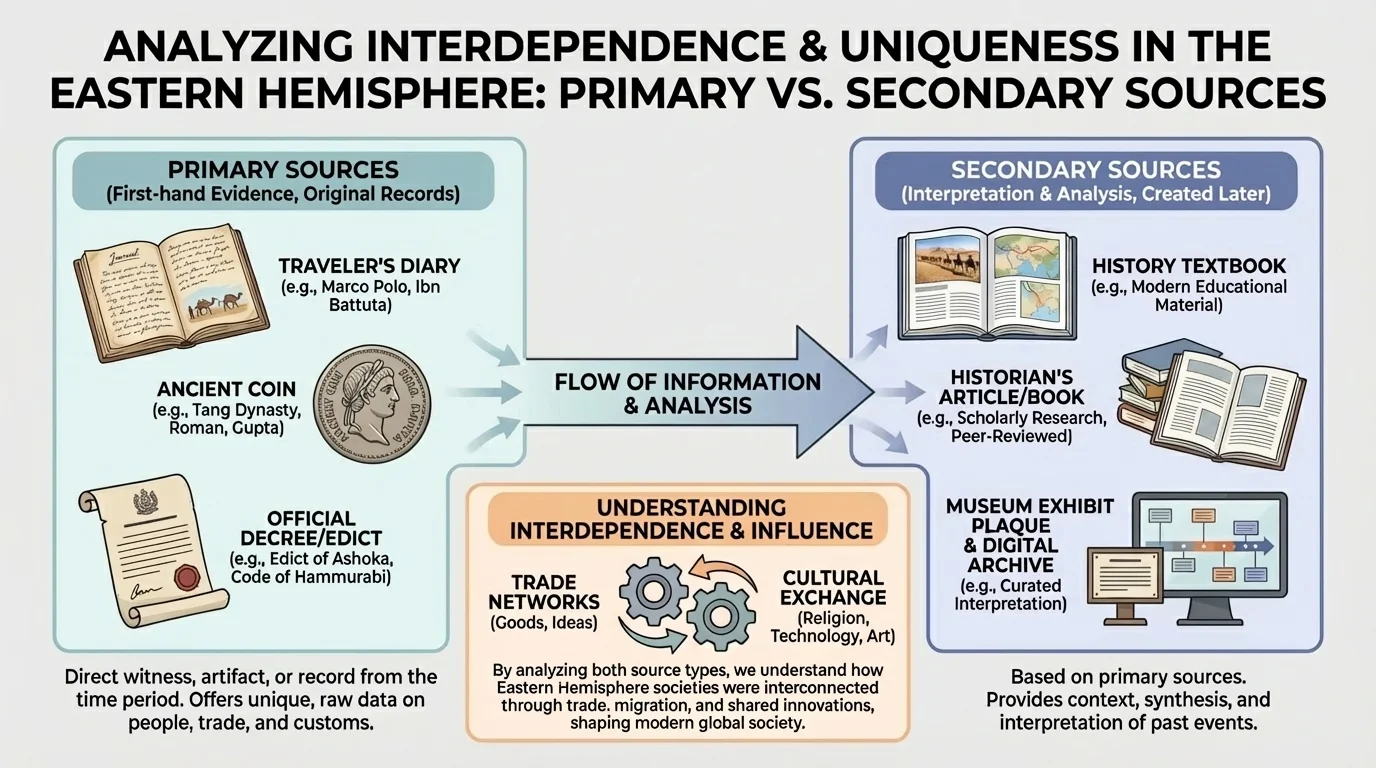
For example, if you wanted to study the city of Timbuktu in West Africa, a primary source could be a traveler's account describing its markets and schools. A secondary source could be a modern historian's essay explaining Timbuktu's role in trade and learning. Reading both helps you see details and bigger patterns.
Another example comes from medieval Japan. A samurai code, a painting, or a government order from that time would count as primary evidence. A modern museum article discussing samurai culture would be a secondary source. Together, these sources help historians understand both the facts and the interpretation.
Reading a source is more than finding information. Historians ask several questions. Who created it? When? Why? For whom? What is included? What is left out? These questions reveal how trustworthy and useful a source is.
A key term in source study is bias. Bias does not always mean a source is false. It means the source reflects a particular point of view. A ruler's monument may exaggerate success. A religious writer may judge other groups harshly. A soldier may notice battle details but miss what happened to civilians. Recognizing bias helps historians interpret evidence more carefully.
Another important idea is corroboration, which means checking one source against another. If an Arab merchant's account of Indian Ocean trade matches archaeological discoveries of imported pottery in East Africa, the evidence becomes stronger. If two sources disagree, historians ask why. The disagreement itself may reveal something important about perspective or conflict.
Context changes meaning
A source must be understood within its historical setting. A law, speech, or image may seem strange today, but its meaning becomes clearer when we know the time period, location, beliefs, and political conditions around it. Context helps historians avoid judging the past only by modern standards.
Suppose a Byzantine writer describes foreign peoples as "barbaric." That word tells us less about the people being described than about the writer's attitude and cultural viewpoint. The source is still useful, but not in a simple way. It may reveal prejudice, fear, or competition between societies.
The Eastern Hemisphere was a network of interconnected regions, as [Figure 2] shows through major land and sea routes. Interdependence means that societies rely on one another. No major civilization created everything it needed by itself. People exchanged metals, silk, spices, horses, paper, ideas, technologies, and beliefs.
Trade routes tied distant places together. The Silk Roads linked China, Central Asia, the Middle East, and Europe. The Indian Ocean network connected East Africa, Arabia, India, and Southeast Asia. The Mediterranean Sea connected parts of Europe, North Africa, and Southwest Asia. These routes moved more than goods; they carried culture.
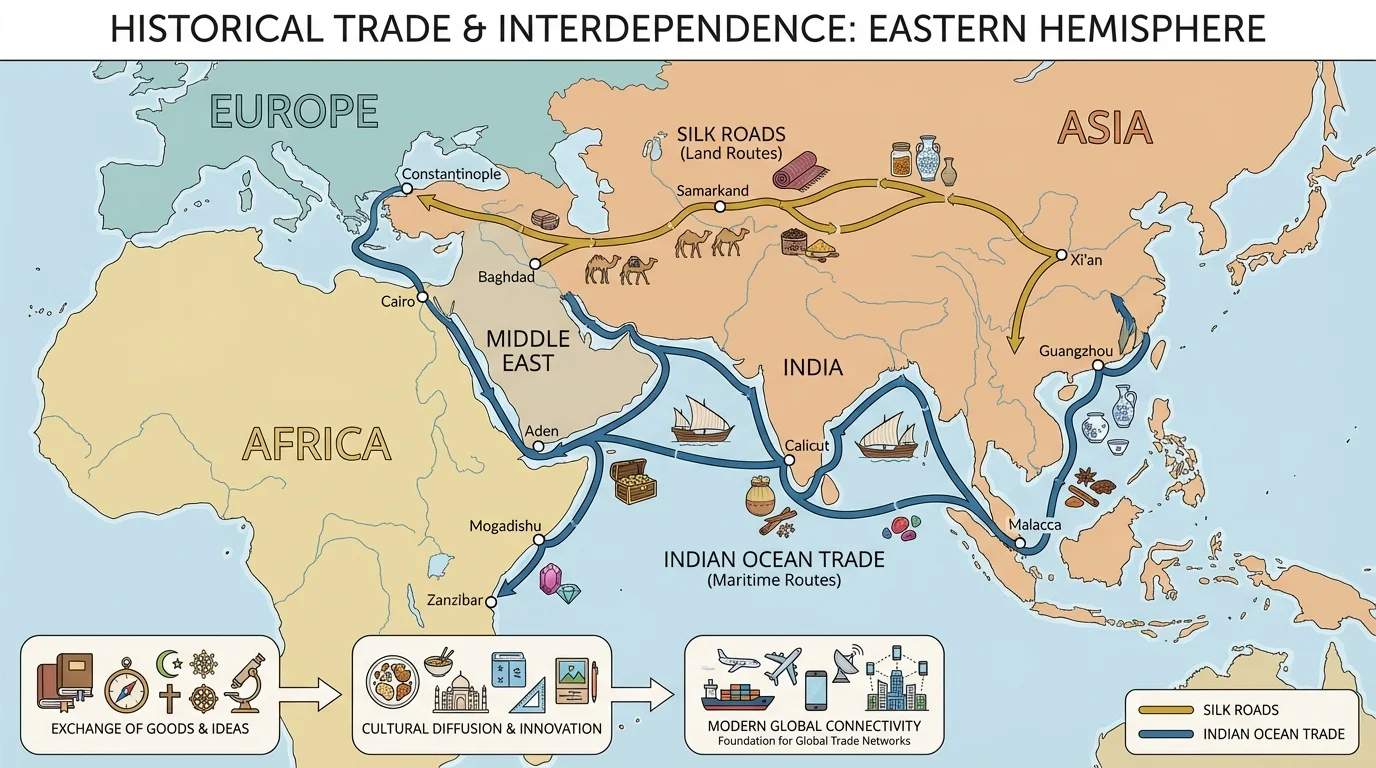
Paper, which was developed in China, eventually spread westward and transformed communication. Hindu-Arabic numerals developed through exchanges involving India and the Islamic world, and they later became essential to modern mathematics and science. Crops such as bananas and citrus fruits traveled to new regions, changing diets and farming systems. In the same way, diseases also moved. The Black Death spread across trade networks in the fourteenth century, showing that interdependence could bring danger as well as opportunity.
This connectedness did not erase local identity. Instead, societies adapted outside influences in their own ways. A religion might spread widely, but each region interpreted it differently. A new crop might be adopted, but prepared according to local traditions. Interdependence means connection, not sameness.
Even while societies influenced one another, each developed its own character. Geography played a major role. River valleys, mountains, deserts, monsoon winds, and coastlines shaped settlement and trade. Belief systems also mattered. Confucian ideas influenced government in China. Hindu traditions shaped life in India. Islam connected many societies while taking different forms in different places. Christianity developed distinct branches such as Eastern Orthodoxy and Roman Catholicism.
Culture includes language, religion, art, government, social customs, and daily habits. Japanese court life, Persian poetry, Swahili coastal trade culture, and Ethiopian Christianity all show that societies in the Eastern Hemisphere were not copies of one another. They were unique communities with their own traditions and values.
Language is another sign of uniqueness. Arabic, Sanskrit, Mandarin, Latin, Greek, and Swahili carried ideas across time and space, but each also shaped how people understood the world. Architecture reveals uniqueness too. A Chinese pagoda, an Indian stupa, a Gothic cathedral, and a mosque in Mali all reflect different beliefs, materials, and artistic choices.
The Swahili language developed along the East African coast through contact among African peoples, Arab merchants, and others across the Indian Ocean. Its vocabulary shows how trade can create cultural blending while still preserving a local identity.
Uniqueness can even be seen in government. Some societies were ruled by emperors with large bureaucracies, while others were led by kings, city-states, or local chiefs. These political differences affected law, taxes, military power, and social order.
The Silk Roads were not one single road but a network of land routes connecting East Asia to Central Asia, Southwest Asia, and Europe. Merchants carried silk, horses, spices, precious stones, glassware, and metal goods. Buddhist monks, Muslim traders, diplomats, and travelers also moved along these routes.
A primary source for Silk Roads history might be the writings of the Chinese historian Sima Qian, the travel accounts of Xuanzang, or the observations of Marco Polo. These sources provide vivid details, but each writer had limits. Marco Polo, for instance, described wonders of Asia for a European audience, so historians compare his account with Chinese records and archaeological evidence.
Case study in source analysis: a traveler on the Silk Roads
Step 1: Identify the source.
A traveler's journal is a primary source because it was written by someone who experienced the places being described.
Step 2: Analyze perspective.
The traveler may notice trade goods, languages, roads, and dangers, but may misunderstand beliefs or customs in unfamiliar regions.
Step 3: Corroborate.
Compare the journal with artifacts, local records, and modern historians' research.
Step 4: Form a claim.
The evidence may support the claim that the Silk Roads encouraged both cultural exchange and regional diversity.
The Silk Roads show interdependence because regions depended on one another for goods and knowledge. They also show uniqueness because every society along the routes chose what to adopt, reject, or reshape. As seen earlier in [Figure 2], these routes connected a vast area, but connection did not create one single culture.
The Indian Ocean trade network linked East Africa, the Arabian Peninsula, India, and Southeast Asia for centuries. Merchants used monsoon winds to sail predictably across the ocean. Cities such as Kilwa, Calicut, and Malacca became important commercial centers.
Primary sources include port records, travelers' accounts such as those of Ibn Battuta, and archaeological evidence like Chinese porcelain found in East African towns. Secondary sources help explain how these findings fit together. Historians have learned that African, Arab, Persian, Indian, and Southeast Asian peoples all helped shape this trade world.
Indian Ocean trade demonstrates interdependence especially clearly. East African merchants exported gold, ivory, and enslaved people. Indian traders exchanged cotton textiles and spices. Chinese merchants supplied porcelain and silk. Each region offered something valuable, and each relied on exchange.
At the same time, port cities developed unique blended cultures. On the East African coast, Muslim influence mixed with local African traditions to create Swahili culture. This is a strong example of how contact can produce something new rather than erase older traditions.
Religions and philosophies spread through trade, migration, conquest, and missionary work. Buddhism moved from India into Central Asia, China, Korea, and Japan. Islam spread from the Arabian Peninsula into North Africa, West Africa, Central Asia, South Asia, and Southeast Asia. Christianity spread through Europe, the Middle East, and parts of Africa.
Primary sources for these movements include sacred texts, inscriptions, missionary letters, mosque and temple architecture, and rulers' decrees. Secondary sources analyze how beliefs changed in different settings. For example, Buddhism in China blended with local traditions and philosophies. Islam in West Africa became connected to trade, scholarship, and regional kingship. Christianity in Ethiopia developed in a distinct African context.
These patterns show both unity and diversity. A faith can connect people across continents through shared beliefs, but local communities still shape worship, art, law, and daily life in different ways. That is another form of uniqueness within interdependence.
"The past is never dead. It's not even past."
— William Faulkner
This idea fits the Eastern Hemisphere well. Ancient exchanges still shape modern languages, architecture, religions, food, and trade systems.
Modern society still carries the marks of Eastern Hemisphere interactions. Many everyday foods reflect long-distance exchange: noodles, bread, tea, coffee, citrus fruits, and spices all have histories tied to movement across regions. Modern math and science rely on ideas that traveled through India, the Islamic world, and Europe. Major world religions continue to shape ethics, law, art, and identity.
Even the global economy echoes older patterns. Shipping routes across the Indian Ocean remain important today. Cities that grew through trade in the past often remain major centers of commerce. Cultural blending continues through migration, technology, and communication.
When we notice these connections, history stops feeling distant. A smartphone made from materials sourced on different continents, software influenced by mathematical traditions from many societies, and foods sold in a local market all reflect interdependence. Yet people still maintain languages, customs, and beliefs that show uniqueness. The same balance existed in the past.
A historian moves from questions to evidence to argument, as [Figure 3] illustrates in the process of building a claim. A thesis is a clear statement that answers a historical question and can be supported with evidence. It should not be vague. Instead of saying, "Many societies traded," a stronger thesis says exactly what that trade did.
For example, a strong thesis might be: Trade networks in the Eastern Hemisphere created interdependence by spreading goods, ideas, and technologies, but regional geography and culture caused societies to adapt these influences in distinct ways. This claim is specific, arguable, and supported by evidence from many sources.
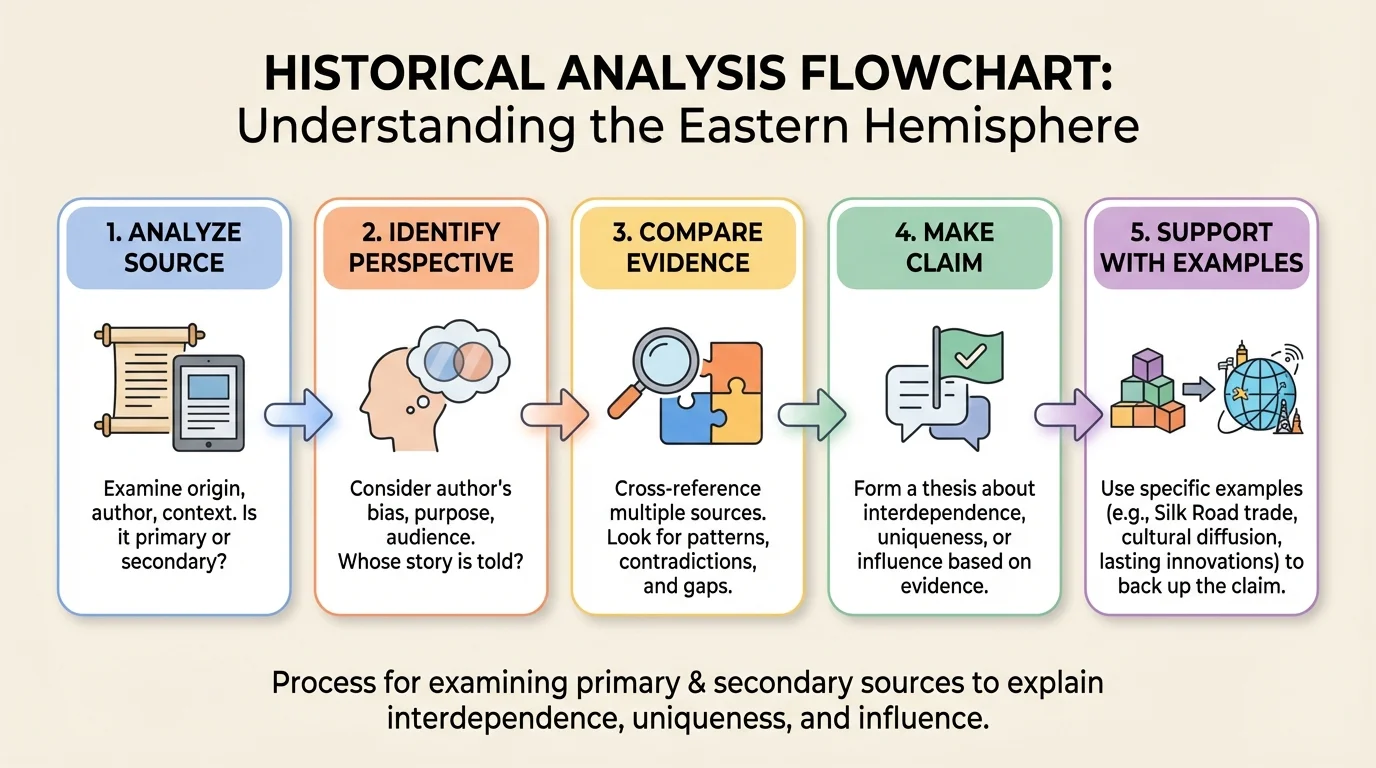
To build a thesis, start with a question. Then gather primary and secondary sources. Analyze each source for point of view, purpose, and context. Compare the sources. Look for patterns. Finally, write a claim that answers the question and use evidence to support it.
Suppose you study the spread of Islam. Primary sources might include travelers' writings, mosque inscriptions, and rulers' letters. Secondary sources might explain regional differences. If the evidence shows that Islam spread through both trade and political power, but looked different in West Africa than in Southwest Asia, your thesis can explain both interdependence and uniqueness at the same time.
| Question historians ask | What to examine | Why it matters |
|---|---|---|
| Who created the source? | Author or speaker | Reveals perspective and possible bias |
| When and where was it created? | Time and place | Provides context |
| Why was it created? | Purpose | Shows what the creator wanted to achieve |
| Who was the audience? | Intended readers or listeners | Helps explain tone and content |
| How does it compare with other evidence? | Similarities and differences | Supports corroboration |
Table 1. Questions historians use when analyzing sources.
Later, when writing an argument, students can return to the process shown in [Figure 3]. Strong history writing does not just list facts. It explains relationships: how people influenced one another, why they remained distinct, and how the past still matters now.
When studying any civilization, remember that evidence does not speak for itself. Historians must interpret it carefully, compare viewpoints, and support claims with relevant details.
The most powerful historical explanations do two things at once: they show connection and difference. The peoples of the Eastern Hemisphere shared routes, ideas, and exchanges that linked their histories together. At the same time, they preserved local traditions and created unique societies. Analyzing primary and secondary sources allows us to see both truths clearly.
