Why does one country produce huge amounts of oil while another imports nearly all of its energy? Why are chocolate bars connected to farms in West Africa, and why do phones depend on minerals mined far from the stores that sell them? These questions point to a powerful idea: the way resources are spread around the world strongly affects what people buy, what businesses sell, and how economies grow. Consumerism is not just about shopping. It is about the choices people make in response to price, availability, advertising, and need—and all of those are shaped by resources.
Resource distribution is the way natural resources, human labor, and useful materials are spread across places. Some areas have rich soil, fresh water, forests, or mineral deposits. Others may have very little farmland but excellent ports, highly trained workers, or advanced factories. Because no region has everything, people and businesses depend on exchange and trade.
Consumerism is the tendency of people and societies to buy and use goods and services. It includes everyday decisions such as choosing food, clothes, electronics, transportation, and energy use. Consumerism grows stronger when people have more income, more products to choose from, and constant messages encouraging them to buy. But the number and type of products available depend on the resources behind them.
Resources are materials or conditions people use to meet needs and wants. These include natural resources such as oil, water, timber, fertile land, and minerals, as well as human resources such as workers and skills.
Scarcity means there is not enough of something to meet all wants. Abundance means a resource is available in large amounts.
Think about a simple cotton T-shirt. Cotton must be grown in a place with enough land, water, and warm weather. It must then be cleaned, spun into thread, woven into cloth, dyed, sewn, shipped, and sold. If one part of that chain becomes difficult—such as drought reducing cotton harvests—the final product may become more expensive or harder to find. That is how resource distribution reaches all the way into a consumer's closet.
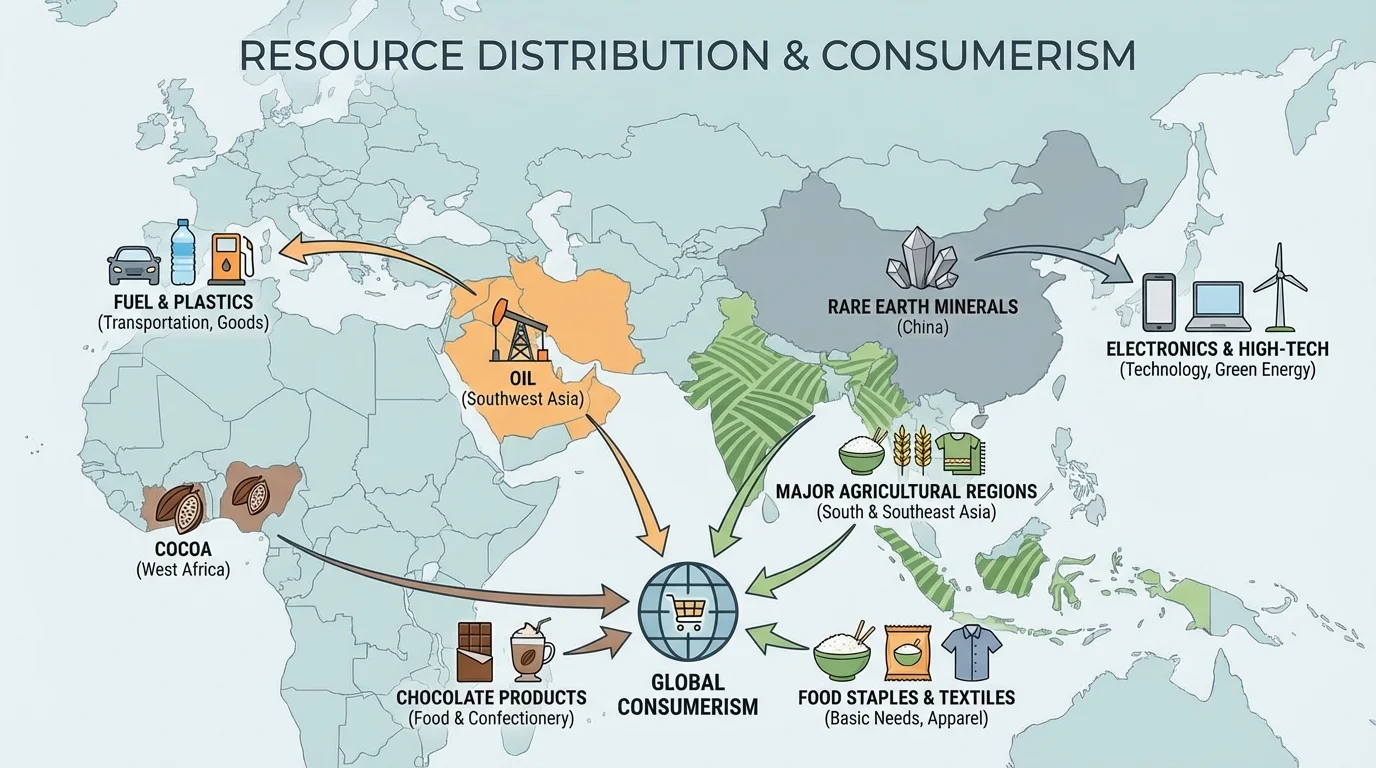
The Eastern Hemisphere includes Africa, Europe, Asia, and Oceania, and resources are not spread evenly across these regions. As [Figure 1] shows, certain resources are concentrated in specific places, which gives those places special roles in the global economy. Southwest Asia has some of the world's largest oil reserves. West Africa is important for cocoa production. China has major supplies of rare earth minerals used in electronics. South and Southeast Asia contain fertile agricultural zones that produce rice, tea, palm oil, and other major crops.
This uneven pattern matters because countries often specialize in what their land, climate, and geology make possible. Saudi Arabia exports oil. Côte d'Ivoire and Ghana are leading cocoa producers. China is central to the processing of important minerals used in batteries, magnets, and electronics. Meanwhile, countries with fewer of these resources may need to import them, making consumers there more affected by world prices and shipping costs.
Some differences come from nature. Oil forms only under certain geological conditions. Fertile farmland depends on climate, soil, and water. Minerals such as copper, cobalt, and rare earth elements are found in some rock formations and not others. Other differences come from human history. Colonization, industrial development, and technology have shaped which regions control processing, shipping, and manufacturing even when raw materials come from somewhere else.
Europe offers another interesting example. Many European countries do not have the same level of oil resources as parts of Southwest Asia, but they have strong transportation networks, advanced industries, and wealthy consumer markets. This means they often import raw materials, turn them into finished goods, and sell those goods in high-value markets. Resource distribution, then, is not only about where materials are found. It is also about where they are transformed.
Some everyday products travel through several countries before reaching a customer. A single smartphone may depend on minerals from Africa, processing in Asia, design work in Europe, and sales all over the world.
Oceania also shows uneven distribution. Australia has large mineral resources, including iron ore and coal, while many Pacific islands have far fewer land-based resources and depend more heavily on imports. This affects what businesses can produce locally and what consumers must buy from abroad.
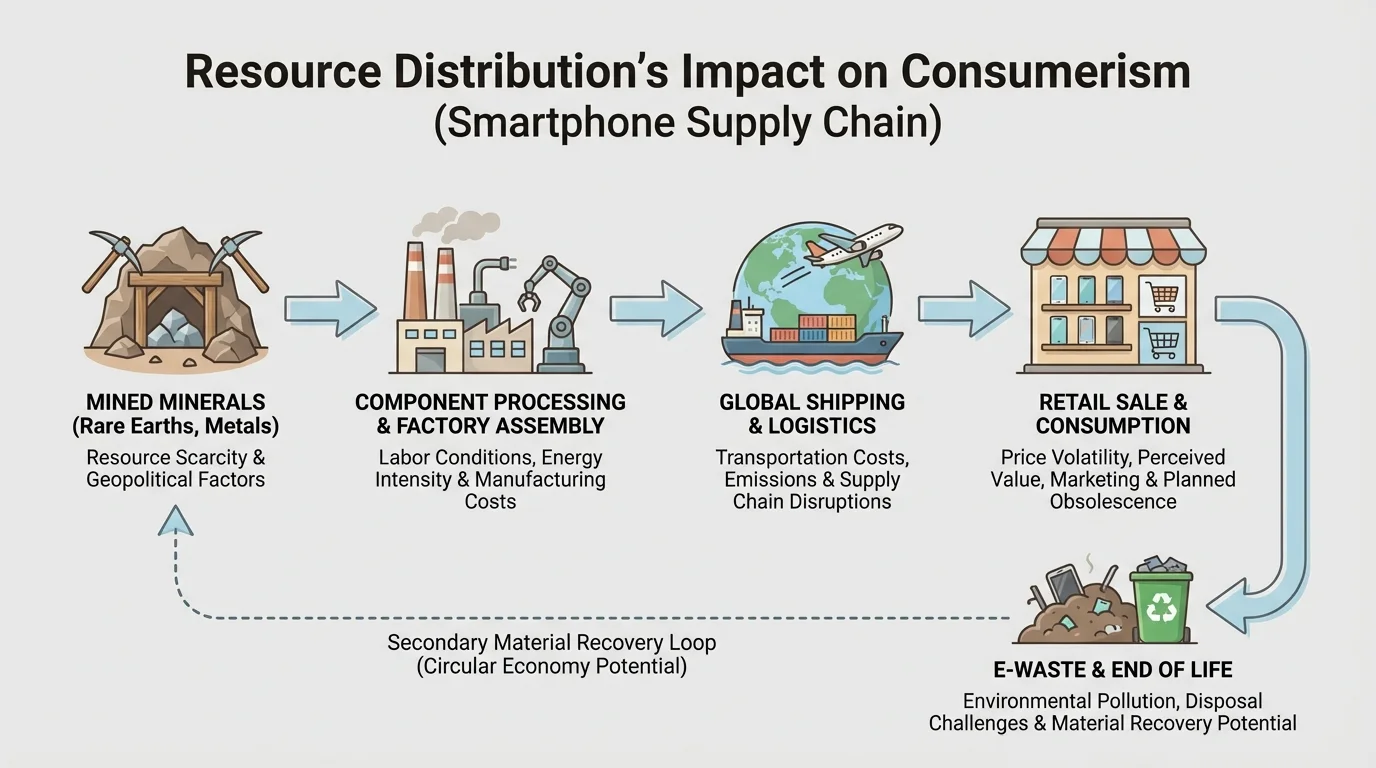
The path from a raw resource to a finished product is called a supply chain. In a global economy, supply chains are often long and complex. [Figure 2] illustrates how one product can move from extraction to manufacturing to transportation to retail sale. When resources are far away from factories or markets, costs usually rise because companies must pay for shipping, fuel, storage, and labor at every stage.
If a resource is scarce, prices often increase. For example, if drought reduces wheat harvests in an important farming region, wheat becomes less available. Food companies may pay more for flour, and then consumers may see higher bread or pasta prices in stores. If a resource is abundant, prices may be lower, though they can still change because of demand, taxes, conflict, or transportation problems.
Transportation is a major link between resource distribution and consumerism. Oil extracted in one region may travel by pipeline, tanker ship, or truck before it is refined into gasoline. Cocoa beans may be grown in West Africa, shipped to Europe for processing, and then turned into chocolate sold around the world. The farther and more difficult the journey, the more likely businesses will add those costs to the final price consumers pay.
Scarcity does not always mean a product disappears. Sometimes it means consumers must make trade-offs. A family may switch from one brand to another, buy less of a product, or choose a substitute. If the price of imported cooking oil rises sharply, consumers may buy a different oil, use less, or cut spending on another item. That is one way resource distribution shapes everyday decision-making.
Prices are also affected by demand. If millions of people want electric cars, the demand for lithium, cobalt, nickel, and copper rises. If these resources are concentrated in a few places, supply can become strained. Businesses may compete to secure contracts, and consumers may face higher prices for products that depend on those materials.
How scarcity changes behavior
When resources become harder to get, businesses often raise prices, search for new suppliers, redesign products, or use substitute materials. Consumers respond by comparing prices, delaying purchases, reusing items, or choosing alternatives. This chain reaction connects distant resource regions to local shopping choices.
Advertising can encourage consumerism, but advertising cannot create unlimited supply. A company may heavily market a product, yet if the key ingredients or materials are limited, the company may not be able to meet demand. This shows that consumer desire and physical resources are connected.
Businesses study resource patterns carefully. They look for places where raw materials, energy, transportation, and labor can be combined efficiently. A factory is more likely to be built where costs are lower and materials are easier to reach. This is why some industries cluster in certain regions.
Manufacturing often develops near transportation routes such as ports, rivers, and major highways. Even if raw materials are imported, a business may choose a location with skilled workers, reliable electricity, and access to large consumer markets. For example, many goods sold in Europe are produced using imported materials but assembled in places with strong industrial systems.
Businesses also respond to risk. If a company depends on one region for an important resource, conflict, drought, sanctions, or natural disasters can interrupt supply. To protect themselves, companies may diversify suppliers, store extra inventory, or invest in recycling. These choices affect product prices and availability for consumers.
Case study: A chocolate company and cocoa supply
A chocolate business depends on cocoa beans, which are grown mainly in a limited number of tropical regions.
Step 1: The company buys cocoa from countries such as Côte d'Ivoire or Ghana.
Step 2: If harvests fall because of disease or weather, cocoa becomes scarcer.
Step 3: The company may raise prices, make smaller bars, or blend ingredients differently.
Step 4: Consumers notice the change and may buy less, switch brands, or wait for sales.
This example shows how a resource grown far away can shape consumer behavior in many countries.
Some businesses also use resource distribution as part of their marketing. They may advertise that their tea comes from India or Sri Lanka, that their olive oil comes from Mediterranean regions, or that their coffee comes from Ethiopia. In these cases, origin becomes part of the product's appeal.
Consumers do not just react to prices. They also react to beliefs, habits, quality, and values. Still, resource distribution influences these choices in major ways. When imported goods become expensive, local products may become more attractive. When key materials are abundant, products that use them may become more common.
Substitute goods are products that can be used in place of one another. If butter becomes expensive, some people may buy margarine. If gasoline prices rise, some families may use public transportation more often or choose smaller cars. Substitute choices help consumers adapt to scarcity.
Consumers also respond to trends created by resource-rich industries. In oil-producing countries, low energy costs can sometimes encourage high energy use. In regions where imported electronics are easy to obtain, demand for the newest devices may grow quickly. In places where fresh water is scarce, consumers may become more careful about water use and support products that save water.
Income matters too. Wealthier consumers can often keep buying expensive imported goods even when prices rise. Lower-income consumers usually have to adjust more quickly, buying fewer items or choosing cheaper alternatives. This means resource distribution can affect different groups in different ways.
Earlier studies of economics and geography show that people make choices because wants are greater than available resources. This basic idea of limited resources helps explain why prices change and why consumers must prioritize needs and wants.
Another major factor is information. Consumers today can learn where products come from, how workers are treated, and whether production harms the environment. This allows people to connect their spending to global resource systems more directly than in the past.
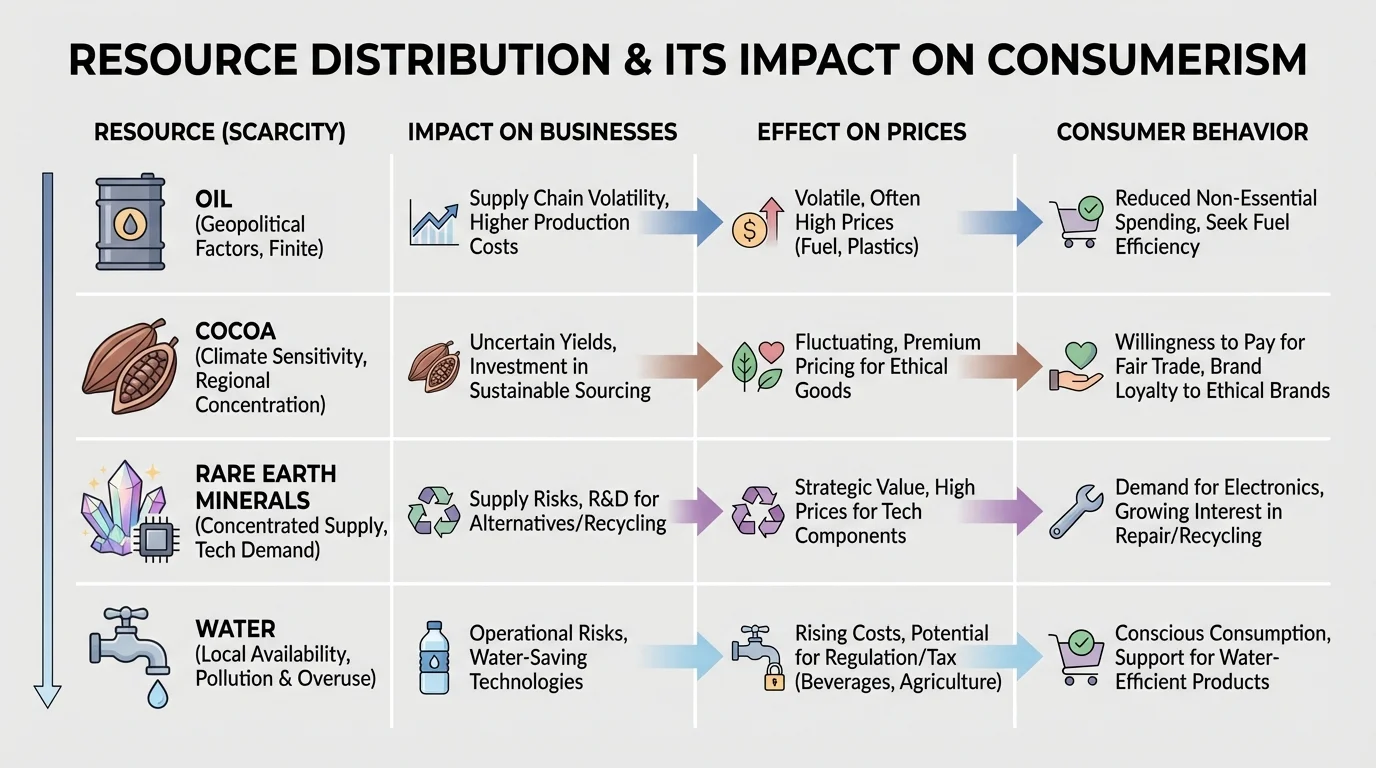
The Eastern Hemisphere provides strong examples of how resource patterns affect consumerism. As [Figure 3] illustrates, different resources shape different kinds of consumer behavior, business strategy, and trade. Looking at several cases together helps reveal both similarities and important differences.
First, consider oil in Southwest Asia. Countries such as Saudi Arabia, Iraq, Kuwait, and the United Arab Emirates hold major oil reserves. Because oil powers transportation, heating, electricity generation, and manufacturing, its distribution has worldwide effects. When oil prices rise, the cost of shipping and producing many goods can rise too. Consumers may then pay more not only for gasoline but also for food, airline tickets, and delivered products.
Second, consider cocoa in West Africa. Côte d'Ivoire and Ghana supply a large share of the world's cocoa. This makes chocolate companies heavily dependent on those farming regions. Weather, disease, and global trade conditions can all affect cocoa supply, which then affects what consumers pay for sweets and baked goods.
Third, consider rare earth minerals and manufacturing in China. Rare earths are used in electronics, wind turbines, headphones, electric vehicles, and many other products. Because these materials are important and not evenly available, countries and businesses pay close attention to access, processing, and trade policies. Consumers may never see these minerals directly, but they feel the effects in the price and availability of technology.
Fourth, consider water scarcity in parts of North Africa and Southwest Asia. Water is essential for farming, industry, and daily life. In regions with limited fresh water, food production may be harder, which increases dependence on imports. Consumers in these places may pay more for certain foods and may support technologies such as drip irrigation, desalination, or water-saving appliances.
The chart in [Figure 3] makes an important point: not all resources shape consumerism in the same way. Oil affects transportation and energy across many industries. Cocoa mainly affects specific food products. Rare earth minerals strongly influence advanced technology. Water shapes agriculture, household life, and long-term development.
| Resource | Major Eastern Hemisphere Region | Main Products Affected | Consumer Impact |
|---|---|---|---|
| Oil | Southwest Asia | Fuel, plastics, shipping | Higher or lower transport and energy costs |
| Cocoa | West Africa | Chocolate, sweets | Changes in food prices and product size |
| Rare earth minerals | China and parts of Asia | Phones, batteries, electronics | Technology prices and availability |
| Fresh water | North Africa and Southwest Asia | Food production, daily use | Food import dependence and conservation habits |
Table 1. Examples of major resources in the Eastern Hemisphere and how they influence products and consumer behavior.
Uneven resource distribution can create benefits. Regions with valuable resources may earn export income, create jobs, and build infrastructure. Trade allows countries to obtain resources they lack. Consumers benefit by gaining access to products that cannot be produced locally.
But there are also problems. Heavy dependence on one resource can make an economy unstable. If world prices fall, jobs and government income may drop. If extraction is poorly managed, the environment may be damaged through pollution, deforestation, soil loss, or water depletion. In some places, people who live near valuable resources do not always share equally in the profits.
Responsible consumerism
Responsible consumerism means thinking about how and where products are made before buying them. It includes asking whether a product uses resources efficiently, whether workers are treated fairly, and whether buying less, repairing, or reusing might be a smarter choice.
Consumers can make more informed choices by reading labels, learning about supply chains, reducing waste, and supporting companies with ethical sourcing practices. For example, buying durable products instead of replacing them often can reduce pressure on limited resources. Recycling electronics can also reduce the need to extract as many new minerals.
Governments and international groups also influence consumerism through laws, trade agreements, and environmental rules. If a government protects water supplies or limits pollution, businesses may have to change how they produce goods. These changes can affect both prices and availability, but they may protect resources for the future.
"There is enough in the world for everyone's need, but not enough for everyone's greed."
— Often attributed to Mahatma Gandhi
This idea connects directly to consumerism. When consumption grows too fast without concern for resource limits, shortages, waste, and environmental damage become more likely. Understanding resource distribution helps people see why thoughtful choices matter.
The future of consumerism will continue to be shaped by changing resource patterns. Renewable energy, recycling, improved transportation, and new technologies may reduce dependence on some limited resources. For instance, better battery design may change how much of certain minerals are needed. More efficient irrigation may help farmers use less water.
At the same time, new technologies can create new demand. As more people buy electric vehicles, solar panels, and advanced electronics, pressure may increase on minerals and manufacturing regions. The same basic lesson remains true: when resources are unevenly distributed, consumer choices are connected to geography, trade, and business decisions.
Seen this way, buying a shirt, a snack, or a phone is never just a personal act. It is part of a larger network linking farms, mines, factories, ports, stores, and households across the Eastern Hemisphere and beyond. The better people understand those links, the better they can explain why products cost what they do, why shortages happen, and how consumer choices can affect the world.
