A surprising amount of modern life began thousands of years ago. The idea that governments should follow laws, the belief that citizens should have a voice, and even technologies that helped people travel, fight wars, and spread information all have deep roots in the Eastern Hemisphere. When historians study Africa, Asia, and Europe, they are not just looking at the distant past. They are tracing the beginnings of systems and inventions that still shape daily life today.
The Eastern Hemisphere includes many of the world's earliest large civilizations. These societies did not all develop in the same way, but they faced similar questions: How do people organize a growing population? Who makes the rules? How can ideas be recorded and shared? How do inventions change the balance of power? By investigating these questions, we can better understand both ancient societies and current events.
Historical developments in the Eastern Hemisphere matter because many regions influenced one another over time. Trade routes connected cities and empires. Armies spread political ideas along with military power. Religious beliefs, writing systems, artistic styles, and inventions crossed borders. A change in one region could affect another region far away.
For example, a technological invention made in China might later influence trade in the Indian Ocean or navigation in Europe. A legal system developed in Mesopotamia might shape later ideas about justice. A political experiment in Greece could inspire later governments. History is not a collection of isolated stories; it is a network of connections.
Civilization is a term for a complex society with cities, organized government, social classes, specialized jobs, and systems of writing or record keeping.
Eastern Hemisphere refers mainly to the continents of Africa, Asia, Europe, and the nearby islands.
Primary source is a source created during the time being studied, such as a law code, inscription, or letter.
Secondary source is an account created later by historians who study primary sources.
Primary and secondary sources help historians investigate the past. A carved law code is a primary source. A modern textbook that explains what that law code meant is a secondary source. Good historical thinking uses both kinds of evidence and asks whether a source shows strength, weakness, fairness, or bias.
[Figure 1] The earliest large civilizations often formed near dependable rivers. Rivers provided water for drinking, farming, transportation, and trade. They also left behind rich soil after flooding, which made agriculture more productive. As farming improved, populations grew, villages expanded into cities, and leaders developed systems to organize labor and resources.
Four famous early river valley civilizations were Mesopotamia near the Tigris and Euphrates Rivers, Egypt along the Nile River, the Indus Valley civilization along the Indus River, and early Chinese civilization along the Huang He, or Yellow River. These regions were separated by distance, but each depended on river systems for survival and growth.
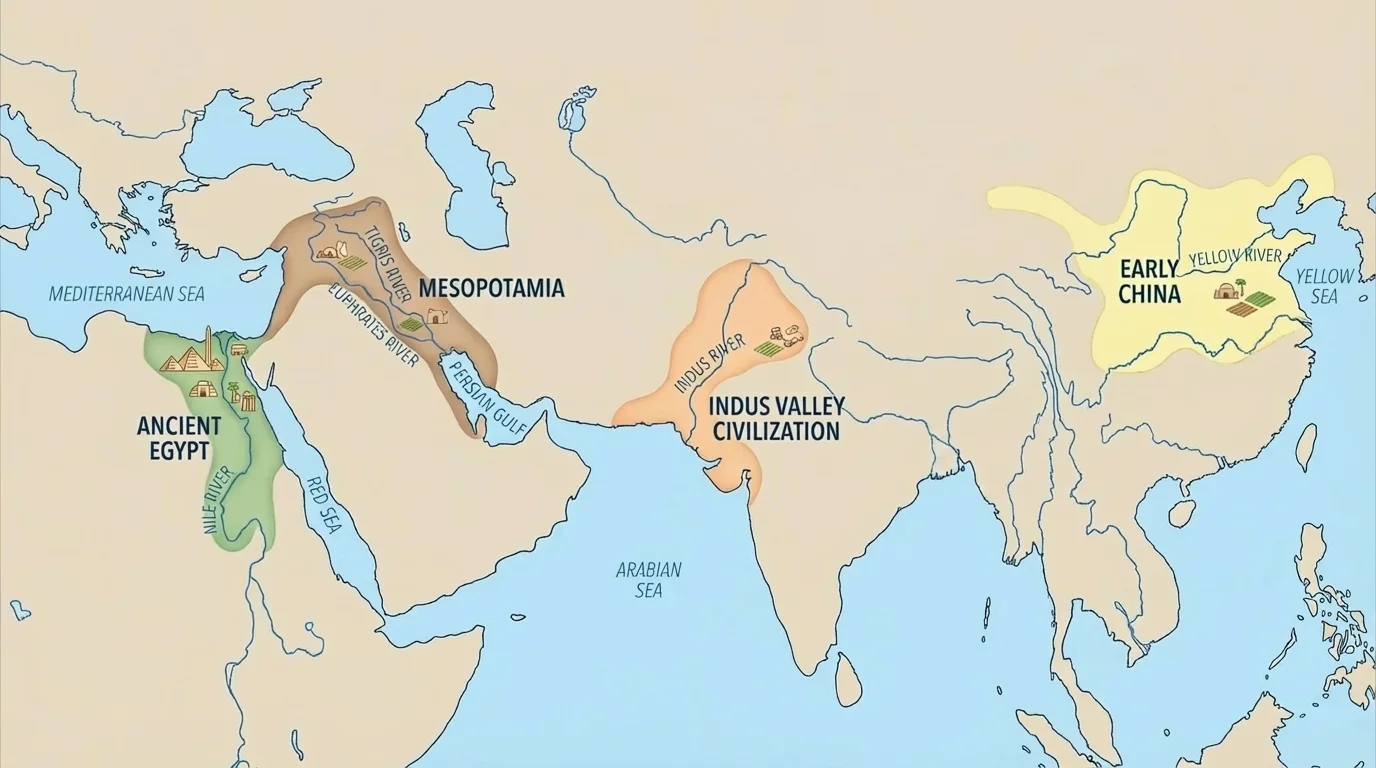
In Mesopotamia, city-states such as Ur and Babylon developed in a region with unpredictable flooding. Because floods could be destructive, people built irrigation systems to control water. This required cooperation and leadership. Mesopotamian societies also developed writing called cuneiform, which allowed officials, merchants, and priests to keep records.
Egypt grew along the Nile, whose flooding was more regular and predictable. This stability helped support strong government under pharaohs. Egyptian culture placed great importance on religion and the afterlife. Monumental architecture such as pyramids showed both religious belief and political power.
The Indus Valley civilization is known for carefully planned cities such as Harappa and Mohenjo-Daro. Streets were laid out in orderly patterns, and some buildings had advanced drainage systems. This suggests a society that valued planning, sanitation, and urban organization. Even though scholars still debate parts of its political structure, its cities reveal impressive social coordination.
In early China, settlements near the Huang He River developed farming, bronze tools, and dynasties. Flooding could be dangerous, and Chinese leaders often linked political power to the ability to maintain order. Over time, Chinese civilization developed strong traditions of family respect, government service, and technological creativity.
These civilizations also had social hierarchies. Kings, priests, officials, merchants, artisans, farmers, and enslaved people often had different roles and different levels of power. As we saw on the regional map in [Figure 1], geography helped shape each society, but people's responses to geography mattered just as much. Rivers created opportunities, yet human decisions turned those opportunities into civilizations.
Why rivers mattered
Rivers supported civilization because they made food production more reliable. Reliable food led to population growth. Population growth led to specialization, meaning that not everyone had to farm. Some people became builders, scribes, traders, soldiers, and rulers. In this way, geography influenced social and political development.
One important historical conclusion is that environment influences human life, but it does not control it completely. Two societies may live near rivers, yet build very different governments and cultures. Historians look at both natural conditions and human choices.
[Figure 2] As societies became more crowded and complex, written laws became more important. One of the best-known examples is the Hammurabi's Code, created by King Hammurabi of Babylon around 1754 BCE. This set of laws is one of the earliest surviving written legal codes.
Hammurabi's Code covered issues such as trade, property, theft, marriage, labor, and punishment. The code was carved onto a stone stele, which is a tall stone slab. Because the laws were written down, they were more permanent and easier to enforce than unwritten customs.
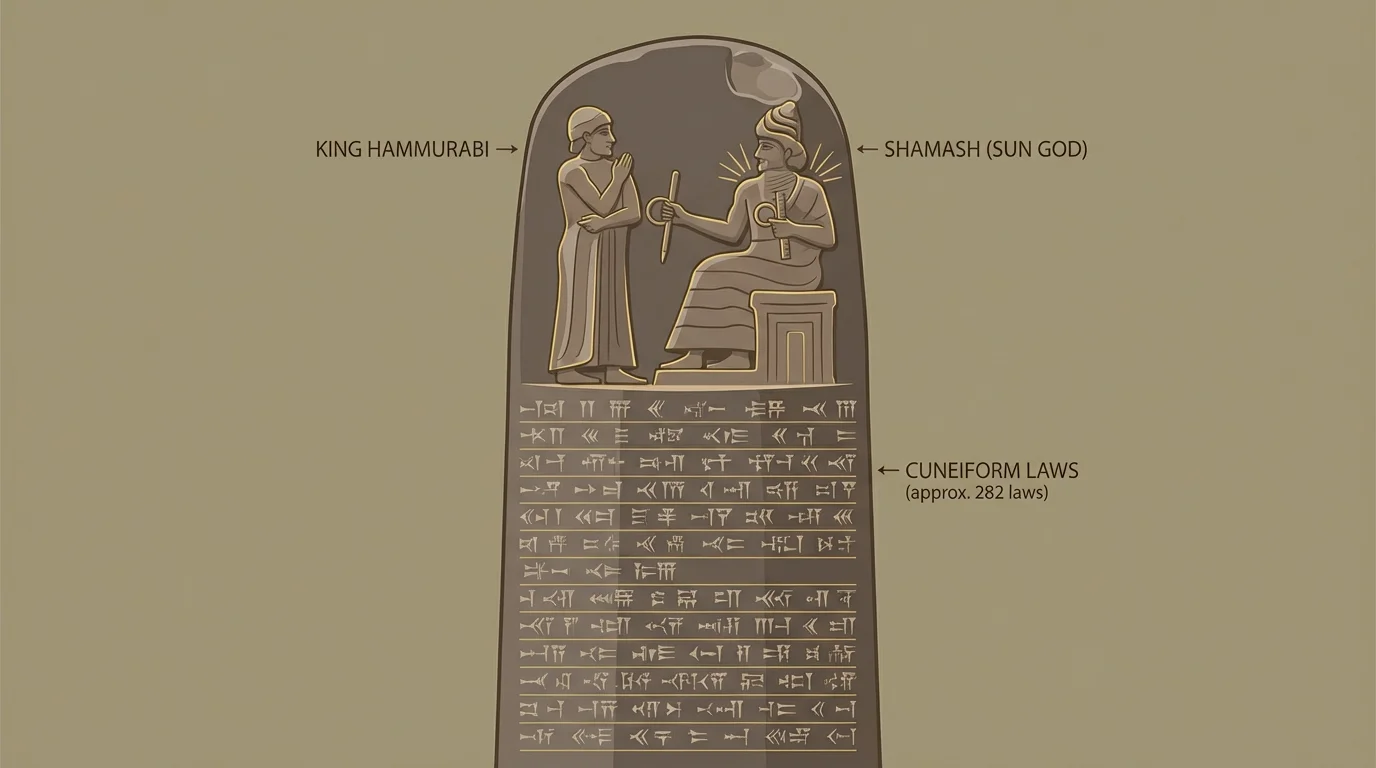
A famous idea in the code is often summarized as "an eye for an eye." This meant that punishments should match the harm done. In some ways, that sounds fair because it tries to create balance. However, the code was not equal for everyone. Punishments could depend on social class or gender. A noble person, a commoner, and an enslaved person might receive different treatment under the same law.
This makes Hammurabi's Code important to evaluate, not just describe. It shows progress because laws were written and organized, which helped create order. But it also shows limits because justice was unequal. Historians must be able to hold both ideas at once: a development can be significant and still be unfair.
Case study: evaluating Hammurabi's Code
A historian asks whether the code was a step forward for society.
Step 1: Identify the evidence.
The code was written, public, and covered many parts of life.
Step 2: Identify the benefit.
Written laws can reduce confusion and strengthen order in a growing kingdom.
Step 3: Identify the weakness.
The punishments were not equally fair to all people.
Step 4: Draw a conclusion.
The code was an important political development, but it did not create equal justice.
This kind of historical thinking is useful today. Modern societies still debate how laws should balance order, fairness, and equal treatment. The issues may be different, but the basic question remains the same: what makes a legal system just?
Primary sources such as the stele itself help historians study Mesopotamian values. The image on the stone suggests that Hammurabi's authority came from the gods. That matters because law was not just political; it was also religious. The connection between divine authority and government power, which appears clearly in [Figure 2], was common in many ancient societies.
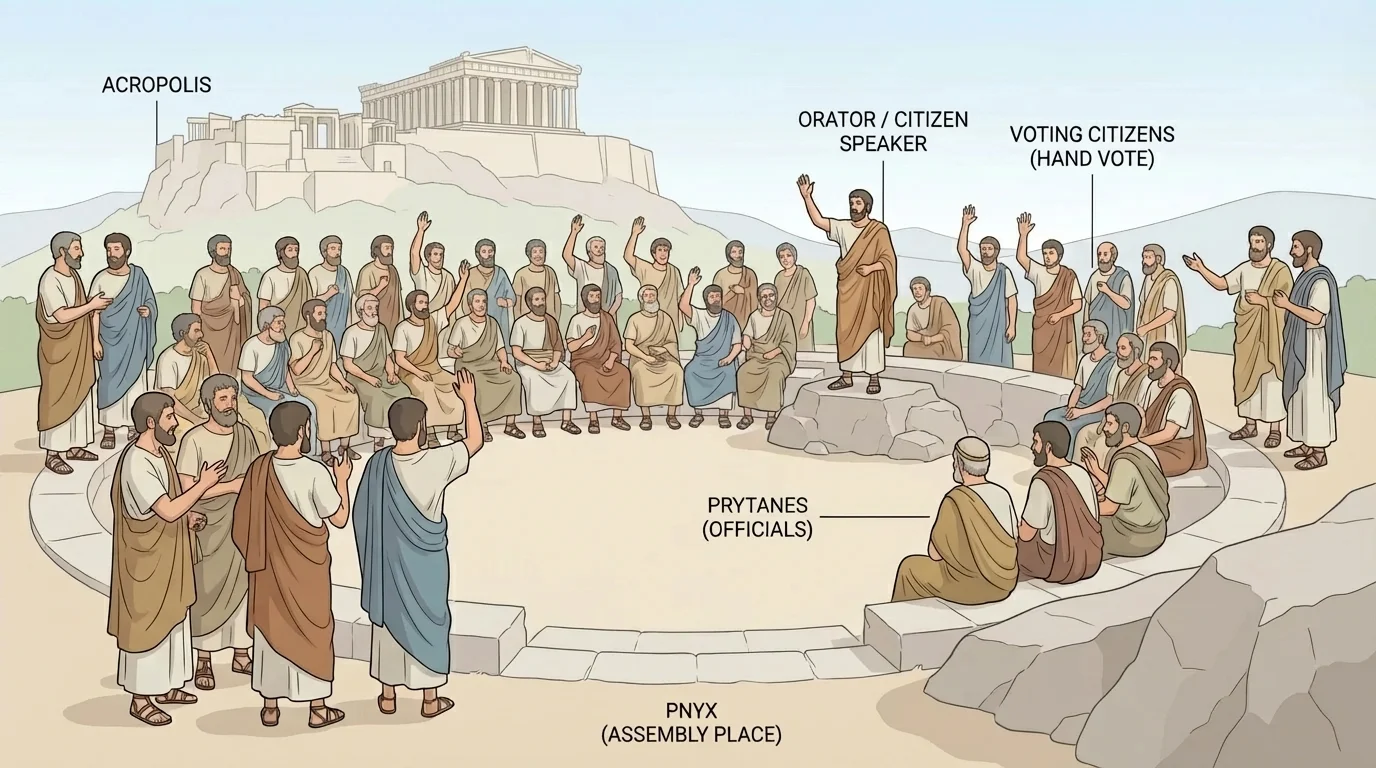
[Figure 3] In ancient Greece, especially in Athens, a new political idea developed: democracy. In a direct democracy, citizens participate personally in making decisions instead of only choosing representatives. This was a major change in political thinking because it connected government to public debate and citizen involvement.
Greek civilization was made up of city-states, not one single country. Athens became famous for democratic government, while Sparta emphasized military discipline. In Athens, male citizens could gather in an assembly, discuss issues, and vote. This encouraged skills such as public speaking, persuasion, and civic responsibility.
At the same time, Greek democracy had serious limits. Women, enslaved people, and foreigners were excluded from citizenship. So while Athens helped introduce the idea that ordinary citizens should help govern, it did not extend that right to everyone.
Greek culture also shaped the Eastern Hemisphere in lasting ways. Greek philosophers asked deep questions about knowledge, ethics, and government. Greek artists studied balance and proportion. Greek historians such as Herodotus and Thucydides tried to explain events using evidence and human decisions rather than myth alone. These cultural achievements traveled widely after the conquests of Alexander the Great spread Greek influence into Egypt and parts of Asia.
The word "democracy" comes from Greek words meaning "rule by the people." Even though Athenian democracy was limited, the idea itself became one of history's most influential political concepts.
Greek democracy matters today because many modern governments value voting, debate, and citizenship. But the limits of Athenian democracy also teach an important lesson: a government can call itself democratic and still exclude many people. Historians and citizens both need to ask who has power and who does not.
The public assembly helps us picture why speaking and listening were so important in Athens. Politics there depended not only on laws, but also on persuasion. That connection between ideas and public decision-making remains important in modern democracies.
[Figure 4] The Romans developed a different political system called a republic, in which people chose leaders to represent them. Roman leaders feared giving too much authority to one person, so they divided power among different institutions. This was one of Rome's most important political contributions.
The Roman Republic included consuls, the Senate, and popular assemblies. Consuls were top officials who served limited terms. The Senate advised and influenced policy. Assemblies allowed citizens to vote on some matters. This system was meant to create balance and prevent tyranny, which is harsh rule by one person.

Roman law was another major achievement. The Twelve Tables made laws public so citizens could know their rights and duties. Like Hammurabi's Code, Roman law tried to create order, but the Roman system continued to develop and became more flexible over time. Roman legal ideas later influenced many legal systems in Europe and beyond.
Still, the Roman Republic was not perfectly fair. Wealthy patricians had more influence than poorer plebeians, especially early on. Political conflict between social classes was common. Over time, military leaders gained more personal power, and the republic weakened. Julius Caesar's rise showed how a republic can struggle when ambition and military loyalty overpower institutions.
| Government system | Main idea | Who held power? | Key limit |
|---|---|---|---|
| Mesopotamian monarchy | King rules by authority | Ruler and elites | Little public participation |
| Athenian democracy | Citizens vote directly | Male citizens | Excluded many groups |
| Roman Republic | Shared and elected power | Officials, Senate, citizens | Class inequality and power struggles |
Table 1. Comparison of major political systems in selected ancient Eastern Hemisphere societies.
Rome's republic is important because it influenced later ideas about separation of powers, civic duty, and elected government. Many modern governments still try to avoid concentrating power in one branch or one leader. The Roman model helps explain why shared power can strengthen a state, but also why institutions must be defended if they are to survive.
"The safety of the people shall be the highest law."
— A Roman legal principle often linked to Cicero
The Roman example also helps us understand current events. When citizens today debate executive power, corruption, or the rule of law, they are dealing with problems that republics have faced for thousands of years.
[Figure 5] Ancient and medieval China made major technological contributions to the world. Several inventions changed communication, travel, and warfare. Three of the most influential were gunpowder, the compass, and printing. These inventions began in China but eventually affected many parts of the Eastern Hemisphere.
Gunpowder was first used in China for fireworks and later for military purposes. Over time, it led to bombs, rockets, and firearms. This changed warfare by making castle walls and older fighting methods less effective. Political power shifted as armies adapted to new weapons.
The compass helped navigators determine direction more accurately. This improved sea travel, especially when sailors could not rely on landmarks or stars. Better navigation increased trade across seas and strengthened connections among regions. Merchants, explorers, and governments all benefited from more reliable travel.
Printing allowed written materials to be reproduced more efficiently. Woodblock printing and later movable type helped spread ideas, religious texts, and administrative information. When texts become easier to copy, knowledge can travel faster and reach more people.
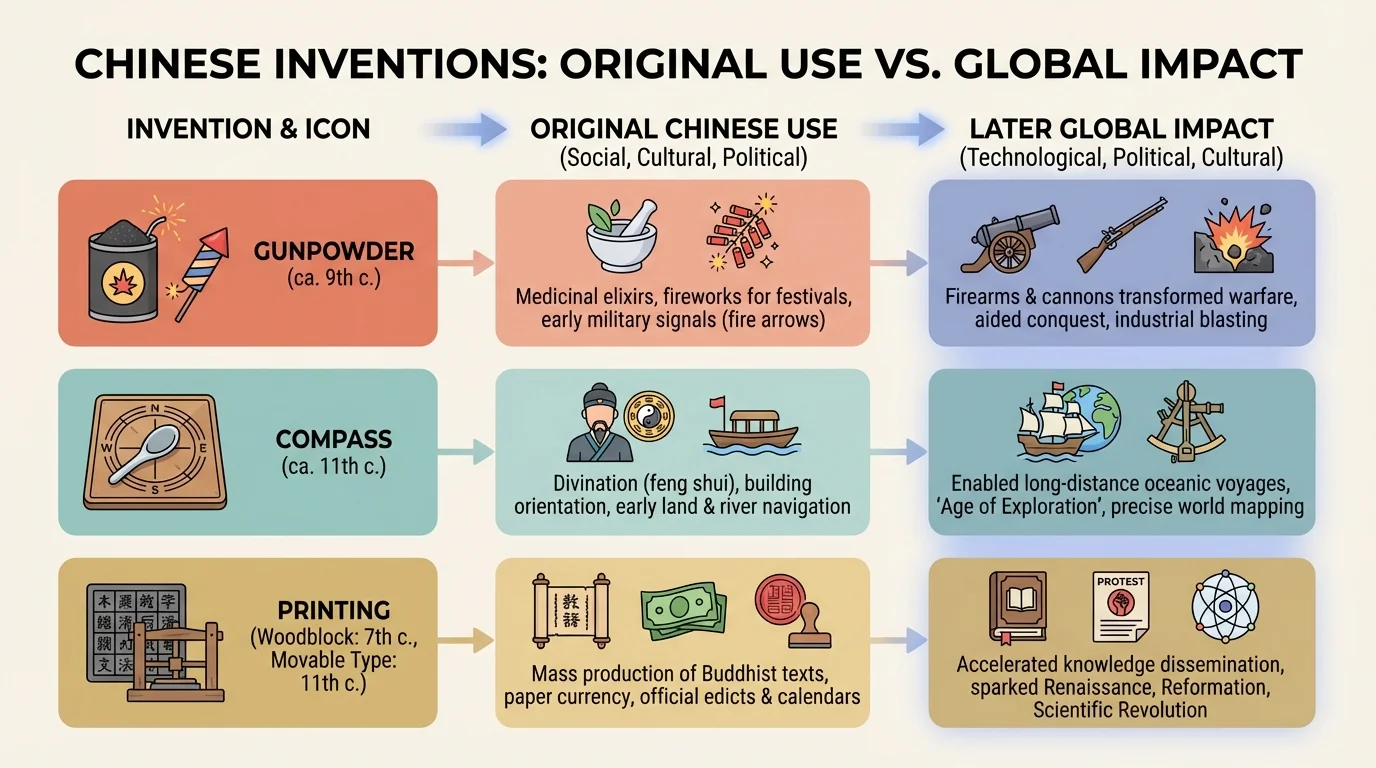
These inventions show that technology is never just about tools. Technology changes society. Printing affects who can learn. The compass affects who can travel and trade. Gunpowder affects who can win wars. In each case, a technological development also creates social and political changes.
Chinese inventions spread through trade routes and cultural contact. Merchants, travelers, diplomats, and conquerors carried ideas from one region to another. This reminds us that civilizations are not isolated. A useful invention rarely stays in one place forever.
Technology and historical change
A technology becomes historically important when it changes how people live, communicate, govern, trade, or fight. Historians ask not only who invented something, but also how the invention changed societies after it spread.
The comparison also helps explain why some inventions matter for centuries. Their importance grows when they can be adapted to many uses. A compass can guide traders, explorers, and military fleets. Printing can support religion, government, and education. Gunpowder can reshape military strategy and state power.
One of the biggest themes in history is connection. Mesopotamia, Egypt, Greece, Rome, India, and China each developed in unique ways, but they also influenced one another directly and indirectly. Trade routes such as the Silk Roads connected East Asia to Central Asia, the Middle East, and Europe. Goods moved across these routes, but so did beliefs, diseases, artistic styles, and technologies.
Culture includes language, religion, art, customs, and learning. Political systems include laws, leaders, and institutions. Social systems include class, family roles, and work. Technological systems include tools, methods, and inventions. In real life, these categories overlap. A new technology can change politics. A new religion can influence law. A growing empire can spread language and architecture.
For example, printing was technological, but it also became cultural because it spread ideas. Hammurabi's Code was political, but it also reflected social differences. Greek democracy was political, yet it depended on cultural values such as debate and public speech. The Roman Republic was political, but also social because class conflict shaped how it worked.
Geography, culture, politics, economics, and technology do not act separately in history. When you study one development, always ask what other parts of society it affected.
This connected view of history helps explain why some regions became especially influential. A society that combined strong agriculture, organized government, writing, and useful technology could expand its influence through trade, conquest, or cultural prestige.
Studying the Eastern Hemisphere helps us understand modern problems and possibilities. Written law still matters in every country. Democracies still debate who should participate and how decisions should be made. Republics still struggle with balancing power. Technologies still reshape society faster than governments can sometimes respond.
Think about the modern internet. Like printing in the past, it spreads information quickly. Like the compass, modern navigation technology changes trade and travel. Like gunpowder, some inventions create both benefits and dangers. History does not repeat exactly, but patterns in human behavior often reappear.
Historical thinking also teaches evaluation. We can admire an achievement while still noticing its limits. Athens helped develop democracy, but excluded many people. Rome built a republic, but struggled with inequality and political violence. Hammurabi created a legal code, but not equal justice. China produced inventions that changed the world, yet those inventions also transformed warfare and power in complicated ways.
When people today discuss voting rights, court systems, military technology, or the spread of information, they are asking versions of ancient questions. That is why the study of the Eastern Hemisphere is not only about the past. It is a way of understanding how human societies solve problems, make mistakes, and create change over time.
