A piece of cloth woven in Asia, a nugget of gold mined in West Africa, and tea grown in India might seem like separate stories. But in history, they are part of the same broader historical pattern: people in different places have always been connected. At the same time, each society developed its own traditions, languages, religions, and ways of life. Understanding both connection and difference helps explain how the modern world was built.
When historians talk about interdependence, they mean that groups of people rely on one another. A kingdom might need salt from the desert, spices from another region, or horses from a distant land. Merchants, travelers, scholars, and rulers created networks that tied societies together. These links were not always equal or peaceful, but they were powerful.
At the same time, every society had its own unique features. Geography, climate, language, religion, political leadership, and local traditions shaped daily life. Even when people traded with outsiders, they did not simply become copies of one another. They adapted new ideas in their own ways.
Interdependence means mutual reliance between people or societies. Cultural diffusion is the spread of ideas, beliefs, technologies, and customs from one culture to another. Colonization is the process by which one country takes control of another land and its people.
These ideas matter because they help us answer modern questions. Why do some countries share languages? Why do trade routes still matter? Why do national borders in some regions lead to conflict? To answer these questions, we need historical context.
The Eastern Hemisphere includes Africa, Asia, Europe, and Australia. This lesson focuses especially on Africa, Asia, and Australia, whose peoples were linked through trade routes that crossed deserts, seas, and grasslands. Rivers, monsoon winds, caravan paths, and ocean currents shaped how people moved and exchanged goods.
Trade was never just about products. Along with goods came stories, religious beliefs, scientific knowledge, artistic styles, crops, and diseases. A merchant might carry silk, but also news from another empire. A traveler might bring books, but also unfamiliar ideas about law or faith. This is why history is full of mixing, borrowing, and adapting.
Still, geography could also protect distinct cultures. Mountain ranges, deserts, and long distances slowed movement. Some communities kept local traditions for centuries even while taking part in wider networks. So the Eastern Hemisphere was both connected and diverse at the same time.
Camels transformed trade across the Sahara because they could travel long distances with limited water. That made huge desert crossings possible and helped connect West Africa to North Africa and the Mediterranean world.
Historians learn about these connections through primary sources such as travel accounts, letters, maps, official records, coins, and artifacts. They also use secondary sources written by later historians who compare evidence and explain patterns over time.
West Africa developed powerful states that grew rich through trade, as [Figure 1] shows through the movement of gold, salt, and people across the Sahara. The empires of Ghana, Mali, and Songhai did not become important because they were isolated. They rose because they controlled key trade routes and taxed merchants who passed through their territories.
Ghana, which flourished roughly from the 700s to the 1200s, was one of the first great West African empires. It became wealthy by controlling access to gold fields and trading with North African merchants. Salt was especially valuable because it preserved food and was necessary for health. Gold and salt together created a strong economic base.
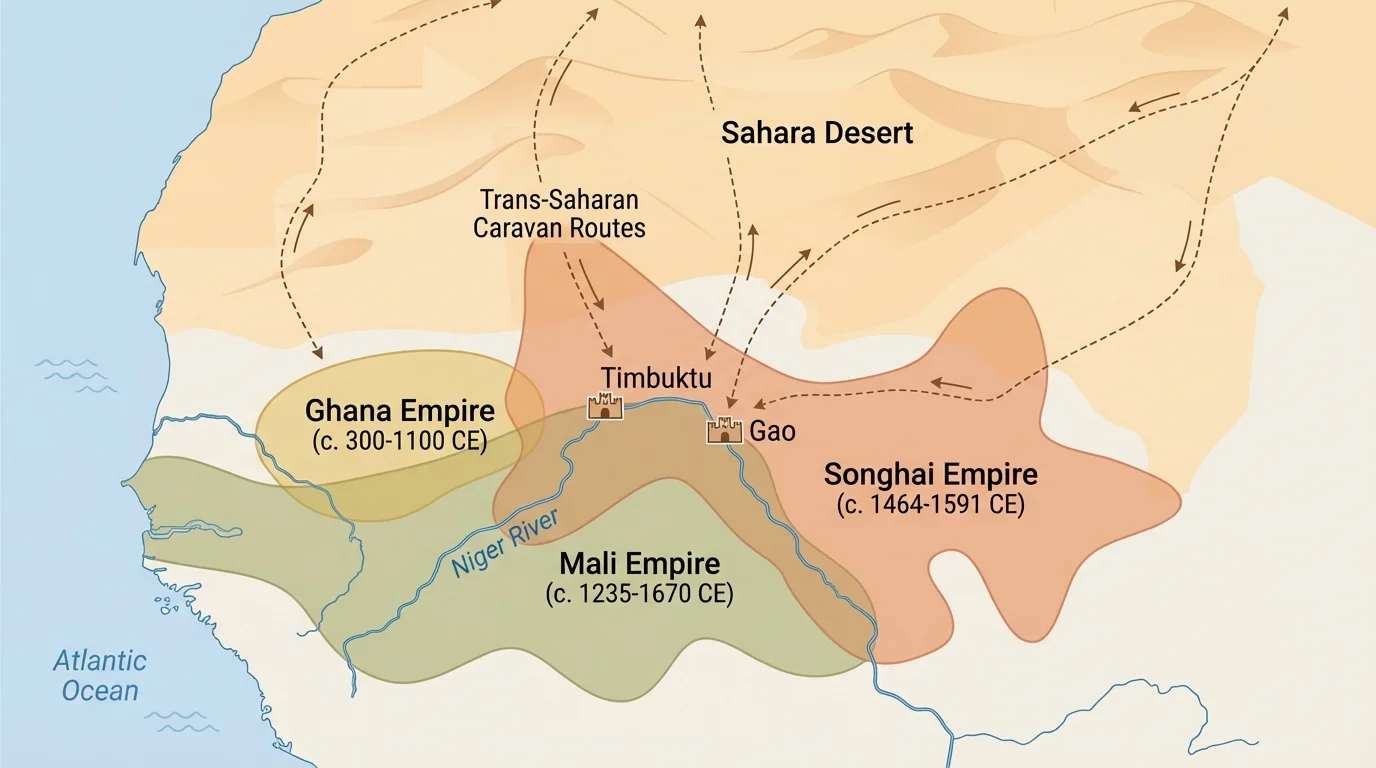
Mali rose after Ghana and reached great strength in the 1200s and 1300s. Its most famous ruler was Mansa Musa, known for both wealth and support for learning. In 1324, he made a pilgrimage to Mecca, a journey called the hajj. Accounts from this trip spread news of Mali far beyond Africa. This is a strong example of interdependence: Mali was part of Islamic networks that linked West Africa to North Africa, Arabia, and beyond.
Mansa Musa also supported cities such as Timbuktu, which became a center of scholarship, religion, and trade. Timbuktu was not just a marketplace. It was also a place where scholars studied law, mathematics, astronomy, and Islamic teachings. That shows the uniqueness of African empires: they were not only rich in resources, but also rich in intellectual and cultural life.
Case study: Why the African empires were both connected and unique
Step 1: Identify the connection.
West African rulers traded with North African and Muslim merchants, sharing goods, religion, and ideas.
Step 2: Identify the uniqueness.
These empires kept local languages, political systems, and regional traditions shaped by West African geography and culture.
Step 3: Draw a conclusion.
African empires were part of wider global networks without losing their own identity.
Songhai later became the largest of these empires, especially during the 1400s and 1500s under rulers such as Sunni Ali and Askia Muhammad. Songhai controlled important trade centers like Gao and Timbuktu. Its leaders built military power and a government strong enough to manage a wide territory.
As seen earlier in [Figure 1], trade routes crossed harsh desert regions, so cooperation among traders, guides, and rulers was essential. Yet each empire had different leaders, military strategies, and cultural developments. Their uniqueness mattered just as much as their connections.
Primary sources help historians understand these empires. The traveler Ibn Battuta wrote about Mali in the 1300s. Arab geographers and scholars recorded information about trade and rulers. These sources must be used carefully, because outsiders sometimes misunderstood local customs, but they still provide valuable evidence.
The Silk Road was not one road but a large network of routes across Asia, as [Figure 2] illustrates. These routes linked China, Central Asia, India, the Middle East, and the Mediterranean world. Merchants moved goods over land and sometimes connected with sea routes across the Indian Ocean.
Silk was one famous product, but many other goods traveled too: spices, paper, porcelain, horses, precious stones, and metalwork. Trade encouraged interdependence because no single region produced everything people wanted. Cities along the routes grew wealthy by serving merchants with food, protection, storage, and markets.
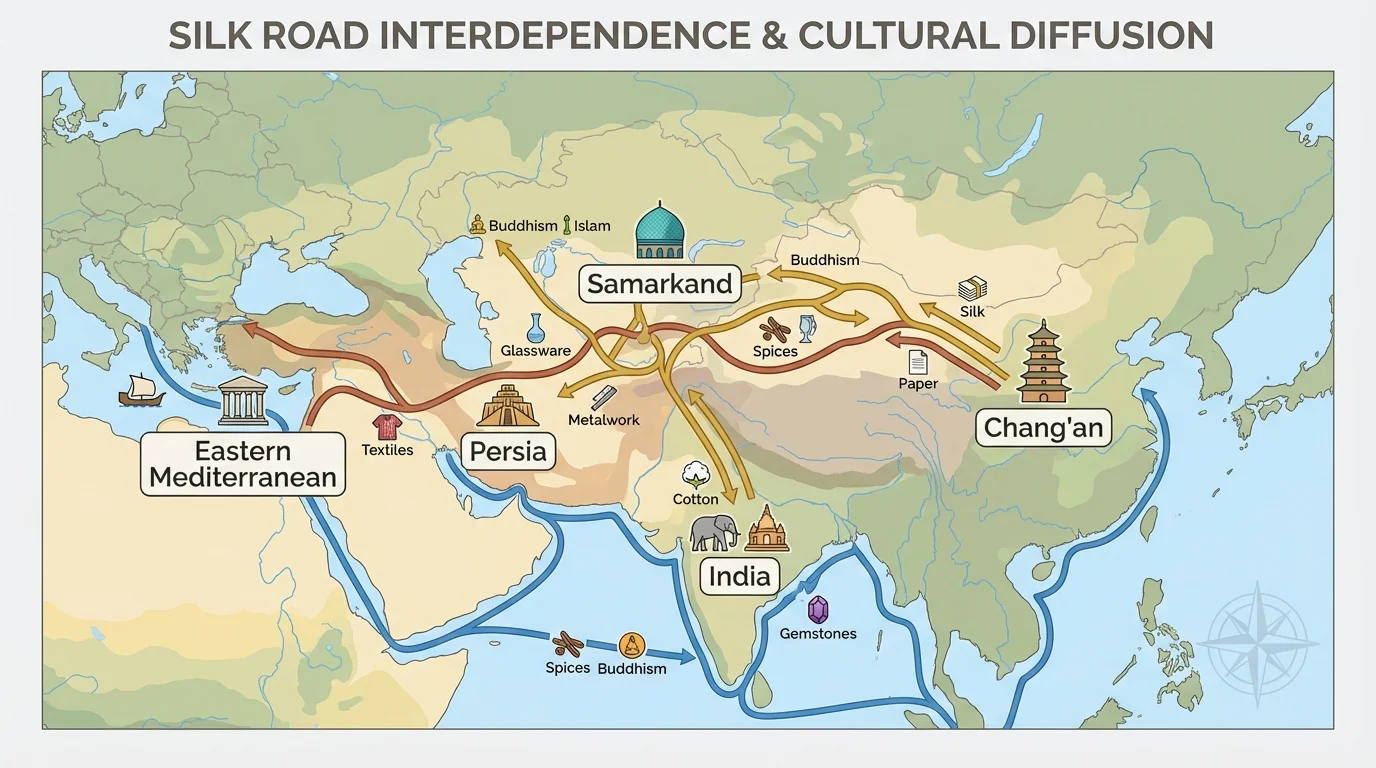
The Silk Road is also one of history's clearest examples of cultural diffusion. Buddhism spread from India into China and other parts of East Asia. Artistic styles mixed. Scientific ideas moved between regions. Paper-making traveled westward from China, and this later helped spread books and learning in many societies.
Religions did not spread in exactly the same way everywhere. Local communities adapted them. In China, for example, Buddhism changed as it mixed with existing Chinese traditions. This shows uniqueness within cultural exchange. People borrowed ideas, but they reshaped them to fit local needs and beliefs.
How the Silk Road changed societies
Trade networks work like channels. They carry goods, but they also carry knowledge and problems. Along the Silk Road, states gained wealth, cities became more diverse, and new technologies spread. At the same time, diseases also moved more easily between populations, reminding us that interdependence can create risks as well as benefits.
One major example is the spread of the Black Death in the 1300s. Trade routes helped connect distant places, but they also allowed disease to travel rapidly. This is a powerful historical lesson: connections between societies can produce both progress and crisis.
Long after silk caravans faded, the pattern shown in [Figure 2] still matters. Modern trade routes, internet communication, and migration continue the same basic idea: distant places affect one another. The products in a store today often come from several countries, much like goods in ancient and medieval markets.
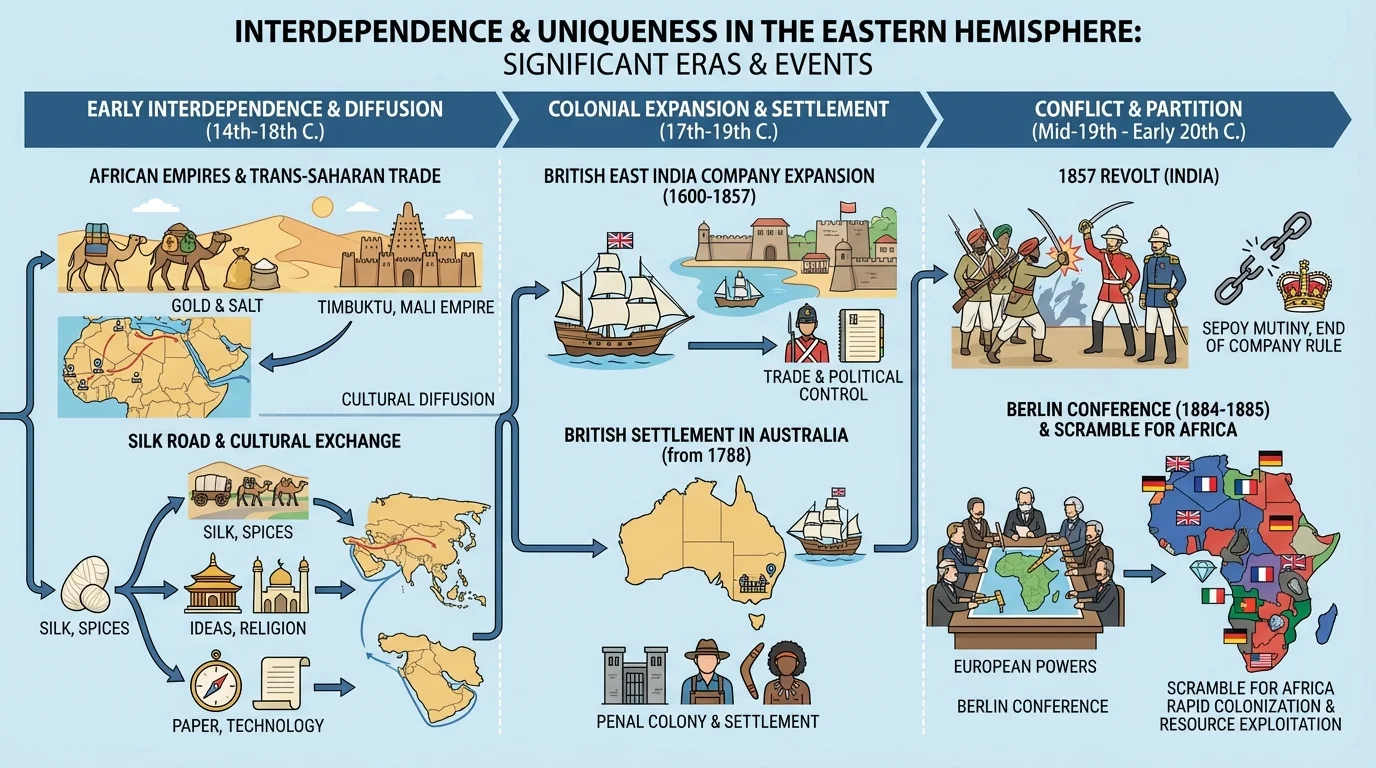
Imperialism, as tracked over time in [Figure 3], changed the Eastern Hemisphere in dramatic ways. Colonization did not happen all at once. It unfolded over centuries and took different forms in Africa, India, and Australia, but in each case outside powers claimed land, resources, and authority over local peoples.
In India, the British East India Company first gained power through trade and political influence. Over time, British control expanded. After the Indian Rebellion of 1857, the British government took direct control. Railroads, new schools, and changes in law were introduced, but these were built within a system that mainly served British interests. India supplied raw materials and became a market for British goods.
India remained unique despite British rule. Indian religions, languages, food traditions, and social structures continued. At the same time, colonization reshaped politics and economics. English became important in administration and education. Anti-colonial leaders later used both local traditions and modern political ideas to argue for independence.
In Africa, European colonization intensified during the late 1800s in the event known as the Scramble for Africa. European powers divided much of the continent with little regard for ethnic groups, languages, or existing political boundaries. The Berlin Conference of 1884–1885 symbolized this process, even though Africans themselves were largely excluded from the decisions.
African societies responded in many ways. Some resisted militarily. Some negotiated. Some adapted to survive within colonial systems. Colonization created railways, ports, and new export economies, but these were designed mainly to benefit the colonizers. The long-term effects included economic inequality, political disruption, and borders that still influence conflicts today.
In Australia, British settlement began in 1788. Colonization there included the claiming of land already inhabited by Aboriginal peoples and Torres Strait Islander peoples. British settlers often treated the land as if it were empty, ignoring Indigenous systems of knowledge, law, and land management. This caused deep harm through violence, displacement, and disease.
"Until the lions have their own historians, the history of the hunt will always glorify the hunter."
— African proverb
Australia's colonization also shows interdependence and uniqueness at the same time. The colony was tied to Britain through law, trade, and migration, but the land's environment and Indigenous cultures made Australia distinct. Today, debates about land rights, historical memory, and reconciliation grow from this history.
The timeline in [Figure 3] shows clearly that colonization in India, Africa, and Australia happened in different periods and under different conditions. Still, a shared pattern appears: outside powers sought control, local peoples responded in diverse ways, and modern societies still carry the results.
African empires, Silk Road societies, and colonized regions all reveal the same big truth: connection does not erase difference. West African empires traded widely but built their own political and scholarly traditions. Silk Road societies exchanged ideas while keeping local identities. Colonized peoples experienced outside control yet continued to shape their own cultures and resist domination.
| Case | Main Form of Connection | Examples of Uniqueness | Long-Term Impact |
|---|---|---|---|
| African Empires | Trans-Saharan trade and Islamic networks | West African leadership, cities, scholarship, and local traditions | Influence on trade, learning, and African historical identity |
| Silk Road | Trade across Asia and cultural exchange | Local adaptation of religions, arts, and technologies | Spread of ideas, goods, and cross-regional connections |
| Colonization | Imperial control by outside powers | Survival and adaptation of local cultures under pressure | Modern borders, languages, inequality, and independence movements |
Table 1. Comparison of interdependence, uniqueness, and long-term impact in three major historical examples.
This comparison helps us avoid oversimplified thinking. It would be incorrect to say that one region simply influenced another in one direction. Exchange often worked both ways, even when power was unequal. African gold shaped Mediterranean economies. Asian inventions changed Europe and the Middle East. Colonized peoples influenced imperial culture while also resisting it.
The legacies of these histories are still visible today, as [Figure 4] shows through language, borders, trade, and cultural memory. Modern global trade depends on interdependence, much like the old desert caravans and Silk Road routes. Countries still specialize in certain goods and rely on one another for resources, technology, and transportation.
Language is one major legacy. English is widely used in India and Australia in part because of colonization. Arabic spread through trade and religion across parts of Africa. Religious traditions such as Islam and Buddhism still connect communities across huge regions because of historical cultural diffusion.
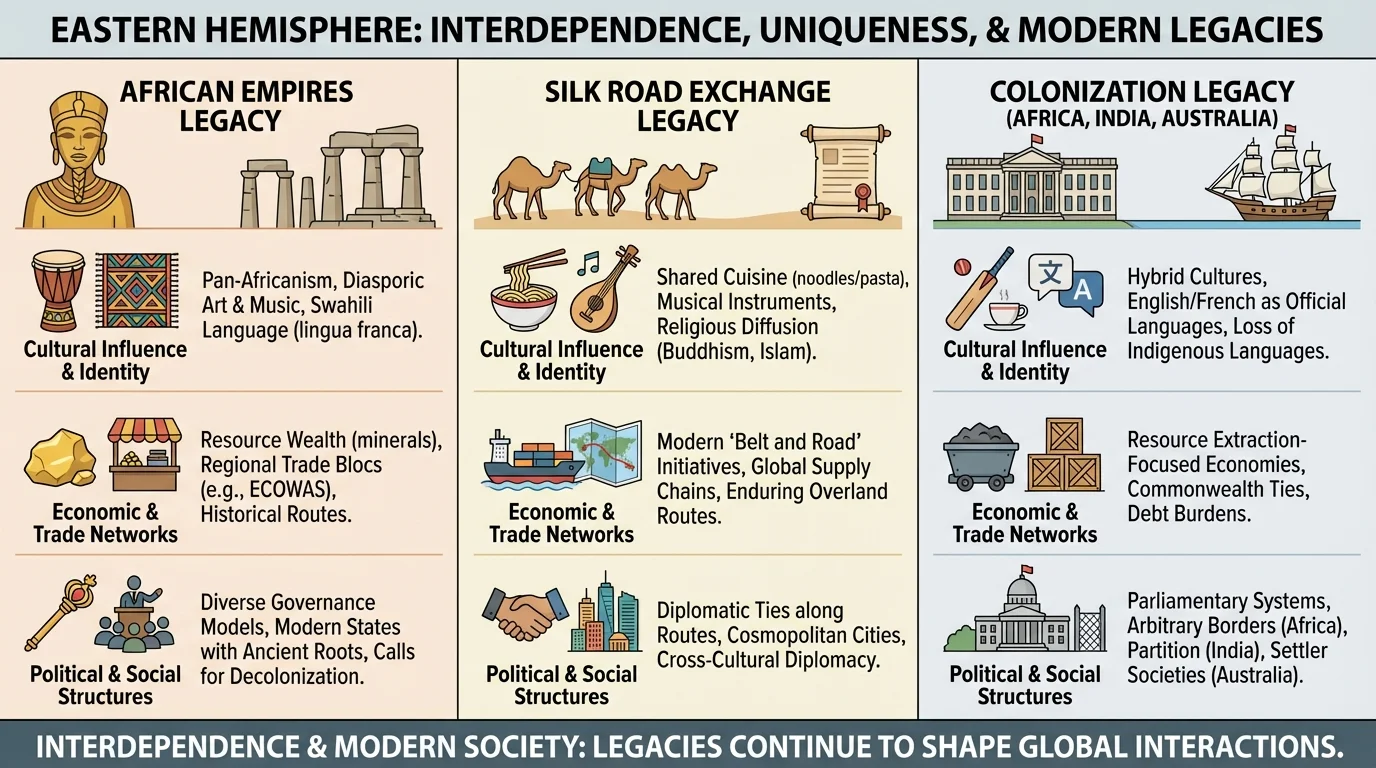
Political borders are another legacy. In Africa, some national boundaries reflect colonial decisions more than older cultural regions. This can create tension when one border includes many different groups or divides people with shared histories. Understanding the past helps explain why some political problems are so difficult to solve.
Education, architecture, food, music, and clothing also show historical blending. Indian cuisine includes ingredients and influences from long-distance trade. East African coastal culture reflects African, Arab, and Asian connections. Australian society includes British traditions, immigrant influences, and the enduring presence of Aboriginal and Torres Strait Islander cultures.
When studying current events, remember that present-day problems usually have deep roots. Borders, trade partnerships, language patterns, and cultural conflicts often come from decisions made long ago.
Looking back to [Figure 4], we can see that not all legacies are the same. Some connections created wealth and learning. Others produced conquest and inequality. Historical thinking requires us to hold both truths at once.
To understand relationships in the Eastern Hemisphere, historians ask careful questions. Who benefited from a trade route? Who lost power under colonization? Which ideas spread, and how were they changed locally? These questions help us move beyond memorizing names and dates.
A timeline also helps. Ghana flourished before Mali, Mali before Songhai, and these empires overlapped with broader Islamic trade networks. The Silk Road developed over many centuries, especially in ancient and medieval times. European colonization in India, Africa, and Australia intensified later, especially from the 1700s through the 1900s. Putting events in order helps explain cause and effect.
Historical sources matter too. A traveler's account, a ruler's record, an oral tradition, and an archaeological discovery may tell different parts of the story. No single source gives the whole picture. Historians compare evidence to build conclusions.
These skills are useful today. If a news story mentions trade conflict, migration, ethnic tension, or debates over land and identity, history gives tools for understanding it. The modern world did not appear suddenly. It grew from centuries of contact, exchange, adaptation, conflict, and resilience among unique peoples whose lives were deeply interconnected.
