What if the most powerful weapon against unfair laws was not a gun or an army, but people walking to work, sitting quietly at a lunch counter, or marching across a bridge? That is exactly what happened during the civil rights movement. In the American South, segregation had been built into everyday life for decades, but Dr. Martin Luther King Jr. and thousands of ordinary people used non-violent action to challenge it. Their strategy was brave, disciplined, and often dangerous. It helped break segregation and pushed the United States to live up more fully to its promise of equality.
During the Jim Crow era, southern states enforced Jim Crow laws that separated Black and white people in schools, buses, restaurants, parks, waiting rooms, and many other public places. These laws were strongest in states across the South, as [Figure 1] shows, including Alabama, Mississippi, Georgia, and Tennessee. The system was not just about separation. It was also about power. White officials often controlled schools, courts, police departments, and voting rules.
Black Americans faced unfair treatment in almost every part of life. Schools for Black children usually had fewer books, older buildings, and less money. Many Black citizens were blocked from voting through poll taxes, literacy tests, and threats of violence. If a person challenged the system, they could lose a job, be arrested, or face attack. This helps explain why changing segregation was so hard. It was built into both law and daily habits.
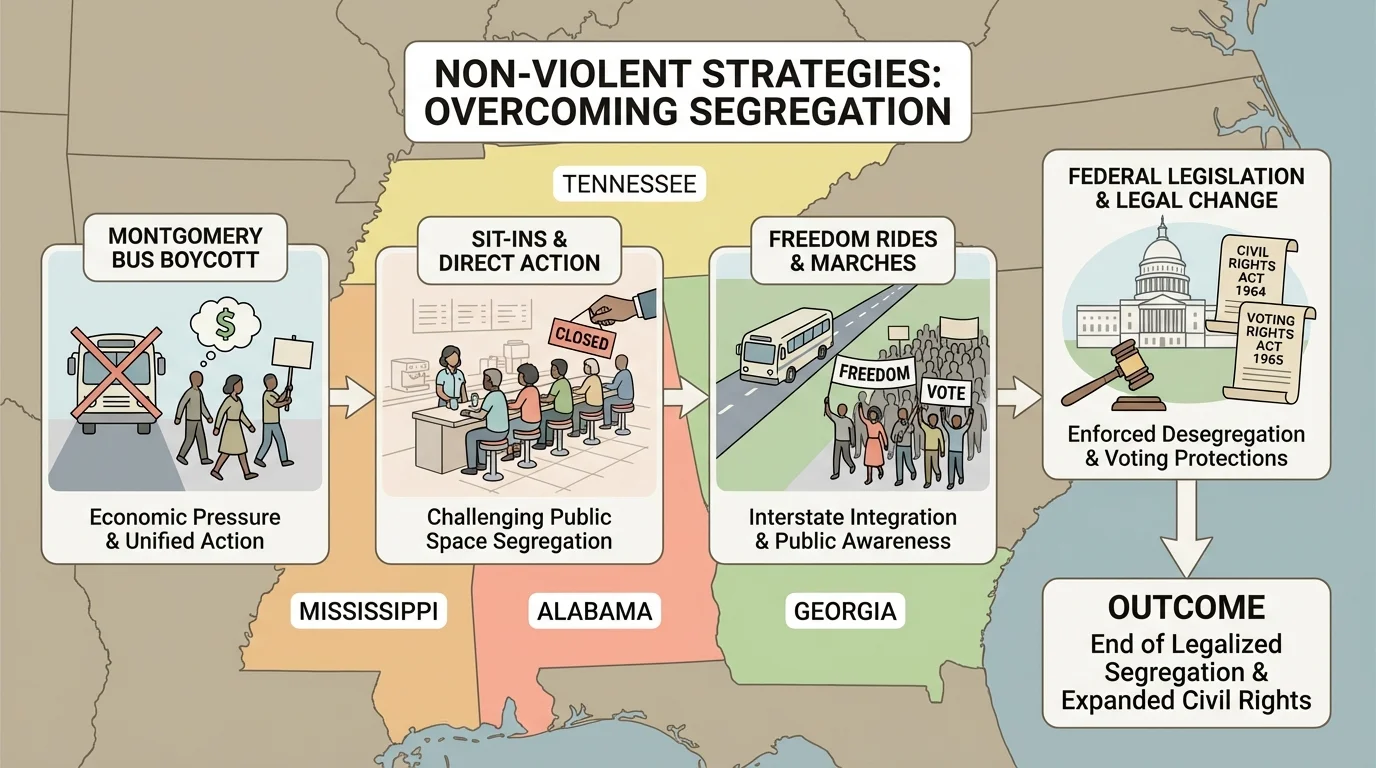
Even though the civil rights movement is often studied as American history, it also connects to larger world ideas about freedom and human rights. Around the globe, people in the twentieth century challenged colonialism, dictatorship, and unequal treatment. Dr. King understood that struggles for justice in one place could inspire people in another. That broader historical context helps explain why the movement gained international attention.
Segregation was the forced separation of people by race in public and private life. Jim Crow laws were state and local laws in the South that enforced racial segregation after Reconstruction. Civil rights are the rights of citizens to equal treatment and full participation in society.
The movement did not begin because injustice was new. It began because more people decided that injustice should no longer be accepted. Churches, local community groups, lawyers, students, and national organizations all played important roles. Dr. King became one of the most famous leaders, but the movement depended on thousands of followers who were willing to act.
Dr. Martin Luther King Jr. believed in nonviolent resistance, the idea that people can fight injustice without using physical violence. He drew this belief from Christian teachings about love and forgiveness, and from the example of Mahatma Gandhi in India, who had used nonviolence against British rule. King argued that violence might create more hatred, but nonviolence could expose injustice and win support from others.
King did not believe nonviolence meant doing nothing. It meant taking action in a disciplined way. Protesters marched, boycotted businesses, sat in forbidden spaces, filled jails, and demanded that unfair laws be changed. The goal was to create what King called a crisis that the nation could not ignore. When peaceful people were attacked for asking for basic rights, the cruelty of segregation became visible to the whole country.
How nonviolent protest creates change
Nonviolent protest works by putting pressure on unfair systems in several ways at once. It can hurt businesses financially, attract media attention, bring court cases, and make government leaders act. It also gives many ordinary people a way to join the movement, because they do not need weapons or military training to participate.
Another important idea was dignity. Activists were trained to stay calm even when insulted, shoved, or arrested. This was extremely difficult. It required self-control and courage. By refusing to strike back, protesters showed that they were not the cause of disorder. Segregation itself was the disorder.
"Darkness cannot drive out darkness; only light can do that. Hate cannot drive out hate; only love can do that."
— Martin Luther King Jr.
King's message also appealed to the conscience of people who were not yet part of the movement. Some white Americans in the North and South had ignored segregation or accepted it. Seeing peaceful protesters face brutality forced many to rethink that position.
One of the first great victories of the movement began on city buses in Montgomery, Alabama. Transportation became a major battleground, as [Figure 2] illustrates, because Black passengers paid fares but were forced to sit in the back and give up seats to white riders. In December 1955, Rosa Parks refused to give up her seat and was arrested. Her arrest sparked a mass protest known as the boycott.
Black residents of Montgomery stopped riding the buses. Instead, they walked, shared rides, or used organized carpools. This action lasted for more than a year. Think about how hard that was: getting to work, school, and church without using the city bus system day after day. Yet people stayed committed because they knew that the buses depended heavily on Black riders.
Dr. King, then a young pastor, became a leader of the Montgomery Improvement Association. He spoke at mass meetings and encouraged people to remain peaceful even after his home was bombed. The boycott showed that nonviolence could combine economic pressure with moral courage. If enough people refused to cooperate with an unjust system, that system could be weakened.
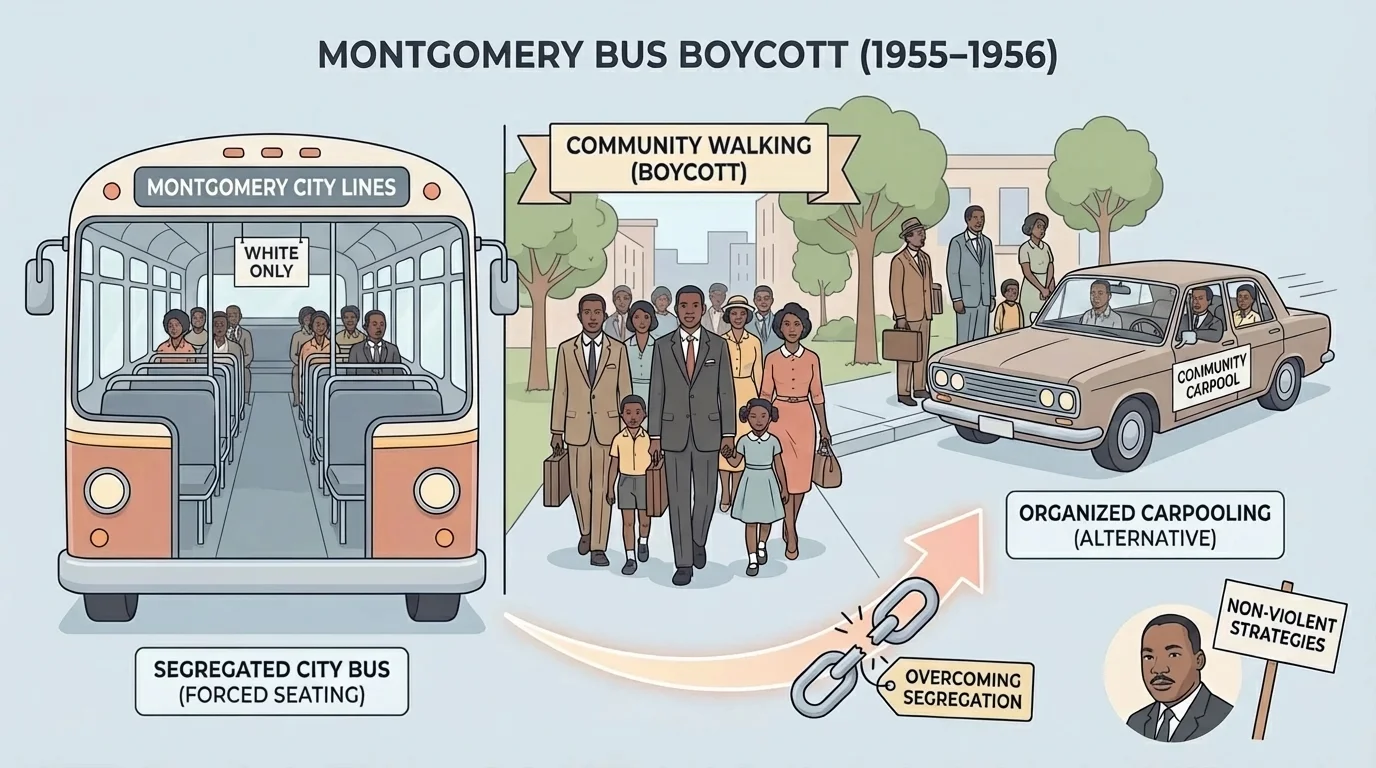
The boycott also connected protest to the courts. In 1956, the Supreme Court ruled that bus segregation in Montgomery was unconstitutional. That meant the boycott succeeded not only in public opinion but also in law. This was a pattern that would appear again and again: protest in the streets combined with legal challenges in the courts.
Montgomery was important for another reason. It proved that ordinary citizens, when organized, could challenge segregation successfully. As people later remembered [Figure 2], the victory came not from one moment alone, but from months of disciplined sacrifice.
Nonviolent direct action spread beyond buses. Students became some of the boldest activists in the movement, using disciplined protest as [Figure 3] shows at segregated lunch counters. In 1960, four Black college students in Greensboro, North Carolina, sat at a whites-only lunch counter and politely asked to be served. They were refused, but they stayed seated. Their action inspired sit-ins across the South.
These sit-ins challenged segregation in stores, restaurants, and public spaces. Protesters dressed neatly, remained quiet, and did not fight back when mocked or attacked. This made the unfairness of the system stand out clearly. Why should peaceful students be dragged away simply for ordering food?
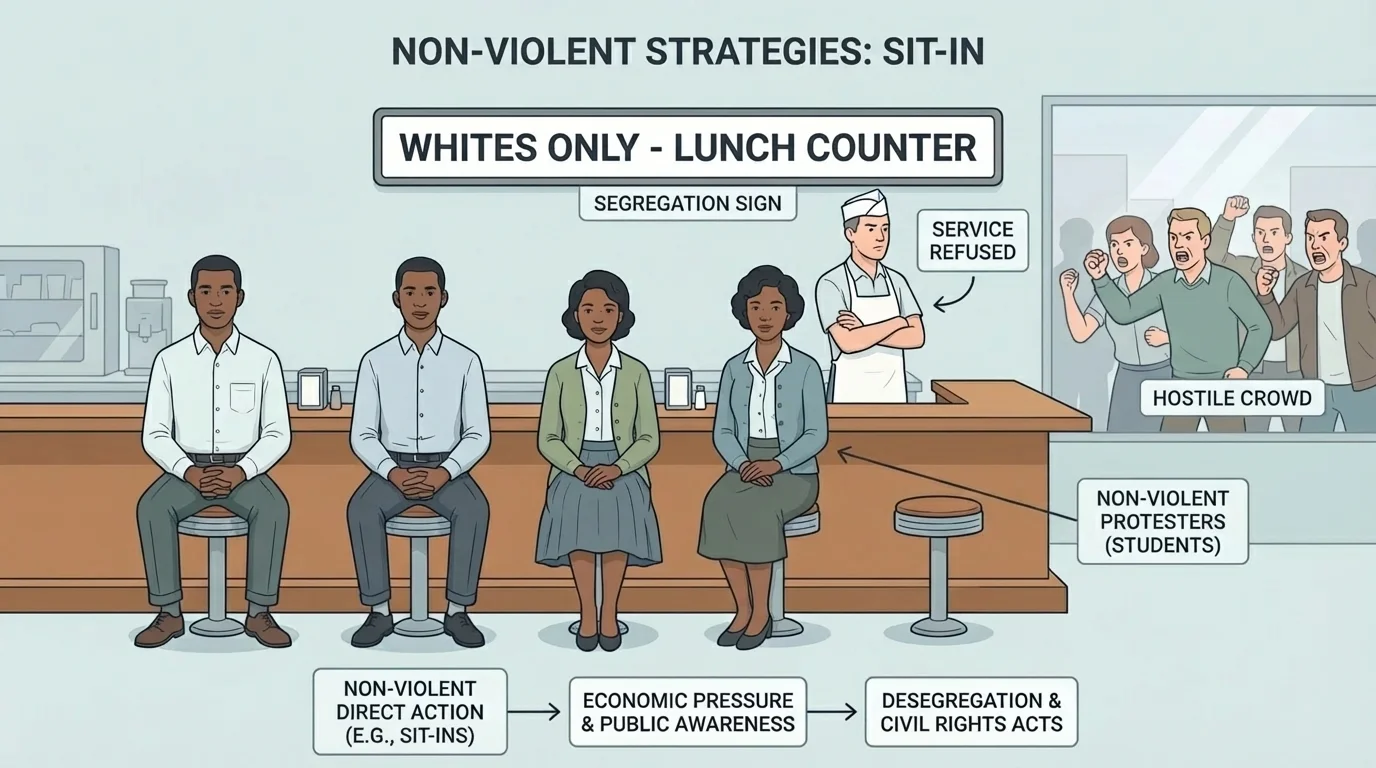
Student leaders helped form the Student Nonviolent Coordinating Committee, or SNCC. Another organization, CORE, organized the Freedom Rides in 1961. Freedom Riders traveled on interstate buses to test whether the federal government would enforce rulings against segregation in bus travel and bus stations. Many riders were beaten, and some buses were attacked or burned.
These actions were risky, but they exposed a major weakness in segregation: local officials often ignored federal law. When violence against Freedom Riders was seen on television and reported in newspapers, the federal government faced growing pressure to act. In the Cold War period, the United States also cared about how it looked to the rest of the world. Segregation damaged America's image as a defender of freedom.
Newspapers and television helped turn local protests into national events. A march or attack in one southern city could be seen by millions of people across the country within a short time.
The student movement added energy and courage. Teenagers and young adults often moved faster than older leaders and pushed the struggle into new places. Their actions showed that nonviolence was not passive. It was active, planned, and brave.
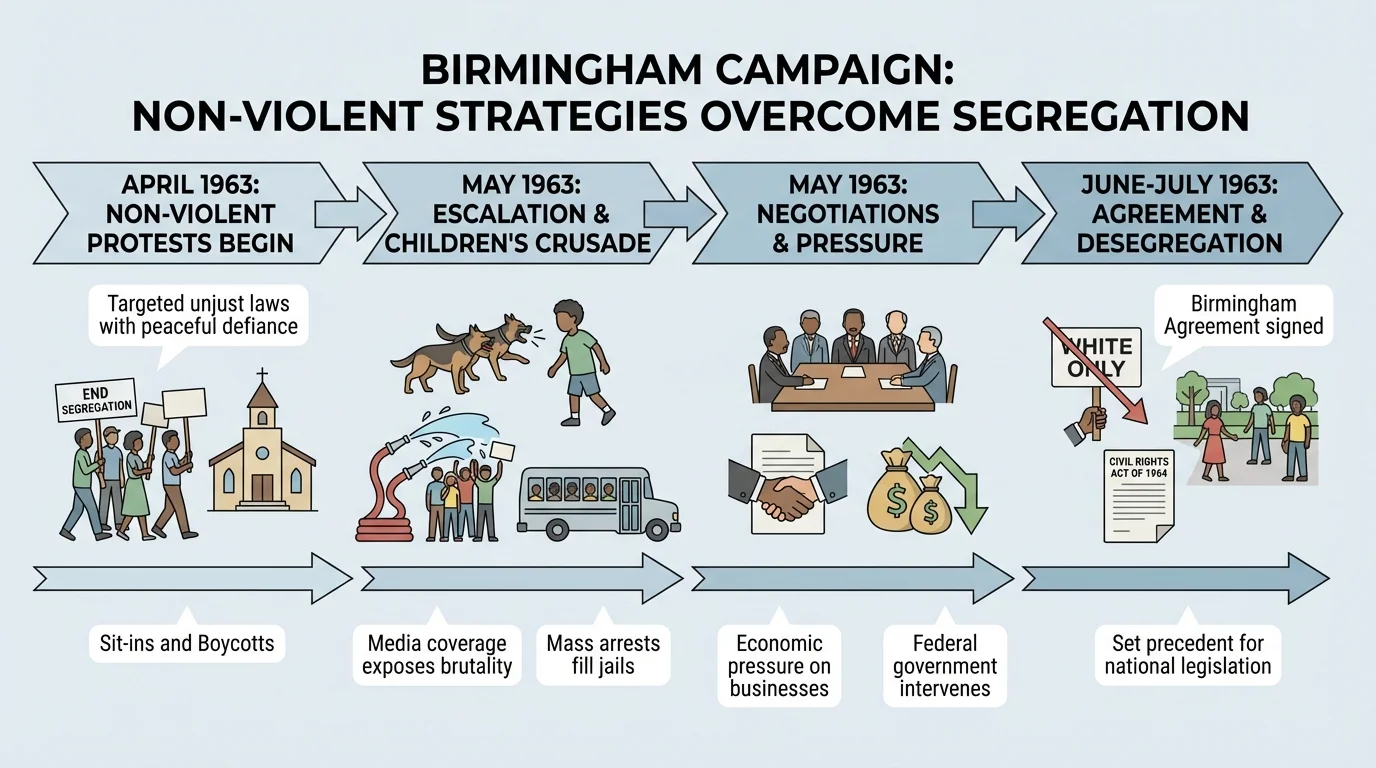
[Figure 4] In 1963, Birmingham, Alabama, became one of the most important battlegrounds of the movement. The campaign developed through a series of protests and confrontations, and it was designed to challenge one of the most segregated cities in America. King and other leaders organized marches, boycotts, and sit-ins to pressure local businesses and officials.
The city's police commissioner, Eugene "Bull" Connor, responded with harsh force. Police used dogs and high-pressure fire hoses against protesters, including children and teenagers. Many activists were arrested. These scenes were photographed and filmed, then shared across the nation. For millions of Americans, Birmingham made the violence of segregation impossible to deny.
While in jail in Birmingham, King wrote his famous Letter from Birmingham Jail. In it, he answered critics who said he should wait for change. King argued that people who suffer injustice cannot always wait, because delay often means that injustice continues. This letter is an important primary source because it lets historians read King's own words and understand his reasoning directly.
Birmingham showed how nonviolence could create a moral crisis. Protesters did not defeat segregation by force. Instead, they revealed how much force segregation required to survive. When peaceful marchers, students, and churchgoers were attacked, many people who had stayed silent began to support civil rights laws.
Later discussions of the movement often return to Birmingham because [Figure 4] helps trace how repeated action, arrests, and media coverage built pressure over time rather than in a single day.
Segregation was not only about public spaces. It was also about political power. In Selma, Alabama, activists focused on the right to vote, and the route toward Montgomery became nationally important, as [Figure 5] shows. If Black citizens could vote, they could help elect leaders who would change laws and challenge unfair policies.
Many Black residents in the South were kept from voting by literacy tests, intimidation, unfair registration systems, and threats from employers or local police. Civil rights groups organized registration drives and marches to expose these barriers. In March 1965, marchers attempting to cross the Edmund Pettus Bridge in Selma were attacked by state troopers. This day became known as Bloody Sunday.
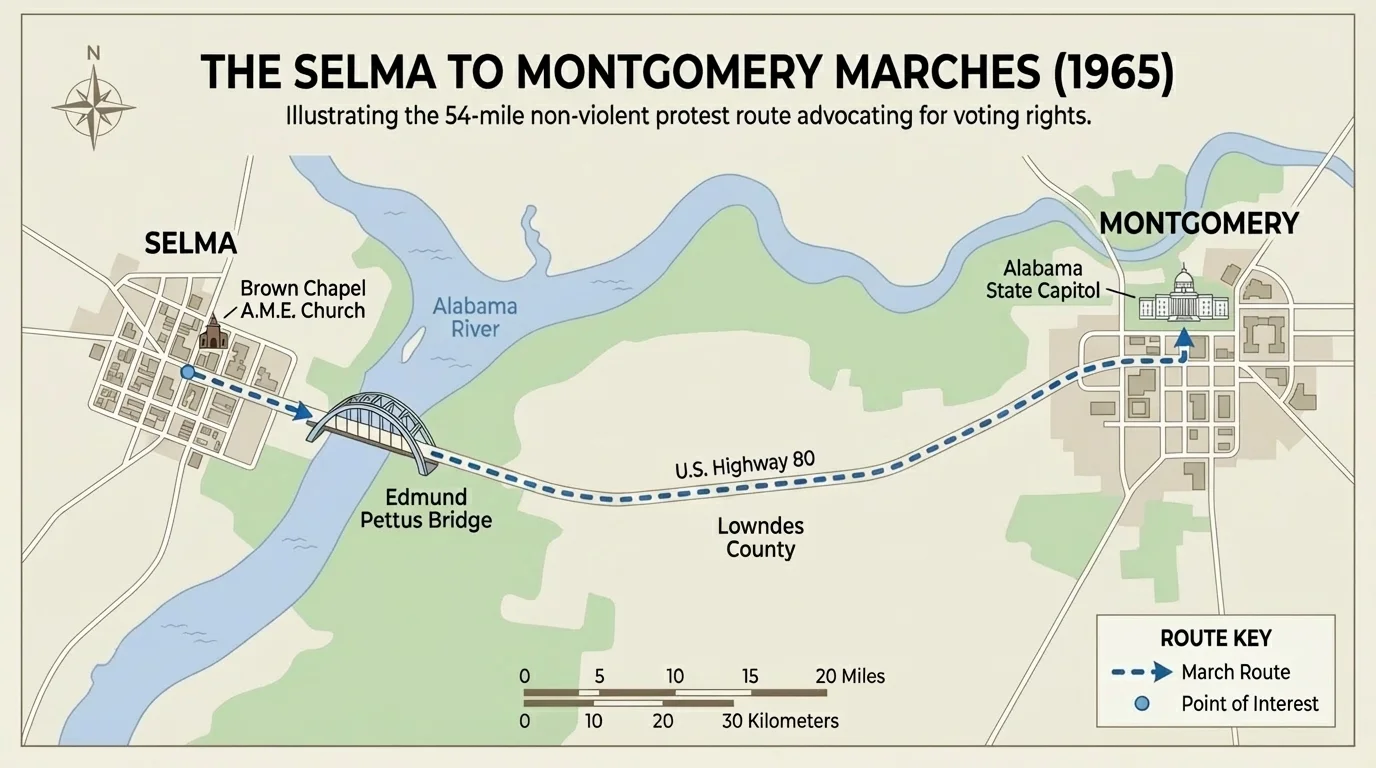
The attack shocked the nation. Television viewers saw peaceful marchers beaten while trying to demand voting rights. A later march, protected by federal authority, successfully traveled from Selma to Montgomery. The message was clear: voting rights were essential to ending segregation and inequality.
Not long afterward, Congress passed the Voting Rights Act of 1965. Along with the Civil Rights Act of 1964, this was one of the movement's greatest achievements. The Civil Rights Act banned segregation in many public places and outlawed many forms of discrimination. The Voting Rights Act attacked barriers that had kept Black citizens from the ballot box.
| Year | Event | Importance |
|---|---|---|
| 1954 | Brown v. Board of Education | Supreme Court ruled school segregation unconstitutional. |
| 1955–1956 | Montgomery Bus Boycott | Showed the power of organized nonviolent protest and economic pressure. |
| 1960 | Greensboro sit-ins | Inspired student-led protests against segregated public spaces. |
| 1961 | Freedom Rides | Tested federal enforcement of desegregation in interstate travel. |
| 1963 | Birmingham campaign | Brought national attention to the violence used to defend segregation. |
| 1963 | March on Washington | Highlighted demands for jobs, freedom, and equality. |
| 1964 | Civil Rights Act | Outlawed segregation in many public places and banned discrimination. |
| 1965 | Selma marches | Focused national attention on voting rights. |
| 1965 | Voting Rights Act | Protected access to voting for Black citizens in the South. |
Table 1. Major events and laws connected to nonviolent civil rights action in the American South.
When historians study Selma, they often note that [Figure 5] represents more than a route on a map. It represents the movement from protest to national lawmaking.
Nonviolent strategy worked for several reasons. First, it exposed injustice clearly. When peaceful people were arrested, insulted, or beaten, segregation looked cruel and unreasonable. Second, it invited broad participation. Children, parents, church members, workers, and students could all join marches, boycotts, and meetings.
Third, it used economic pressure. Bus systems, stores, and downtown businesses lost money when Black customers stayed away. Fourth, it gained media attention. Photos and television footage brought local struggles into homes across America and around the world. Fifth, it pushed federal leaders to act. Presidents, judges, and members of Congress often moved only when pressure became impossible to ignore.
Case study: How one protest created several kinds of pressure at once
The Birmingham campaign shows why nonviolence could be so effective.
Step 1: Activists organized marches and boycotts.
This disrupted normal business and drew local attention.
Step 2: City officials reacted with arrests and violence.
The harsh response made the injustice more visible.
Step 3: Media shared the images nationwide.
People outside Birmingham saw what segregation looked like in real life.
Step 4: National leaders faced pressure to respond.
The result was greater support for civil rights legislation.
This pattern helps explain how local action could lead to national change.
Nonviolence also had a moral strength. It aimed not to destroy opponents, but to transform society. King hoped to create what he called the Beloved Community, a society based on justice, respect, and cooperation. Not everyone accepted this vision, but it gave the movement a powerful sense of purpose.
Nonviolence was effective, but it was not easy or safe. Activists were jailed, fired from jobs, threatened, and sometimes murdered. Churches and homes were bombed. Some people within the wider Black freedom struggle argued that nonviolence was too slow or that it depended too much on the sympathy of white audiences. These debates were real and important.
Still, the achievements were historic. Segregation in public facilities was struck down. Voting protections expanded. The movement changed laws, courts, politics, and national culture. It also inspired later movements for women's rights, disability rights, and freedom struggles in other parts of the world.
Historical change usually happens because many people act over time, not because of one speech or one leader alone. Dr. King was crucial, but so were local organizers, students, church members, lawyers, and ordinary families.
Primary sources such as King's speeches, letters, photographs, television footage, court rulings, and newspaper reports help historians understand the movement. Secondary sources, such as history books and documentaries, help explain patterns and causes. Together, these sources show that segregation in the South did not end by itself. It was challenged through organized courage.
The civil rights movement teaches an important lesson about problem-solving in history: people can confront deeply rooted injustice by choosing strategies that fit the situation. Dr. King and his followers used marches, boycotts, sit-ins, court cases, and public witness to force change. Their success came from persistence, planning, sacrifice, and the ability to turn moral truth into political action.
