A smartphone may be designed in one country, use minerals from another, be assembled in a third, and then shipped across oceans before it reaches a store shelf. That surprising journey shows an important idea in economics: regions do not produce everything equally. What gets made, where it gets made, and how much gets made are strongly affected by trade, resources, and the forces of buying and selling.
People everywhere face the problem of scarcity. Scarcity means there are limited resources, but people have many wants and needs. Because no region has unlimited land, labor, water, energy, or raw materials, societies must make choices about what to produce. Trade helps regions get things they do not have enough of, while supply and demand help decide what businesses and workers focus on producing.
In the Eastern Hemisphere, economic systems developed in different ways because regions had different climates, natural resources, histories, beliefs, and experiences. A dry oil-rich area may build an economy around energy exports. A fertile monsoon region may grow rice, tea, or cotton. A highly educated urban region may focus on banking, engineering, or software. These differences are not random. They grow from the connection between nature, people, and markets.
Scarcity is the condition of having limited resources to meet unlimited wants and needs.
Trade is the exchange of goods and services between people, businesses, or regions.
Goods are physical products such as wheat, clothing, or phones. Services are actions people do for others, such as teaching, shipping, banking, or medical care.
When trade expands, producers often change what they make. If buyers in many countries want a product, producers may increase output. If demand falls, production may shrink. This is why a change in one region can affect factories, farms, ports, and jobs in another region far away.
One of the biggest reasons regions produce different goods and services is that resources are unevenly distributed. Some places have rich soil and regular rainfall. Others have large deposits of oil, natural gas, iron ore, or copper. Some regions have long coastlines with busy ports, while others are landlocked. Access to rivers, seas, and trade routes matters because moving products costs time and money.
Human resources matter too. A region with many skilled workers and strong schools may become known for technology or finance. A region with many farmers and favorable growing seasons may focus on crops. Cultural values also shape economic choices. In some societies, family businesses, craft traditions, or religious rules influence what is produced and traded.
For example, Japan has limited farmland and few energy resources compared with its population, so it imports many raw materials. Yet it developed strong industries in automobiles, robotics, and electronics because of skilled labor, technology, and global trade connections. In contrast, parts of Southwest Asia have major oil reserves, so petroleum production became central to their economies.
The same product can depend on resources from several continents. A chocolate bar may involve cocoa from Africa, sugar from Asia, packaging from Europe, and shipping services that cross major sea routes.
Because resources differ, regions often make choices based on trade-offs and opportunity cost. If land is best used for growing high-value crops, it may not be used for factories. If a coastline is perfect for shipping, ports and trade services may grow faster than mining. In this way, scarcity pushes regions to choose carefully.
In economics, supply is the amount of a good or service producers are willing and able to offer, while demand is the amount consumers are willing and able to buy. These two forces work together in markets, and the point where they meet helps determine price and quantity. If demand rises and supply stays the same, prices usually go up, and producers often try to make more.
Suppose a new fashion trend makes cotton shirts extremely popular. Stores order more shirts, so textile factories need more cotton and more workers. Farmers may plant more cotton if they expect good prices. Shipping companies may transport more fabric and clothing. A change in demand can spread through an entire chain of production.
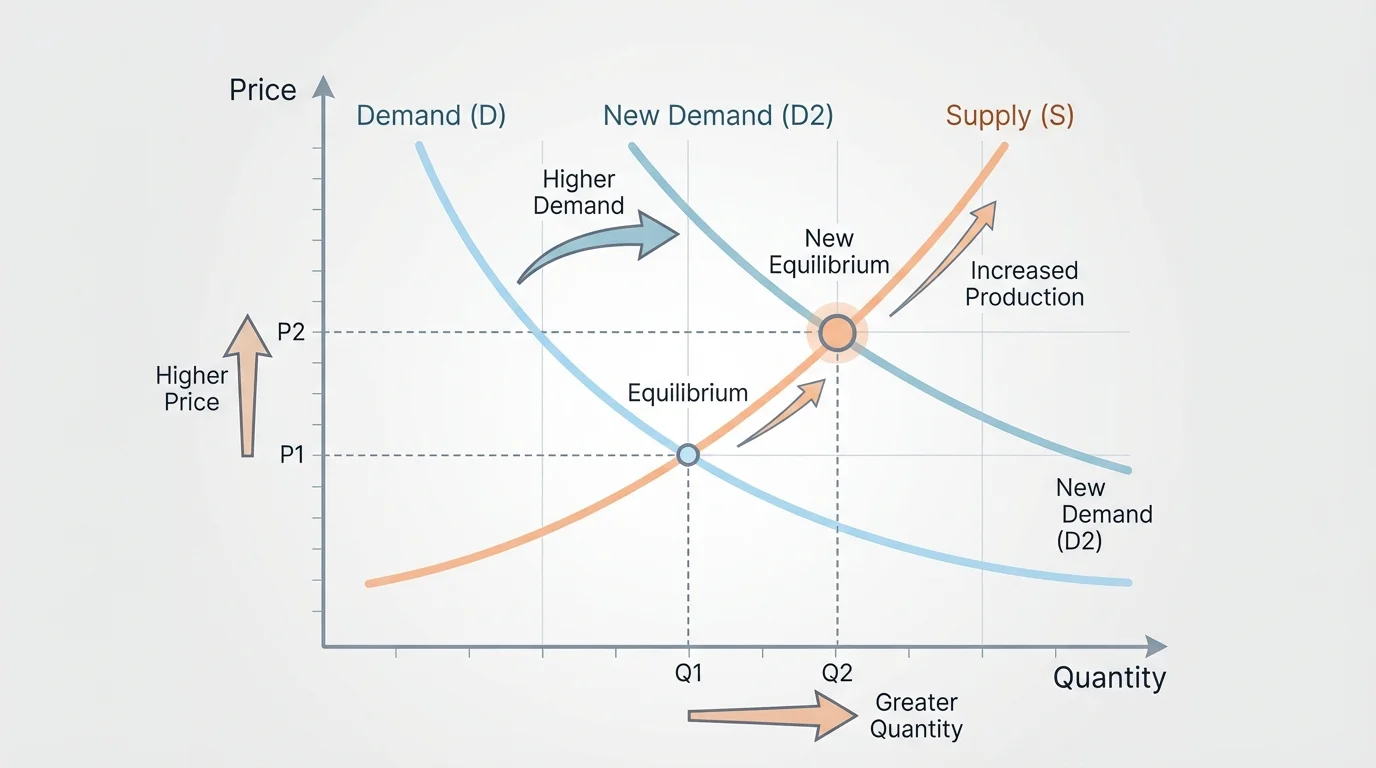
The opposite can also happen. If demand drops, producers cut back. For instance, if fewer people buy a certain kind of phone, factories may reduce shifts, suppliers may receive fewer orders, and transportation companies may move fewer parts. This can lower incomes in the regions that depend on that product.
Supply can change too. Bad weather, shortages of workers, rising fuel costs, war, or damaged ports can reduce supply. When supply falls but demand stays high, prices often rise. During a drought, for example, wheat harvests may decline. Countries that import wheat may then pay more, and bakeries may face higher costs for bread.
Trade connects these market forces across regions. When one region has extra production, it can export goods to places where demand is strong. When a region lacks a product, it can import it. This helps reduce some effects of scarcity, but it also creates dependence. A nation that depends heavily on imported grain, fuel, or computer chips may face problems if trade is disrupted.
How supply and demand affect production
Producers watch prices and customer demand because those signals help them decide what to make. Higher expected profit often leads businesses to increase production, hire workers, buy equipment, or expand to new markets. Lower expected profit often causes producers to reduce output or switch to different products or services.
As we see again in [Figure 1], production is not determined by resources alone. A region may have the ability to make something, but if few people want it, output may stay low. On the other hand, strong demand can encourage regions to improve transportation, train workers, and build factories.
Many regions practice specialization, which means focusing on producing certain goods or services more efficiently than others. Specialization grows when a region has the right combination of resources, skills, location, and demand. Across the Eastern Hemisphere, this pattern becomes clear on a regional scale.
A region does not have to be the best in the world at everything. It often makes more sense to produce what it can make relatively well and trade for the rest. This idea is related to comparative advantage, a theory that explains why trade can benefit both sides. For seventh graders, the key idea is simple: if different regions focus on what they do best, total production can rise.
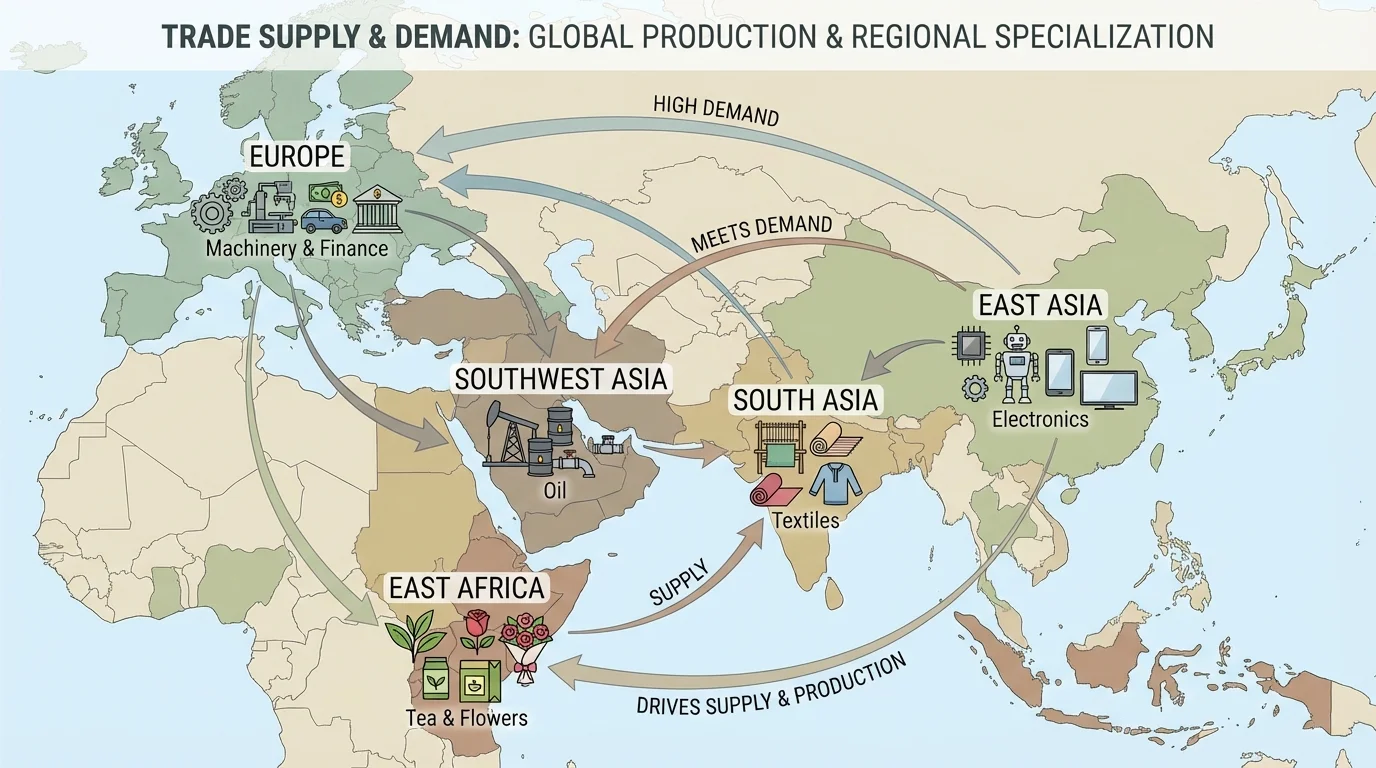
For example, South Asia has large labor forces and long histories in cotton and textile production. That has helped countries such as India and Bangladesh become major producers of clothing and fabric. East Asia developed strong manufacturing systems, advanced ports, and technology industries, so countries such as China, South Korea, and Japan produce electronics, machinery, and vehicles. Europe includes many regions with capital, transportation networks, and highly trained workers, so it produces advanced machinery, pharmaceuticals, financial services, and engineering services.
Specialization also appears in agriculture and services. Kenya and Ethiopia export tea, coffee, and flowers partly because of climate and elevation. Singapore became a major trade and finance center because of its strategic location near important shipping routes. The United Arab Emirates expanded transportation, tourism, and financial services alongside oil because trade created new opportunities.
When regions specialize, trade volume usually grows. That can increase incomes and lower prices for consumers. However, specialization also carries risk. If a region depends too much on one product, such as oil or coffee, a fall in demand or price can damage the economy.
Case study: cotton shirts and regional production
One popular product can connect several regions through trade.
Step 1: Cotton is grown in a region with warm weather and suitable farmland, such as parts of India.
Step 2: Textile mills turn cotton into fabric where labor, machinery, and factory systems are available.
Step 3: Clothing factories sew shirts in places with skilled workers and lower labor costs, such as Bangladesh or Vietnam.
Step 4: Shipping companies move the shirts to ports and stores in Europe, Africa, or other parts of Asia.
If demand for shirts rises, each part of this chain may expand production.
The regional pattern shown earlier in [Figure 2] helps explain why products rarely come from just one place. Trade links specialized regions into one larger system.
Southwest Asia provides one of the clearest examples of trade affecting production. Countries such as Saudi Arabia, Iraq, Kuwait, and the United Arab Emirates have large reserves of oil and natural gas. Because global demand for energy has been high for decades, these countries invested heavily in drilling, refining, pipelines, ports, and shipping. When oil prices rise, production and government revenue often increase. When oil prices fall, budgets and jobs can come under pressure.
In South Asia, textile and service industries show another pattern. India produces cotton textiles, pharmaceuticals, and software services. Bangladesh is known for garment manufacturing. Global demand for affordable clothing helped these industries grow, but they also depend on access to imported materials, shipping routes, and foreign buyers.
East Asia shows how manufacturing can expand when supply chains, technology, and demand work together. China became a major center of production because of large labor forces, factory investment, export networks, and rising global demand for manufactured goods. South Korea and Japan developed advanced industries such as automobiles, electronics, and shipbuilding, using skilled labor and innovation.
In Africa, regional trade patterns differ widely. Nigeria exports oil. Kenya exports tea, coffee, and flowers. South Africa produces minerals, machinery, and services. These examples show that natural resources matter, but so do roads, ports, education, investment, and stable government systems.
| Region | Key Resources or Advantages | Common Goods or Services | How Trade and Demand Affect Production |
|---|---|---|---|
| Southwest Asia | Oil and natural gas | Petroleum, transport, finance | High energy demand increases extraction and export activity |
| South Asia | Large labor force, cotton, service skills | Textiles, garments, software | Global clothing and service demand encourages factory and office growth |
| East Asia | Ports, technology, skilled labor | Electronics, vehicles, machinery | Consumer demand and export trade expand manufacturing |
| East Africa | Favorable climate for certain crops | Tea, coffee, flowers | Foreign demand affects farm output and shipping patterns |
| Europe | Capital, infrastructure, education | Machinery, medicine, banking, tourism | Demand for high-value goods and services supports specialized production |
Table 1. Comparison of selected regions, their resources, major production patterns, and the role of trade and demand.
This table shows that production is shaped by both what a region has and what the world wants. Resources open possibilities, but demand often decides whether those possibilities become major industries.
Production does not stay the same forever. It shifts when conditions in supply or demand change, and several major forces can reshape regional output. Sometimes the change is sudden, like a flood. Sometimes it happens over many years, like improvements in education or transportation.
Infrastructure is a key factor. Roads, railways, ports, internet systems, and electric power make production easier and cheaper. If a country builds a modern port, it may export more goods because shipping becomes faster and more reliable. If electricity is unreliable, factories may struggle to meet demand.
Government policy also matters. Taxes, trade agreements, tariffs, safety laws, and investment in schools can all affect production. A tariff is a tax on imported goods. Tariffs can protect local producers from foreign competition, but they can also raise prices for consumers and increase costs for businesses that rely on imported materials.
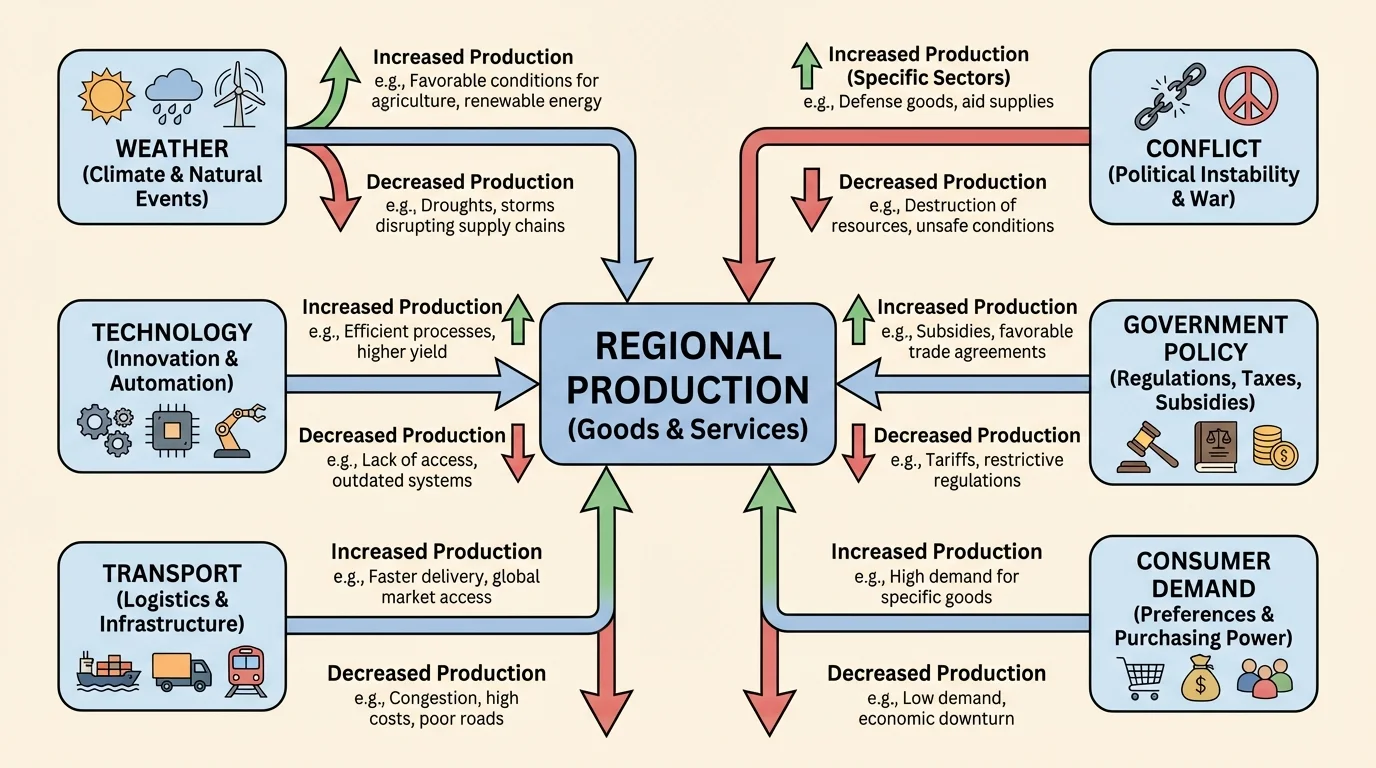
Weather and climate can strongly affect agricultural regions. A drought may reduce rice harvests in one area, while good rainfall may increase tea production in another. Conflict can interrupt trade routes, damage factories, and push workers to leave. Technology can increase supply by making production faster and more efficient.
For example, improved irrigation can raise crop production in dry regions. Better refrigeration can help farmers export fish, flowers, or fruit over long distances. Automation in factories can increase output, though it may also reduce some types of jobs. The flowchart in [Figure 3] shows that production changes for many reasons at once, not from a single cause.
Markets are made of choices. Consumers decide what to buy, and producers decide what to sell. Trade connects those choices across regions, so a decision in one place can affect workers and businesses far away.
Societal values also influence production. Some communities may support local farming even if imported food is cheaper. Others may prioritize industrial growth, tourism, or technology. Human experiences, including colonization, migration, and past trade networks, have also shaped modern regional economies.
These economic ideas are not just about maps and factories. They affect ordinary life. If demand for a region's exports rises, families may gain jobs and income. If global prices fall, workers may lose hours or wages. If imports become more expensive, household budgets may feel tighter.
Trade can increase variety for consumers. People can buy fruit out of season, electronics from another continent, or clothing made far away. Trade can also spread services, such as online tutoring, customer support, and software design. At the same time, heavy production can affect the environment through pollution, deforestation, water use, or carbon emissions.
Case study: a drought and wheat prices
A weather problem in one region can affect food production and prices in many places.
Step 1: A drought lowers wheat supply in a major exporting region.
Step 2: Because supply falls while demand remains high, wheat prices rise.
Step 3: Countries that import wheat must pay more.
Step 4: Bakeries and stores may charge more for bread and noodles.
This example shows how trade spreads the effects of supply shortages across regions.
Another important effect is interdependence. Interdependence means regions rely on one another. A country that imports fuel depends on exporters. Exporters depend on buyers. Manufacturers depend on miners, farmers, drivers, port workers, programmers, and financiers. Modern economies are deeply connected.
Interdependence can be helpful because it allows regions to share resources and skills. But it can also make the world economy fragile. A blocked canal, a pandemic, a war, or a shortage of microchips can slow production in places that seem far apart. That is why many countries try to balance trade efficiency with security.
When you study production in different regions, ask a few key questions. What resources are available? What does the climate allow? What skills and infrastructure exist? What goods or services do people around the world want? What events might disrupt supply? These questions help explain why economies develop differently.
It is also important to remember that regions are not trapped forever in one role. Economies change. A country that once depended mainly on farming may build factories, improve schools, and grow service industries. A port city may become a finance center. A nation rich in raw materials may invest profits in tourism, transportation, or technology.
"No country is rich enough to be independent of all others."
— Adapted economic principle about interdependence
Trade, supply, and demand do more than move products from one place to another. They guide decisions about land use, labor, technology, transportation, and investment. They help explain why one region grows rice, another builds ships, and another exports banking services.
Understanding these patterns helps us make sense of the world. The products people use every day are evidence of decisions shaped by scarcity, resources, human values, and market forces. Regional production is really a story about choices: what to make, how much to make, where to make it, and who will trade for it.
