A shortage of one thing can change an entire society. If a country has very little fresh water, this affects farming, cities, energy, jobs, and even politics. If another country has plenty of oil but little farmland, it may become wealthy from energy exports while depending on imports for food. These are not random differences. They are examples of how scarcity shapes the economic system of a place.
In the Eastern Hemisphere, scarcity has influenced how people live for thousands of years. From the river valleys of Asia to the dry deserts of Southwest Asia, from Europe's industrial regions to parts of Africa rich in minerals but lacking infrastructure, societies have had to answer the same basic question: how do we use limited resources to meet unlimited wants and needs?
Scarcity means that people do not have unlimited amounts of time, money, land, water, energy, or goods. Because resources are limited, individuals, businesses, and governments must make choices.
Resources are the natural, human, and capital tools used to produce goods and services. Economic system means the way a society organizes production, distribution, and consumption.
Scarcity is not the same as a temporary shortage. A store may run out of bread for one day, but scarcity is a bigger idea. It means there is never enough of everything for everyone to have all they want. This forces choices, and every choice has a cost. Economists call the next best choice given up an opportunity cost.
Every society faces scarcity because wants are greater than available resources. People want food, clean water, shelter, transportation, health care, education, electronics, and entertainment. But land is limited, workers have limited time, and natural resources are not spread evenly around the world.
Scarcity affects three basic economic questions: What should be produced? How should it be produced? For whom should it be produced? A farming region might choose to grow rice instead of cotton because water and climate make rice more practical. A government might build trains instead of more highways if fuel is expensive or land is crowded. A family might spend money on cooking oil before buying a new phone because needs come before wants.
Scarcity creates trade-offs
When resources are limited, choosing one option means giving up another. A government that spends money on desalination plants to create fresh water may have less money for schools or roads. A nation that uses land for cash crops may have less land for food crops. Economic systems are the set of rules and habits societies use to manage these trade-offs.
Students see scarcity in everyday life too. If you have only two hours after school, you cannot spend all of that time on sports, homework, gaming, and helping at home. Time is scarce. The same idea applies to countries, but on a much larger scale.
Scarcity does not look the same everywhere. In the Eastern Hemisphere, geography matters a great deal, as [Figure 1] shows through the uneven spread of oil, fertile land, minerals, and industrial centers. Climate, landforms, rivers, coastlines, and population patterns all help decide which resources are easy to use and which are hard to find.
Some places have rich farmland. Others have deserts, mountains, or frozen regions that make farming difficult. Some countries have major rivers that support transportation and irrigation. Others depend on seasonal rainfall. Population matters too. A country may have resources, but if it has a very large population, those resources may still feel scarce when shared among many people.
For example, Southwest Asia contains large petroleum reserves, but many areas have limited fresh water and little arable land. South Asia has fertile river valleys and a huge labor force, but also dense populations that put pressure on land and water. Europe has fewer energy resources in some regions than it once relied on, but it has strong industry, technology, and transportation networks. Many African countries have valuable minerals, yet some struggle with infrastructure, conflict, or unequal access to wealth.
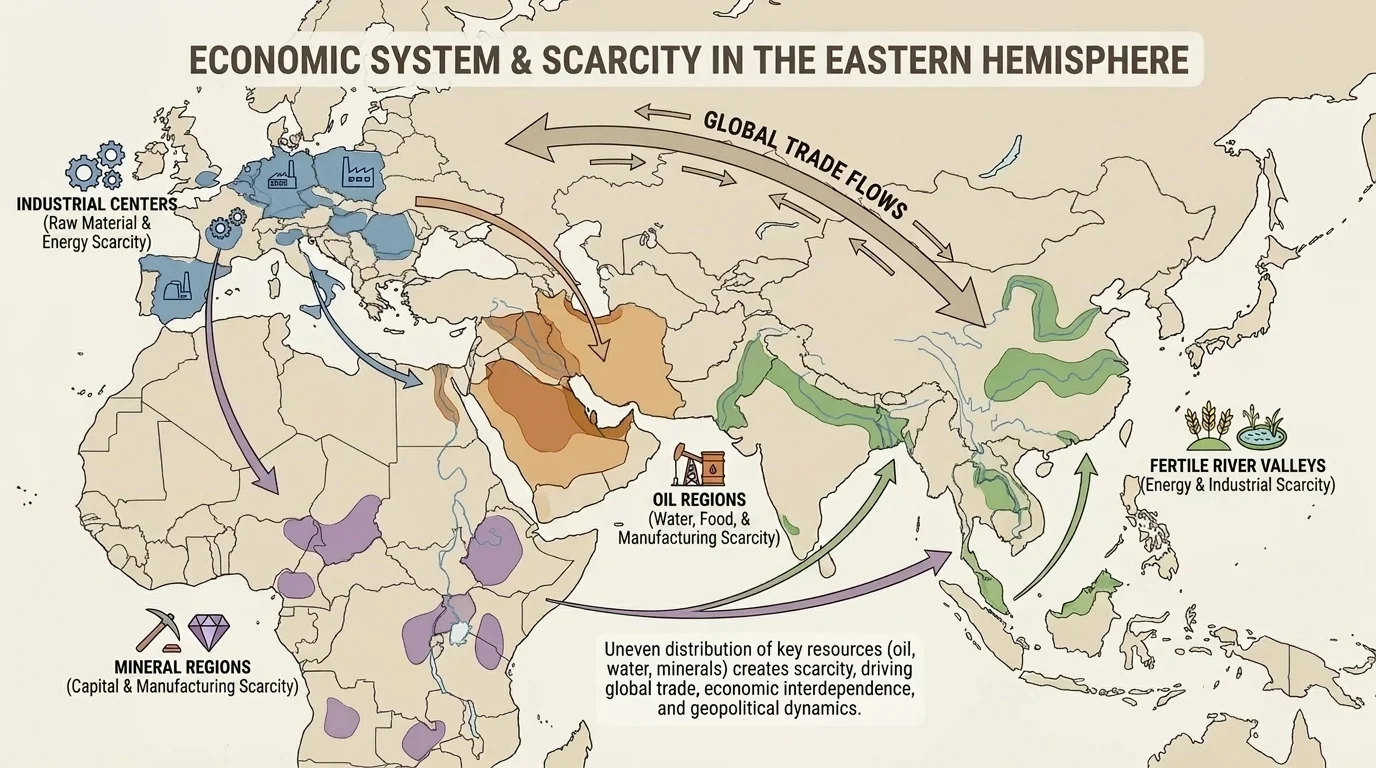
This uneven distribution of resources helps explain why different economies developed in different ways. People build systems that respond to the conditions they face. In dry areas, water management becomes essential. In coastal areas, fishing and trade may be central. In mineral-rich areas, mining may shape jobs, transportation, and foreign investment.
Geography is powerful, but it is not destiny. Two places with similar resources can still develop different economies because people make different choices based on culture, history, and government policy.
Societies use different kinds of economic systems to deal with scarcity, and [Figure 2] compares the main approaches. The four major types are traditional economy, market economy, command economy, and mixed economy.
In a traditional economy, people often produce goods the way earlier generations did. Choices are shaped by customs, family roles, and local environments. This system may be found in small rural or tribal communities where herding, farming, or fishing follow long-used patterns.
In a market economy, buyers and sellers make many decisions. Prices help signal scarcity. If a product becomes rare, its price often rises. That higher price may encourage producers to make more of it or consumers to buy less.
In a command economy, the government makes many major decisions about production and distribution. Leaders may decide what factories produce, where resources go, and what goods should cost. This can allow quick action, but it can also limit consumer choice and reduce efficiency.
In a mixed economy, both markets and governments play important roles. Most countries in the Eastern Hemisphere today use some form of mixed economy. Governments may regulate pollution, provide education, build roads, or support certain industries while businesses still compete in the marketplace.
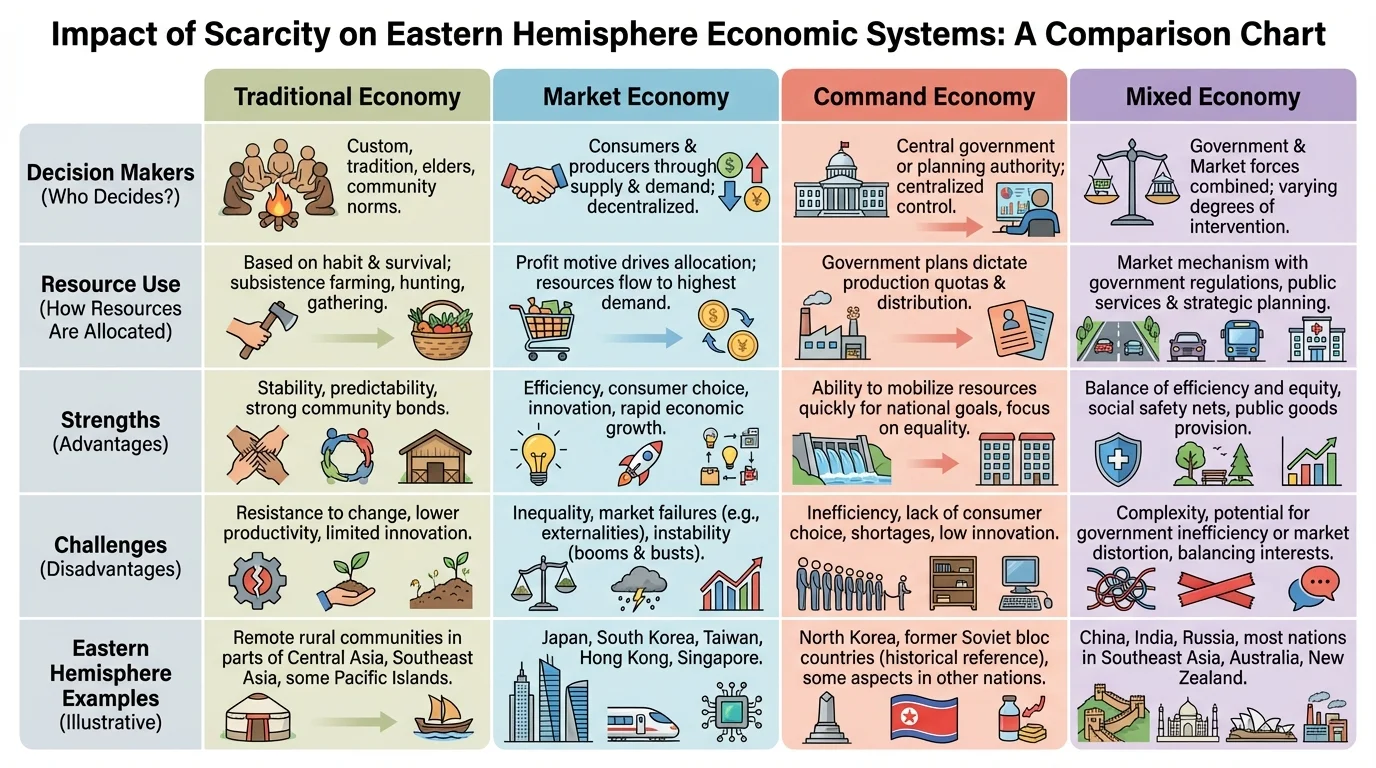
Scarcity affects each system differently. In market systems, scarcity often shows up through price changes. In command systems, scarcity may lead to rationing or government planning. In traditional systems, scarcity may be handled through sharing, seasonal movement, or limits set by custom. In mixed systems, governments try to reduce the worst effects of scarcity while still allowing private choice.
| Economic System | Who makes most decisions? | How scarcity is addressed | Possible challenge |
|---|---|---|---|
| Traditional | Families and customs | Use local knowledge and shared habits | May change slowly |
| Market | Consumers and businesses | Prices guide choices | Can create inequality |
| Command | Government | Planning and rationing | Can reduce freedom and efficiency |
| Mixed | Businesses and government | Combines markets with public policy | Balancing goals can be difficult |
Table 1. Comparison of how major economic systems respond to scarcity.
No system removes scarcity. Each system simply uses different rules to manage it.
Access to natural resources strongly influences what kinds of jobs and industries develop. If a country has fertile soil and enough water, agriculture may become the base of its economy. If it has coal, iron, or oil, mining and energy may become more important. If it lacks raw materials but has skilled workers and advanced technology, manufacturing and services may grow instead.
Natural resources include things such as water, forests, fish, oil, natural gas, fertile land, and minerals. But resources alone are not enough. A society also needs tools, transportation, stable government, and workers with useful skills. A gold deposit hidden underground has little value unless people can reach it, process it, and move it to markets.
Case study: Oil and water in Southwest Asia
Step 1: Identify the scarce and abundant resources.
Many countries in Southwest Asia have abundant oil and natural gas, but scarce fresh water and limited farmland.
Step 2: Look at economic choices.
These countries often export energy to earn money and import food, machinery, and consumer goods.
Step 3: Notice the effect on daily life.
Governments may invest in desalination, pipelines, and modern cities because water scarcity affects homes, farms, and industries.
Scarcity does not mean poverty. A country can be wealthy overall and still face serious scarcity in one key resource.
Japan offers a different example. It has limited farmland and few major energy resources compared with its population and industrial needs. Because of this, Japan imports many raw materials and fuels. At the same time, it developed highly skilled manufacturing, shipping, robotics, and technology industries. Scarcity pushed innovation.
Russia's eastern regions and parts of Central Asia have large land areas and energy or mineral resources, but distance, climate, and transportation challenges affect how easily those resources can be used. In parts of Africa, scarcity may involve not only water or fertile soil, but also access to electricity, roads, and investment.
Economic systems do not grow only from geography. They also reflect what people value. Some societies place a high value on community responsibility, while others emphasize private ownership and competition. Some governments focus strongly on stability and planning. Others put more trust in individual choice and business activity.
Societal values are the beliefs a society holds about what is important. These values influence economic decisions. A government that values food security may support local farming even if imports are cheaper. A society that values social welfare may provide health care, housing support, or unemployment benefits to reduce the effects of scarcity on vulnerable people.
Human capital also matters. Human capital means the knowledge, education, health, and skills people bring to work. Countries with limited natural resources can still build strong economies if they invest in education, research, and technology. This is one reason some places become leaders in finance, engineering, or software rather than agriculture or mining.
Singapore has very limited land and almost no natural resources, yet it became a major global trade and finance center by investing in ports, education, and strategic location advantages.
Human experiences shape economies as well. Colonialism, war, migration, and trade have all changed who controls resources and how wealth is distributed. For example, borders drawn during colonial periods sometimes grouped together people with different goals or split up natural resource areas. Past conflicts can damage roads, farms, schools, and businesses for years, making scarcity worse.
On the other hand, migration can help reduce scarcity in some ways. Workers may move to cities or other countries for jobs, and money they send home can support families. New ideas and technologies can spread too.
Southwest Asia: Oil has shaped many economies, but water scarcity remains one of the region's biggest long-term challenges. Wealth from petroleum can fund cities, transportation, and services, yet many countries still rely on imported food and costly water systems.
South Asia: Countries such as India and Bangladesh depend heavily on rivers, monsoon rains, and fertile land. Scarcity appears when population growth increases demand for food, housing, and jobs. At the same time, technology and service industries have expanded, showing that economies can diversify even under resource pressure.
East Asia: Japan and South Korea have relatively limited raw materials compared with their industrial output. They import many resources and export manufactured goods such as cars, electronics, and machinery. This pattern shows how trade can help countries overcome scarcity.
Sub-Saharan Africa: Many countries have rich supplies of minerals, fertile areas, or energy resources, but transportation, political instability, unequal wealth distribution, and climate stress can limit development. Scarcity here may mean not only limited resources but limited access to those resources.
Europe: Much of Europe uses mixed economies. European countries often combine free markets with government services such as health care, public transportation, and environmental rules. Scarcity has encouraged regional trade, careful land use, and investment in renewable energy.
"People do not just use resources; they organize their societies around them."
The same kind of resource can produce different outcomes in different places. Oil wealth may lead to rapid development in one country, but conflict or corruption in another. Fertile land may support small family farms in one region and large commercial agriculture in another. This is why scarcity must be studied together with government, culture, and history.
No country is completely self-sufficient. Because resources are unevenly distributed, countries trade with one another, as [Figure 3] illustrates through flows of energy, food, and manufactured goods across the Eastern Hemisphere. Trade allows places to specialize in what they produce well and import what they lack.
Specialization means focusing on the production of certain goods or services. A country with abundant oil may specialize in energy exports. A country with strong factories and skilled engineers may specialize in manufacturing. A country with fertile plains may specialize in grain production.
Interdependence means countries depend on one another. This can reduce scarcity, but it also creates risk. If shipping routes are blocked, wars interrupt trade, or prices rise suddenly, countries that depend on imports may face serious problems.
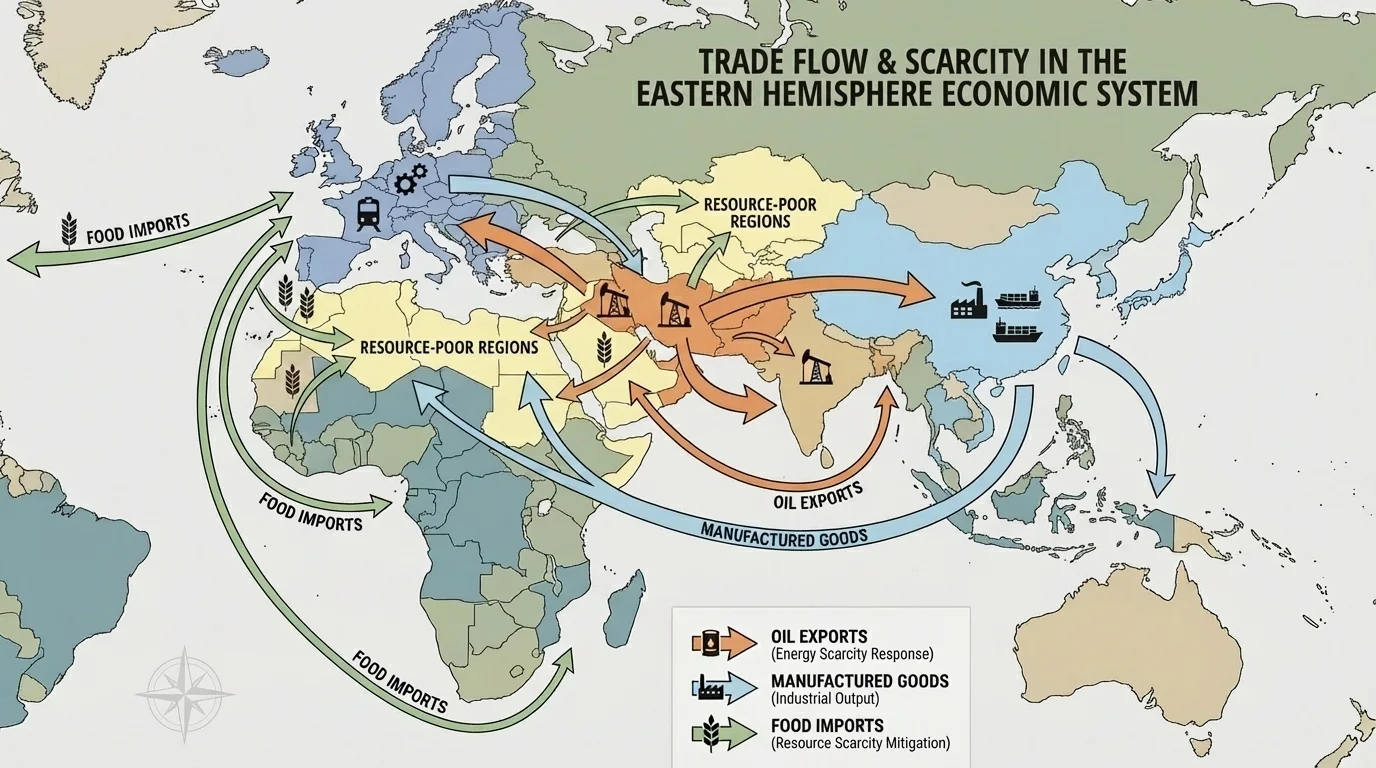
For example, many countries import wheat, rice, fuel, or fertilizer. If global supply is disrupted, prices increase. Families may pay more for bread, bus rides, or electricity. Businesses may cut production. Governments may step in with subsidies or price controls.
Trade links together distant places. A drought in one region, a conflict near a shipping route, or an energy shortage in another area can affect people far away. Scarcity in one place can quickly become a broader economic issue.
Governments play a major role in how scarcity is managed. They can build dams, roads, and ports. They can regulate water use, support farmers, subsidize fuel, or invest in solar and wind power. They can also decide how taxes are collected and how money is spent.
These choices affect everyday life. If a government improves irrigation, food production may rise. If it invests in schools and training, workers may gain new skills. If it fails to manage resources fairly, scarcity can deepen inequality between regions or groups.
Prices, rationing, and subsidies
When goods are scarce, societies often use one or more of these tools. Prices rise to signal scarcity in market systems. Rationing limits how much each person can buy when supply is too low. Subsidies are government payments that lower the cost of important goods such as fuel, food, or water.
Each tool has advantages and problems. Higher prices can encourage conservation, but they may hurt poor families. Rationing can spread goods more evenly, but it may cause long lines or black markets. Subsidies can help people afford necessities, but they are expensive for governments and may encourage waste if prices stay too low.
Scarcity will remain important in the Eastern Hemisphere because new pressures are growing. Climate change is affecting rainfall, drought, floods, and crop yields. Population growth continues in many areas. Energy systems are changing as countries try to reduce pollution and rely less on fossil fuels.
Water may become one of the most serious scarcity issues in the future. Regions already facing dry conditions may need better irrigation, water recycling, desalination, and international agreements over shared rivers. Energy transitions also matter. Countries rich in oil may need to diversify their economies, while countries investing in solar panels, batteries, and rare minerals may gain new advantages.
Resources are not only things found in nature. People, ideas, education, and technology are also economic strengths. A country can respond to scarcity not just by finding more resources, but by using existing resources more wisely.
Innovation can change how scarcity is experienced. Improved seeds can raise crop yields. Better public transportation can reduce fuel use. Recycling can stretch supplies of metals and plastics. Renewable energy can reduce dependence on imported fuels. But new technology also requires investment, training, and fair access.
Understanding scarcity helps explain why the Eastern Hemisphere contains such varied economic systems. Scarcity pushes societies to make choices, and those choices are shaped by geography, culture, government, trade, and human experience. When we study economic systems, we are really studying how people respond to limits.
