A government is not just a building, a flag, or a leader on television. It can decide whether people vote freely, whether children attend school, whether families can get medical care, and even whether certain groups are treated fairly under the law. Around the world, the relationship between a nation and its people can be supportive, unequal, or even violent. Studying these relationships helps us understand why civic participation matters so much.
Every nation creates rules for how people live together. Governments collect taxes, make laws, run schools, provide security, and manage public resources. In return, citizens may obey laws, vote, serve in the military, pay taxes, speak out on issues, or work to change unfair policies. This relationship is at the heart of civic participation, which means the ways people take part in the life of their community and country.
Some governments protect freedoms such as speech, religion, and voting. Others limit these rights. A citizen in one country may criticize leaders online without fear, while a citizen in another country may be arrested for doing the same thing. That difference tells us a lot about how power works.
Human rights are basic rights and freedoms that belong to all people, such as the right to life, safety, fair treatment, belief, and expression. Citizenship is legal membership in a nation, often connected to rights and responsibilities. Rule of law means that laws apply to everyone, including leaders, and are enforced fairly.
Government-citizen relationships are not all the same, even within the Eastern Hemisphere. Countries in Africa, Asia, Europe, and the Middle East have different histories, political systems, and legal traditions. These differences shape how people participate in public life.
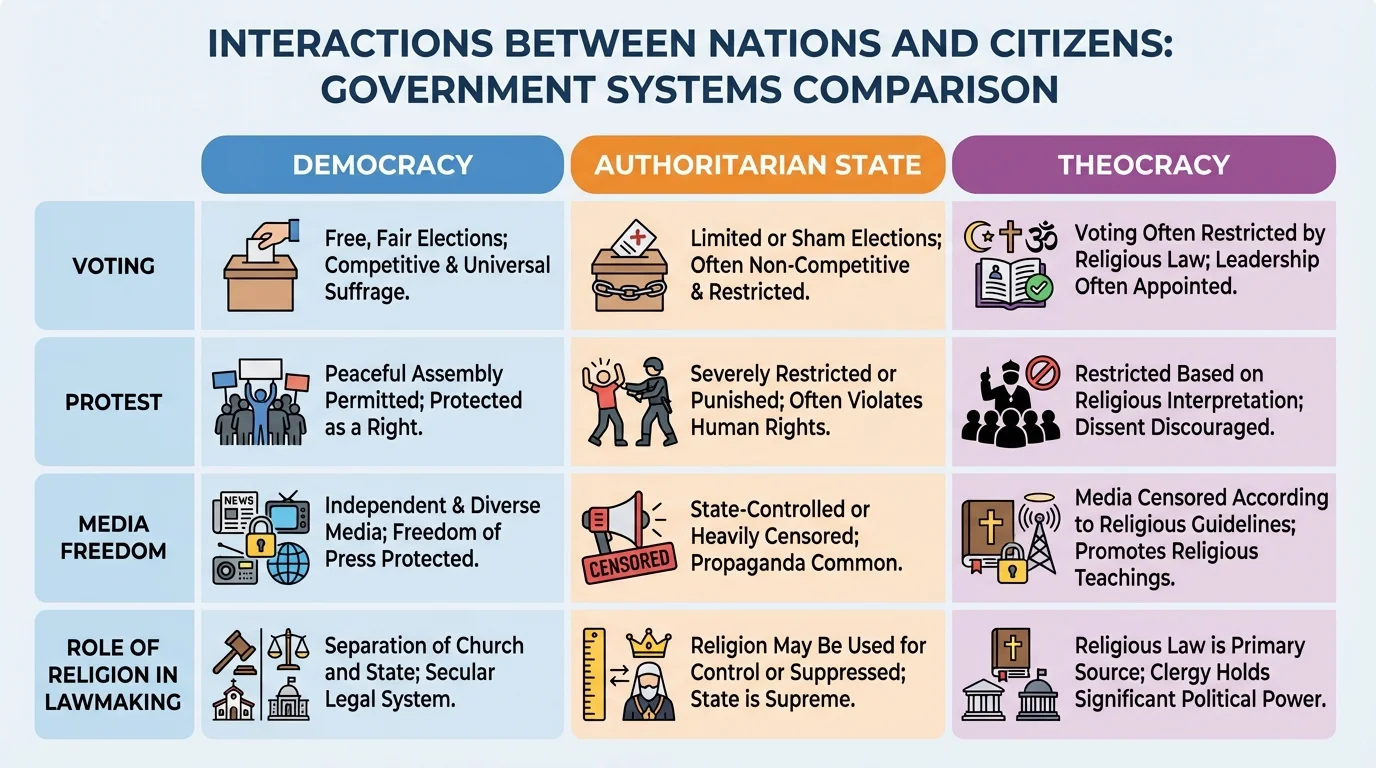
In a democracy, citizens usually elect leaders, join political parties, speak publicly, and protest peacefully. In an authoritarian system, leaders hold most power and may limit elections, censor the press, or punish opposition. In a theocracy or a government strongly influenced by religion, political decisions may be tied closely to religious law and religious leadership. These different forms of participation are easier to compare when viewed side by side, as [Figure 1] shows through voting, media freedom, and protest rights.
For example, in Japan, India, and South Korea, citizens vote and debate public issues in active democracies. In contrast, in North Korea, the state controls information tightly, and citizens have almost no freedom to criticize the government. In Iran, elections exist, but unelected religious authorities also hold major power, which shapes what citizens can and cannot do politically.
Even where elections exist, civic participation can still be unequal. Some people may have more wealth, education, or social influence than others. Some minorities may face barriers that make participation harder. So the question is not only whether people can participate, but also how fairly they can participate.
Citizens also interact with governments through everyday life. A student attending a public school, a family receiving health care, or a worker paying taxes is part of this connection. Politics is not only about elections; it is about daily decisions that affect millions of people.
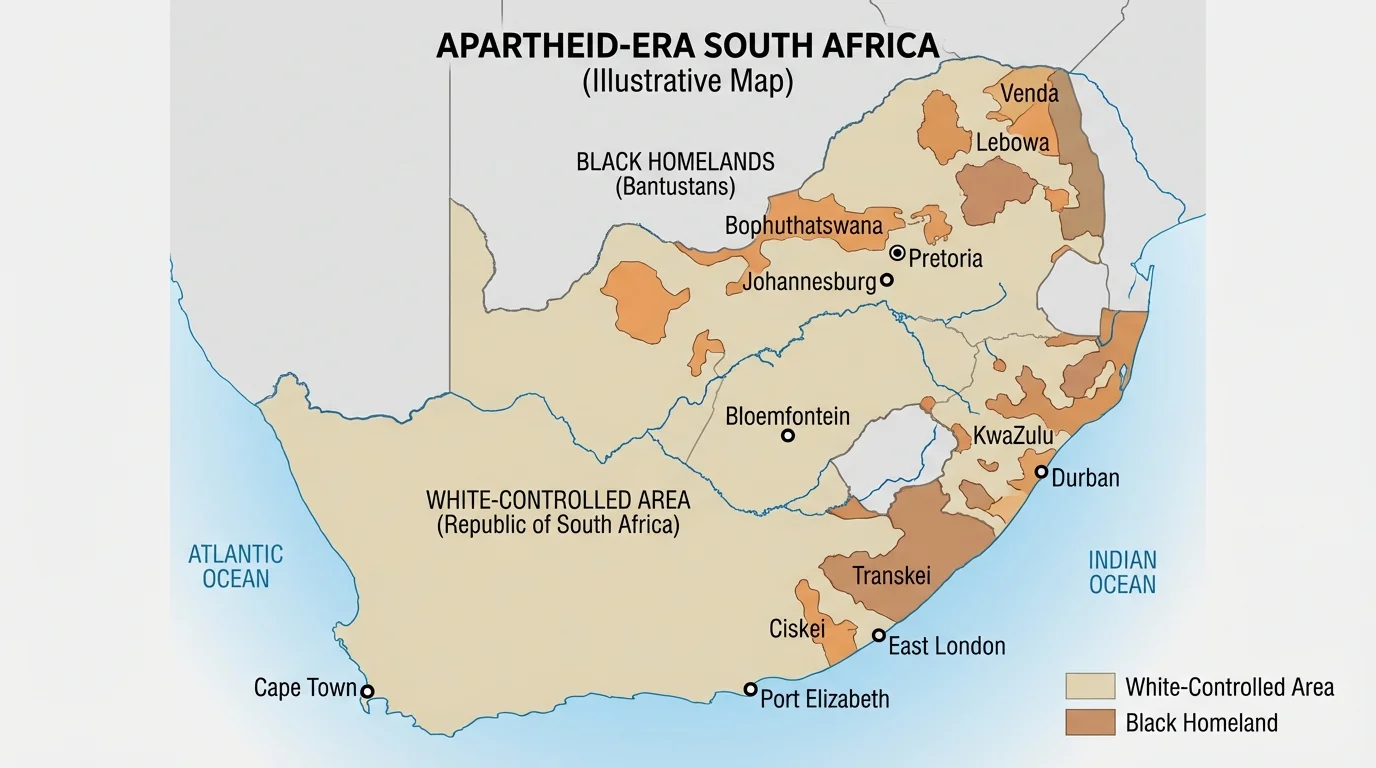
One of the clearest examples of a harmful government-citizen relationship is Apartheid in South Africa. Apartheid was a system of laws that enforced racial separation and inequality from 1948 until the early 1990s. The government classified people by race and gave white South Africans far more political power, land, and economic opportunity than Black South Africans and other groups. [Figure 2] helps show the geography of separation, including homelands and restricted movement.
Under apartheid, Black South Africans were forced to live in certain areas, attend separate schools, and use separate public facilities. They often needed passbooks to travel into areas reserved for white citizens. Families were separated by labor systems, and people could be arrested simply for being in the "wrong" place.
The system was defended by the government as a way to preserve order, but in reality it denied equal rights to the majority of the population. Black South Africans could not fully participate in government, even though the laws controlled nearly every part of their lives.
Many people resisted apartheid. Leaders such as Nelson Mandela, Desmond Tutu, and thousands of activists organized protests, strikes, boycotts, and international campaigns. The African National Congress, often called the ANC, became one of the major resistance groups. Students also played an important role, especially in the 1976 Soweto Uprising, when young people protested unfair education policies.
Apartheid also shows that nations do not act in isolation. Other countries placed pressure on South Africa through sanctions, sports boycotts, and diplomatic criticism. Eventually the system ended, Mandela was released from prison, and South Africa held multiracial democratic elections in 1994. Looking back at [Figure 2], we can see that political power was tied to control of land and movement, not just to voting rules.
Case study: A law can shape daily life
Under apartheid, government decisions affected where a person could live, learn, and work.
Step 1: The state classified people by race.
This classification was written into official records and used to decide legal rights.
Step 2: The state enforced separation.
Housing, schools, transportation, and public spaces were separated, and the quality was unequal.
Step 3: Citizens responded.
People resisted through protest, writing, organizing, and international appeals.
This case shows that a government can use law either to protect equality or to deny it.
The end of apartheid did not instantly erase inequality, but it changed the relationship between the South African state and its citizens. People who had been excluded gained voting rights and a voice in the nation's future.
When a government harms citizens instead of protecting them, the result may be a human rights violation. This can include torture, censorship, forced labor, unlawful imprisonment, political violence, or discrimination against ethnic or religious groups. These abuses often grow gradually, as [Figure 3] illustrates through a progression from prejudice to mass violence.
Not every rights violation becomes genocide, but genocide is one of the most extreme forms of state or organized violence. Genocide is the deliberate attempt to destroy, in whole or in part, a national, ethnic, racial, or religious group.
Examples include the Holocaust in Europe during World War II, the 1994 genocide in Rwanda, and the genocide in Cambodia under the Khmer Rouge. In Rwanda, extremist leaders and militias targeted Tutsi people and moderate Hutu in a campaign that killed around 800,000 people in about 100 days. Radio broadcasts were used to spread hate and encourage killing.
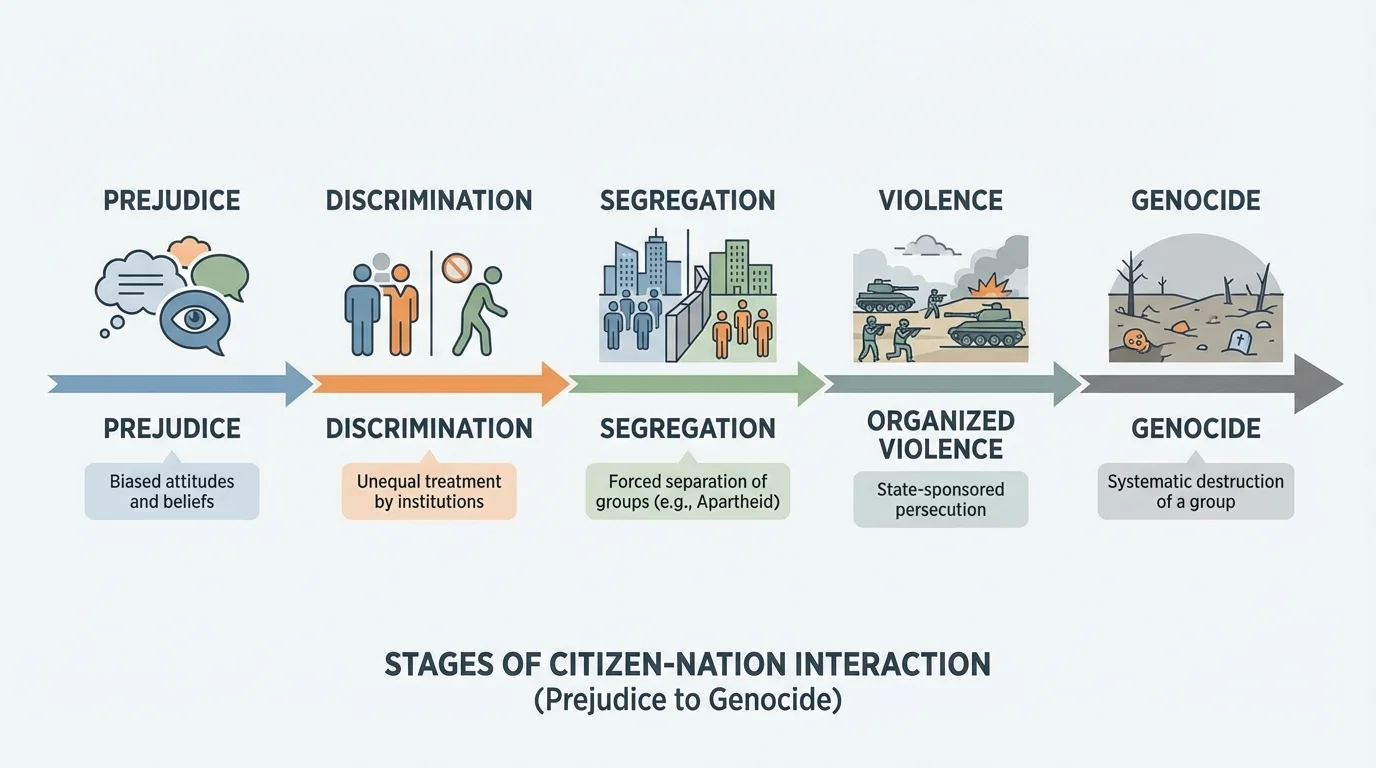
Genocide usually does not appear out of nowhere. It often begins with language that dehumanizes a group, laws that isolate them, propaganda that spreads fear, and organized violence that grows over time. That pattern is why early warning signs matter so much.
International groups such as the United Nations try to respond to major human rights abuses, but responses are not always fast or effective. Other nations may debate whether to use sanctions, diplomacy, peacekeeping, or criminal trials. Sometimes they act too late. The timeline in [Figure 3] reminds us that stopping hatred early is often more effective than trying to stop mass killing after it begins.
The phrase "never again" became widely used after the Holocaust, but later genocides still occurred. This shows how difficult it is for the world to prevent mass violence, even when warning signs are visible.
Citizens can resist human rights abuses by documenting events, supporting victims, reporting evidence, and pressing leaders to act. Journalists, teachers, students, religious leaders, and survivors all play a role in defending human dignity.
In some countries, religion strongly shapes the legal system. One important example is Shari'ah law, a body of Islamic legal and moral principles based on the Qur'an, the teachings of the Prophet Muhammad, and later interpretation by scholars. It is important to understand that Shari'ah is not applied the same way everywhere.
In countries such as Saudi Arabia and Iran, religious law influences national law more directly than in many other countries. In other Muslim-majority nations, such as Indonesia or Turkey, legal systems may include civil law, constitutional law, and only limited religious law in certain areas, such as family matters.
Religion and law can interact in different ways
A state may base many laws on religion, may use religion only in certain legal areas, or may separate religion from government almost completely. The key question is how much power religious authorities hold and how that affects citizens of different beliefs, genders, or social groups.
Supporters of religious law may believe it preserves moral values and social order. Critics may argue that some interpretations limit freedom of religion, women's rights, freedom of speech, or equal treatment under the law. These debates are not only about religion; they are also about power, rights, and who decides what justice means.
This topic requires careful thinking. It would be incorrect to assume that all Muslim-majority countries govern in the same way. Just as democratic countries differ from one another, countries influenced by Islamic law also vary widely in practice and interpretation.
Governments do not only shape political rights. They also shape jobs, prices, trade, and access to resources through economic policies. A government-sanctioned economic policy is an official decision about how money, land, business, labor, or trade should be managed.
Some economic policies are designed to help citizens. Governments may subsidize food, build roads, support farmers, or create public housing. Other policies may unfairly benefit one group over another, or they may fail badly even if the original goal seemed useful.
For example, in Zimbabwe, land policies and economic instability contributed to severe inflation and shortages. In the Soviet Union, the state controlled much of the economy through central planning. In China, the government has used a mix of state control and market reforms, creating rapid economic growth while still keeping strong political control.
Economic policy can also be used as punishment or pressure between nations. Sanctions are restrictions on trade or finance meant to push a government to change its behavior. Sanctions were used against apartheid South Africa, and they have also been used against countries such as Iran and Russia. These policies can pressure leaders, but they can also affect ordinary citizens by raising prices or reducing access to goods.
| Policy Type | Goal | Possible Effect on Citizens |
|---|---|---|
| Subsidy | Lower cost of important goods | Food or fuel becomes more affordable |
| Sanction | Pressure another government | Imported goods may become scarce or expensive |
| State planning | Control production and distribution | Basic needs may be organized by government, but choice may be limited |
| Privatization | Transfer services or businesses to private owners | Efficiency may increase, but access can become less equal |
Table 1. Examples of government economic policies and how they can affect daily life.
These examples show that economics is also a form of nation-citizen interaction. A family experiences the effects of policy not only in political speeches, but also when paying for bread, riding a bus, buying medicine, or searching for work.
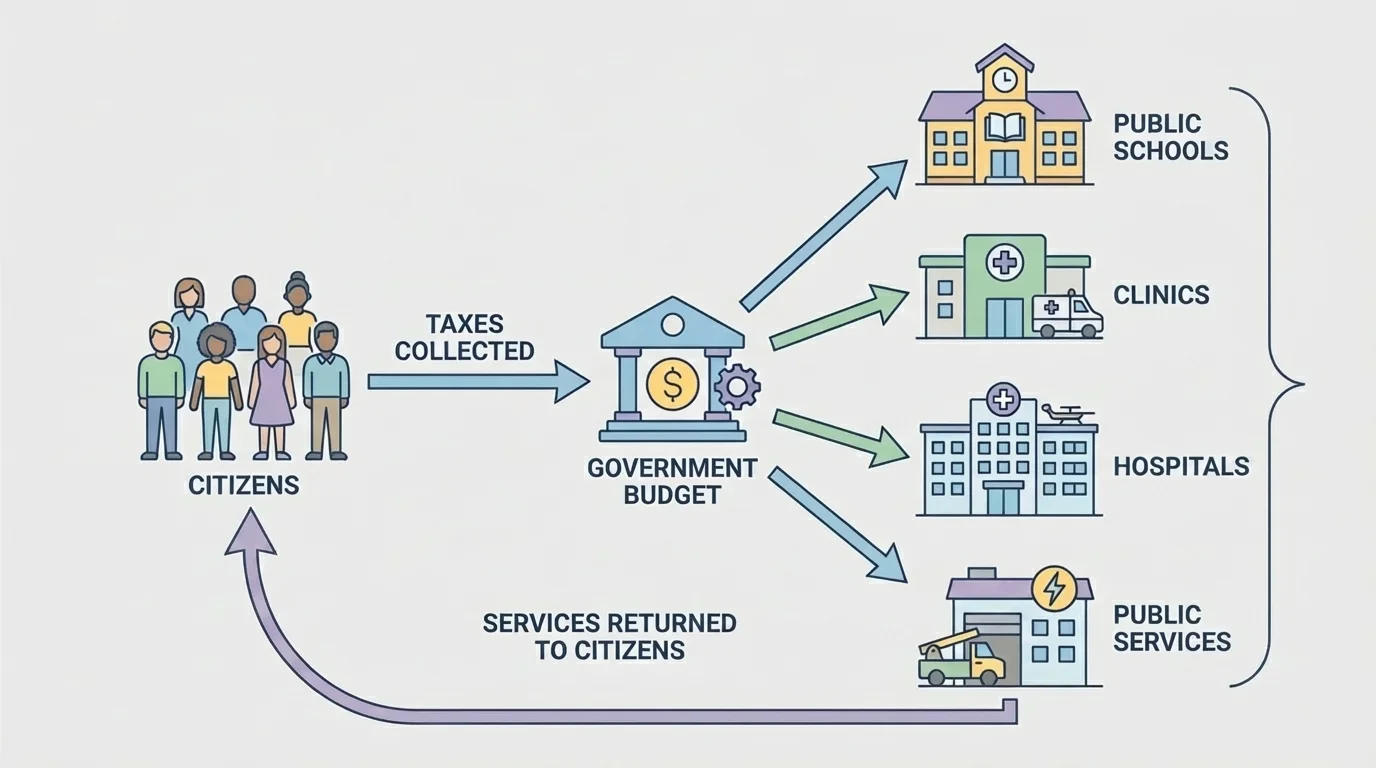
One of the most direct ways a government interacts with citizens is by providing public services. [Figure 4] shows the flow of money and services from citizens to the state and back to citizens. In a socialized healthcare system or other publicly funded system, the government helps pay for or runs health services so that medical care is available to more people. Public education works in a similar way: taxes support schools, teachers, buildings, and learning materials.
Countries in the Eastern Hemisphere offer many examples. The United Kingdom has the National Health Service, often called the NHS, which provides healthcare mainly funded by taxes. Finland is known for strong public education, and many European countries support both schooling and healthcare with public money.
Supporters say these systems make basic services more equal, because a child can attend school or a sick person can see a doctor even if the family is not wealthy. Critics may argue that waiting times, high taxes, or government inefficiency can be problems.
Some countries combine public and private systems. For example, a government may provide basic schooling but allow private schools too. Or it may offer public hospitals while private clinics serve those who can pay extra. This means socialized services are not simply "all public" or "all private"; many nations use mixed systems.
Looking again at [Figure 4], we can see that socialized systems depend on trust. Citizens pay taxes believing the government will return value through services. If the government is honest and effective, people may support the system. If corruption is widespread, trust may weaken.
Real-world comparison: healthcare access
Consider two families, each with a child who breaks an arm.
Step 1: In a publicly funded system, the family usually goes to a public clinic or hospital.
The cost to the family may be very low at the time of care because taxes already support the system.
Step 2: In a mostly private system, the family may depend on insurance or personal savings.
If coverage is weak, the bill can be a major burden.
Step 3: Compare the nation-citizen relationship.
In the first case, the government plays a larger direct role in daily well-being. In the second, private choices and personal finances play a larger role.
Both systems involve trade-offs, but each reflects a different idea about the government's responsibilities.
Education works in much the same way. Public schools can create opportunity, teach citizenship, and help build national identity. At the same time, governments may try to influence what students learn, which is why school systems also reflect political values.
Although governments vary, several common patterns appear. First, every government makes choices that affect citizens' rights and daily lives. Second, citizens respond in different ways: by voting, protesting, obeying, resisting, organizing, or sometimes fleeing. Third, laws and policies often reveal what a state values most, whether that is equality, order, religion, economic growth, or control.
Democracies usually offer more channels for citizens to speak and vote, but they still face problems such as inequality and discrimination. Authoritarian states may provide stability or services while limiting freedom. Religious governments may connect law to moral tradition, but debates often emerge over inclusion and rights. Looking back to [Figure 1], the major difference is not simply who rules, but how much voice ordinary people have.
Historical examples make these differences real. Apartheid shows how law can enforce injustice. Genocide shows how governments or organized groups can turn hatred into mass murder. Public healthcare and education show how states can also improve quality of life. Economic policies show that decisions made by leaders can affect something as personal as the cost of food or the ability to find work.
Understanding these interactions helps students become thoughtful citizens. It encourages people to ask important questions: Are laws fair? Who benefits from a policy? Who is excluded? How can people participate responsibly? Those questions matter in every region of the world.
"The arc of the moral universe is long, but it bends toward justice."
— Martin Luther King Jr.
Justice does not happen automatically. It depends on people, institutions, and the courage to challenge unfair systems. The relationship between a nation and its citizens is one of the most powerful forces in history because it shapes freedom, opportunity, and human dignity.
