A disease outbreak in one city can affect airports on the other side of the world within days. Smoke from factories in one country can drift into another. A war in one region can force millions of people to leave their homes. These are not just local troubles; they are public problems that can spread across borders and affect entire societies. Governments exist partly to deal with problems like these, but not all governments respond in the same way.
A public problem is an issue that affects many people and cannot usually be solved by one person acting alone. Public problems include pollution, unsafe food, disease outbreaks, terrorism, natural disasters, water shortages, cyberattacks, and refugee crises. Governments step in because these problems threaten the public good, which means the well-being, safety, and basic interests of the community as a whole.
Public good means the benefit or well-being of the whole community, not just one person or one group. Governments protect the public good by making laws, providing services, and responding to dangers that affect society.
Students can see the public good in everyday life. Clean drinking water, safe roads, vaccinations, emergency services, and laws against fraud all exist because governments try to protect people from harm. Sometimes the challenge is local, like fixing a dangerous bridge. Sometimes it is international, like limiting the spread of a virus. In both cases, government action matters.
Many public problems cross borders, as [Figure 1] illustrates through examples such as pollution, migration, and disease. A problem may begin in one country, but trade, travel, weather patterns, and modern technology can quickly connect it to many others.
In the Eastern Hemisphere, countries in Europe, Asia, Africa, and Oceania face both shared and unique challenges. Some regions deal with severe air pollution caused by factories and vehicles. Others struggle with drought, food insecurity, or conflict. In coastal areas, stronger storms and rising sea levels create new risks. In rapidly growing cities, governments must manage traffic, housing, sanitation, and public health all at once.
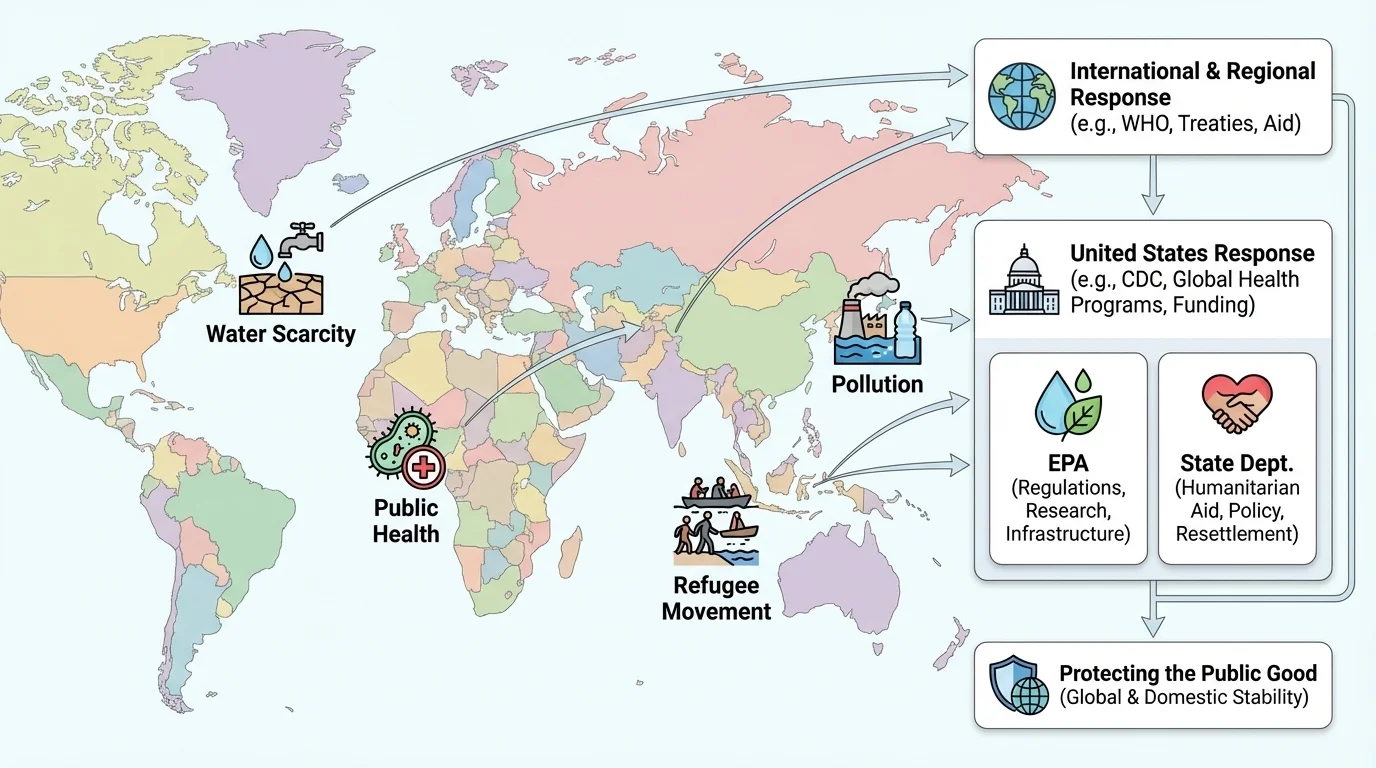
These problems can be grouped into several major categories:
These categories often overlap. For example, war can cause migration, migration can create pressure on housing and schools, and crowded conditions can make disease spread faster. A drought can hurt farming, increase food prices, and force people to move. Governments must often solve several connected problems at the same time.
Air pollution does not stop at national borders. Winds can carry polluted air from one country into another, which is one reason environmental policy often requires international cooperation.
The United States faces many of these same public problems. Wildfires, hurricanes, cybercrime, disease outbreaks, and water issues all require government action. Comparing the United States with countries in the Eastern Hemisphere helps us see what governments have in common and where they differ.
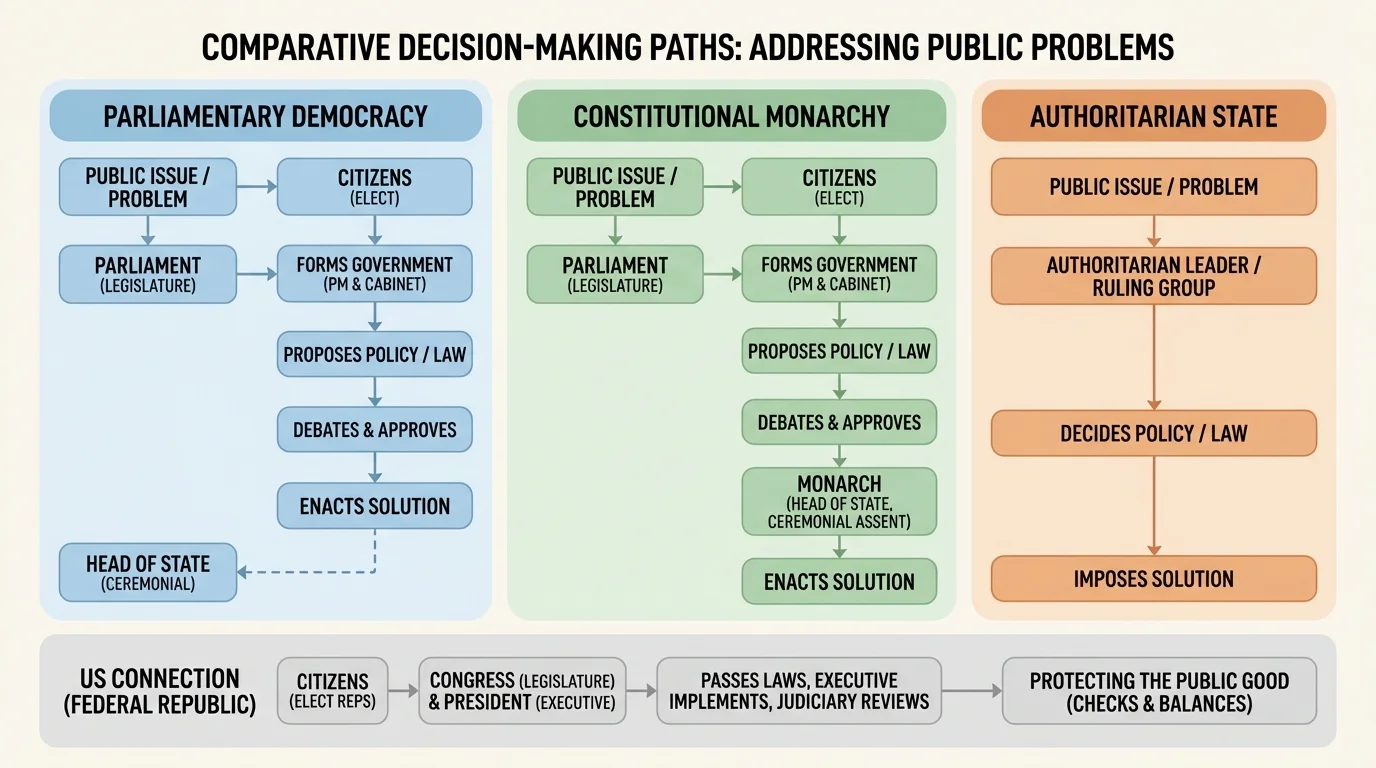
The structure of a government affects how it responds to public problems, and [Figure 2] makes that easier to see by comparing how decisions move through different systems. A country with free elections, multiple political parties, and an independent court system may respond differently from a country where leaders hold most power and public criticism is limited.
In a democracy, citizens usually have ways to influence public policy through voting, contacting leaders, joining groups, speaking publicly, or protesting. Democratic governments may move more slowly because they debate policies, hold hearings, and allow disagreement. However, they often have stronger public accountability because leaders can be voted out of office.
In a parliamentary system, such as the systems used in Japan and India, the executive leader usually comes from the legislature. This can sometimes make it easier to pass laws quickly if the ruling party has strong support. In a constitutional monarchy such as Japan or the United Kingdom, a monarch serves as a symbolic head of state while elected officials govern.
In an authoritarian system, leaders may act quickly because fewer groups can challenge their decisions. That speed can help during emergencies, but it may also reduce transparency, limit public voice, and make it harder for citizens to question government mistakes.
Governments also use different tools to address problems. They may pass laws, create agencies, collect taxes, fund research, enforce regulations, build infrastructure, or cooperate with other countries. The United States uses all of these tools too. Congress passes laws, executive agencies carry them out, courts review legality, and state and local governments also play major roles.
| Government approach | Common features | Possible strengths | Possible limits |
|---|---|---|---|
| Democratic republic | Elected representatives, checks and balances | Public accountability, protection of rights | Decision-making may be slower |
| Parliamentary democracy | Executive linked to legislature | Can pass policies efficiently | Coalition disagreements may cause instability |
| Constitutional monarchy | Symbolic monarch, elected government | National continuity with democratic rule | Same policy challenges as other democracies |
| Authoritarian system | Power concentrated in leaders or one party | Fast action in some situations | Less public input, weaker protections for dissent |
Table 1. Comparison of general government approaches and how they may respond to public problems.
Some public problems are simply too large for one country to solve alone. That is why governments often work through regional groups and international organizations. In Europe, countries cooperate through the European Union on trade, environmental standards, migration policy, and some public health issues. In Africa, the African Union helps member states discuss peace, security, and development. Around the world, the United Nations and other international bodies help coordinate responses to war, hunger, refugee crises, and disease.
Why cooperation matters
When problems cross borders, countries need shared information, shared rules, and sometimes shared resources. Cooperation can include warning systems for disasters, agreements to reduce pollution, refugee aid, and scientific research. Even powerful countries cannot fully protect the public good if they ignore international connections.
The United States is part of many international efforts too. It works with allies on security, trade, disease monitoring, and environmental research. At the same time, U.S. leaders must decide how much power to share with international organizations and how to balance national interests with global responsibilities.
Stopping disease requires action at several levels, and [Figure 3] shows how local clinics, national agencies, borders, and international organizations connect. Public health is a strong example of how governments protect the public good because one person's illness can put many other people at risk.
South Korea is often studied for its response to infectious disease outbreaks. Its government has used testing, contact tracing, public communication, and digital tools to identify and limit spread. India has carried out very large vaccination campaigns and public information efforts across a huge and diverse population. These responses show that even when governments differ, they often use common strategies: collect information, warn the public, support hospitals, and coordinate resources.
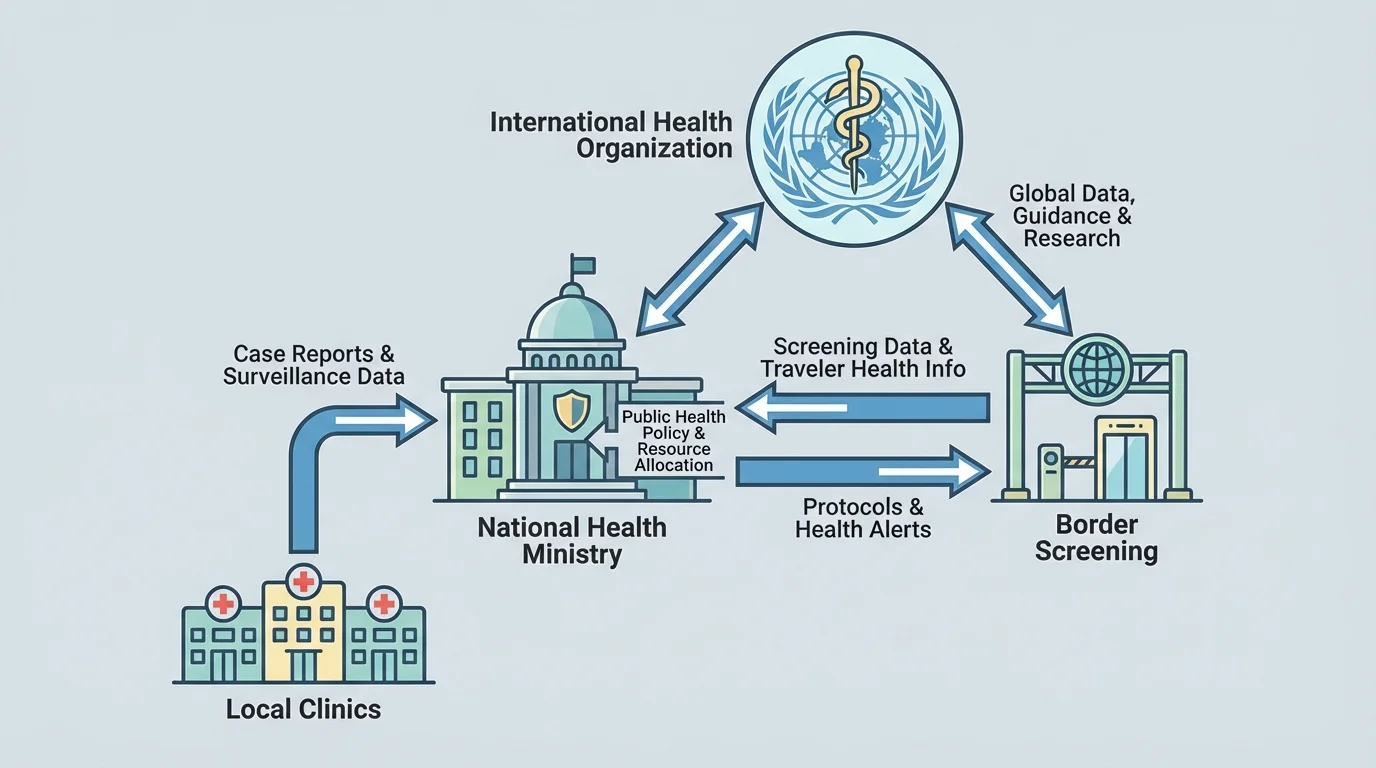
In the United States, public health responsibilities are shared across levels of government. Local health departments monitor outbreaks in communities. State governments manage many health rules and emergency actions. Federal agencies, including the Centers for Disease Control and Prevention and the Food and Drug Administration, provide guidance, research, safety review, and national coordination.
Countries may disagree about how strict public health rules should be. Some require masks, quarantines, or digital tracking in emergencies. Others focus more on voluntary action. These choices often reflect different political values, legal systems, and public expectations.
Case study comparison: disease control
Step 1: Identify the public problem.
An infectious disease can spread quickly through travel, schools, workplaces, and crowded transportation systems.
Step 2: Look at government tools.
Governments may test for disease, trace contacts, share health information, fund hospitals, and regulate entry at borders.
Step 3: Compare systems.
South Korea used strong digital coordination; India relied on massive vaccination and regional administration; the United States used federal, state, and local agencies working together, sometimes with disagreements among levels of government.
Step 4: Connect to the public good.
All three examples aim to protect life, reduce spread, and keep essential services functioning.
Later, when students compare civic participation, [Figure 3] is still useful because health policy is not only about experts. Citizens influence health policy by following rules, asking questions, attending meetings, and voting for leaders who support certain approaches.
Environmental problems are another major area of government action. The European Union has created shared environmental rules for many member countries. These include limits on some pollution, goals for cleaner energy, and efforts to reduce greenhouse gas emissions. Japan has also invested in energy efficiency, public transportation, and disaster planning related to earthquakes and tsunamis.
Governments address environmental problems in many ways: setting emissions standards, protecting forests, funding cleaner technology, building flood defenses, and regulating waste disposal. Some actions are preventive, trying to stop future damage. Others are responsive, helping after a flood, drought, or wildfire.
The United States addresses environmental issues through federal laws, state rules, and agencies such as the Environmental Protection Agency. States may go beyond national rules in areas like vehicle emissions or renewable energy. This means U.S. environmental policy can vary by region, while other countries may use a more centralized approach.
Government power is often divided in different ways. In the United States, federalism means national and state governments share power. That structure affects how environmental, health, and safety policies are made.
Environmental policy often leads to difficult trade-offs. A factory may provide jobs but also produce pollution. Building a dam may create electricity but change ecosystems and force communities to relocate. Governments must weigh costs, benefits, and fairness. That is true in Europe, Asia, Africa, and the United States.
Security problems can include terrorism, organized crime, war, and cyberattacks. Governments respond by strengthening intelligence, policing borders, monitoring threats, and working with allies. In some countries, these policies are tightly controlled by central leaders. In others, courts and legislatures check executive power.
One challenge is balancing safety with freedom. A government may argue that surveillance helps stop attacks, but citizens may worry about privacy and rights. In democracies, debates over this balance are common. In less democratic systems, people may have fewer opportunities to challenge security policies.
Refugee crises show this tension clearly. Countries near wars or disasters often receive large numbers of displaced people. Governments must decide how to provide shelter, schooling, health care, and legal protection while also managing budgets and public concerns. European countries have faced this issue during conflicts in the Middle East and elsewhere.
"The safety of the people shall be the highest law."
— A principle often linked to public responsibility in government
The United States also responds to security threats through agencies, laws, and international cooperation. But U.S. courts, media, and elections create public debate over whether government actions go too far or not far enough. That debate is an important part of civic life.
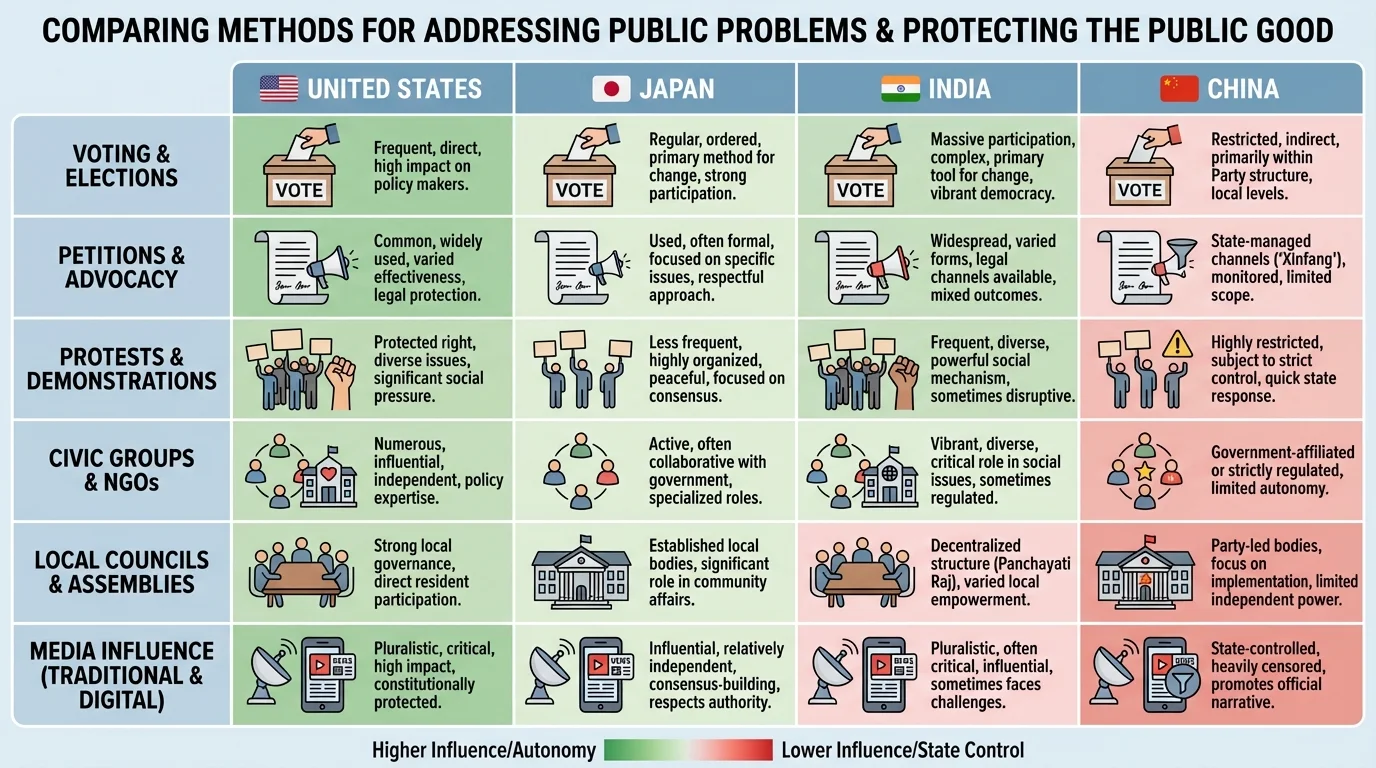
Citizens do not participate in the same ways everywhere, and [Figure 4] compares several methods of civic participation across different systems. This matters because solving public problems is not only the job of officials. People influence what governments do.
In democratic countries such as India, Japan, and the United States, citizens can usually vote, join political parties, sign petitions, contact representatives, write news articles, organize community groups, and protest publicly. These actions can push governments to improve schools, clean rivers, increase disaster readiness, or change public health policy.
In countries with fewer political freedoms, citizens may still participate, but in more limited ways. They may work through approved local groups, social media, or community networks. However, criticism of leaders may be censored or punished. That changes how quickly public concerns become public policy.
Similarities still exist. Across many systems, people volunteer after disasters, raise money, share information, and help neighbors. Civic participation is not only voting. It also includes community action, public discussion, and efforts to solve problems together.
The United States gives citizens many formal ways to influence policy, including elections at local, state, and national levels. Because power is divided among branches and levels of government, people may need to work through several channels at once. For example, a community concerned about water pollution might contact city officials, state environmental agencies, members of Congress, and courts.
As [Figure 4] makes clear, participation changes with political structure, but the goal is often similar: people want governments to protect health, safety, fairness, and opportunity. That shared goal connects many societies even when their systems differ.
Comparing governments helps students think more carefully about public policy. No government solves every problem perfectly. Some act quickly but limit freedom. Some protect rights strongly but move slowly. Some rely heavily on national agencies; others share power among regional and local governments.
Looking at public problems across the Eastern Hemisphere and the United States shows that governments face common responsibilities. They must gather information, make laws, provide services, use resources wisely, and respond to emergencies. They must also earn public trust. If people do not trust government information or believe decisions are unfair, even a strong policy may fail.
Connection to the public good
When governments address disease, pollution, disaster risk, or security threats, they are trying to protect conditions that allow people to live safely and participate in society. The public good includes health, order, fairness, and access to essential services. Good government does not remove every danger, but it works to reduce harm and support the common welfare.
Understanding these comparisons also prepares students to be informed citizens. When they hear about air quality alerts, refugee debates, vaccination rules, or cyber safety, they can ask stronger questions: What is the problem? Who is affected? Which level of government is responsible? How do other countries handle this? What rights and responsibilities are involved?
