One government may hold elections, another may limit opposition, and both may claim they serve the people. That raises an important question: how can different governments say they support good citizenship while acting in very different ways? To answer that, we need to look closely at civic virtues and civic principles and how governments put them into action.
Civic virtues are the attitudes and behaviors that help a society work well. These include respecting others, obeying just laws, helping the community, staying informed, and participating in public life. Civic principles are the big ideas that guide government, such as freedom, equality, justice, and the rule of law.
Governments do more than talk about these ideas. They turn them into real policies, institutions, and expectations. A government can support participation by protecting voting rights. It can support equality by making laws that apply to all citizens. It can support the common good by building schools, roads, and health systems. But governments can also weaken civic life if they punish criticism, ignore unfair treatment, or allow power to be used without limits.
Civic virtue is behavior that helps the community and supports responsible citizenship. Civic principle is a basic idea that guides how government and citizens should act, such as justice, equality, liberty, and the rule of law.
When studying governments, it is important to ask not only, "What does this government say?" but also, "What does this government actually do?" A constitution may promise rights, but the real test is whether courts, leaders, police, schools, and citizens follow those promises in everyday life.
Several major principles appear again and again in modern governments, as [Figure 1] shows in a side-by-side comparison of ideas and actions. These principles include rule of law, liberty, equality, participation, accountability, and the common good.
Rule of law means everyone, including leaders, must obey the law. Liberty means people have freedoms, such as speaking, worshiping, or gathering peacefully. Equality means the law should treat people fairly. Participation means citizens take part in public life. Accountability means leaders can be questioned, judged, or removed if they misuse power. The common good means acting for the benefit of society as a whole, not only for one person or group.
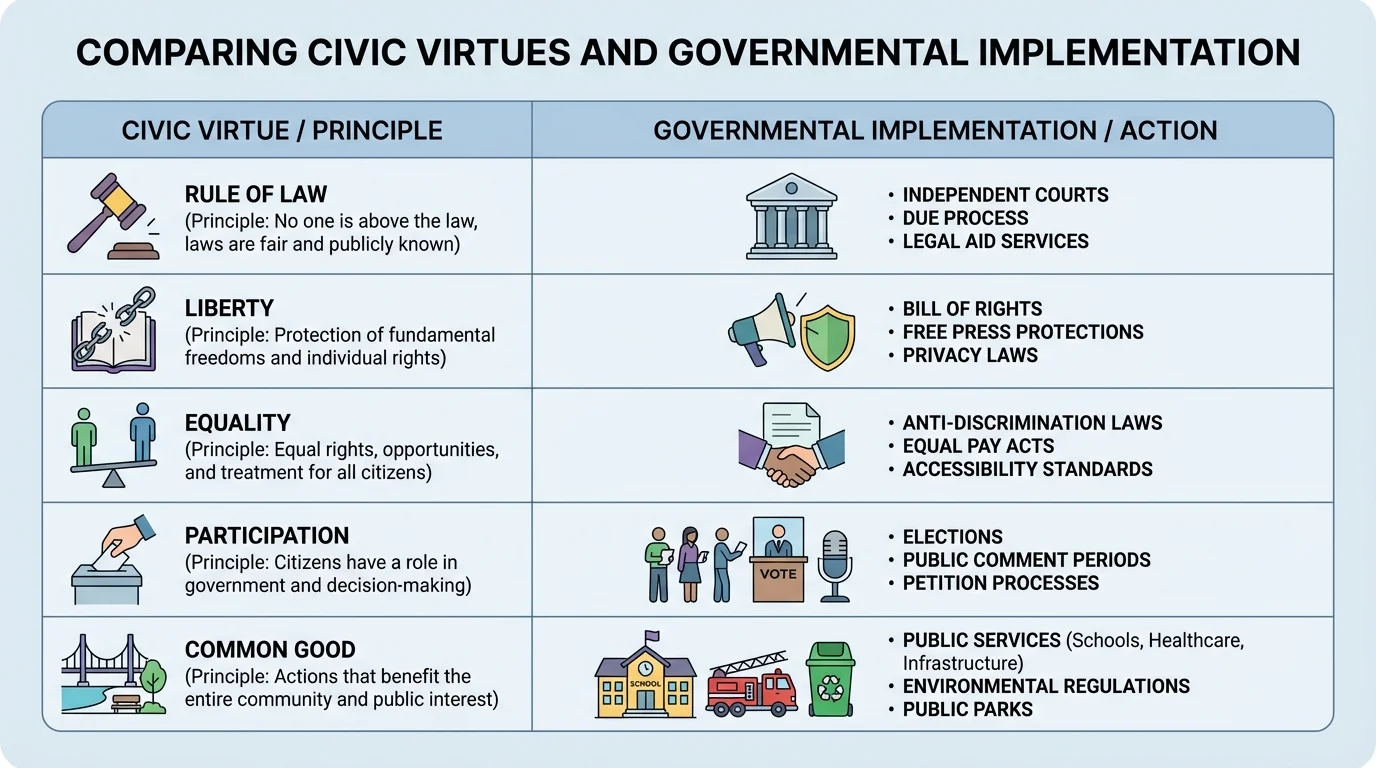
These principles often support one another, but sometimes they can also create tension. For example, a government may say it limits protests to maintain order and protect the common good. Critics may argue that the same policy reduces liberty. This is why comparing governments requires careful thinking. Students should examine both goals and results.
Principles become real through institutions
Civic principles are not only ideas. They are carried out through institutions such as constitutions, courts, legislatures, local councils, schools, and election systems. If these institutions are strong and fair, civic principles are more likely to be protected. If they are weak or controlled by a small group, the principles may exist only on paper.
A useful way to compare governments is to look for evidence in four areas: laws, political institutions, citizen rights, and actual participation. This approach helps us see the difference between a government that encourages active citizenship and one that mainly expects obedience.
[Figure 2] Many countries in the Eastern Hemisphere provide strong examples of civic participation across Asia and Africa. In a democracy, citizens usually choose leaders through elections, express opinions publicly, and organize in groups. Democracies are not all identical, but they generally value participation and accountability.
Democracy in India offers one important example. India is the world's largest democracy. Citizens vote in national, state, and local elections. The country's constitution supports equality, rights, and representative government. India has political parties, an independent judiciary, and a free press, all of which help citizens influence public life. At the same time, India still faces challenges such as corruption, inequality, and conflict over religion and identity. This shows that democratic principles may be strong in law but still difficult to carry out perfectly.
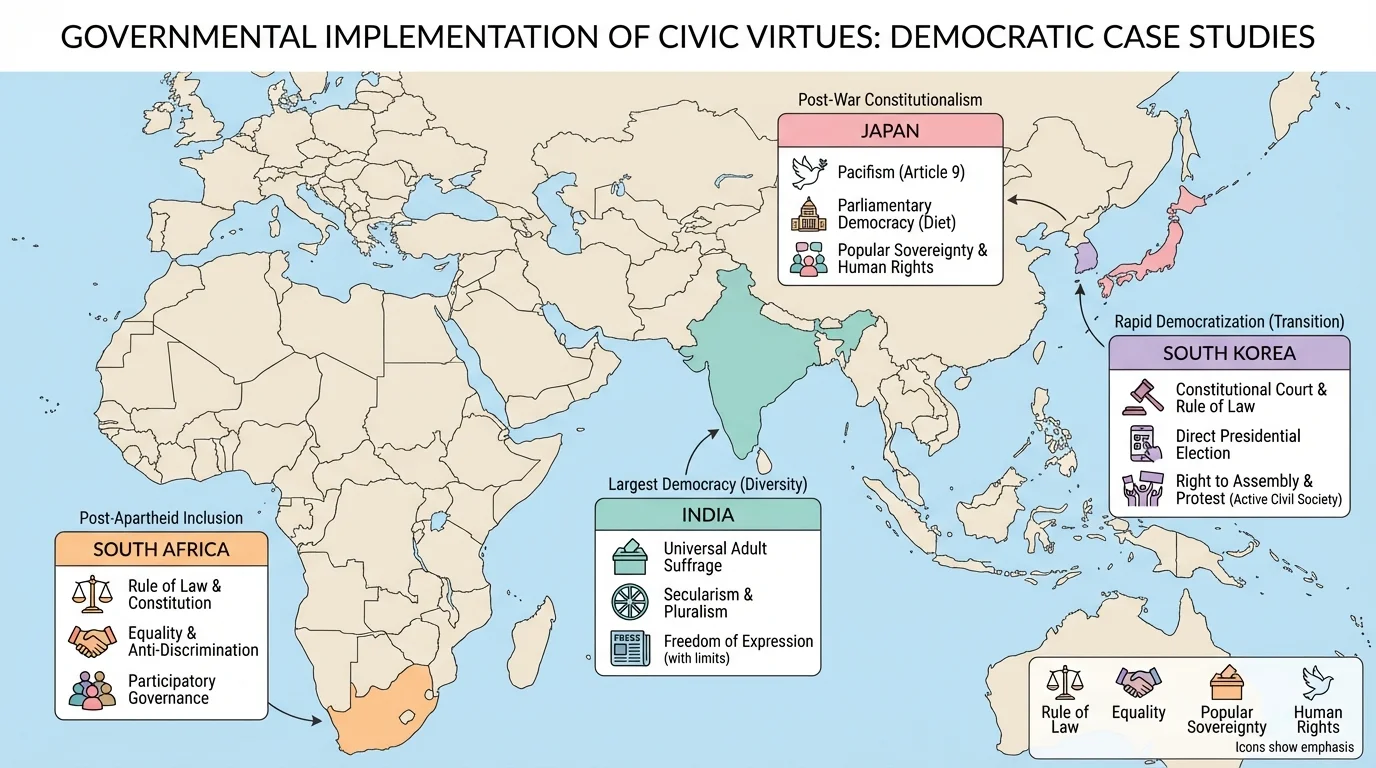
Japan is another example. Japan has a constitutional government with elected representatives and a prime minister. Citizens vote, parties compete, and laws are debated in the legislature. The Japanese constitution, written after World War II, emphasizes peace, rights, and democratic government. Civic participation in Japan often includes voting, local meetings, public discussion, and community responsibility. Compared with some other democracies, protest may be less common, but civic duty can appear strongly in organized local service and public cooperation.
South Korea also shows how democratic participation can grow over time. Decades ago, South Korea experienced authoritarian rule. Citizens, especially students and activists, protested for democratic reform. Today, elections, public debate, and protests are important parts of political life. This demonstrates that civic participation can expand when citizens push governments to respect rights.
South Africa, though located in the Southern Hemisphere, is sometimes included in broad Afro-Eurasian comparisons in global studies. Its post-apartheid government provides a powerful example of implementing equality and justice through a democratic constitution. After years of racial oppression, South Africa adopted laws designed to protect voting rights and equal citizenship. Even so, economic inequality remains a major challenge, reminding us again that legal equality does not always produce immediate social equality.
Some governments combine democratic participation with long-standing traditions. In a constitutional monarchy, a king or queen serves as head of state, but elected officials govern according to law. The monarch's role is usually limited by a constitution or political tradition.
The United Kingdom is a well-known example. Citizens vote for members of Parliament, political parties compete, and the prime minister leads the government. Civic principles such as accountability and rule of law are implemented through parliamentary debate, elections, courts, and a long history of legal rights.
Japan also has a constitutional monarchy. The emperor is a symbol of the nation, but elected representatives make political decisions. This creates an interesting comparison with the United Kingdom: both keep a monarch, but real political authority belongs to democratic institutions. In both cases, the government supports civic virtues such as lawful participation and public responsibility, yet each country has its own political culture and history.
| Country | Government Type | How Civic Participation Happens | Main Civic Principles Seen |
|---|---|---|---|
| India | Federal democracy | Voting, parties, courts, protests, local councils | Liberty, equality, participation |
| Japan | Parliamentary constitutional monarchy | Voting, parties, local service, public debate | Rule of law, accountability, civic duty |
| South Korea | Democracy | Elections, protests, media, activism | Liberty, accountability, reform |
| United Kingdom | Parliamentary constitutional monarchy | Voting, Parliament, civic groups, media | Rule of law, representation, accountability |
Table 1. Comparison of selected governments and the civic principles they emphasize through participation.
As seen earlier in [Figure 1], the same principle can appear in different forms. For example, accountability may come through courts in one country, parliamentary questioning in another, or local elections in a third.
[Figure 3] Not all governments encourage participation in the same way. In an authoritarian system, power is concentrated in a leader or small group, and citizens have limited ability to challenge decisions. Decision-making often moves from the top downward, with fewer opportunities for open competition or criticism.
China is an important example. The government is led by one ruling party, and national political opposition is not allowed in the same way it is in multiparty democracies. The Chinese government often emphasizes order, unity, economic development, and national strength. It may present these as part of the common good. Citizens can participate in some local issues and community activities, but speech, media, and protest are more tightly controlled. This means the government supports some civic ideas, such as public responsibility and national service, while limiting others, especially political liberty and open opposition.
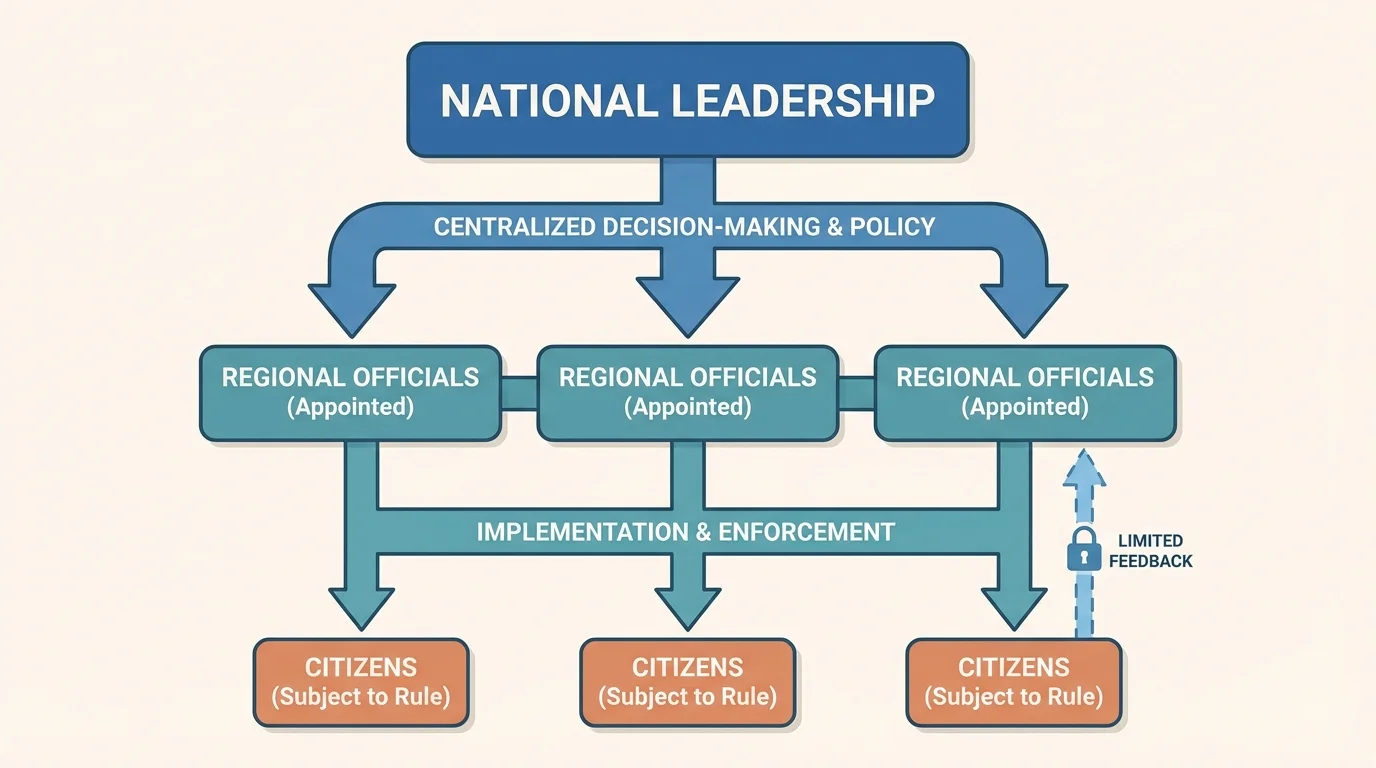
Iran provides another mixed example. Iran has elections and elected offices, but religious leaders and unelected bodies hold major power. Some citizens take part in voting and public debate, yet the government restricts speech, dissent, and some personal freedoms. This creates a system where participation exists, but only within boundaries set by powerful institutions.
Authoritarian governments may still promote certain civic virtues. They may encourage discipline, loyalty, respect for authority, and service to the nation. However, these systems often define a "good citizen" as someone who supports the state rather than someone who questions it. In democratic systems, questioning leaders can be seen as a civic duty. In authoritarian systems, the same behavior may be treated as disloyalty.
Case study: Comparing participation in India and China
Step 1: Look at elections.
India holds competitive multiparty elections in which different political parties try to win power. China does not hold national multiparty elections in the same way.
Step 2: Look at speech and media.
Indian citizens generally have broader freedom to criticize leaders and organize protests. In China, criticism of the government is more restricted.
Step 3: Look at the government's goals.
Both governments may say they serve the public and national development. However, they use different methods and allow different levels of citizen influence.
This comparison shows that governments can claim similar goals while implementing civic principles very differently.
The centralized pattern shown earlier in [Figure 3] helps explain why citizen influence is often narrower in authoritarian systems. If most major decisions are controlled from the top, public participation has less power to change policy.
One of the most important skills in civics is noticing that governments may use the same words but mean different things. Nearly all governments say they support justice, order, security, or the public good. The difference lies in how they balance these goals with freedom and accountability.
For example, both a democracy and an authoritarian state may build schools and hospitals. Both may ask citizens to obey laws and contribute to society. But if one government also protects free elections, opposition parties, and independent courts, then its implementation of civic principles is broader. It allows citizens not only to serve the state, but also to shape it.
Similarly, both democratic and nondemocratic governments may claim to represent the people. In a representative democracy, citizens can remove leaders through elections. In a more controlled system, leaders may say they act for the people without giving citizens a real chance to replace them.
Some of the strongest democratic reforms in the modern world came after long periods of limited freedom. Civic participation often grows because ordinary people insist that governments live up to their own promises.
This is why civic language should always be tested against evidence. A student comparing governments should ask: Are rights protected? Can citizens organize freely? Are leaders accountable? Do courts apply the law fairly? Are minority groups treated equally?
Government is only part of civic life. Civil society includes organizations and groups outside the government, such as charities, religious groups, labor unions, youth organizations, and community associations. These groups help citizens work together, solve problems, and influence leaders.
In democratic systems, civil society often strengthens civic virtues by teaching cooperation, responsibility, and respect for others. In countries such as India, South Korea, and South Africa, social movements and community groups have played major roles in expanding rights and demanding fair treatment.
Protest can also be a form of civic participation. Peaceful protest allows citizens to express disagreement and ask for change. However, governments respond to protest differently. Some permit it and protect it under law. Others restrict it, monitor it, or punish participants. That difference tells us a great deal about how a government understands liberty and citizenship.
"The spirit of democracy is not a mechanical thing to be adjusted by abolition of forms. It requires change of heart."
— Mahatma Gandhi
Gandhi's words remind us that civic virtue is not only about institutions. It also depends on how citizens and leaders treat one another. A government can have elections, but if people use violence, spread hatred, or refuse to respect lawful outcomes, civic life weakens.
[Figure 4] History matters because today's political systems were shaped by earlier struggles, reforms, and leaders. Governments do not appear fully formed. They develop over time through conflict, change, and public action.
In India, Mahatma Gandhi encouraged nonviolent resistance against British colonial rule. His leadership helped connect civic virtues such as self-discipline, service, and peaceful protest to the cause of independence. After independence in 1947, India adopted a democratic constitution in 1950.
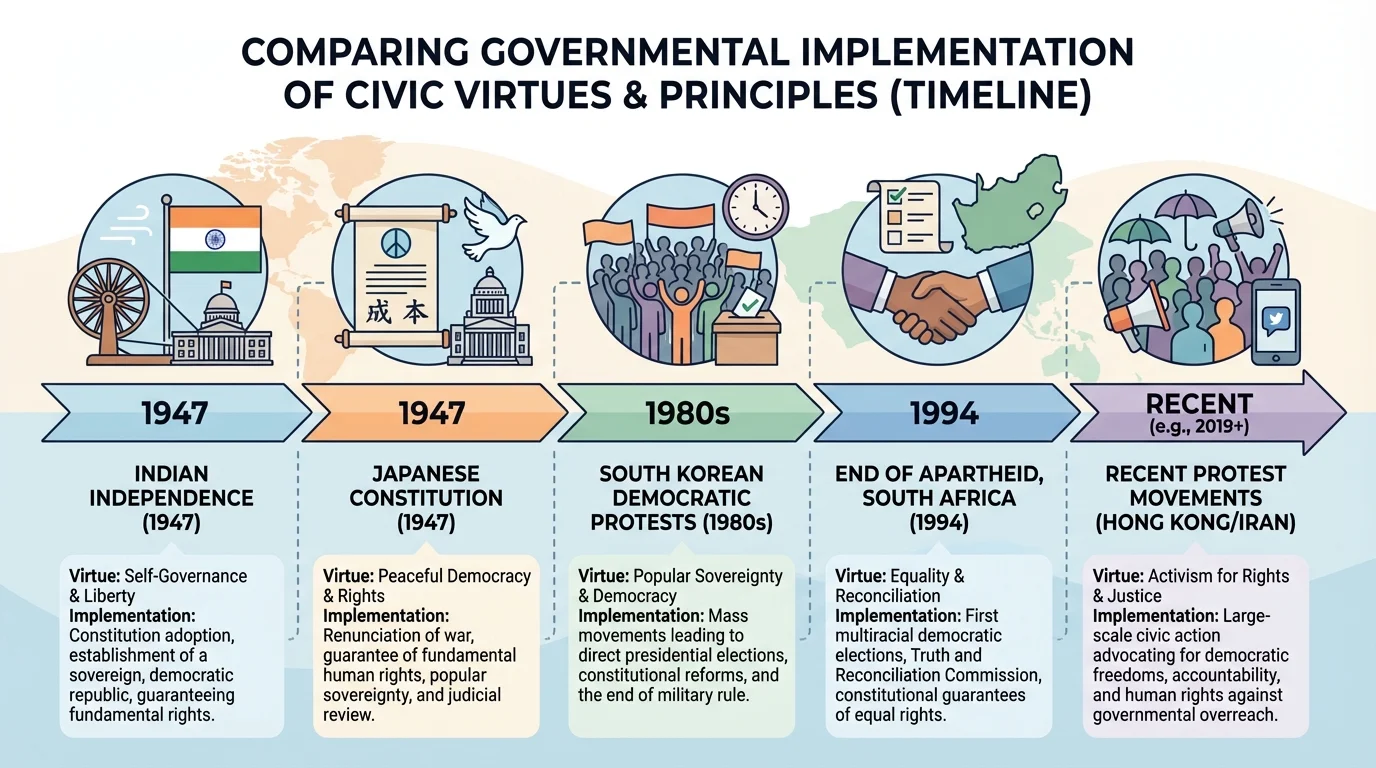
In Japan, the post-World War II constitution reshaped government by strengthening democracy, limiting military power, and protecting civil rights. This was a major turning point in how civic principles were implemented.
In Turkey, Mustafa Kemal Atatürk led reforms that built a more secular republic after the fall of the Ottoman Empire. His government promoted national unity, modernization, and citizenship, though later Turkish politics continued to debate how democracy, religion, and state power should relate.
In South Africa, Nelson Mandela became a symbol of justice and equality during and after apartheid. The transition to majority rule in 1994 marked a major shift toward democratic civic participation.
More recent events also matter. Protests in places such as Hong Kong and Iran have shown that many citizens continue to demand greater voice, fairness, and freedom. These movements reveal that civic virtues are not fixed; they are debated and defended over time.
The timeline in [Figure 4] makes it easier to see that democratic participation often grows through long struggles rather than sudden change. Rights that seem normal today were often won through years of organized action.
To compare governments well, students should use clear criteria. First, identify the government type: democracy, constitutional monarchy, or authoritarian system. Second, look for the civic principles the government says it supports. Third, examine evidence of implementation: elections, courts, laws, media freedom, local government, public services, and treatment of dissent.
It also helps to separate ideals from outcomes. A government may value equality, but some groups may still face discrimination. A government may promise liberty, but emergency laws may reduce freedom. A careful comparison notices both what is intended and what actually happens.
Another useful habit is to compare similarities and differences at the same time. For example, India, Japan, and South Korea all support elections and representative institutions, yet each has a different political culture. China and Iran both limit certain freedoms, yet their histories, ideologies, and systems of power are not identical. Good civic analysis avoids oversimplifying.
When comparing governments, think back to the difference between government and citizenship. Government is the system that makes and enforces laws. Citizenship includes the rights and responsibilities people have within that system. Civic virtues connect the two.
In the end, civic participation is strongest where citizens can act responsibly, speak openly, and influence public decisions, while leaders remain accountable to law. Comparing governments in the Eastern Hemisphere helps us see that civic principles are universal ideas, but their implementation varies widely from one system to another.
