A disease can spread across borders, a war in one country can force families to flee into another, and a drought in one region can raise food prices far away. Problems like these do not stop at national boundaries. That is why governments often need more than their own laws and leaders to solve them. They work with neighbors, regional groups, and global organizations to protect people, support economic growth, and reduce conflict.
Countries in the Eastern Hemisphere are connected through trade, migration, security, technology, health, and the environment. A government in Kenya may work with the African Union on peace and security. Indonesia may cooperate with ASEAN on regional trade and disaster response. India may participate in the United Nations on climate or peacekeeping. Egypt or Vietnam may seek development support from the World Bank for roads, schools, or water systems. These connections shape how societies function.
No country is completely independent. Even powerful nations depend on others for resources, markets, transportation routes, and security partnerships. This idea is called interdependence, which means that countries rely on one another in many ways. When nations are interdependent, decisions made in one place can affect people somewhere else.
Governments also work together because many major issues are shared. Pollution in one country can drift into another. Rivers may flow across borders. Armed conflict can create refugee crises in nearby states. Trade depends on agreements about tariffs, shipping, and safety rules. International organizations help countries discuss these issues in a more organized way instead of reacting alone.
Sovereignty is a country's power to govern itself. Diplomacy is the process of managing relations between countries through discussion and negotiation rather than force. A treaty is a formal agreement between countries. Cooperation means working together toward a shared goal.
Even when governments disagree, they often still cooperate in some areas. Two countries might argue over a border but still trade goods or share disease-control information. International relations are rarely simple friendships or rivalries. They usually involve a mixture of competition, negotiation, and partnership.
To understand international cooperation, it helps to think of governments and organizations as parts of a network. National governments make decisions for their own citizens, but international organizations bring countries together to address common concerns. Some organizations are global, while others are regional.
Another important idea is diplomacy. Diplomats, ambassadors, and government leaders meet to discuss disagreements, propose solutions, and build trust. Diplomacy does not always solve a problem quickly, but it can prevent violence and open the door to compromise.
Countries also rely on treaties and other agreements. A treaty can address trade, human rights, environmental protection, or military alliances. Once countries sign and approve a treaty, they are expected to follow its rules, although enforcement can be difficult.
The United Nations has nearly every country in the world as a member, yet countries still keep their own governments and laws. International cooperation usually adds another layer of decision-making rather than replacing national government.
Finally, cooperation is shaped by power. Large, wealthy countries may have more influence in some organizations because they contribute more money or military support. Smaller countries may join together in regional groups so their voices become stronger.
[Figure 1] The United Nations, often called the UN, is the largest global organization where countries meet to discuss international issues. It was created after World War II to promote peace, security, and cooperation. Its basic goal is simple but enormous: help countries resolve problems without repeated global war. The way the UN is organized helps different parts of the organization focus on different tasks.
The UN includes major bodies such as the General Assembly, where member nations can debate issues; the Security Council, which deals with threats to peace; and specialized agencies that focus on health, children, refugees, education, and more. This structure allows the UN to respond to very different kinds of problems, from war to disease to hunger.
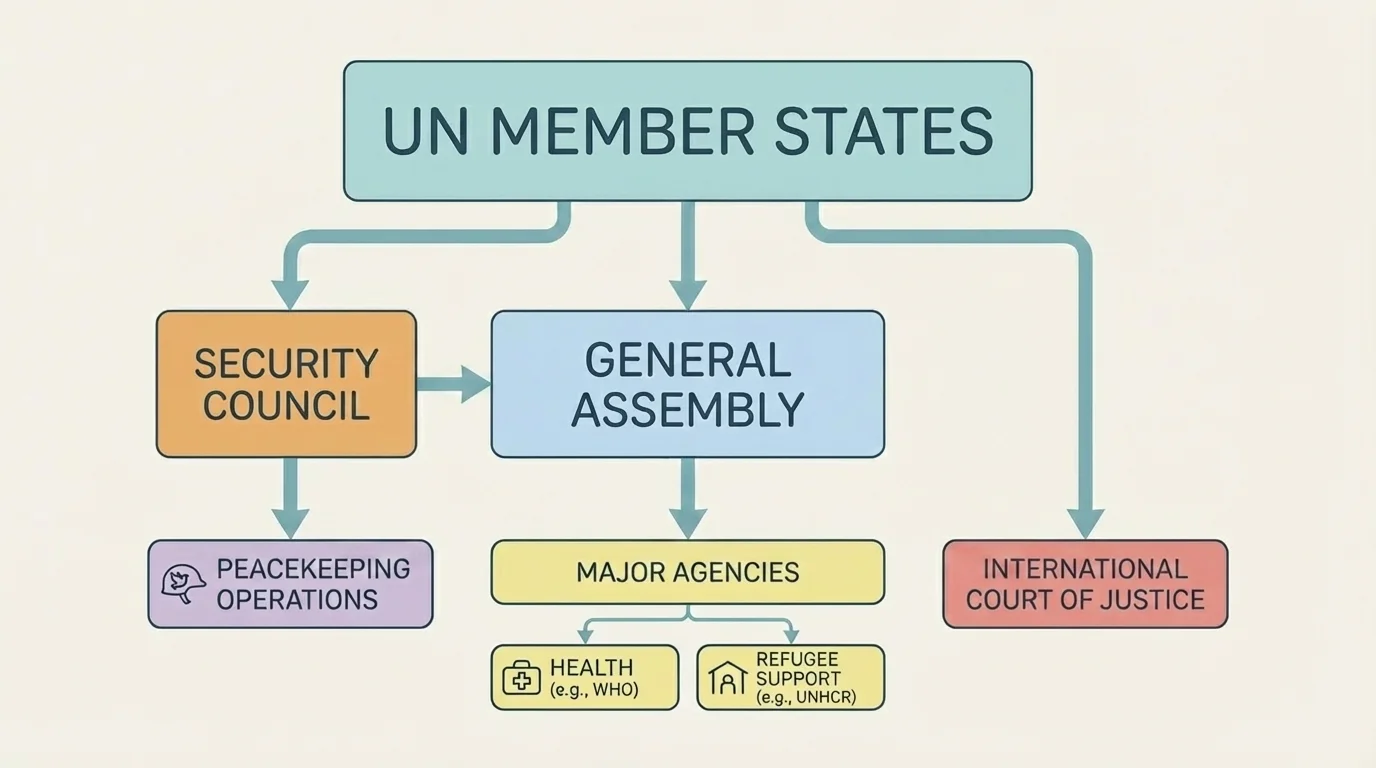
The General Assembly gives each member state a voice, which matters because small countries can speak alongside large ones. However, not all UN bodies have equal power. The Security Council has special authority on peace and security, and some of its permanent members have veto power. That means one powerful country can block certain actions even if many others agree.
The UN is known for peacekeeping, in which international forces help monitor ceasefires, protect civilians, or support stability after conflict. Peacekeepers do not always fight wars directly. Often, they help create safer conditions so communities can rebuild. The UN also supports refugees, provides food aid, and coordinates responses to disasters and health emergencies.
Still, the UN has limits. It depends on member states to provide money, troops, and political support. If major countries disagree, action can stall. That is one reason the UN is sometimes praised for its goals but criticized for moving slowly. Even so, many countries continue to use it because it offers a place for dialogue, legitimacy, and international coordination.
Later, when we compare regional groups, [Figure 1] remains useful because it shows that global organizations often need many branches to handle many types of issues at once.
[Figure 2] Not every problem needs a worldwide organization. Sometimes neighboring countries can respond more effectively through regional cooperation. This pattern appears clearly in the African Union and ASEAN. Regional groups often understand nearby conflicts, trade patterns, languages, and cultural connections better than distant countries do.
The African Union, or AU, brings together countries across Africa. It promotes unity, economic development, and peace and security on the continent. The AU has worked on election monitoring, conflict mediation, and long-term planning for African development. It also encourages member states to work together on shared challenges such as terrorism, public health, and transportation links.
The ASEAN, which stands for the Association of Southeast Asian Nations, includes countries in Southeast Asia. ASEAN aims to strengthen regional stability and encourage economic growth. It is especially known for promoting discussion and consensus. Instead of forcing rapid decisions, ASEAN often prefers gradual cooperation and dialogue among members.
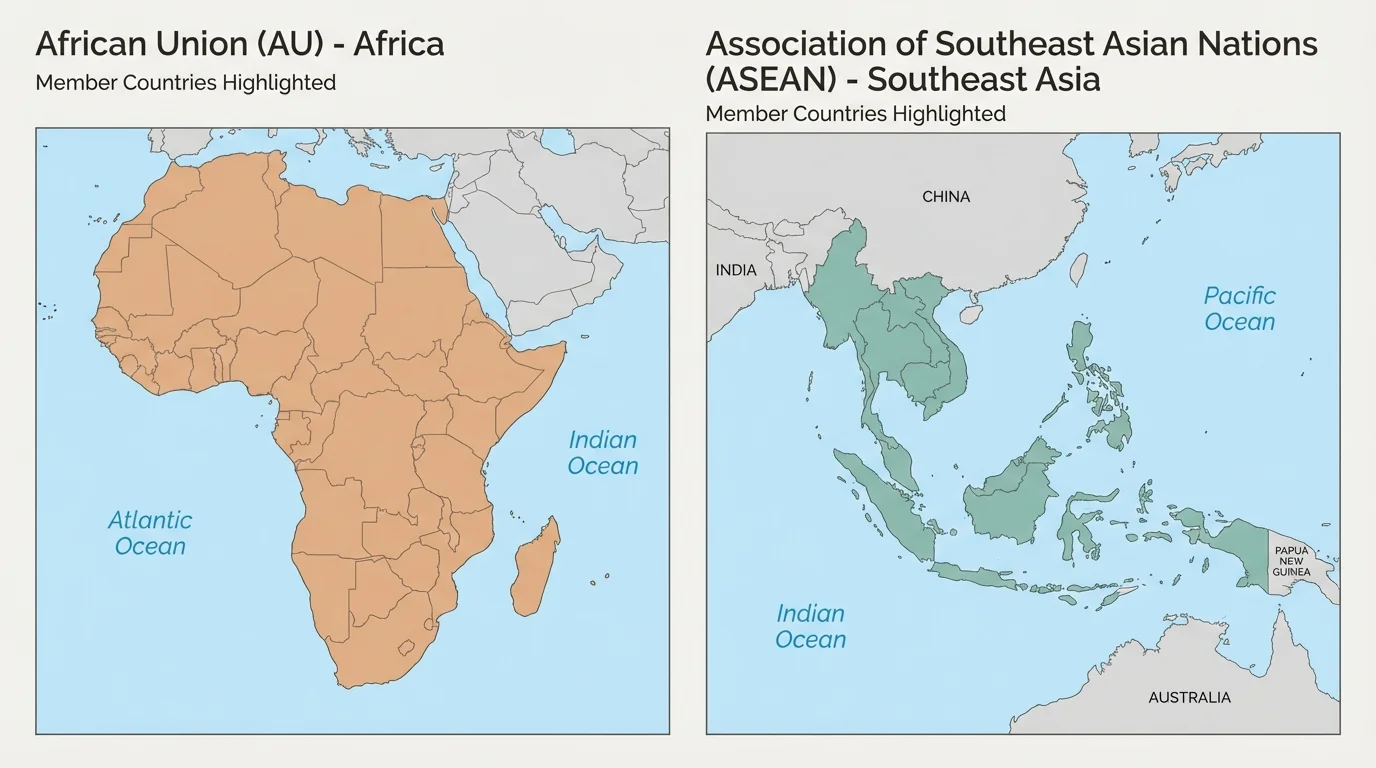
These two organizations are alike in some ways. Both help countries communicate, reduce tensions, and coordinate regional goals. Both also respect national sovereignty, meaning member countries usually keep strong control over their own decisions. But they also differ. The AU has often taken a more direct role in peace and security issues on the African continent, while ASEAN is widely associated with careful diplomacy, trade cooperation, and consensus-based decision-making.
Regional organizations can respond faster to nearby crises because members are directly affected. For example, if conflict in one African country sends refugees into neighboring states, the AU has a strong reason to act. If a major storm hits Southeast Asia, ASEAN members can coordinate aid and emergency planning. Looking again at [Figure 2], it becomes easier to see why geography matters so much: neighboring states often share the same risks.
| Organization | Region | Main Goals | Common Methods |
|---|---|---|---|
| United Nations | Global | Peace, security, human rights, development | Debate, resolutions, peacekeeping, aid |
| African Union | Africa | Unity, security, development, cooperation | Mediation, monitoring, regional planning |
| ASEAN | Southeast Asia | Stability, economic growth, dialogue | Consensus, meetings, trade cooperation |
| World Bank | Global | Development and poverty reduction | Loans, grants, technical support |
Table 1. A comparison of major international and regional organizations discussed in the lesson.
Some organizations focus mainly on economic development. The World Bank is one of the best-known examples. It provides loans, grants, and expert advice to support development projects in countries around the world. These projects may involve transportation, electricity, clean water, schools, agriculture, or health systems.
The main idea behind the World Bank is that long-term development can improve people's lives and reduce poverty. If a country builds better roads, farmers may reach markets more easily. If children gain access to schools, job opportunities may improve in the future. If clinics receive support, disease can be treated earlier and more effectively.
Development cooperation involves governments and organizations working together to improve living conditions. This may include funding infrastructure, training workers, improving public health, or expanding education. Development projects can help societies grow stronger, but they must be planned carefully so benefits reach the people who need them.
However, the World Bank is not free from criticism. Loans must often be repaid, and some people argue that borrowing can create long-term debt problems. Others question whether outside organizations always understand local needs. A project that looks good on paper may fail if local communities are not included in the planning.
Even with these concerns, the World Bank remains important because many governments need financial and technical support to complete major projects. Building a dam, modern highway, or national water system can require resources that are difficult to raise quickly within one country alone.
[Figure 3] When countries disagree, they do not automatically go to war. They often use several tools to manage conflict. Common methods include negotiation, mediation, arbitration, sanctions, and formal agreements.
Negotiation means that the countries involved talk directly and try to reach a compromise. Mediation means a third party helps them communicate and search for common ground. That third party might be another country, the UN, or a regional organization such as the AU. Sanctions are penalties, such as trade restrictions, used to pressure a country to change its behavior. Governments may also appeal to international courts or legal rules.
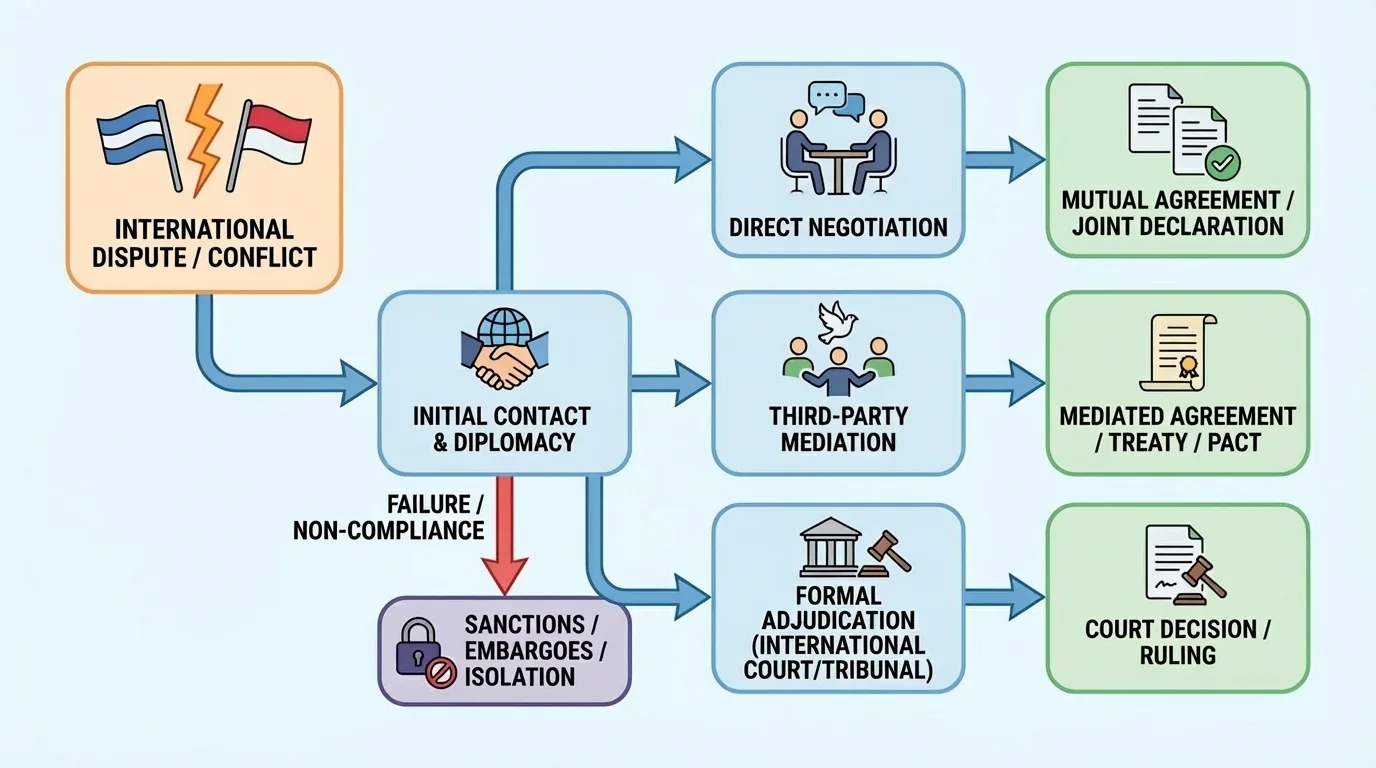
Diplomacy matters because it creates ways to disagree without immediate violence. A border conflict, for instance, may begin with accusations and troop movements. But if leaders meet, accept mediation, and sign an agreement, fighting may be avoided. Diplomatic success often depends on patience, trust-building, and willingness to compromise.
Not every dispute is solved peacefully. Some governments refuse to negotiate, or they break agreements after signing them. Still, international organizations can help by offering a place to talk, sending observers, or putting pressure on those who threaten peace. Looking back at [Figure 3], we can see that conflict resolution is usually a process with many possible paths, not a single event.
Case study: A regional dispute and mediation
Suppose two neighboring countries disagree over access to a river that crosses their border.
Step 1: The disagreement begins.
One country builds a dam, and the other fears reduced water for farms and cities.
Step 2: Diplomats meet.
Officials exchange proposals and explain their concerns.
Step 3: A mediator joins.
A regional organization or the UN helps both sides keep talking.
Step 4: An agreement is written.
The countries set rules for water sharing, dam timing, and emergency communication.
This kind of settlement does not remove every disagreement, but it lowers the chance of conflict and creates rules both sides can use.
These methods are especially important in the Eastern Hemisphere, where many countries share rivers, seas, migration routes, and trading networks. Cooperation is often the safest and least costly option.
An international treaty is more than a promise. It is a formal agreement that countries negotiate, sign, and usually approve through their own legal systems. Treaties can cover peace, trade, arms control, environmental protection, or human rights.
For example, countries may sign a climate agreement to reduce pollution, a trade agreement to lower barriers to commerce, or a refugee agreement to protect people fleeing danger. Treaties help create predictable rules. Businesses, travelers, and governments all benefit when expectations are clear.
But treaties only work well when countries actually follow them. There is no single world government with unlimited power to enforce every agreement. That means compliance often depends on trust, reputation, pressure from other countries, and the desire to keep future cooperation possible.
"Jaw-jaw is better than war-war."
— Winston Churchill, emphasizing the value of talking rather than fighting
This idea captures why treaties matter. They turn difficult relationships into organized rules, even when countries still disagree on other issues.
Real examples make these ideas clearer. In Africa, the AU has been involved in mediation and peace efforts in several conflict areas. While results have varied, its role shows how a regional organization can try to manage problems close to home. AU election observers have also monitored voting in member states to support fairer political processes.
In Southeast Asia, ASEAN has worked on economic ties and disaster response. When powerful storms, earthquakes, or tsunamis strike the region, cooperation matters because supplies, rescue teams, and communication systems often need to cross borders quickly. ASEAN helps members share information and coordinate action.
The UN has also played major roles across the Eastern Hemisphere through refugee support, health campaigns, and peacekeeping. In places affected by conflict, UN agencies may provide food, shelter, or education for displaced children. In health emergencies, international cooperation can help deliver vaccines, medical supplies, and training.
World Bank projects can be seen in infrastructure and public-service improvements. In some countries, support has helped expand access to electricity or improve water systems. These changes can strengthen local economies and improve quality of life, although the results depend on fair planning and effective government management.
Governments have different systems and priorities, but all governments must make decisions about safety, resources, and public needs. International cooperation adds another level to those decisions rather than replacing local or national leadership.
These case studies show that international cooperation is not just about leaders meeting in conference rooms. It affects elections, roads, schools, disease control, refugee protection, and the chances for peace.
If cooperation is so useful, why do countries still struggle to achieve it? One reason is that governments have different national interests. A policy that helps one country may seem harmful to another. Leaders are also responsible to their own citizens first, so they may reject compromises that seem too costly at home.
Another challenge is inequality. Wealthier countries may have more leverage because they can offer aid, investment, or military support. Poorer countries may feel pressure to accept terms they do not fully like. This can create resentment and mistrust.
Enforcement is also hard. If a government breaks an agreement, international organizations may not have enough power to force compliance. They can criticize, investigate, or impose penalties, but they cannot always stop bad behavior quickly. That is one reason international politics can seem frustrating: rules exist, but power still matters.
Culture, history, and memory also shape cooperation. Countries that fought wars in the past may have trouble trusting one another. At the same time, repeated cooperation in trade, education, or disaster response can slowly build stronger relationships over time.
[Figure 4] International cooperation may sound far away, but it reaches into daily life more than many people realize. Decisions made by governments and international organizations can affect roads, schools, clinics, safety, food supply, and access to emergency aid. A student may travel on a road improved by a development loan, receive vaccines through an international health effort, or live in a community made safer by peace agreements.
Trade agreements can influence the price of clothing, electronics, or food. Environmental treaties can affect air and water quality. Refugee programs can determine whether families find shelter and education after fleeing war. Peacekeeping missions can help reduce violence so markets reopen and children return to school.
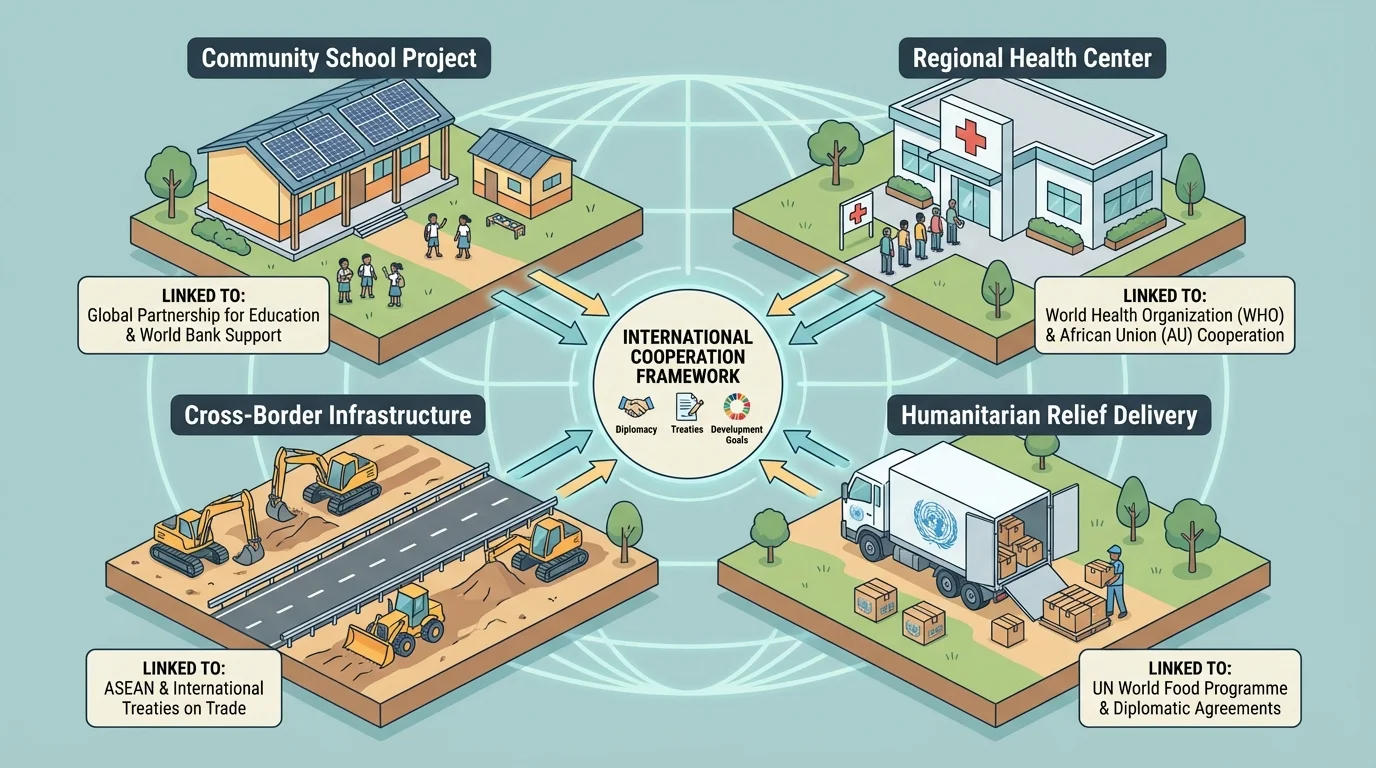
International organizations do not solve every problem, and they sometimes move slowly or face criticism. But without them, countries would have fewer tools for addressing conflict, poverty, disaster, disease, and environmental danger. Cooperation does not guarantee success, yet it often gives societies a better chance to improve.
When we connect this idea back to [Figure 4], the big picture becomes clear: global and regional cooperation is not only about meetings between leaders. It shapes the conditions in which ordinary people live, learn, work, and hope for a more stable future.
