A virus can spread across continents in days, a war in one region can create refugees in another, and the destruction of an ancient temple can matter to people around the world. That is one reason nations do not act alone. Countries are connected through trade, travel, health, culture, and security, and these connections mean that solving major problems often requires teamwork.
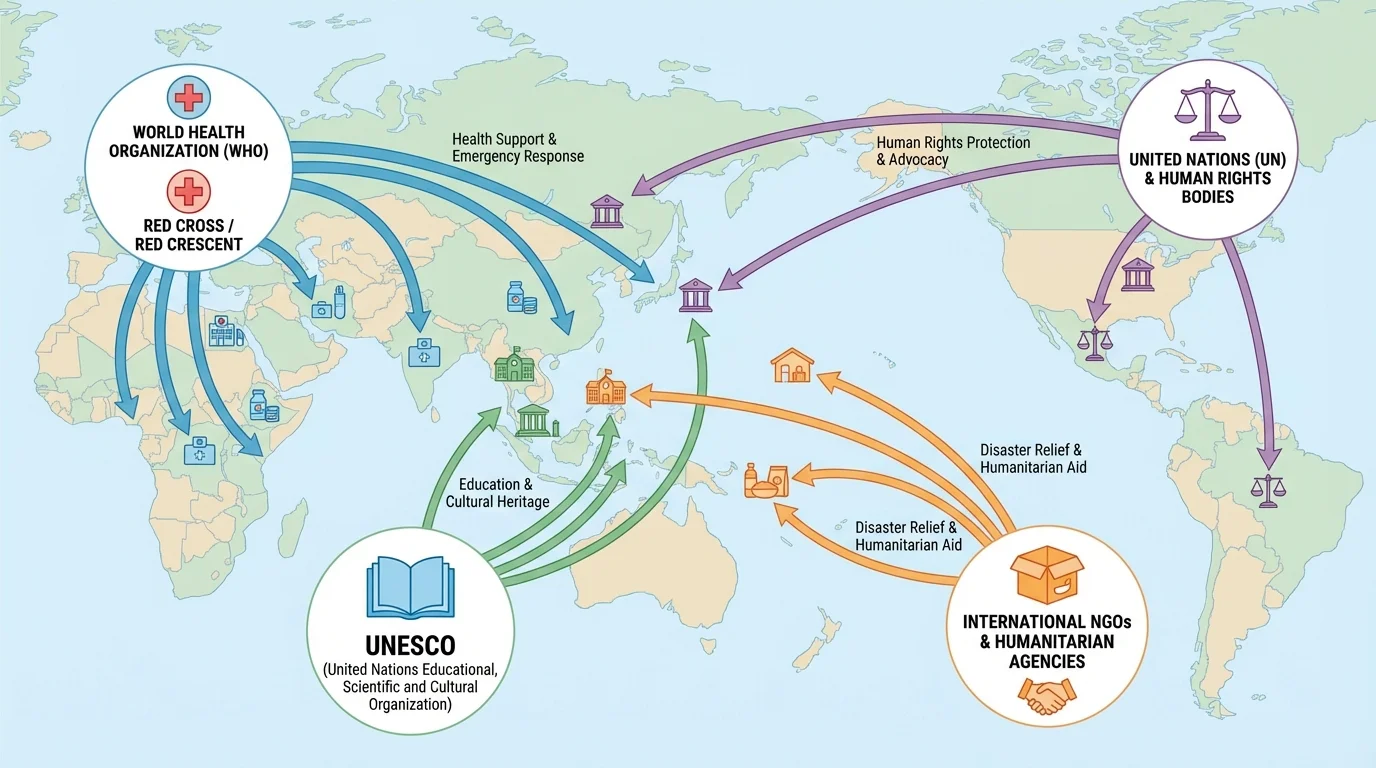
When nations rely on each other, that relationship is called interdependence. No country can completely separate itself from the rest of the world. Food, medicine, technology, energy, information, and people move across borders every day. Problems also move across borders, as [Figure 1] shows through the links between countries and organizations working on health, education, aid, and rights.
International organizations exist because many issues are too large for one country to solve alone. They create spaces for countries to share information, set goals, send aid, and make agreements. Some organizations are made up of governments. Others are private groups that work independently. Together, they help countries respond to emergencies, protect people, and improve life in many parts of the world.
Think of the world like a team sport. One player can be excellent, but winning depends on passing, planning, and trust. In the same way, countries may have their own governments and goals, but they often need partners. Cooperation does not erase differences. Instead, it helps countries work through differences while dealing with shared problems.
International organization means a group that works across national borders to address shared issues. Some are created by countries, such as the United Nations, while others are independent groups, such as many NGOs.
Human rights are basic rights and freedoms that belong to all people, such as the right to life, safety, education, and fair treatment.
Countries in the Eastern Hemisphere provide many examples of this cooperation. Nations in Africa may work with health agencies to fight disease. Countries in Asia may work with UNESCO to protect cultural heritage. European countries may cooperate with the United Nations on refugees and peacekeeping. Middle Eastern countries may work with humanitarian organizations during conflict or disaster.
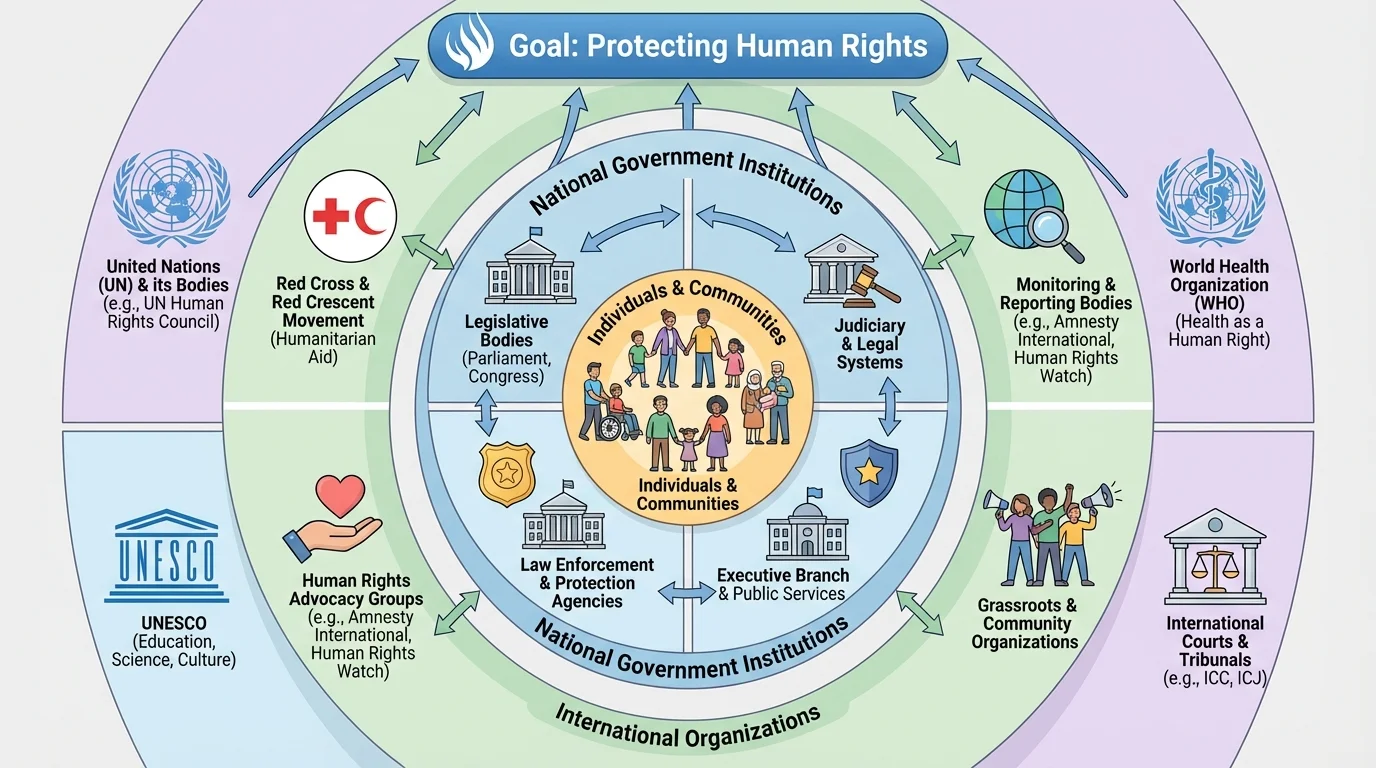
Human rights are not supposed to depend on a person's nationality, religion, language, or gender. But in real life, rights are sometimes violated. People may face unfair arrests, discrimination, violence, or limits on freedom. Protecting rights often requires action at several levels, as [Figure 2] illustrates through the roles of individuals, governments, NGOs, and international organizations.
National governments are the first line of protection. They make laws, run courts, and train police and public officials. But when governments fail to protect rights, outside groups may help. International organizations can investigate, report abuses, provide aid, or pressure governments to make changes. NGOs may speak out, collect evidence, support victims, or educate the public.
The idea that rights belong to all people became especially powerful after World War II. The world had seen terrible violence, including genocide and mass displacement. In response, nations worked together to create international agreements and organizations focused on peace and dignity. This did not solve every problem, but it created shared standards that countries could be judged against.
For example, if children are denied schooling during a conflict, several groups may become involved. A government ministry of education may try to reopen schools. UNICEF or UNESCO may support learning programs. NGOs may provide school supplies or temporary classrooms. The United Nations may bring attention to the crisis. This is a clear example of collaboration: different groups bring different strengths.
Why human rights need cooperation
Rights can be protected best when local action and international support work together. Local leaders understand the community, while international groups can provide funding, attention, and pressure. Neither level is always enough by itself.
The same idea appears in refugee crises. People fleeing war or persecution often cross international borders. One country may receive refugees, another may donate money, and an international agency may organize shelters, food, and legal support. The problem begins in one place, but the response becomes international because human lives are at stake.
The United Nations, often called the UN, is one of the best-known international organizations. It was founded in 1945 after World War II. Its broad goals include keeping peace, encouraging cooperation, protecting human rights, and supporting development. Almost every country in the world belongs to it.
The UN is not just one office or one leader. It is a system with different parts. The General Assembly allows member countries to discuss global issues. The Security Council focuses on international peace and security. Other UN agencies work on children, refugees, food, labor, and development. This structure allows countries to cooperate on many different problems at once.
In the Eastern Hemisphere, the UN has been active in many situations. It has supported refugee camps in countries near war zones, monitored elections, sent peacekeeping missions, and helped deliver food in famine areas. In some cases, countries request help. In others, the UN steps in because the crisis affects international peace or human welfare.
The UN depends on countries for money, workers, supplies, and political support. That means the UN is powerful in some ways, but limited in others. It can organize and coordinate, but it cannot always force countries to agree. This is one of the clearest examples of interdependence: countries create the organization, and the organization helps countries, but each depends on the other.
The UN has six official languages: Arabic, Chinese, English, French, Russian, and Spanish. This reflects its global membership and the need for countries from many regions to communicate clearly.
When we look back at [Figure 2], the UN fits into the outer layer of protection and support. It often does not replace governments. Instead, it works with them, pressures them, or helps them do better.
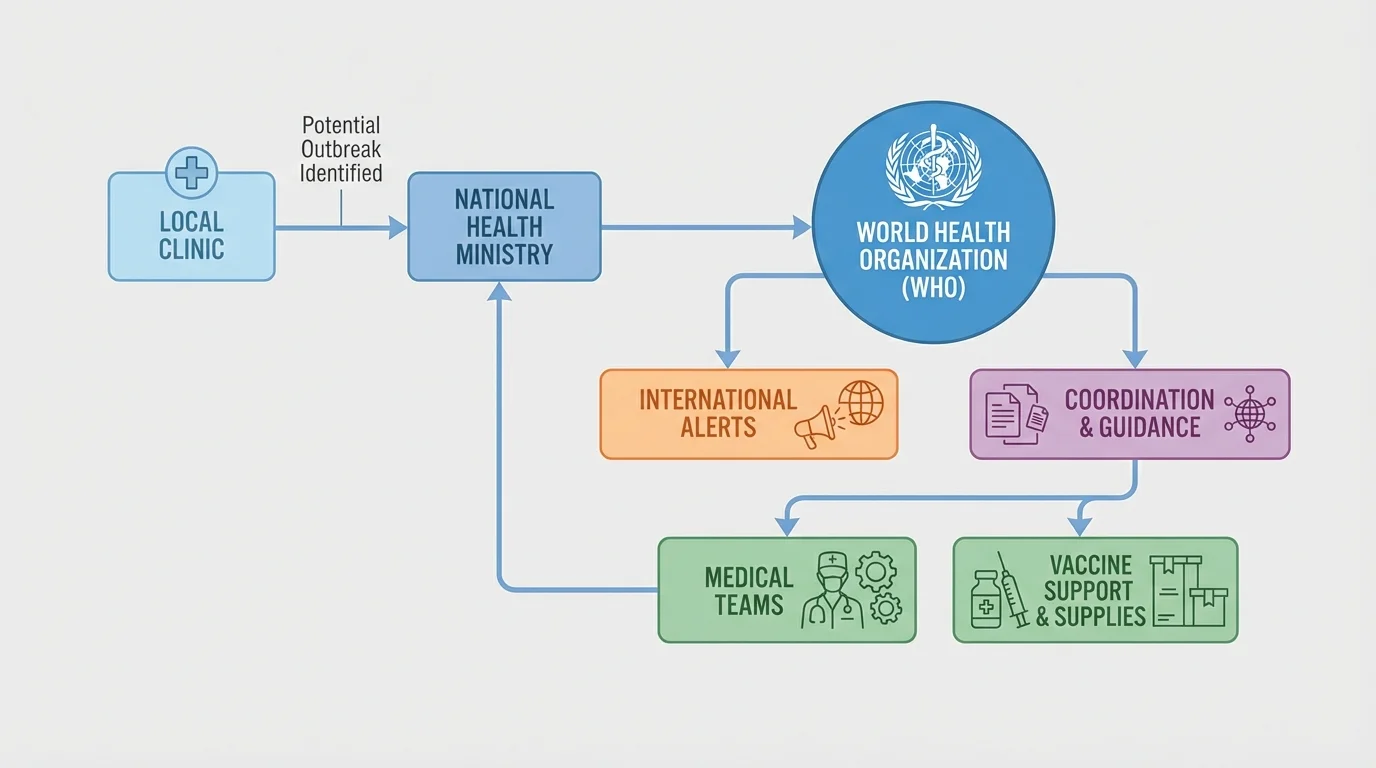
The World Health Organization, or WHO, focuses on health. Diseases do not stop at borders, so countries must share information quickly, as [Figure 3] demonstrates through the path from local clinics to national ministries to international response teams. WHO helps countries track outbreaks, issue health guidance, improve vaccination programs, and strengthen health systems.
If an illness appears in one city and begins spreading, local doctors report cases to national health authorities. Those authorities may then share data with WHO. WHO compares reports from different countries, studies patterns, and warns the international community if needed. This lets countries prepare hospitals, test patients, and educate the public.
The COVID-19 pandemic showed how interdependent the world is. Countries in Asia, Europe, Africa, and the Middle East had to share scientific data, medical advice, and vaccine research. WHO issued updates and recommendations, but countries still had to decide how to apply them. Some acted quickly, while others struggled. The pandemic made it clear that one country's health choices can affect many others.
WHO also supports long-term health goals, not just emergencies. It helps countries fight malaria, improve maternal health, reduce tobacco use, and expand access to clean water and sanitation. In parts of Africa and Asia, WHO has worked with governments to reduce deadly diseases through immunization campaigns and public health education.
For example, in efforts to reduce polio, governments, health workers, WHO, and local communities all play a part. Vaccines may be funded internationally, transported nationally, and delivered locally. If trust is low or conflict interrupts access, progress slows. That means medical success depends not only on science, but also on cooperation.
Case study: responding to an outbreak
A new infectious disease appears in a coastal city in Southeast Asia.
Step 1: Local doctors notice unusual symptoms and report them.
Hospitals gather information about patients and share it with the country's health ministry.
Step 2: The national government contacts international partners.
Health officials send data to WHO and request advice, testing support, or emergency supplies.
Step 3: International cooperation begins.
WHO issues guidance, nearby countries increase screening, and researchers in several countries study the disease.
Step 4: Local action and global support work together.
Public health workers educate communities, while international organizations help coordinate a wider response.
This example shows that disease control depends on shared information and trust.
Later, when students examine regional case studies in [Figure 5], they can see that health cooperation in places such as Central Africa also depends on roads, security, funding, and local leadership.
The Red Cross and Red Crescent movement is known for helping people during wars, disasters, and emergencies. In some countries the symbol used is the red cross, while in others it is the red crescent. These organizations provide medical care, food, clean water, shelter, and help for families separated by conflict.
One important idea behind the Red Cross and Red Crescent is humanitarian aid. This means assistance meant to save lives and reduce suffering during crises. The movement also values neutrality, meaning it tries not to take sides in conflict. That neutrality can help workers reach people on all sides of a war or disaster.
In an earthquake, for example, the government may send rescue teams, while the Red Cross or Red Crescent sets up emergency shelters and medical tents. International donations may bring blankets, food, and water purification supplies. Local volunteers often do much of the immediate work because they know the language and the area. Again, collaboration matters.
The Syrian conflict created enormous humanitarian needs across Syria and in neighboring countries such as Turkey, Lebanon, and Jordan. Red Cross and Red Crescent workers, UN agencies, NGOs, and host governments all played roles in helping displaced people. No single group could have handled needs that large alone.
Governments have authority over territory and laws, but not all help comes directly from governments. International organizations and NGOs often support people when governments are overwhelmed, affected by conflict, or unable to reach everyone in need.
The same kind of cooperation appears after floods in Bangladesh, drought in the Horn of Africa, or conflict in Yemen. Emergency aid may arrive through international networks, but it only reaches people effectively when local systems, transportation, and communication also work.
An NGO, or non-governmental organization, is a group that works independently from government control. NGOs may be local, national, or international. Some focus on health, some on education, some on the environment, and others on human rights. They often bring energy, expertise, and public attention to problems that governments may ignore or struggle to solve.
For example, an NGO might document abuses against journalists, provide legal support to women facing discrimination, or build wells in rural villages. Others work on refugee protection, anti-poverty programs, or protecting endangered cultural sites. Some famous NGOs operate in many countries, while smaller groups may focus on one region or one issue.
NGOs can be powerful because they are often flexible. They can raise awareness through reports, videos, campaigns, and community programs. They may work closely with international organizations, but they can also criticize governments and even criticize international agencies when they believe people are being ignored.
However, NGOs also face challenges. They need funding, they may be restricted by governments, and they may not always agree with each other. In some countries, leaders worry that NGOs interfere in domestic affairs. In others, NGOs fill gaps where government services are weak. Their role can therefore be helpful, controversial, or both.
How NGOs differ from intergovernmental organizations
Intergovernmental organizations, such as the UN or WHO, are created by member countries. NGOs are not created by governments, even though they may cooperate with them. This difference affects how they make decisions, raise money, and speak out on issues.
When human rights groups collect evidence of abuse and share it with the UN, they are helping build international pressure. When an education NGO partners with UNESCO, it may help bring global goals into local schools. The relationship is not one-way. International organizations rely on NGOs for information from communities, and NGOs often rely on international organizations for attention and support.
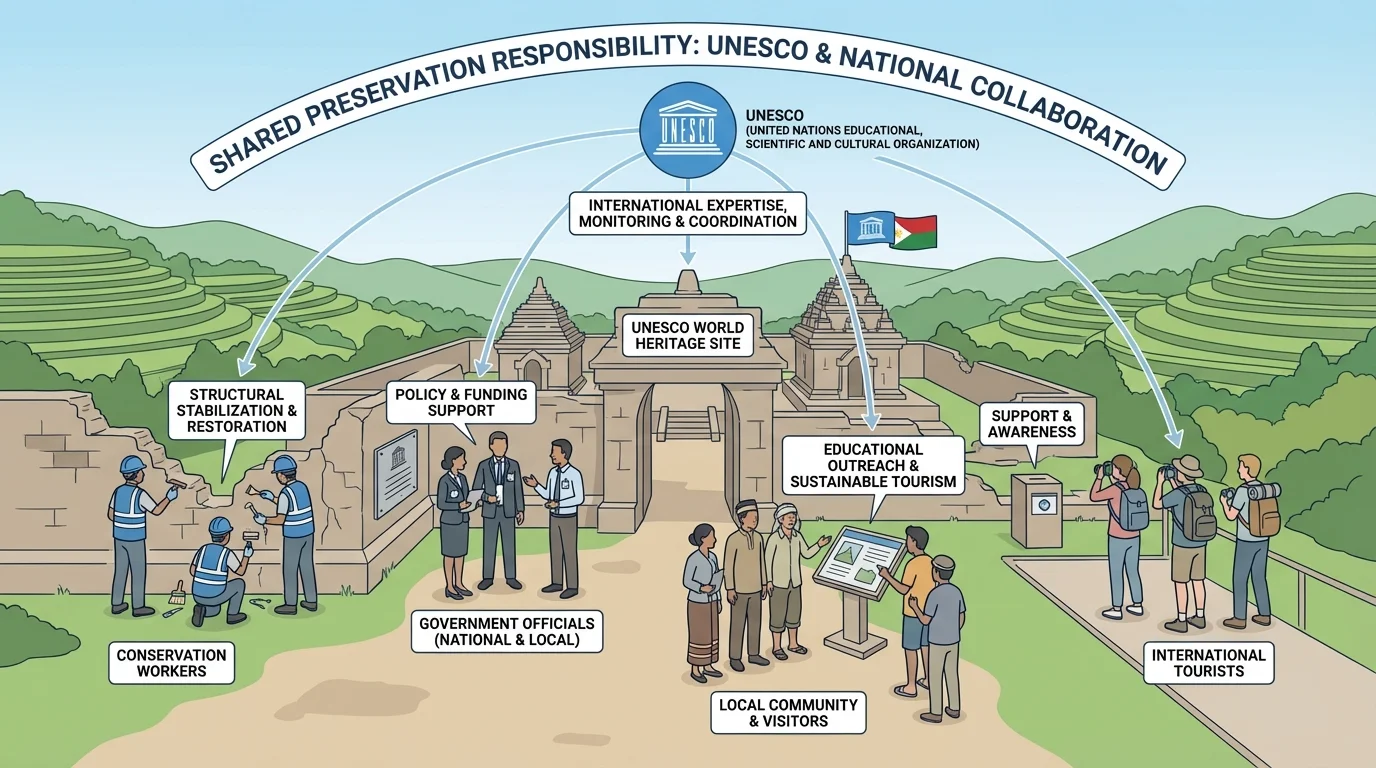
UNESCO stands for the United Nations Educational, Scientific, and Cultural Organization. It works to improve education, encourage scientific cooperation, protect culture, and preserve important natural and historical places. Preserving major sites is a shared responsibility, as [Figure 4] shows through cooperation among local workers, governments, and UNESCO support.
UNESCO is especially well known for its World Heritage Sites. These are places considered so valuable that they matter to all humanity, not just to one country. They may include ancient cities, temples, forests, coral reefs, or monuments. Countries identify and nominate sites, but UNESCO recognition can bring international attention, tourism, funding, and conservation support.
Examples in the Eastern Hemisphere include the Pyramids of Egypt, the Great Wall of China, the Serengeti in Tanzania, and the Acropolis in Greece. These places are inside particular countries, but they are valued by people worldwide. If they are damaged by war, pollution, looting, or neglect, the loss is global as well as local.
UNESCO also supports literacy, teacher training, scientific research, and the protection of languages and traditions. In places recovering from conflict, education can help rebuild society. In areas facing climate risk, scientific cooperation can help communities prepare. UNESCO therefore connects culture, science, and education rather than treating them as separate subjects.
| Organization | Main Focus | How It Works with Countries |
|---|---|---|
| United Nations | Peace, rights, development | Member countries debate, fund, and carry out programs |
| World Health Organization | Global health | Countries share health data and follow guidance |
| Red Cross/Red Crescent | Emergency and war relief | Works with local authorities and volunteers during crises |
| NGOs | Varies: rights, health, education, environment | Support communities, advocate, and partner across borders |
| UNESCO | Education, science, culture, heritage | Countries cooperate to preserve sites and improve learning |
Table 1. Comparison of major organizations and how they collaborate with countries.
As students compare these groups with [Figure 1], it becomes clear that international cooperation is not only about emergencies. It also includes protecting the past, building schools, and sharing scientific knowledge for the future.
The examples on the regional map highlight how collaboration takes different forms across the Eastern Hemisphere. The places are different, but the pattern is similar: local needs connect to international action.
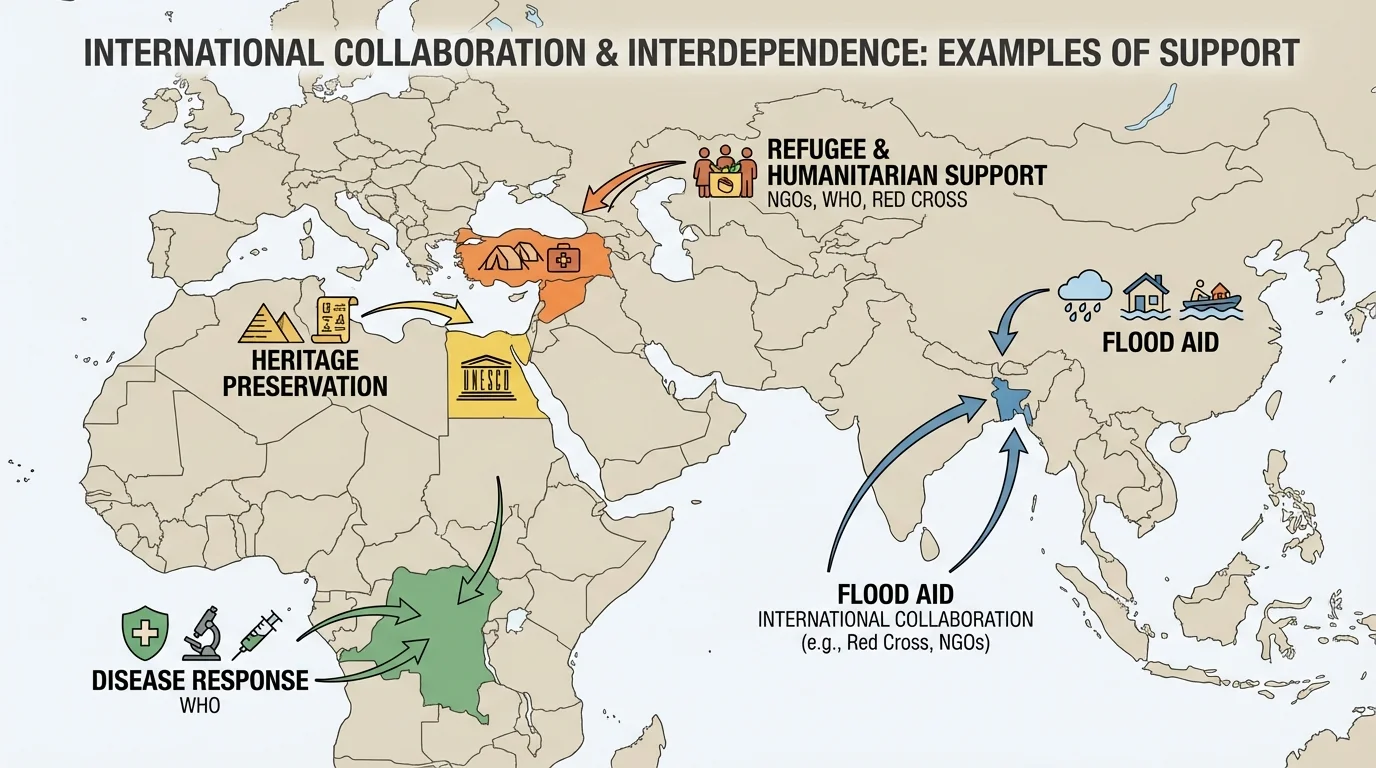
Bangladesh: Bangladesh often faces severe flooding and cyclones. The government works with the Red Crescent, the UN, NGOs, and other countries to prepare shelters, warn communities, and provide emergency supplies. International weather data and disaster planning help save lives before storms even arrive.
Democratic Republic of the Congo: During Ebola outbreaks, local health workers, the government, WHO, and international medical teams cooperated to track cases, isolate the virus, and educate communities. Success depended not just on medicine, but also on trust. If communities feared officials, they might avoid treatment, making the outbreak harder to control.
Syria and neighboring countries: War created a massive refugee crisis. Countries such as Turkey received millions of refugees. UN agencies, the Red Crescent, NGOs, and host governments provided shelter, food, medical care, and schooling. This case shows how a conflict inside one country can affect an entire region.
Egypt: Egypt protects famous heritage sites that are important nationally and globally. UNESCO recognition can support conservation work, tourism planning, and international attention. Protecting such sites requires local laws, trained experts, funding, and cooperation with the broader world.
Afghanistan and Pakistan: International organizations and NGOs have worked with local communities on vaccination campaigns, girls' education, and emergency aid after earthquakes. Progress has often been difficult because of conflict, geography, and political tensions, but cooperation has still saved lives and expanded opportunities.
Comparing two kinds of collaboration
Consider Bangladesh flood response and Egypt heritage preservation.
Step 1: Identify the main problem.
Bangladesh faces natural disasters that threaten lives immediately. Egypt works to protect historic places over long periods of time.
Step 2: Identify the partners.
Bangladesh may work with disaster agencies, the Red Crescent, and neighboring countries. Egypt may work with UNESCO, archaeologists, and cultural ministries.
Step 3: Compare the type of interdependence.
In Bangladesh, cooperation centers on rescue and relief. In Egypt, cooperation centers on conservation, education, and tourism.
Both cases show that countries depend on outside support, but the purpose of that support can be very different.
These case studies also show that international cooperation is not just something distant leaders do in meeting rooms. It affects villages, cities, schools, hospitals, museums, refugee camps, and disaster shelters.
Collaboration sounds ideal, but it is not always easy. Countries have different priorities, levels of wealth, political systems, and beliefs. A government may refuse outside criticism, even when human rights are being violated. An international organization may want to act, but lack funding or permission.
Another challenge is sovereignty, the idea that a country has the right to control its own territory and affairs. Sovereignty is important because it protects independence. But it can also create tension when international groups try to step in. Governments may ask, "Who are you to tell us what to do?"
There are also practical problems. Roads may be damaged. Internet access may be weak. Fighting may block aid deliveries. Corruption may divert supplies. Donor countries may lose interest over time. Even when everyone agrees on a goal, carrying it out can be hard.
Still, these limits do not make cooperation unimportant. They show why trust, planning, local knowledge, and long-term commitment matter. The outbreak system in [Figure 3] works only if each level shares accurate information. Heritage preservation in [Figure 4] succeeds only if local and international partners both contribute.
"Peace must be founded upon the intellectual and moral solidarity of humanity."
— UNESCO Constitution
This idea is powerful because it suggests that peace is not only about ending wars. It is also about building understanding through education, science, culture, health, and respect for rights.
International organizations may seem far away, but their work connects to daily life. Vaccines, weather warnings, refugee support, access to education, protection of historic sites, and human rights campaigns all affect real communities. If a disease is controlled abroad, people elsewhere are safer. If a disaster warning system improves, families have more time to prepare. If a cultural site is preserved, future generations can learn from it.
Students in the Eastern Hemisphere live in a world shaped by these relationships. A phone may contain materials from several countries. News spreads instantly across borders. Climate events in one region may affect food prices in another. International cooperation is not perfect, but it is part of how modern societies function.
By studying organizations such as the UN, WHO, the Red Cross, NGOs, and UNESCO, students can better understand how nations govern, organize, and influence one another. They can also see that citizenship today includes understanding global responsibilities as well as local ones. The world is made of separate countries, but many of its biggest challenges and achievements are shared.
