Two people can witness the same event and tell very different stories about it. That happens in school hallways, at sporting events, and in history. A military officer might call an attack a victory. Survivors might call it a massacre. A government document might describe removal as policy. The people forced from their homes might describe it as theft, grief, and violence. Learning history means more than memorizing dates. It means asking who is speaking, what evidence they give, and whose voices were ignored.
Historians study the past by examining primary sources and secondary sources. A primary source comes from the time being studied, such as a speech, diary, letter, law, newspaper article, treaty, photograph, or oral testimony. A secondary source is created later by someone interpreting the past, such as a textbook, documentary, or scholarly article.
When historians compare sources, they pay attention to perspective, purpose, audience, and reliability. Perspective means the position from which a person sees events. A U.S. official, a soldier, a Native elder, an enslaved person, and an immigrant laborer may all describe the same event differently because their experiences are different. That does not mean every account is equally accurate, but it does mean historians must investigate carefully.
Perspective is the point of view shaped by a person's background, experiences, culture, and interests. Bias is a tendency to favor one side or interpretation. Corroboration means checking one source against other sources to see what matches, what conflicts, and what still remains uncertain.
Good historical thinking requires more than finding one quote that supports what you already believe. It requires testing claims against evidence. If one report says a camp was hostile, but eyewitness testimony, later investigations, and physical evidence suggest the camp expected peace, a historian must weigh the full record rather than repeat the strongest-sounding statement.
This matters in Colorado and United States history because many major events involve power. People with more power often controlled official records. That is one reason voices from Indigenous nations, African Americans, immigrants, and other marginalized groups are so important. They help historians see what official documents left out.
Chronology helps historians connect cause and effect, and [Figure 1] shows how events such as colonization, removal, Civil War-era military change, and immigration conflicts unfolded over time rather than as isolated stories. Seeing the order of events makes it easier to understand why later conflicts grew out of earlier policies.
European colonization of North America began long before the United States existed. Indigenous peoples across the continent experienced invasion, land seizure, mission systems, disease, warfare, and forced cultural change. The forced labor of enslaved Africans became central to colonial and later U.S. economies. In the nineteenth century, westward expansion increased pressure on Native nations. The Indian Removal Act became law in 1830. The Sand Creek Massacre took place in 1864 during the Civil War era. The Buffalo Soldiers began serving after the Civil War. In the later nineteenth century, immigration from Asia and Latin America shaped labor systems, communities, and political debates.
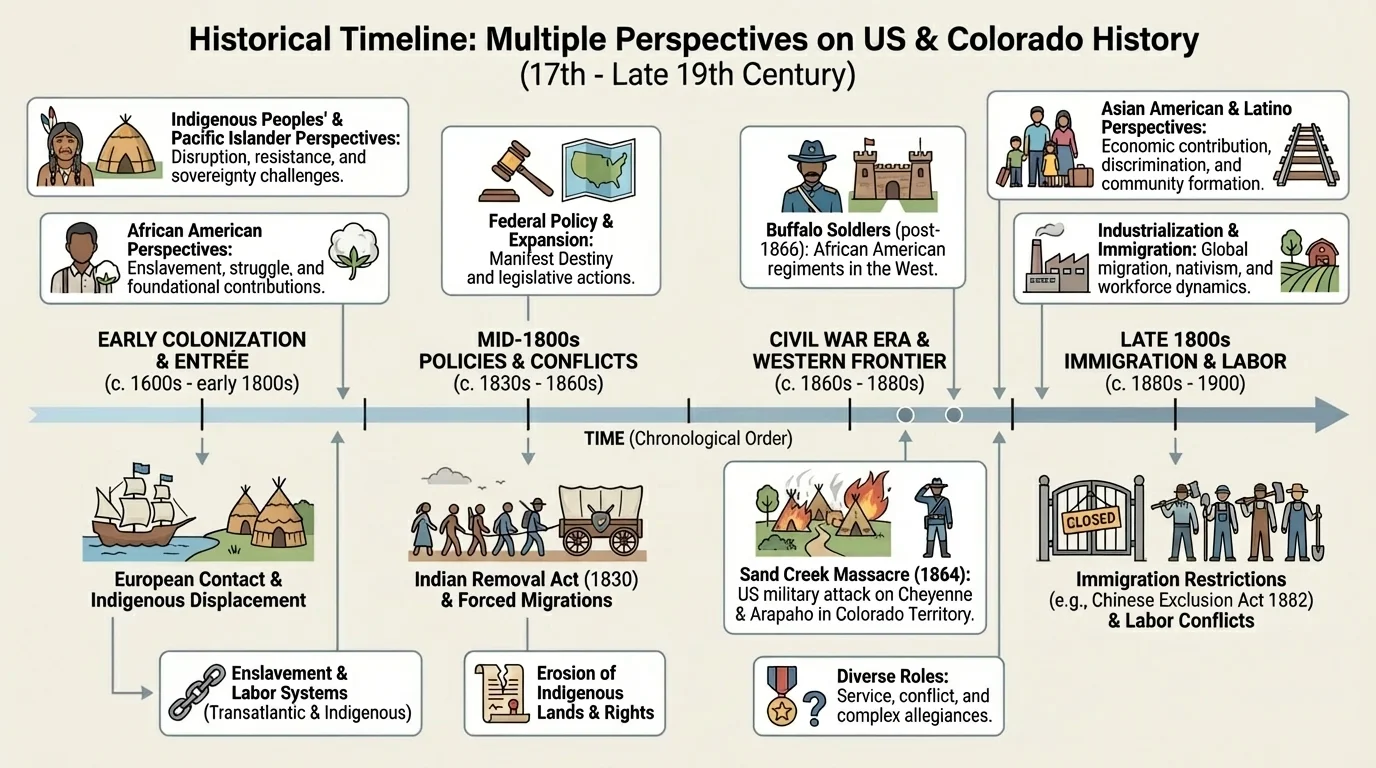
A timeline does not tell us who was right. It does something just as important: it shows sequence. If we know that removal policy came before later settlement patterns, or that emancipation came before Black regiments served in the West, we can better understand how one event influenced the next.
| Period | Major Event | Why It Matters |
|---|---|---|
| Colonial era | European colonization expands | Indigenous nations face conquest, land loss, and cultural disruption |
| 1600s–1800s | Atlantic slavery grows | Millions of Africans and their descendants are exploited through enslavement |
| 1830 | Indian Removal Act | Federal policy supports forced relocation of Native nations |
| 1864 | Sand Creek Massacre | Cheyenne and Arapaho people are attacked in Colorado Territory |
| After 1866 | Buffalo Soldiers serve in the West | African American troops gain military roles while serving in expansionist campaigns |
| 1800s | Asian and Latino immigration debates intensify | Labor needs, racism, and exclusion shape national policy |
Table 1. Major events and why they are important for analyzing evidence and perspective.
Traditional textbook narratives often described westward expansion as settlement, progress, or civilization. From many Indigenous perspectives, however, colonization meant invasion, broken treaties, loss of land, violence, and attacks on sovereignty. A U.S. history book written long ago might celebrate pioneers. Oral histories and Native accounts may center survival, resistance, and the protection of community.
Colonization is not just the arrival of newcomers. It is a process in which outside powers take control of land, labor, and government. Indigenous peoples in what is now Colorado and across North America experienced this through warfare, removal, boarding schools, treaty violations, and pressures to give up language and culture.
Hawaiian and Pacific Islander perspectives also challenge simple stories of American expansion. In many older accounts, U.S. influence in the Pacific appears as trade and strategic growth. From Native Hawaiian perspectives, outside intervention disrupted an independent kingdom, weakened self-rule, and contributed to the overthrow of Hawaiian leadership in the late nineteenth century. Looking at these accounts together helps students see that expansion often benefited one group while harming another.
African American perspectives on enslavement are equally important. Slaveholders often defended slavery as legal, necessary, or even beneficial. Enslaved people described it as family separation, forced labor, punishment, and denial of freedom. Narratives by formerly enslaved people, such as Frederick Douglass and Harriet Jacobs, reveal the cruelty and resistance that official slave records tried to hide.
"Power concedes nothing without a demand. It never did and it never will."
— Frederick Douglass
When historians compare these perspectives, they ask key questions. Who had power to write laws and reports? Who was denied that power? What evidence comes from personal testimony, legal documents, newspapers, speeches, or later research? The goal is not to flatten differences but to understand them.
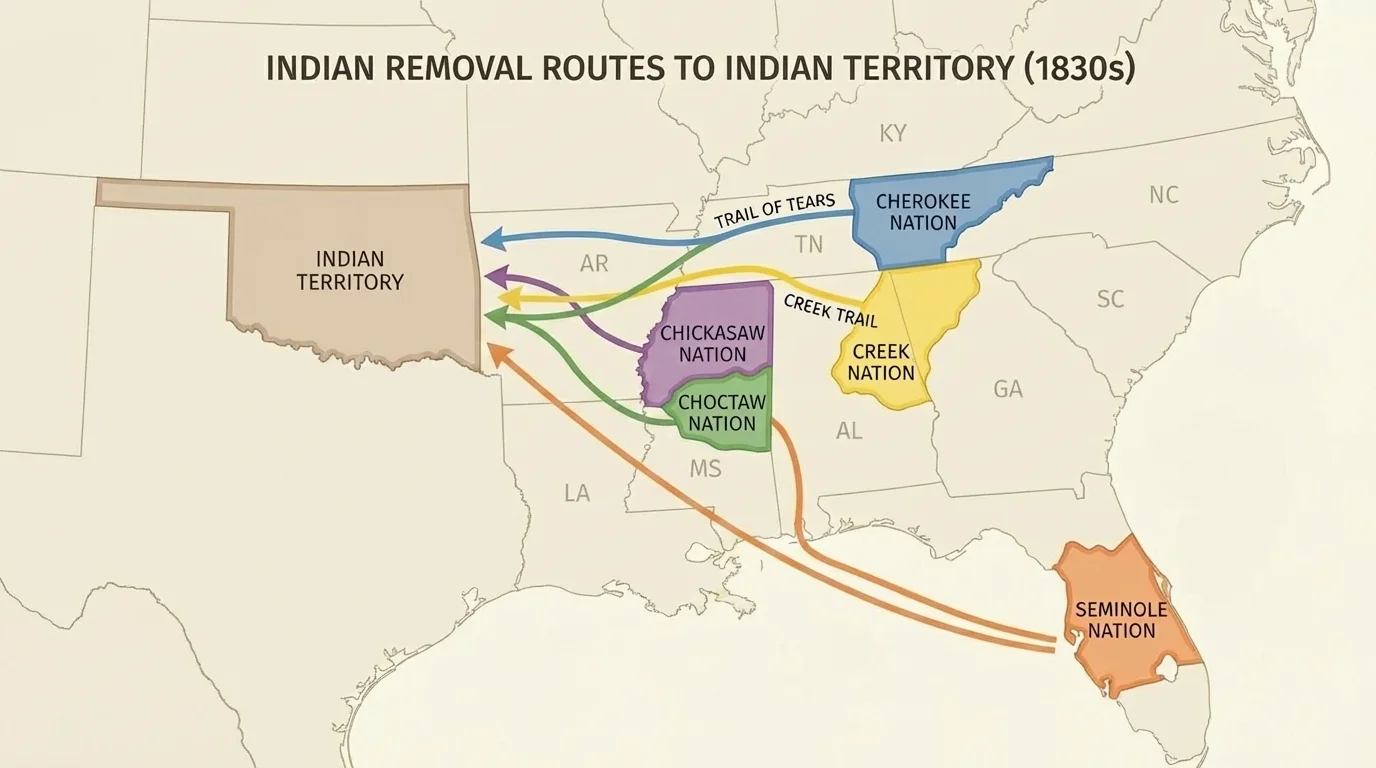
The Indian Removal Act of 1830 was a federal law that supported the relocation of Native nations from their homelands in the Southeast to lands west of the Mississippi River. To understand it, students need both policy language and Native experiences, and [Figure 2] makes the scale of forced movement across the map visible.
Supporters of the law argued that removal would reduce conflict and open land for white settlement. President Andrew Jackson and his allies presented it as a practical solution. But Native leaders and communities often saw it as a violation of sovereignty and treaty rights. The Cherokee Nation, for example, used legal arguments and petitions to resist removal. In Worcester v. Georgia, the Supreme Court recognized certain Cherokee rights, yet removal still went forward.
The forced relocation of the Cherokee is remembered as the Trail of Tears. Thousands died from disease, hunger, exhaustion, and exposure during the journey. Government records may list numbers, routes, or military orders. Cherokee accounts and later tribal memory describe grief, loss, and injustice. Both kinds of evidence matter, but they tell different parts of the story.
Notice how word choice affects interpretation. If a source says Native people were "relocated," the language may sound neutral. If another source says they were "forcibly removed," the role of government power becomes clearer. Historians should pay attention to these choices because language can hide violence.
Case study: comparing evidence about removal
Step 1: Read a government statement.
A federal official may claim removal protects peace and creates order.
Step 2: Read Native testimony.
A Cherokee account may describe soldiers, hardship, and death on the journey.
Step 3: Compare purpose and audience.
The official statement may be written to justify policy. The testimony may be written to record lived experience.
Step 4: Form a claim.
A strong claim might state that federal leaders presented removal as policy, but Native evidence shows it caused widespread suffering and violated Native rights.
Later, when students study western settlement or conflict in Colorado, the same pattern appears again: official policy often described expansion as orderly progress, while many Native communities experienced it as dispossession. The map in [Figure 2] reinforces that removal was not a small local event but a massive reorganization of people and power.
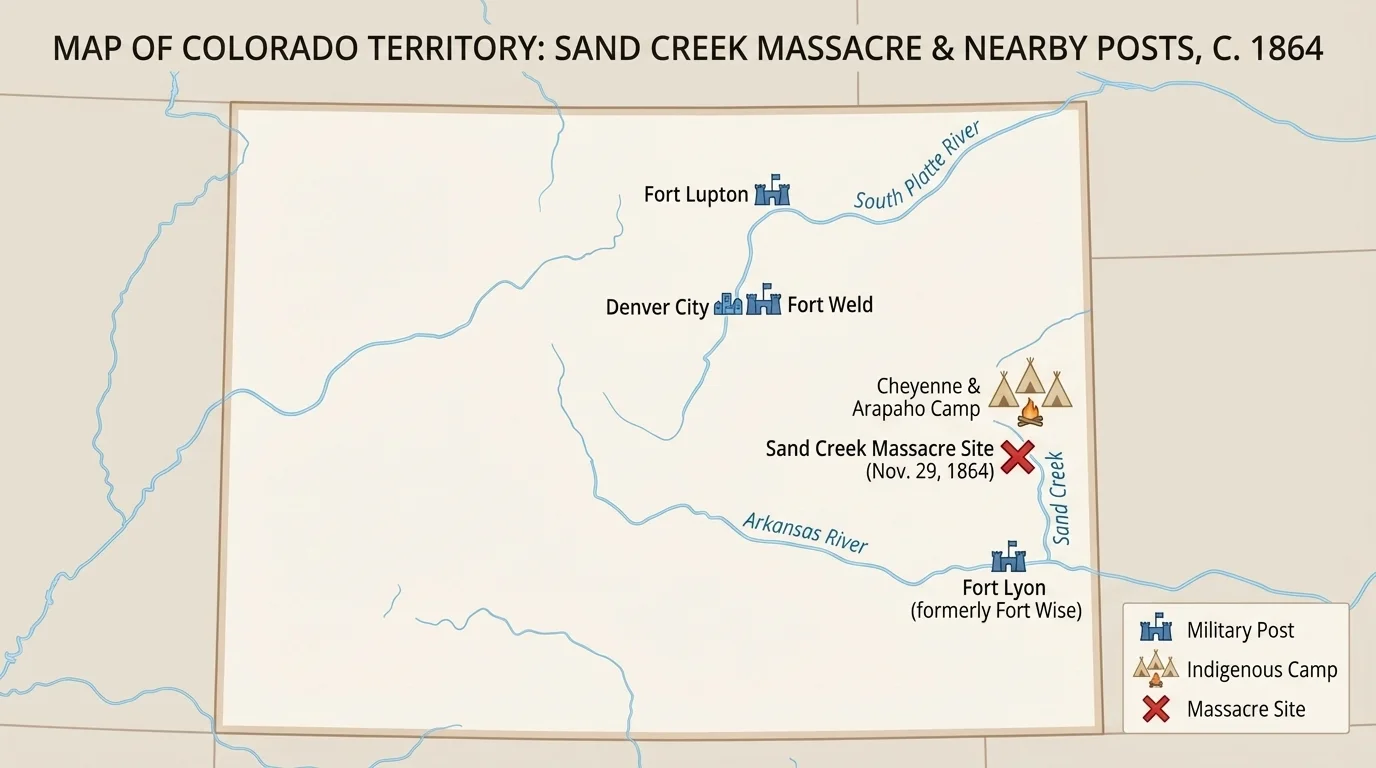
The Sand Creek Massacre is one of the most important events in Colorado history, and [Figure 3] shows why location matters when evaluating claims about danger, military action, and whether the camp expected peace. It took place on November 29, 1864, in Colorado Territory when a force led by Colonel John Chivington attacked a Cheyenne and Arapaho encampment.
Some early military reports described the attack as a battle against hostile forces. But many other sources directly conflict with that claim. Survivors said the camp included women, children, and elders and that people believed they were under U.S. protection. Some reports mention that a white flag and an American flag were present. Later congressional investigations strongly criticized the attack.
The difference between calling Sand Creek a battle and calling it a massacre is not just about emotion. It is about evidence. If a heavily armed military force attacks a camp that is not prepared for combat and kills many noncombatants, the term massacre is historically supported. Historians examine testimony from Cheyenne and Arapaho survivors, soldiers, officers, investigators, and later scholars to make that judgment.
Colorado history is especially shaped by this event because it reveals how territorial politics, fear, racism, and military power combined. Governor John Evans and Colonel Chivington became central figures in the story. Today, the Sand Creek Massacre National Historic Site helps preserve memory and evidence.
How conflicting accounts work at Sand Creek
Official statements made close to the event tried to justify the attack. Survivor testimony and later investigations exposed major contradictions. When several independent sources point toward the same conclusion, historians gain stronger confidence. At Sand Creek, the weight of evidence supports the conclusion that the event was a massacre, not a fair battle.
Notice the method: historians do not choose the version they like best. They compare witness statements, timing, motives, and physical facts. Later in the lesson, this same method helps us understand Buffalo Soldiers and immigration debates. The map in [Figure 3] helps students place the event within Colorado Territory rather than treating it as an abstract story.
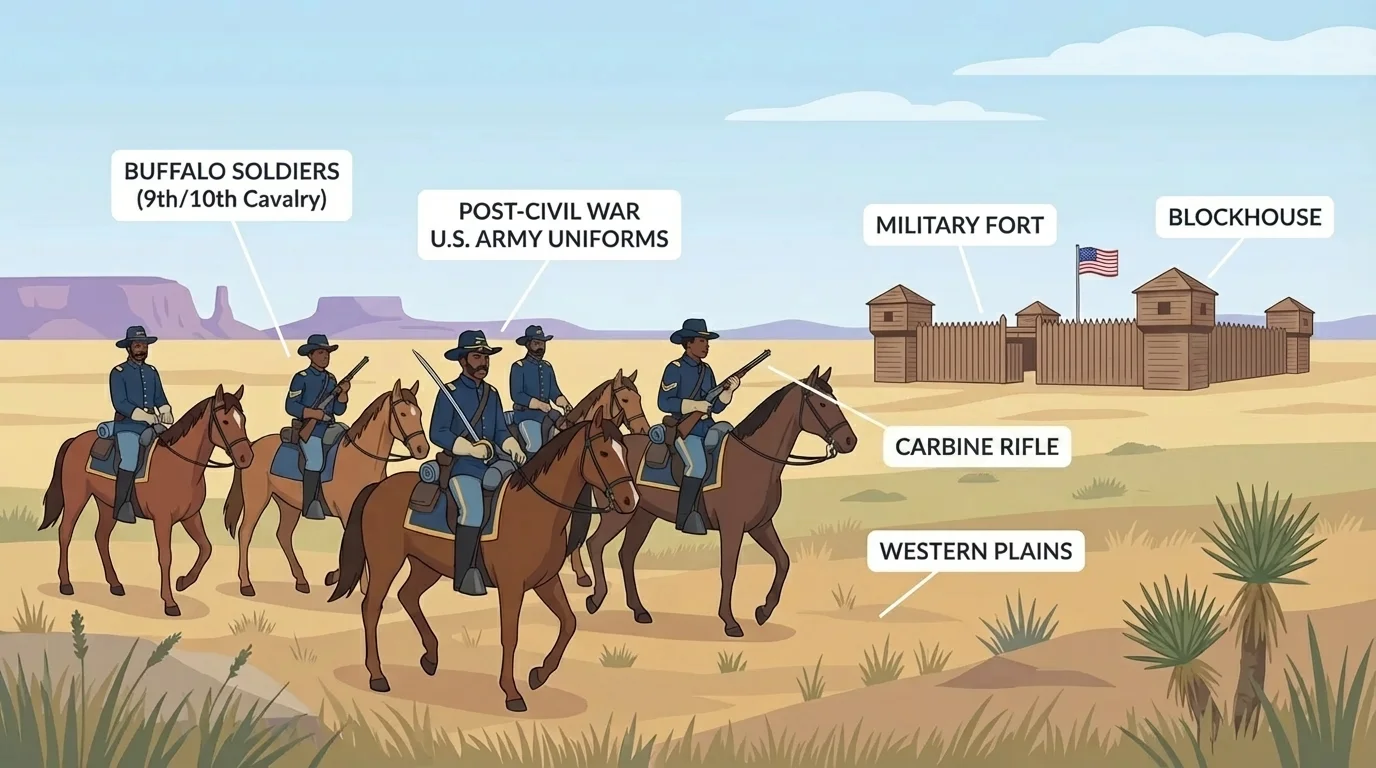
The Buffalo Soldiers, as shown in [Figure 4], were African American soldiers who served in the U.S. Army after the Civil War. They are remembered for discipline, bravery, and persistence in a nation that still treated Black Americans unequally. At the same time, their service in the West connected them to federal campaigns against Native nations. That makes their history powerful and complicated.
For many African Americans, military service offered pay, status, purpose, and a way to claim citizenship in a country that had long denied equal rights. The soldiers served in difficult conditions, built roads, protected routes, and fought in conflicts across the West. Their accomplishments challenged racist ideas that Black soldiers were inferior.
However, some Native perspectives view these soldiers within the larger system of westward expansion and military enforcement. This does not erase the soldiers' courage. It shows that people can be both oppressed in one context and agents of government policy in another. History often contains these contradictions.
When historians analyze the Buffalo Soldiers, they compare military records, letters, newspapers, photographs, and later interpretations. One source may celebrate heroism. Another may focus on the role of the army in taking Indigenous land. A strong historical understanding includes both.
The name "Buffalo Soldiers" is widely believed to have been given by Native peoples, possibly because the soldiers' hair or fighting ability reminded them of buffalo. Historians still discuss the exact origin, which is a good reminder that even famous names can have uncertain histories.
The image in [Figure 4] highlights the western setting that shaped this contradiction: service in uniform could represent opportunity for Black soldiers while also advancing U.S. control over Native lands.
Immigration stories are often told as stories of opportunity, but not everyone experienced the United States in the same way. Immigration can involve hope, labor, danger, exclusion, and discrimination all at once. Asian American and Latino perspectives help historians move beyond simple ideas of the U.S. as either a perfect refuge or a closed gate.
Chinese immigrants in the nineteenth century helped build railroads, worked in mining, and supported growing western economies. Yet they also faced violence, unfair taxes, and exclusion. Some newspapers and politicians described them as threats to jobs or culture. Chinese immigrants and their communities described hard work, sacrifice, and the struggle to survive in a hostile environment. These conflicting accounts matter because public opinion helped shape laws such as the Chinese Exclusion Act.
Latino history in the United States is also more complex than a single migration story. In the Southwest, many Mexican Americans did not cross a border; the border crossed them after the U.S.-Mexican War. Others later migrated for work in agriculture, ranching, mining, and railroads. Employers often wanted labor, but communities and lawmakers sometimes promoted discrimination or deportation. A business owner, a worker, and a politician might describe the same immigration issue in very different terms.
Students should ask: who benefits from immigrant labor, and who tries to restrict it? A railroad company may praise workers when labor is needed. A politician may attack the same group during economic hardship. Immigrants' letters, oral histories, and community newspapers often reveal experiences that official debates ignore.
| Group | Common dominant narrative | Perspective from communities themselves |
|---|---|---|
| Chinese immigrants | Described by critics as economic or cultural threats | Emphasize labor, family support, survival, and discrimination |
| Mexican and Mexican American communities | Often reduced to labor or border issues | Emphasize long community history, land, work, identity, and unequal treatment |
| Native peoples | Sometimes described as obstacles to expansion | Emphasize sovereignty, survival, and defense of homeland |
| African Americans | Sometimes erased from western stories | Emphasize freedom struggles, service, labor, and citizenship claims |
Table 2. Examples of how dominant narratives can differ from community perspectives.
A historical claim is an argument about the past supported by evidence. It is not just an opinion. To defend a claim, historians and students must explain why the evidence supports that conclusion better than another conclusion.
Suppose a student is asked whether Sand Creek was a battle or a massacre. A weak answer says, "I think it was a massacre because it sounds bad." A stronger answer says, "Survivor testimony, later congressional investigations, and reports about noncombatants in the camp show that the attack targeted people who were not engaged in equal battle, so the evidence supports calling it a massacre." The second answer uses evidence and reasoning.
Building a claim from multiple sources
Step 1: Identify the question.
Example: How did different groups view westward expansion?
Step 2: Gather multiple sources.
Use laws, speeches, maps, letters, oral histories, and later research.
Step 3: Compare agreements and conflicts.
Look for places where sources support each other and where they disagree.
Step 4: Evaluate reliability.
Ask who created each source, when, why, and with what knowledge or bias.
Step 5: Write a claim with evidence.
Explain which interpretation is best supported and why.
One useful habit is to separate evidence from interpretation. For example, the fact that a law was passed is evidence. Saying the law was fair is interpretation. A letter from an immigrant describing unfair treatment is evidence. Claiming that all Americans agreed with that treatment would require more evidence.
Remember that a source does not have to be neutral to be useful. A biased source can still reveal important information, especially about what the creator wanted others to believe.
Another useful habit is to ask what is missing. Whose voice is absent from the record? In many earlier histories, Native women, enslaved people, laborers, and immigrants were underrepresented. Historians often use oral histories, archaeology, and community records to fill gaps left by official archives.
Several key figures help anchor this topic. Andrew Jackson supported Indian removal. Cherokee leaders such as John Ross fought against it. John Chivington led the attack at Sand Creek. Governor John Evans played an important territorial role in the political climate leading up to the massacre. Buffalo Soldiers served in regiments such as the 9th and 10th Cavalry. African American writers such as Frederick Douglass provided powerful critiques of slavery and inequality.
These events still matter because history shapes the present. In Colorado, the memory of Sand Creek affects how communities discuss justice, memorials, and relationships with Tribal nations. In the United States more broadly, arguments over immigration, citizenship, race, and government power continue. Studying multiple perspectives does not divide history into separate stories. It helps create a fuller, more truthful one.
When students analyze evidence carefully, they become better historians and better citizens. They learn to challenge oversimplified narratives, recognize whose voices have been ignored, and defend conclusions with proof rather than guesswork. That skill matters far beyond history class.
