Two people can watch the same event and tell completely different stories about it. That is not just true in daily life; it is true in history too. A newspaper editor, a soldier, an enslaved person, a president, and a protester might all describe the same moment in very different ways. Historians do not simply collect old documents and accept them as facts. They question them, compare them, and test them. To study United States history from the American Revolution through Reconstruction, you need to know how to critique evidence for point of view, historical context, distortion, propaganda, and historical inquiry.
Critiquing a source does not mean attacking it or assuming it is useless. It means examining it carefully. Historians ask questions such as: Who created this? When? Why? For whom? What is included, and what is left out? How does this source compare with others? These questions help historians decide whether a source is trustworthy, limited, biased, persuasive, or valuable.
Primary sources are materials created during the time being studied, such as letters, speeches, laws, newspaper articles, diaries, maps, songs, photographs, or political cartoons. Secondary sources are later interpretations created by historians or other writers, such as textbooks, biographies, documentaries, or historical essays. Both matter, but both must be examined critically.
When historians investigate the past, they are doing more than collecting information. They are building arguments about what happened and why it mattered. Good historical thinking depends on evidence, but evidence only becomes useful when it is analyzed carefully.
History is not just a list of dates and names. It is an interpretation of human actions. A source may be honest but incomplete. It may be vivid but exaggerated. It may tell us more about the creator's beliefs than about the event itself. For that reason, historians do not ask only whether a source is real. They also ask what kind of truth it offers.
For example, if a soldier writes home during the Civil War, the letter may give powerful first-hand details about camp life. But the soldier may hide fear in order not to worry family members. A politician's speech may reveal what leaders wanted the public to believe, even if it does not fully describe reality. A newspaper article may contain valuable information, but it may also reflect the political goals of the paper's editors.
Questioning evidence is especially important in periods of conflict such as the American Revolution, the Civil War, and Reconstruction. In these eras, people were trying to persuade others, defend their side, and shape public opinion. That means sources from those times often contain strong opinions as well as useful facts.
Historians first sort evidence by source type, as [Figure 1] shows, because primary and secondary sources answer different kinds of questions. A primary source brings us close to the time period. A secondary source helps explain patterns and connections across many pieces of evidence.
A diary entry from the Revolutionary era is a primary source. So is the text of the Declaration of Independence, a runaway slave advertisement, a Civil War photograph, or the 14th Amendment. A textbook chapter about Reconstruction is a secondary source. So is a historian's article explaining the causes of the Civil War.
Neither kind of source is automatically better. A primary source can be biased, mistaken, or limited. A secondary source can be well researched, but it can also reflect the historian's own perspective or the evidence that historian chose to emphasize. Strong historical work usually uses both.
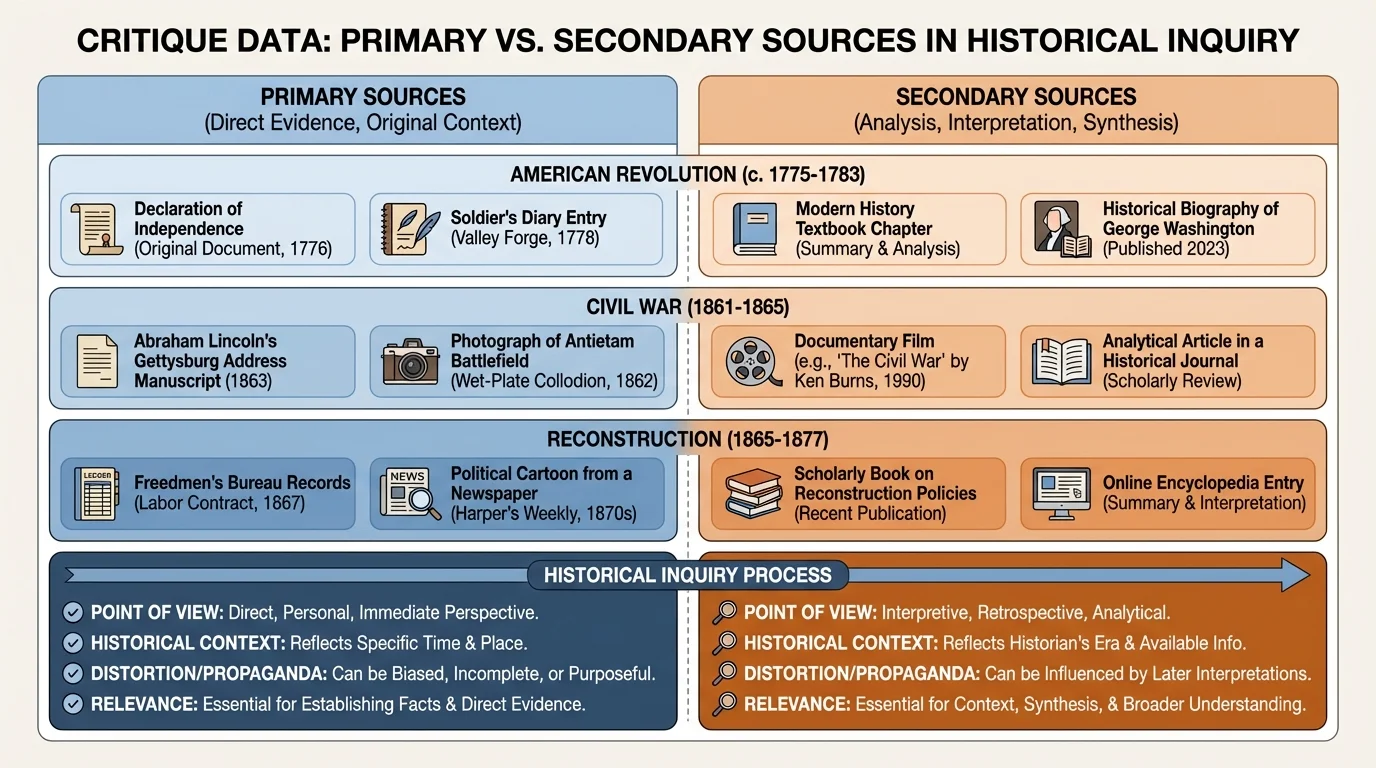
Suppose you are investigating whether the Boston Massacre was an unprovoked attack or a chaotic street confrontation. A Patriot engraving, witness testimonies, and trial records are primary sources. A modern historian's chapter explaining the event is a secondary source. The best understanding comes from comparing these kinds of evidence, not relying on only one.
| Source Type | Example | Strength | Limitation |
|---|---|---|---|
| Primary | Letter from a soldier | Firsthand details | Limited viewpoint |
| Primary | Political cartoon | Shows opinions and persuasion | May exaggerate |
| Secondary | History book chapter | Uses many sources | Interpretation may differ |
| Secondary | Documentary | Gives broad overview | May simplify events |
Table 1. Comparison of primary and secondary sources, including strengths and limitations.
One event can produce very different accounts, as [Figure 2] illustrates, because every source comes from a particular point of view. Point of view is the position from which a person sees and describes events. It is shaped by identity, role, beliefs, goals, and experiences.
A merchant in Boston, a British official in London, and an enslaved person in Virginia all lived in British America before the Revolution, but they did not experience it in the same way. Their social class, race, location, and political interests shaped what they noticed and what they thought was important.
When you analyze point of view, ask: What was the creator's role in the event? What did this person stand to gain or lose? Who was the audience? Was the source meant to inform, persuade, entertain, justify, or complain? These questions help you see why the source sounds the way it does.
Consider Thomas Paine's Common Sense. It argued strongly for independence from Britain. That makes it useful evidence for understanding revolutionary ideas and persuasion. But it is not a neutral description of all opinions in the colonies. Its purpose was to convince readers.
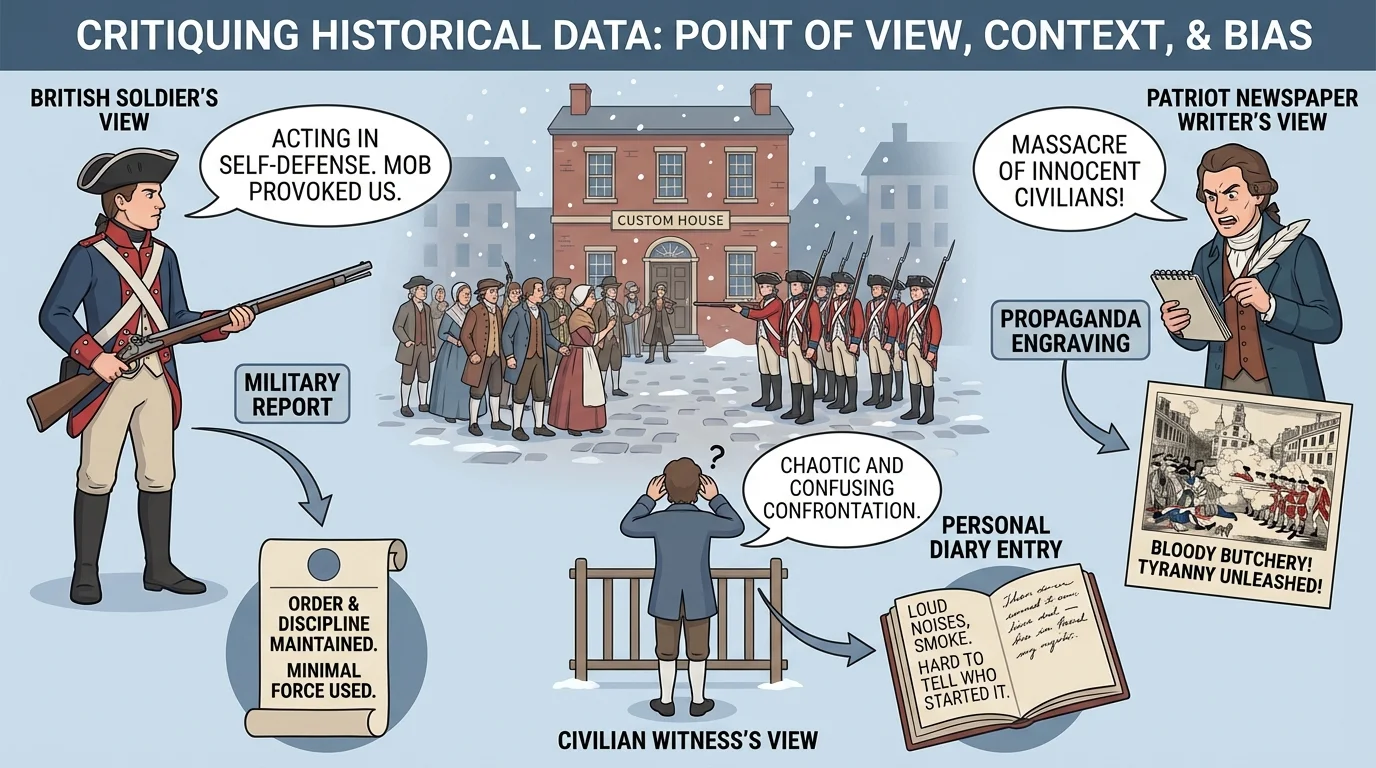
Point of view does not mean a source is false. It means the source reflects a specific angle. An enslaved person's narrative, for example, may be deeply personal and emotional, but that does not make it less important. In fact, such sources are essential because they preserve voices often ignored in official records.
Case study: analyzing point of view in the Boston Massacre
Step 1: Identify the source creator.
Paul Revere created a famous engraving of the Boston Massacre.
Step 2: Identify the purpose and audience.
The engraving aimed to stir colonial anger against British troops and was made for a colonial audience.
Step 3: Look for choices that shape meaning.
The image presents the colonists as orderly victims and the British soldiers as a unified line firing on civilians.
Step 4: Judge usefulness and limits.
The engraving is useful for understanding Patriot propaganda and colonial anger, but it is limited as an exact record of what happened.
Later, when historians compare witness testimony with Revere's engraving, they often find a more complicated event than the image suggests. That is why a source can be valuable even when it is not fully accurate.
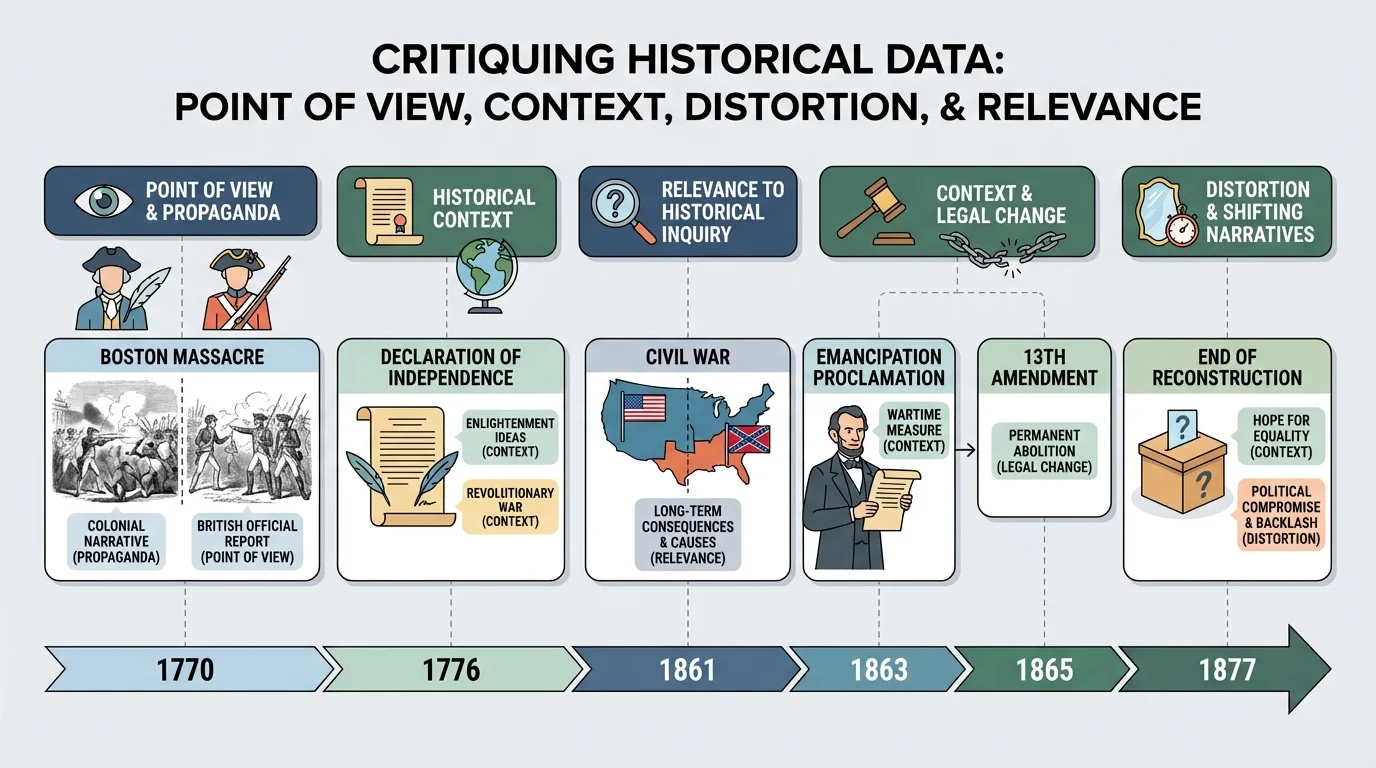
Historians place every source inside a larger sequence of events, as [Figure 3] shows, because words and actions make sense only in the conditions of their own time. Historical context includes the time, place, political situation, social ideas, economic conditions, and recent events surrounding a source.
Without context, people can misread the past. A law, speech, or cartoon may seem strange until you know what had happened just before it was created. For example, the Emancipation Proclamation makes more sense when you know it was issued during the Civil War as a war measure and did not instantly free every enslaved person everywhere.
Context also helps prevent presentism, the mistake of judging the past only by today's standards without first understanding the beliefs and conditions of the time. Historians can still criticize injustice in the past, but they first need to understand how people at the time explained or challenged that injustice.
Take the 14th Amendment. If you read it without context, you might only see legal language about citizenship and equal protection. In context, it becomes part of the struggle after the Civil War to define freedom, citizenship, and rights in a nation emerging from slavery.
Context can also reveal change over time. The meaning of freedom in 1776 was not identical to the meaning of freedom in 1865. Many colonists demanded liberty from Britain while slavery still existed. During Reconstruction, new amendments tried to reshape the nation by ending slavery and redefining citizenship, but resistance remained strong.
Some of the most important historical misunderstandings happen because a source is quoted in isolation. A short line from a speech can sound simple, but the full speech, the audience, and the moment in history may change its meaning completely.
That is why historians often ask what happened right before the source appeared. As we see again in [Figure 3], major turning points such as the Declaration of Independence, the Civil War, and Reconstruction amendments change the meaning of sources created around them.
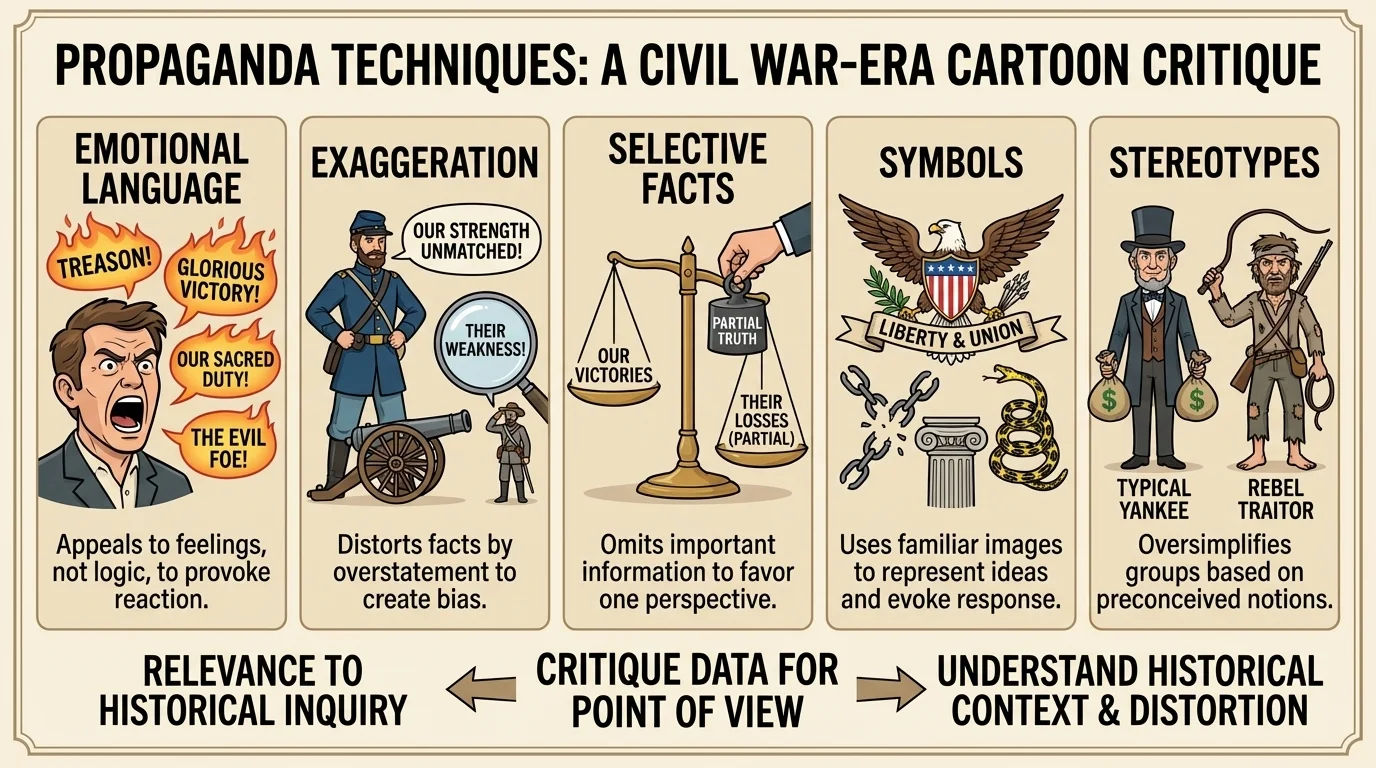
During times of conflict, historical sources may contain distortion or propaganda. Propaganda often uses predictable persuasive techniques, shown in [Figure 4], to influence what people think and feel. Distortion means a source presents a misleading picture. This can happen by accident through memory errors, missing information, or misunderstanding. It can also happen on purpose through exaggeration or selective reporting.
Propaganda is information designed mainly to persuade, often by appealing to emotion, fear, pride, or anger instead of giving a balanced picture. Propaganda may use some true facts, but it arranges them in a way that pushes people toward a certain conclusion.
Common warning signs include emotional language, dramatic images, stereotypes, one-sided evidence, loaded labels, and the complete absence of the other side's viewpoint. A political cartoon from the Civil War era may be historically useful, but historians should read it as persuasion, not as simple fact.
For example, abolitionist newspapers sometimes used powerful and shocking descriptions to awaken readers' moral outrage against slavery. Pro-slavery writers, meanwhile, often distorted reality by describing slavery as a benevolent system. Both sets of sources are important, but they must be read with attention to purpose, audience, and omitted details.
Revere's Boston Massacre engraving is one example of propaganda. Another is wartime recruiting posters that present military service as glorious while leaving out hardship and death. These sources are valuable because they show what people wanted others to believe.
How distortion differs from propaganda
Distortion is a misleading picture of reality. It can happen by error, limited knowledge, or deliberate manipulation. Propaganda is a special kind of distortion or selection that aims to persuade an audience. A mistaken diary entry might be distorted without being propaganda. A political poster designed to stir fear is propaganda because persuasion is its main purpose.
Historians do not throw propaganda away. Instead, they ask what it reveals about public opinion, political goals, and social conflict. As with the techniques listed in [Figure 4], the very methods of persuasion can become evidence.
Not every source that mentions a topic is useful for every question. Historical inquiry is the process of asking focused questions about the past and using evidence to answer them. A source is relevant if it helps answer the specific question being investigated.
Suppose your question is, "How did formerly enslaved people try to build new lives during Reconstruction?" A speech by President Andrew Johnson may provide context about federal policy, but a labor contract, a Freedmen's Bureau report, a school record, or a letter from a freedperson may be more directly relevant. Relevance depends on the question.
This is why historians begin with a clear inquiry question. Without one, it is easy to collect interesting but unfocused information. A source can be authentic and important, yet still not be the best evidence for your exact claim.
When making a historical claim, evidence should connect directly to the question. A strong claim is not based on random facts; it is based on facts that actually support the argument.
Relevance also includes scale. If you are studying the causes of the Civil War, one person's opinion matters, but you also need broader evidence such as legislation, speeches, census data, newspaper debates, and sectional conflicts. If you are studying one community during Reconstruction, local evidence may be more relevant than national speeches.
Looking at real examples helps show how all these ideas work together.
American Revolution: Sources about the Boston Massacre, the Stamp Act protests, and the Declaration of Independence often reflect strong Patriot or Loyalist positions. A Patriot pamphlet may be excellent evidence for colonial anger, but weak evidence for British motives. A Loyalist letter may reveal fear of mob violence. Neither should stand alone.
Declaration of Independence: The document declares that "all men are created equal," but historians place those words in context. The declaration is a primary source for revolutionary ideals. At the same time, historians compare it with the reality that women, enslaved people, Native peoples, and many others did not receive equal rights. That tension is a major historical question.
Civil War: Speeches by Abraham Lincoln, Confederate leaders, soldiers' letters, and newspaper editorials all reflect point of view. Lincoln's Gettysburg Address is brief but powerful. It is useful for understanding Union ideals and the meaning leaders gave to the war, but not as a complete description of soldiers' experiences or all political opinions.
Reconstruction: The 13th, 14th, and 15th Amendments changed the Constitution, but their impact cannot be understood from text alone. Historians also use Black Codes, court cases, testimony from freedpeople, records from the Freedmen's Bureau, and reports of white supremacist violence. These sources show conflict between new rights on paper and resistance in daily life.
| Historical Question | More Relevant Source | Why It Helps |
|---|---|---|
| Why did Patriots oppose Britain? | Pamphlet such as Common Sense | Shows arguments for independence |
| How was slavery challenged? | Abolitionist newspaper article | Shows anti-slavery activism |
| How did freedpeople experience Reconstruction? | Freedmen's Bureau report or personal letter | Provides direct evidence of daily struggles and hopes |
| How did leaders explain the Civil War? | Political speeches | Reveals public arguments and goals |
Table 2. Examples of matching historical questions with more relevant kinds of sources.
These examples show that the same source can be useful for one question and less useful for another. Historians are always matching evidence to inquiry.
Before making a conclusion, historians move through a series of checks, as [Figure 5] shows. One of the most important is corroboration, which means comparing multiple sources to see where they agree, disagree, or fill in missing information.
If one newspaper says a protest was peaceful and another says it was violent, historians do not simply choose the one they like better. They compare both with letters, court records, diaries, and other reports. They ask which source was closest to the event, which had the strongest reason to exaggerate, and which details appear in more than one source.
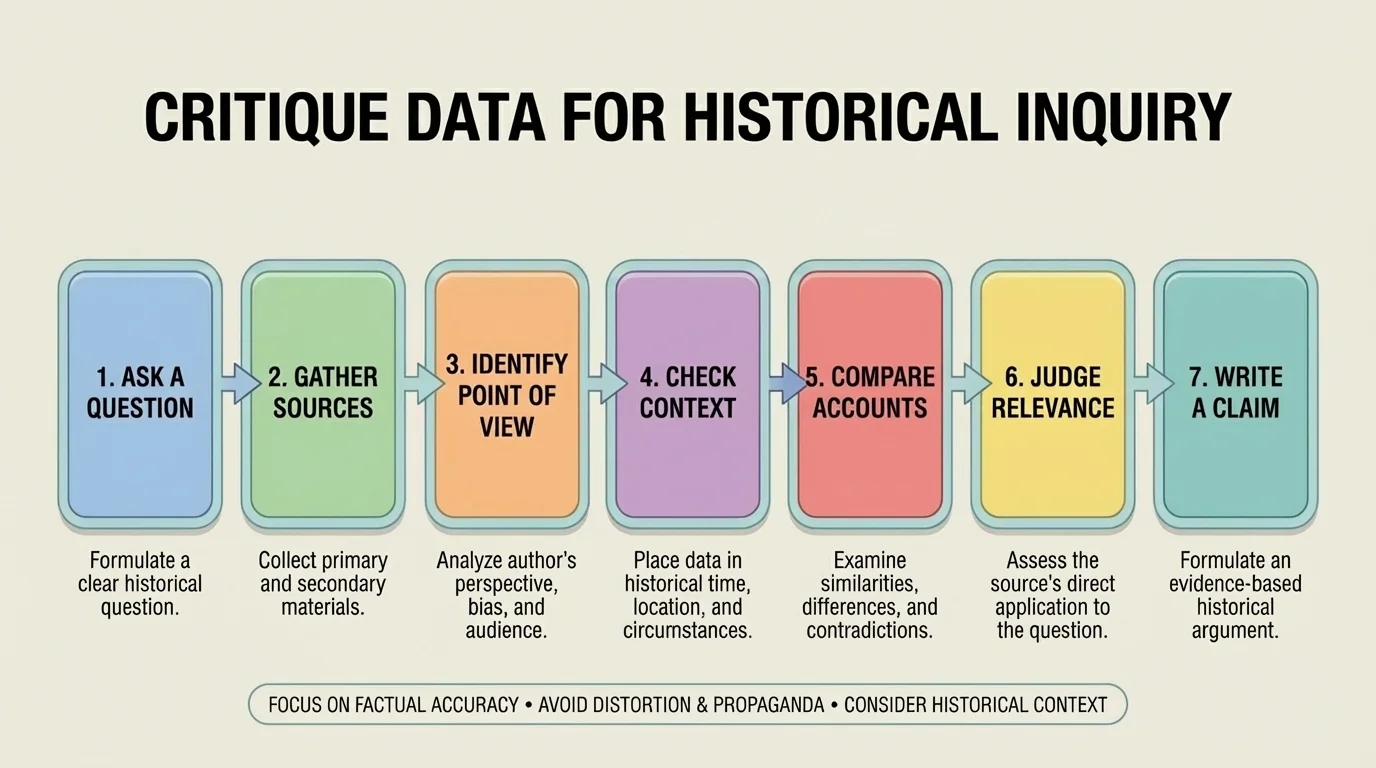
Corroboration does not always produce total agreement. Sometimes sources conflict because historical events are messy. In that case, historians explain the disagreement and support the interpretation that best fits the evidence.
For example, to investigate whether Reconstruction expanded democracy, a historian might compare constitutional amendments, voter registration records, testimony from Black officeholders, reports of intimidation, and later state laws. Together these sources create a fuller picture than any single document could provide.
Building a claim from multiple sources
Step 1: Ask a focused question.
How did Reconstruction create new opportunities and new dangers for freedpeople?
Step 2: Gather different types of sources.
Use amendments, personal letters, Bureau reports, newspaper articles, and records of violence.
Step 3: Critique each source.
Check point of view, context, purpose, possible distortion, and relevance.
Step 4: Compare and connect.
Look for patterns: legal freedom increased, but intimidation and unequal treatment often limited rights.
Step 5: Write a defensible claim.
Reconstruction expanded citizenship and rights in law, but many freedpeople faced violent resistance that restricted those gains.
That process is stronger than making a claim from one dramatic quotation. As the sequence in [Figure 5] makes clear, historical arguments become more convincing when they are tested against several kinds of evidence.
One common mistake is trusting the first source you find. Another is assuming that official documents are automatically unbiased. Government records can be useful, but they also reflect the goals and language of those in power.
A third mistake is confusing bias with uselessness. Every source has a perspective. The task is not to find a perfectly neutral source, which may not exist. The task is to understand perspective and use it intelligently.
A fourth mistake is ignoring missing voices. If you only use sources written by powerful leaders, you may miss how ordinary people, women, enslaved people, free Black communities, Native nations, immigrants, and soldiers experienced events. Historical inquiry becomes stronger when it includes multiple diverse perspectives.
"The past is never dead. It's not even past."
— William Faulkner
That idea matters because the way people describe the past shapes what later generations believe. By critiquing sources carefully, students and historians can move beyond simple stories and toward evidence-based understanding.
