Two students can read the same historical event and come to different conclusions. One might say the American Revolution brought freedom. Another might say it brought freedom mainly for some people, not all. How can both be discussing the same past? The answer is that history is not only about remembering dates. It is also about asking questions, examining evidence, and building arguments that can be defended.
When historians write, they do not simply list facts. They make a case. A strong historical argument answers a question about the past and supports that answer with evidence and reasoning. This matters because the past is complicated. Events such as the Revolution, the writing of the Constitution, the Civil War, and Reconstruction affected different groups in different ways.
A historical argument is not the same as saying, "I think this was important," or "That was unfair." Those statements may express feelings, but they do not yet prove anything. A historical argument must be based on evidence that can be examined by others. It must also explain why the evidence supports the claim.
Think of it like a courtroom case or a sports replay review. A coach cannot just say, "We should win." The coach needs video evidence and a reason why the play should count. In history, your "video evidence" comes from documents, speeches, letters, laws, newspapers, maps, and later historians' studies. Your job is to put that evidence together in a logical way.
Historical argument is a claim about the past that is supported by relevant evidence and explained with logical reasoning.
Claim is the main answer or position a writer is trying to prove.
Evidence is the information from sources that supports the claim.
Reasoning is the explanation that shows how the evidence proves the claim.
A good historical argument is also specific. For example, "Reconstruction changed the United States" is too broad by itself. A stronger claim would be: "Reconstruction created important constitutional changes for African Americans, but those gains were weakened by violence, weak enforcement, and the end of federal protection in the South." That statement can be tested with evidence.
To be historical, an argument must focus on the past and be tied to sources. It usually answers a question such as: Why did colonists support independence? How revolutionary was the Revolution? Did Reconstruction succeed? Which factor most shaped westward expansion? These are not yes-or-no questions with simple answers. They require interpretation.
A historical argument usually includes several parts. First, it begins with a question. Next, the writer creates a claim that answers that question. Then the writer selects evidence from sources. Finally, the writer explains the connection between the evidence and the claim.
Strong arguments also deal with complexity. History is rarely simple. A claim can argue that something was successful in some ways and unsuccessful in others. It can compare viewpoints, explain causes, or show change over time. That complexity makes an argument stronger, not weaker, as long as the writer stays clear.
Primary sources and secondary sources are the foundation of historical writing. As [Figure 1] shows, some sources give direct evidence from the time period, while others are later interpretations built from many pieces of evidence. You need both kinds to understand the past well.
A primary source comes from the time being studied or from someone who experienced the event. Examples include the Declaration of Independence, letters from soldiers in the Continental Army, enslaved people's narratives, the Emancipation Proclamation, the 14th Amendment, political cartoons, and newspaper articles from the era.
A secondary source is created later by someone analyzing the past. Examples include textbook chapters, biographies of George Washington or Frederick Douglass, scholarly articles about Reconstruction, and documentaries made long after the events happened.
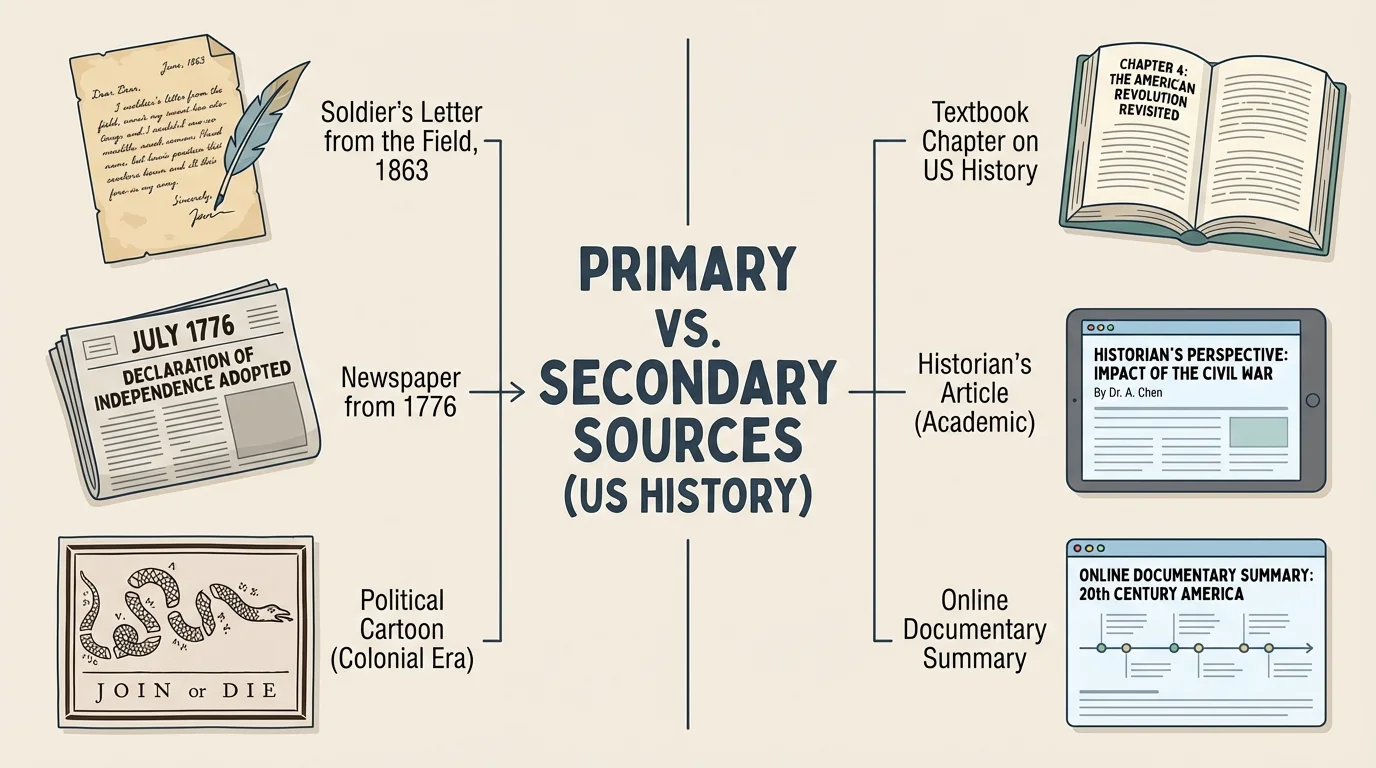
Neither type is automatically better. Primary sources can be powerful because they show what people at the time said, believed, feared, or wanted. But they can also be limited. A Patriot pamphlet from 1775 tells you what one side believed, not necessarily what everyone believed. A secondary source can give broader context, compare many sources, and help explain patterns over time, but it also reflects the historian's choices and interpretation.
Suppose you are studying the Boston Massacre. A primary source might be Paul Revere's engraving, which presents the British soldiers as cruel attackers. A secondary source might explain that Revere's image was also propaganda designed to persuade colonists. Looking at both helps you understand not only what happened, but also how people tried to shape public opinion.
Paul Revere's famous image of the Boston Massacre was based partly on another artist's work and carefully edited to make the event look more one-sided. Historians study details like this to see how images can persuade, not just record.
When using sources, ask: Who created this? When? Why? For whom? What does it include, and what does it leave out? Those questions help you judge how useful the source is for your argument.
History looks very different depending on where you stand. In United States history from the American Revolution through Reconstruction, events affected Patriots, Loyalists, enslaved Africans and African Americans, free Black communities, women, Indigenous nations, immigrants, soldiers, political leaders, and ordinary workers in different ways. The range of perspectives in [Figure 2] reminds us that no single source can tell the whole story.
This is why historians compare sources from multiple perspectives. A Patriot leader might describe the Revolution as a fight for liberty. A Loyalist might see it as rebellion and disorder. An enslaved person might ask whether "liberty" really applied to them. An Indigenous nation might focus on the danger of American settlers moving westward.
During Reconstruction, a formerly enslaved person might describe hope, political participation, and education opportunities, while a white former Confederate might describe resentment and resistance. Northern politicians, Southern Democrats, Black officeholders, and members of the Freedmen's Bureau all experienced the period differently.
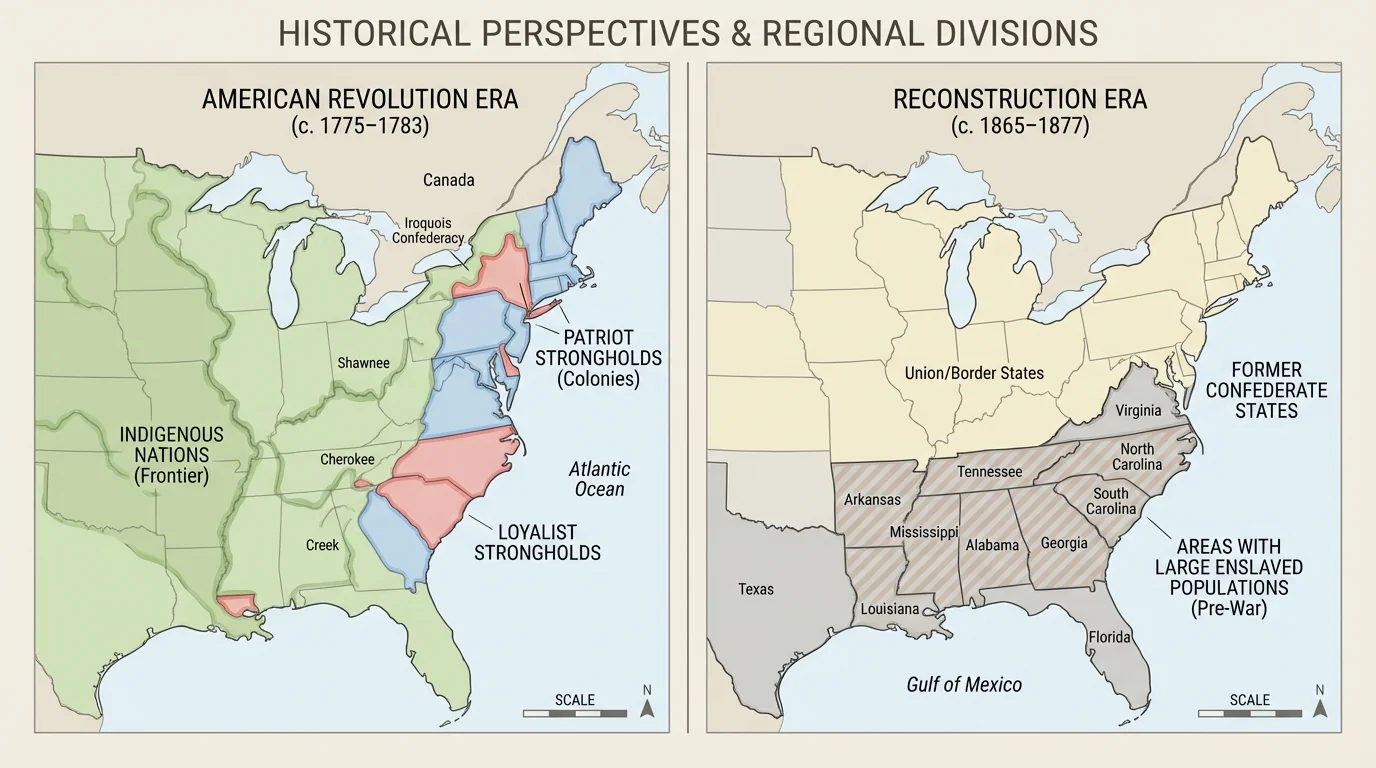
Looking at diverse perspectives does not mean every viewpoint is equally accurate or moral. It means historians test claims by comparing evidence. A source may reveal important beliefs even if those beliefs were unfair, false, or self-serving. For example, a Black Code passed in the South after the Civil War is valuable evidence not because it was just, but because it shows attempts to restrict the freedom of African Americans.
To evaluate perspective, pay attention to point of view, audience, and purpose. A speech given to persuade voters may sound different from a private diary entry. A newspaper backed by a political party may present events differently from a court record or military order.
Sourcing, contextualization, and corroboration help historians evaluate evidence. Sourcing means asking who made a source and why. Contextualization means placing it in its historical setting. Corroboration means comparing it with other sources to see what matches, what conflicts, and what new questions appear.
These habits matter because sources often disagree. Instead of getting frustrated, historians use disagreement as a clue. If two writers describe the same event differently, ask why. Their disagreement may reveal political conflict, social tension, or different experiences of the same moment.
A claim is the backbone of your argument. It should answer the question directly and be detailed enough to guide the rest of your writing. Weak claims are too obvious, too broad, or impossible to prove. Strong claims are focused and arguable.
Compare these examples. "The Civil War was important" is weak because almost no one would disagree, and it is too vague. "The Civil War transformed the United States by ending slavery legally, increasing federal power, and setting the stage for struggles over citizenship during Reconstruction" is much stronger because it names specific effects.
A good claim often includes a line of reasoning. That means it hints at the categories or ideas the essay will use to prove the point. For example, a claim about the American Revolution might focus on political change, social limits, and economic effects. A claim about Reconstruction might focus on legal gains, violent backlash, and the role of federal enforcement.
Evidence should be relevant, which means it directly relates to the claim. If your claim is about whether Reconstruction created lasting change, a quotation from the 14th Amendment is relevant because it addresses citizenship and equal protection. A random fact about colonial trade would not be relevant.
You can use evidence by quoting, paraphrasing, or describing a source. Quoting gives the exact words. Paraphrasing restates the idea in your own words. Describing explains what a visual source, law, or event shows. All three can be effective.
For example, if you are arguing that the Revolution did not bring liberty equally to everyone, you might use the Declaration of Independence's language about equality, then compare it with evidence that slavery continued and women still lacked political rights. The power comes from placing evidence side by side and explaining the contrast.
Using evidence in a body paragraph
Claim: The American Revolution expanded political ideas about liberty, but it did not create equal freedom for all groups.
Step 1: Introduce the evidence.
A writer might begin with the Declaration of Independence, which states that "all men are created equal."
Step 2: Add another source that complicates the first one.
The writer could then mention that slavery continued after independence and that many states still restricted voting to property-owning men.
Step 3: Explain the significance.
The reasoning would show that revolutionary ideals were powerful, but their application was limited, especially for enslaved people, women, and many poor men.
The paragraph becomes stronger because the writer does more than quote famous words; the writer tests those words against historical reality.
Avoid dropping a quotation into your paragraph and moving on. Evidence does not speak for itself. You must tell the reader why it matters.
Corroboration helps you check whether evidence agrees across sources, but even when you have good evidence, your argument needs logic. Logical reasoning explains the connection between source details and your claim.
There are several common types of reasoning in history. Cause and effect shows how one event led to another. Comparison shows similarities and differences between groups or time periods. Change over time explains what changed, what stayed the same, and why. Contextual reasoning explains how conditions of the time shaped events or decisions.
For example, suppose your evidence shows that Black men voted and held office during Reconstruction. That evidence supports a claim about political progress. But if another source shows the rise of violent groups such as the Ku Klux Klan and the passage of restrictive laws, your reasoning might explain that progress was real but constantly threatened. The logic links political gains with the forces that tried to undo them.
Good reasoning often uses words and phrases such as because, therefore, however, this suggests, in contrast, and as a result. These signal to the reader how your ideas connect.
A clear structure helps readers follow your thinking. Even a strong idea can be hard to understand if it is poorly organized.
An effective historical argument usually has an introduction, body paragraphs, and a conclusion. The introduction gives background, presents the question, and states the claim. As [Figure 3] shows, each body paragraph focuses on one reason or category of evidence. The conclusion reinforces the argument by showing what the evidence demonstrates.
Many strong essays also include a counterclaim. A counterclaim is a viewpoint that challenges your own. Addressing it does not weaken your argument. It shows that you understand the complexity of the topic. For example, if you argue that Reconstruction only partly succeeded, you can still recognize that the 13th, 14th, and 15th Amendments created major constitutional changes.
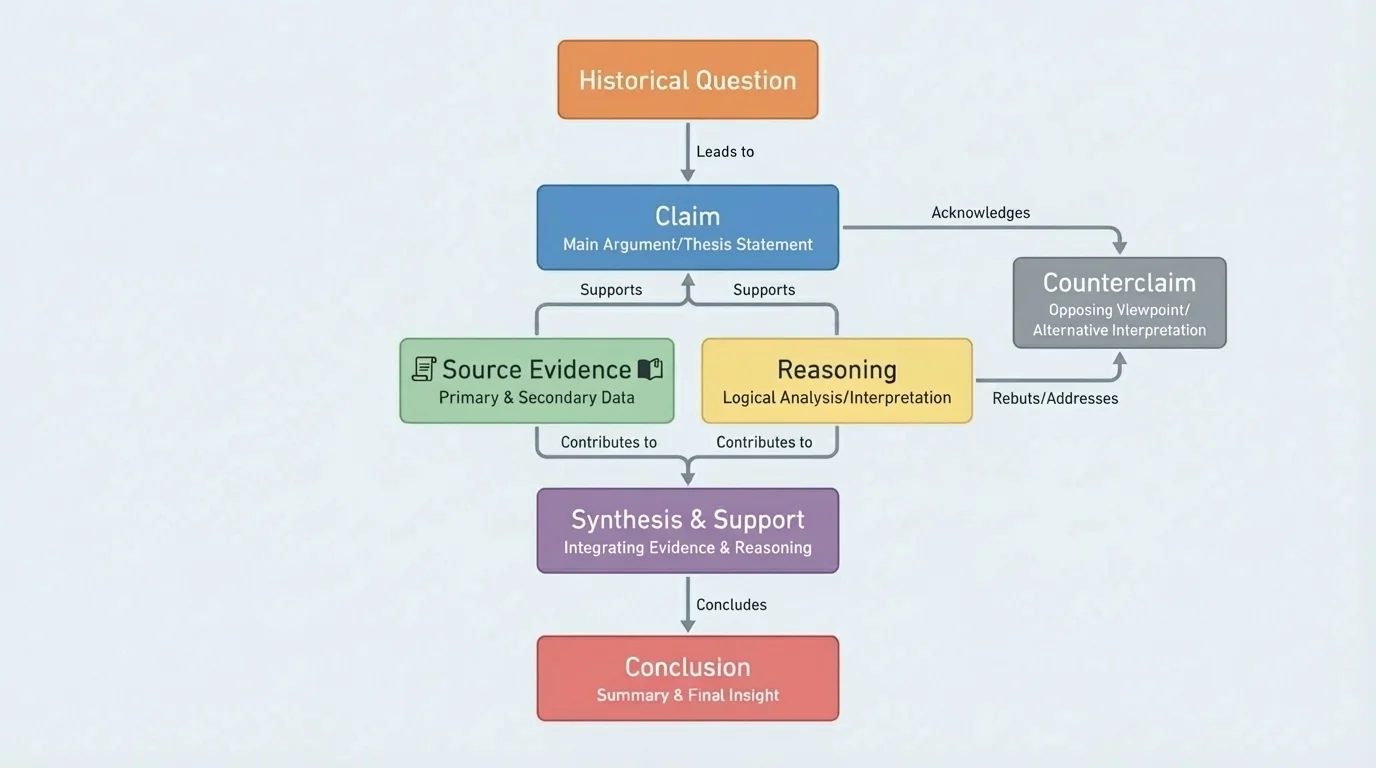
Each body paragraph should usually follow a simple pattern: topic sentence, evidence, reasoning, and transition. That pattern keeps your writing focused. Readers should always be able to tell what point the paragraph is making and how the evidence supports it.
Your evidence can come from both primary and secondary sources. A thoughtful writer combines direct evidence from the period with later analysis to create a fuller argument.
This question is excellent for historical argument because it invites multiple perspectives. A simple answer would miss too much. The Revolution was revolutionary in some ways and limited in others.
A strong claim might say: "The American Revolution was revolutionary in creating a new republic and spreading ideas of liberty and popular government, but it was not fully revolutionary for women, enslaved people, and many Indigenous nations, whose rights and power remained limited or were further threatened."
Evidence for the first part of the claim could include the Declaration of Independence, state constitutions, and the rejection of monarchy. Those sources show major political change. Colonists did not just protest taxes; they created a new system of government based on representation and republican ideas.
Evidence for the second part could include the continued existence of slavery, Abigail Adams's reminder to "remember the ladies," and evidence that westward settlement harmed Indigenous nations. A historian might also use a secondary source to explain how revolutionary language inspired later reform movements even though equality was incomplete at the time.
"Remember the ladies, and be more generous and favorable to them than your ancestors."
— Abigail Adams, 1776
This kind of argument does not force you to choose between "yes" and "no." Instead, it allows you to show that historical change can be real and incomplete at the same time. That is often a sign of mature historical thinking.
Reconstruction is another topic where strong arguments depend on evidence, perspective, and change over time.
As [Figure 4] shows, a possible claim is: "Reconstruction created lasting constitutional changes by abolishing slavery and redefining citizenship, but its promise of equality was weakened by white resistance, violence, and the withdrawal of federal support."
Evidence supporting lasting change includes the 13th Amendment ending slavery, the 14th Amendment establishing birthright citizenship and equal protection, and the 15th Amendment protecting voting rights for men regardless of race. These changes remain part of the Constitution today.
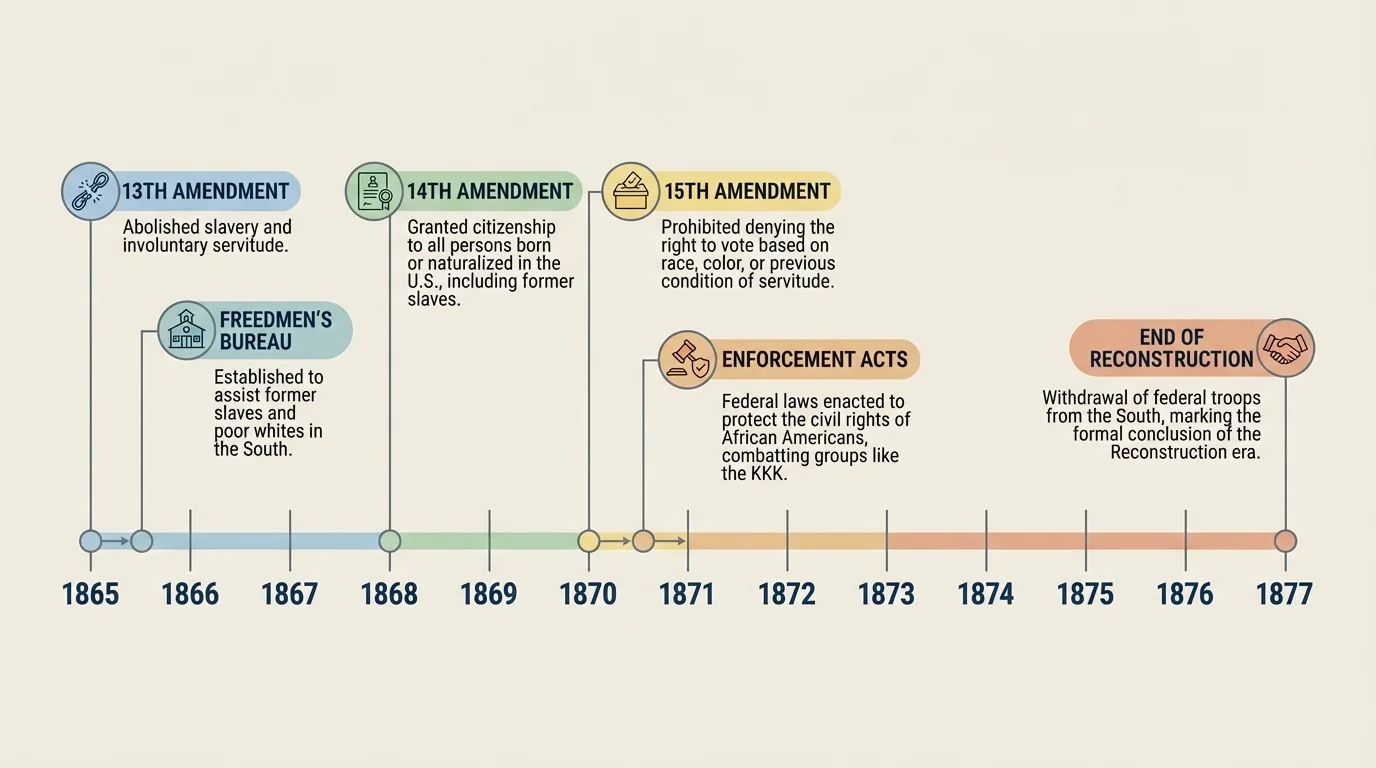
Other evidence reveals the limits of Reconstruction. Black Codes restricted freedom. White supremacist violence terrorized communities. Supreme Court decisions and declining Northern commitment weakened enforcement. The Compromise of 1877 effectively ended Reconstruction, allowing many Southern states to impose segregation and disfranchisement in the years that followed.
Using reasoning, a writer can argue that Reconstruction was neither a total failure nor a complete success. It changed the Constitution and opened a brief period of political participation for African Americans, yet it did not secure equal rights in daily life for the long term. This balanced argument is stronger than an extreme claim that ignores half the evidence.
The geographical and political differences introduced earlier in [Figure 2] also matter here. Reconstruction looked different in different states, and local power struggles shaped how federal laws were carried out.
One common mistake is confusing a topic with a claim. "Reconstruction" is a topic. "Reconstruction created major legal change but failed to protect those gains fully" is a claim. Another mistake is using evidence that is interesting but unrelated. Historical writing is not about collecting random facts; it is about choosing the facts that help prove your point.
A third mistake is summarizing sources without analyzing them. If you write, "The 14th Amendment said people born in the United States are citizens," you have only reported information. If you add, "This supports the claim that Reconstruction reshaped the meaning of citizenship nationwide," then you are reasoning.
A fourth mistake is relying on only one perspective. A stronger argument considers whose voices are present and whose are missing. If your only sources about slavery come from slaveholders, your argument is incomplete. If your only sources about the Revolution come from Patriot leaders, you may miss the experiences of Loyalists, women, or Indigenous peoples.
Remember that good writers in history do not just answer what happened. They also answer why it happened, for whom it mattered, and how we know.
Finally, avoid present-day assumptions. Historians must understand people in their own time. This does not mean excusing injustice. It means using evidence to explain how people thought, what choices they faced, and what conditions shaped their actions.
Strong historical argument writing depends on habits that historians practice constantly. Read closely. Notice words with strong emotion or persuasion. Compare sources. Look for agreement and disagreement. Ask what is missing. Pay attention to when a source was created and what was happening at the time.
When a historian studies whether the Revolution fulfilled its ideals, or whether Reconstruction transformed the nation, the answer does not come from one dramatic quote alone. It comes from carefully examining multiple sources, weighing reliability, and constructing a logical argument.
That is what makes historical writing powerful. It allows you to do more than repeat the past. It allows you to investigate it, question it, and defend your understanding with evidence.
