One dramatic event can produce completely different stories depending on who is speaking. A soldier, a newspaper printer, an enslaved person, a president, and a historian may all describe the same moment in different ways. That is not a problem to avoid; it is the heart of historical thinking. Historians do not simply collect facts like items in a box. They compare voices, weigh evidence, and connect details from many accounts to build a fuller picture of what happened.
When you synthesize historical evidence, you bring together information from different sources and use it to explain the past more clearly. Instead of repeating one document, you combine evidence. This helps you connect individual experiences to the bigger story often told in textbooks, speeches, documentaries, and classrooms.
No single source tells the whole truth about the past. A diary may reveal private feelings, but it shows only one person's experience. A government law tells what leaders wanted to happen, but not always what happened in daily life. A painting may shape public opinion, while a newspaper article may reflect political goals. Historians therefore gather different kinds of evidence and compare them.
This process matters especially in United States history from the American Revolution through Reconstruction. Traditional stories often focus on famous leaders such as George Washington, Thomas Jefferson, Abraham Lincoln, and Ulysses S. Grant. Those people matter, but the nation was also shaped by women, free Black communities, enslaved people, Indigenous nations, immigrants, soldiers, laborers, and children. A stronger historical account includes these voices too.
Primary source means evidence created during the time being studied, such as letters, speeches, laws, newspaper articles, maps, or diaries.
Secondary source means a later interpretation or analysis of the past, such as a textbook, documentary, biography, or scholarly article.
Traditional historical narrative means the common story often told about an event or era, usually focusing on major events, political leaders, and broad turning points.
Using multiple sources does not mean all sources are equally accurate. It means each source can contribute something important. One source may reveal facts, another may reveal motive, and another may reveal what was left out.
A primary source from the American Revolution might be Thomas Paine's pamphlet Common Sense, a soldier's letter from Valley Forge, or the Declaration of Independence. A secondary source might be a modern book explaining how revolutionary ideas spread through the colonies. Both are useful, but they do different jobs.
Primary sources place us close to the historical moment. They show the language, beliefs, fears, and hopes of the time. Secondary sources help organize many pieces of evidence and explain patterns over time. Historians often begin with primary sources and then compare them with secondary interpretations.
Consider a simple example. If you want to understand the Battle of Yorktown, a letter from a Continental soldier can tell you about food shortages, weather, and morale. A modern historian can explain why the French alliance was decisive and how Yorktown fit into global conflict. When combined, those sources connect personal experience to larger history.
Some of the most important evidence in U.S. history comes from ordinary people whose names are not widely remembered. A short diary entry or a local petition can challenge what a famous speech seems to suggest.
That is one reason historians search for perspective. Perspective means the position, background, and interests that shape how a person sees events. A Patriot printer, a Loyalist merchant, and a member of an Indigenous nation might all describe the Revolution differently because they experienced it differently.
The traditional historical narrative often presents history as a sequence of major events led by important political figures. For example, a common narrative of the Revolution may move from taxation, to protest, to war, to independence. A common narrative of the Civil War may move from sectional conflict, to secession, to war, to emancipation, to Reconstruction.
These narratives are useful because they give structure. They help us understand chronology, cause and effect, and turning points. But if the narrative is too narrow, it can make history seem simple and complete when it is actually complex and contested.
A strong historian does not throw away the traditional narrative. Instead, the historian tests it, expands it, and sometimes corrects it. For example, the traditional narrative may say the Revolution was a fight for liberty. Synthesizing many sources may reveal a harder truth: some colonists demanded liberty while also denying freedom to enslaved people. Both ideas belong in the historical account.
Historians move through a series of connected steps when building understanding from many sources, and the process in [Figure 1] shows how each step leads to the next. They identify the source type, place it in context, examine perspective, compare it with other evidence, and then build a claim that fits the larger historical narrative.
First, identify the source. Ask who created it, when, where, and for what audience. Second, place it in context. What was happening at that time? Third, study the creator's point of view. What goals or limits shaped the source? Fourth, compare it to other sources. What details match, and what details conflict? Fifth, connect those findings to the broader story of the era.
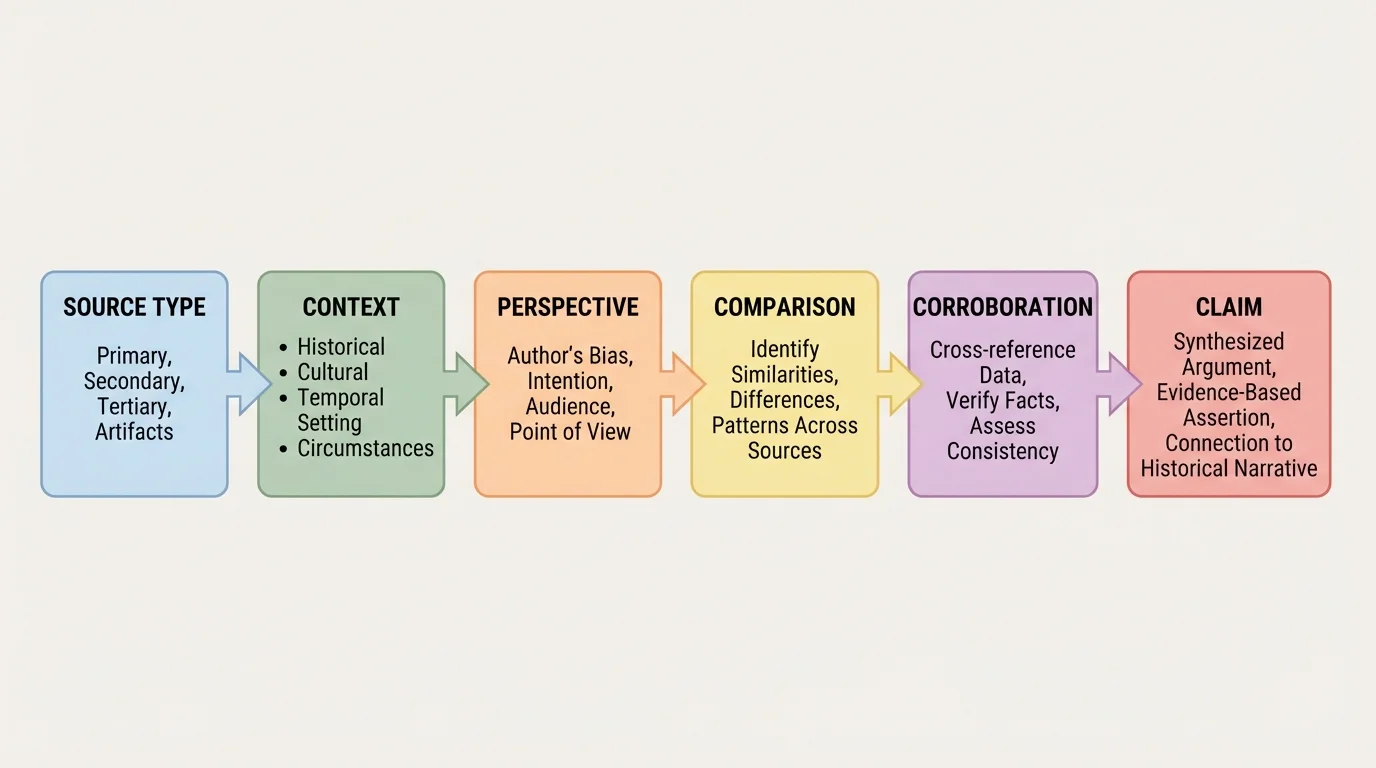
Another important idea is corroboration. Corroboration means checking whether information in one source is supported, challenged, or complicated by another source. If several independent sources agree on a basic fact, confidence in that fact grows. If they disagree, the disagreement itself becomes important evidence.
This does not mean that historians always reach one perfect answer. Instead, they build the strongest possible explanation from the available evidence. Later historians may discover new sources and revise earlier conclusions. History is not guessing; it is reasoned interpretation based on evidence.
Synthesis is more than summary
Summary tells what one source says. Synthesis explains how several sources work together. A student who summarizes might say, "This speech argues for independence." A student who synthesizes might say, "This speech argues for independence, but when compared with letters from soldiers and petitions from free Black colonists, it becomes clear that ideas about liberty spread unevenly and meant different things to different groups."
As you continue reading, notice that synthesis often reveals both agreement and tension. Those tensions are not mistakes. They are clues.
The Boston Massacre is a powerful example because the comparison in [Figure 2] reveals how the same event can be framed in sharply different ways. On March 5, 1770, British soldiers fired into a crowd in Boston, killing five colonists. In a traditional narrative, this event often appears as clear proof of British oppression and colonial resistance.
That interpretation has support, but synthesis shows a more complicated picture. Paul Revere's famous engraving pictured disciplined British soldiers firing at defenseless colonists. It was persuasive propaganda. Captain Thomas Preston's testimony defended the soldiers and suggested the crowd was threatening. Witness statements differed in important details about noise, confusion, snowballs, clubs, and who gave orders.
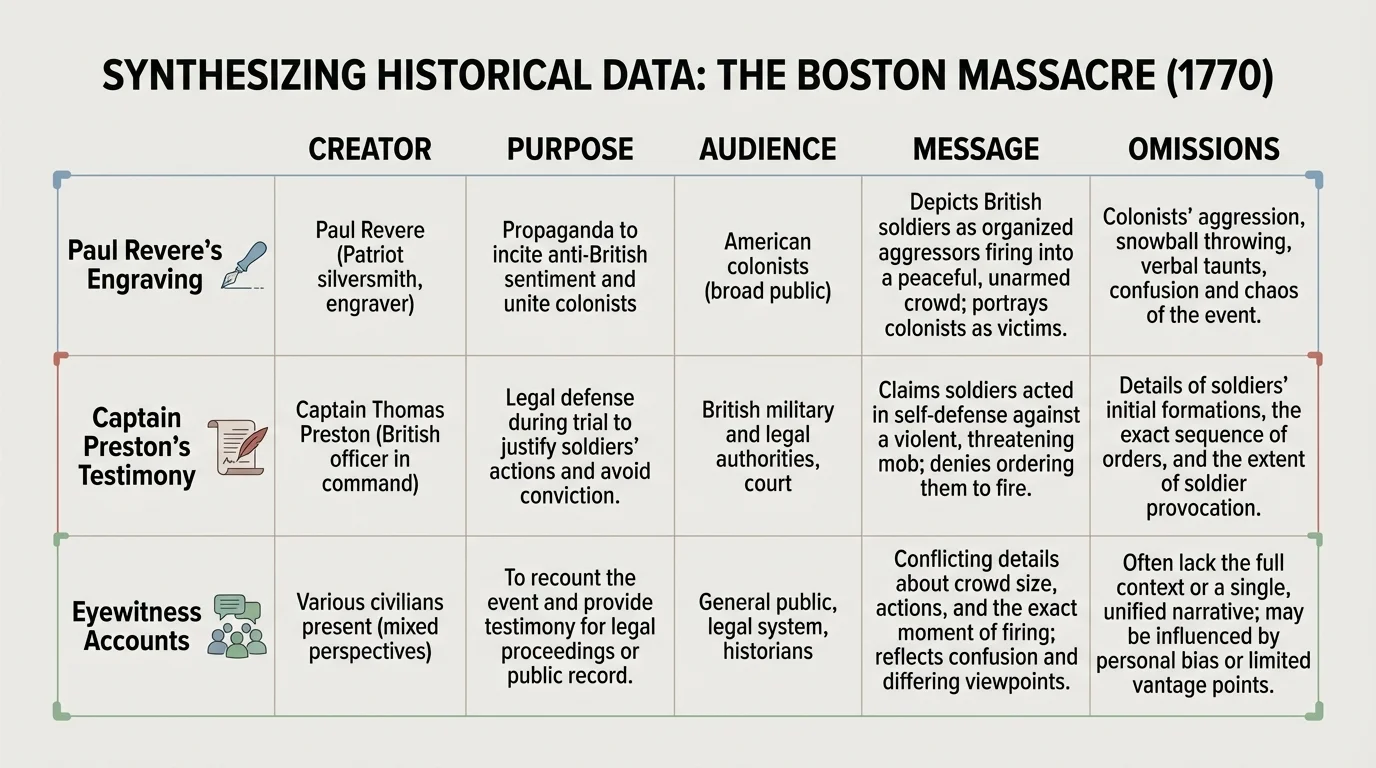
When historians synthesize these sources, they do not simply choose one and ignore the others. They ask why Revere's image spread so effectively, how Patriot leaders used the event politically, and what ordinary witnesses actually saw. The result is a stronger interpretation: the Boston Massacre became a symbol because Patriot leaders shaped public memory, even though the event itself was chaotic and contested.
This matters because the traditional narrative often remembers symbols more clearly than uncertainty. By comparing image, testimony, and eyewitness evidence, historians connect street-level conflict in Boston to the larger revolutionary movement. Later, when students study propaganda in other eras, the lesson of this comparison still applies: the most memorable source is not always the most complete one.
The Declaration of Independence states that "all men are created equal" and have rights to "life, liberty, and the pursuit of happiness." In the traditional narrative, this document stands as a founding statement of American ideals. It deserves that place. But synthesis requires more than admiration. It requires comparison.
To deepen understanding, historians place the Declaration beside plantation records, runaway advertisements, petitions by free Black Americans, and later speeches by abolitionists. These sources reveal a major contradiction: the nation announced universal ideals while slavery continued and expanded.
When you connect these sources, the traditional narrative changes. Independence remains important, but it is no longer a simple story of liberty achieved for everyone at once. Instead, it becomes a story of ideals that inspired people while also exposing the nation's failures. Enslaved people heard the language of liberty and measured American actions against American words.
Case study claim built through synthesis
A historian wants to answer the question: How can the Declaration of Independence be both inspiring and limited?
Step 1: Use the Declaration as evidence of revolutionary ideals.
The document announces equality and natural rights, showing what many leaders said the new nation stood for.
Step 2: Compare it with sources about slavery.
Sale notices, laws, and plantation records show that many people remained enslaved despite those ideals.
Step 3: Add voices responding to the contradiction.
Petitions and later antislavery writings show that Black Americans and reformers used the nation's own language of liberty to demand change.
Step 4: Form a claim.
The Declaration created a powerful national ideal, but multiple sources show that its promise was not fully applied, making it both a statement of hope and a record of contradiction.
This kind of synthesis helps explain why the Revolution matters long after the war ended. Documents can shape future struggles, even when they fail to solve the problems of their own time.
To understand the Civil War and Reconstruction, historians must connect battles, laws, speeches, and personal experiences across time, and the sequence in [Figure 3] helps show how military events, emancipation, and citizenship struggles fit together. A narrow narrative might focus only on generals and battlefields. A wider one includes the destruction of slavery and the fight over the meaning of freedom.
Sources from this era include Abraham Lincoln's speeches, the Emancipation Proclamation, soldiers' letters, the 13th, 14th, and 15th Amendments, testimonies from formerly enslaved people, Black newspaper articles, and records of white supremacist violence. Secondary historians then examine how these pieces fit together.
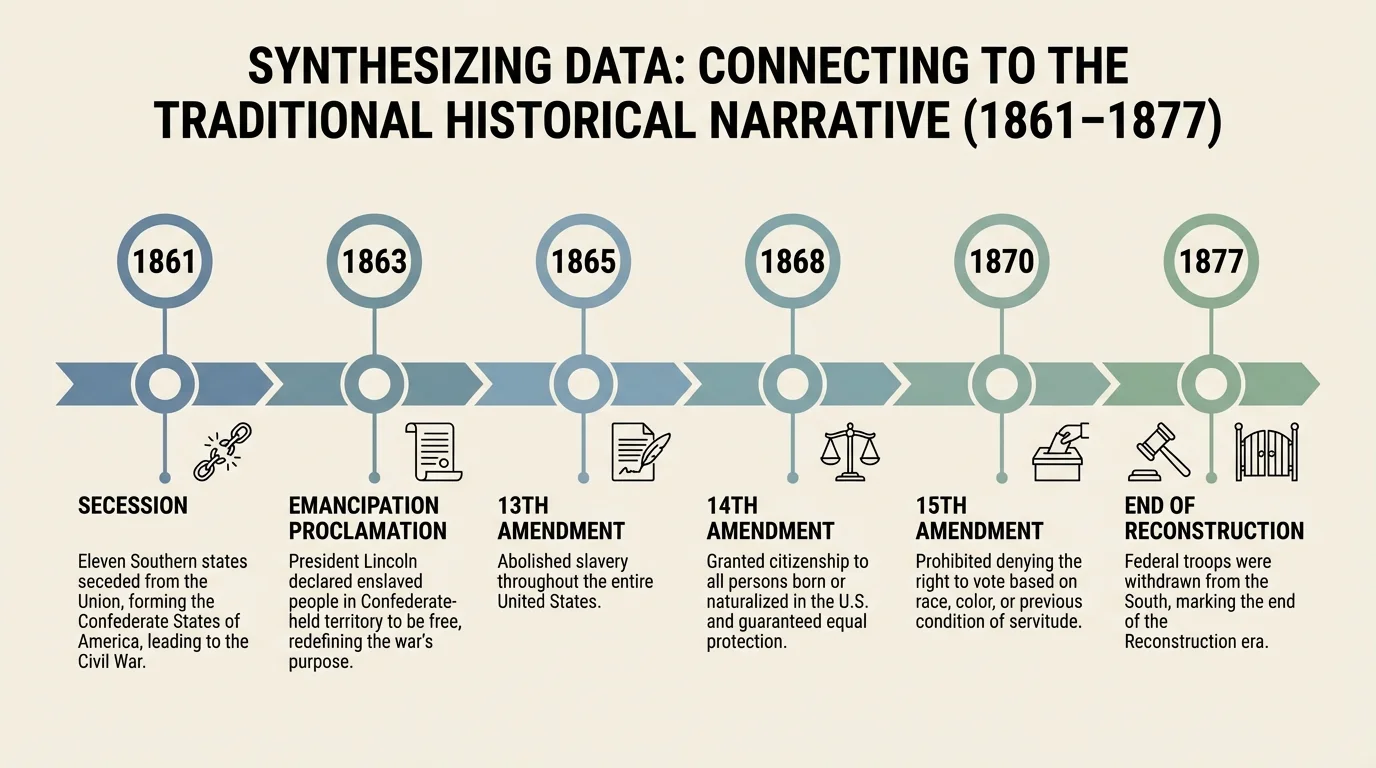
If you synthesize these sources, a richer narrative appears. The Civil War was not only a struggle to preserve the Union. It became a war that destroyed slavery. Reconstruction was not only a period of rebuilding in the South. It was also a major contest over citizenship, voting rights, labor, education, and racial equality.
For example, the 13th Amendment legally ended slavery, but labor contracts and Black Codes show that freedom was still being restricted. The 14th Amendment promised citizenship and equal protection, but reports of violence reveal how fiercely those rights were resisted. The 15th Amendment protected voting rights for men regardless of race, yet intimidation and discrimination limited participation. This sequence shows that each legal milestone connects to a new struggle rather than to an automatic victory.
| Source | What it helps explain | What synthesis adds |
|---|---|---|
| Emancipation Proclamation | War aims and freedom policy | Shows that emancipation was tied to military strategy and changing national purpose |
| Freedmen's Bureau records | Education, labor, and family reunification | Connects freedom to daily life after slavery |
| Amendments 13, 14, 15 | Legal changes | Shows how rights expanded in law |
| Testimonies about violence | Resistance to change | Shows why legal rights were difficult to enforce |
| Modern historical analysis | Long-term interpretation | Connects short-term events to the unfinished struggle for equality |
Table 1. Sources for understanding how the Civil War and Reconstruction changed the meaning of freedom and citizenship.
Through synthesis, historians connect official documents to lived experience. Without that connection, the era can look more complete and successful than it really was.
"What to the Slave is the Fourth of July?"
— Frederick Douglass, challenging Americans to compare national ideals with national actions
Douglass's question remains powerful because it pushes readers to compare patriotic language with evidence from real lives. That is exactly what synthesis asks us to do.
A source can be biased and still be useful. Bias means a tendency to favor one side, interpretation, or group. Almost every historical source contains some bias because every human being writes from a point of view. The goal is not to find bias-free sources. The goal is to understand bias and account for it.
Suppose a newspaper in the 1850s strongly supported slavery or strongly opposed it. That newspaper may still provide valuable evidence, but historians must ask what political purpose shaped its language. The same is true for campaign speeches, military reports, and memoirs written years later.
Reliability depends on several questions: Was the creator in a position to know the information? Was the account produced close to the event or much later? Did the creator have reason to exaggerate or hide details? Do other sources support the claim? A memoir written decades after a battle may capture memory vividly but confuse some facts. A military report may provide dates and troop movement yet hide mistakes.
Remember that historical evidence works best when it is both specific and contextualized. A quotation alone is not enough; you must explain who said it, why, and how it connects to other evidence.
This is where corroboration becomes powerful. If a government law, a private letter, and a newspaper report all point toward the same pattern, that pattern becomes more convincing. If the sources disagree, historians investigate why. Sometimes disagreement reveals regional differences, class conflict, propaganda, or changing memory over time.
A strong historical claim is a clear argument that can be defended with evidence. It is not just an opinion. It answers a question and can be tested against sources. For example, instead of saying "Reconstruction was good," a stronger claim would be, "Reconstruction made major legal advances in freedom and citizenship, but multiple sources show that violent resistance prevented those rights from being fully protected."
Notice what makes that claim strong. It is specific. It includes complexity. It points toward more than one kind of evidence. It also connects details to the larger narrative of U.S. history.
Turning source notes into a defensible claim
Question: Was the American Revolution only a fight against Britain?
Step 1: Gather evidence from different sources.
Use pamphlets about taxation, soldiers' letters, petitions from free Black colonists, and accounts from Indigenous nations.
Step 2: Identify patterns and tensions.
Some colonists emphasized representation and liberty, while other groups experienced the Revolution as danger, exclusion, or opportunity.
Step 3: Connect to the larger narrative.
The Revolution was a war for independence, but it was also a struggle over who belonged, who had rights, and who would gain power in the new nation.
Step 4: Write the claim.
The American Revolution was not only a colonial rebellion against Britain; when multiple perspectives are synthesized, it also appears as a conflict that reshaped rights and power differently for different groups.
That claim does not abandon the traditional narrative. It deepens it. It takes the familiar story and makes it more accurate.
One common mistake is summary without connection. A student may describe Source A, then Source B, then Source C, but never explain how they relate. Another mistake is cherry-picking, which means selecting only the evidence that supports a preferred answer while ignoring evidence that complicates it.
A third mistake is assuming that famous sources are automatically the most important. A presidential speech may be influential, but a letter from an ordinary person can reveal daily realities that official language hides. A fourth mistake is treating disagreement among sources as failure. In history, disagreement often reveals the real issue: conflict over meaning, memory, and power.
Good synthesis asks: What does each source contribute? Where do the sources overlap? Where do they conflict? How does this evidence support, challenge, or expand the usual story of the period?
Connecting source details to narrative
The best historical writing moves back and forth between close evidence and big interpretation. It might zoom in on one letter, one law, or one image, then zoom out to explain what that detail reveals about the Revolution, slavery, the Civil War, or Reconstruction as a whole.
That movement between detail and big picture is what makes historical thinking powerful. It lets us understand not only what happened, but also how people understood their own world and how later generations remembered it.
