One of the most surprising things about United States history is this: the nation was founded on ideas of liberty while millions of people were denied liberty at the same time. To understand that contradiction, historians look at context—the conditions, beliefs, conflicts, and goals that shaped people's actions. From the years before the American Revolution to the end of Reconstruction, people argued over power, rights, land, labor, and citizenship. Those arguments did not affect everyone in the same way.
Historical context means the background surrounding an event: what had happened before, what people believed, what problems they faced, and what choices seemed possible at the time. It helps us avoid judging the past too simply. For example, when colonists protested British taxes, some saw themselves defending freedom, while others saw them as breaking lawful order.
Another important idea is perspective. A Patriot in Boston, a member of Parliament in London, an enslaved African American in Virginia, and an Indigenous leader in the Ohio Valley could all witness the same event and understand it differently. Historians learn from both primary sources, which come from the time being studied, and secondary sources, which are later interpretations by historians.
Primary source means a document, image, speech, law, or object created during the time being studied. Secondary source means a later explanation or interpretation based on evidence from the past.
A letter from Abigail Adams, the Declaration of Independence, Frederick Douglass's speeches, and newspaper editorials from the Civil War era are all examples of primary sources. A modern history textbook or documentary is a secondary source. Both kinds of sources matter, but they must be read carefully because every source reflects a point of view.
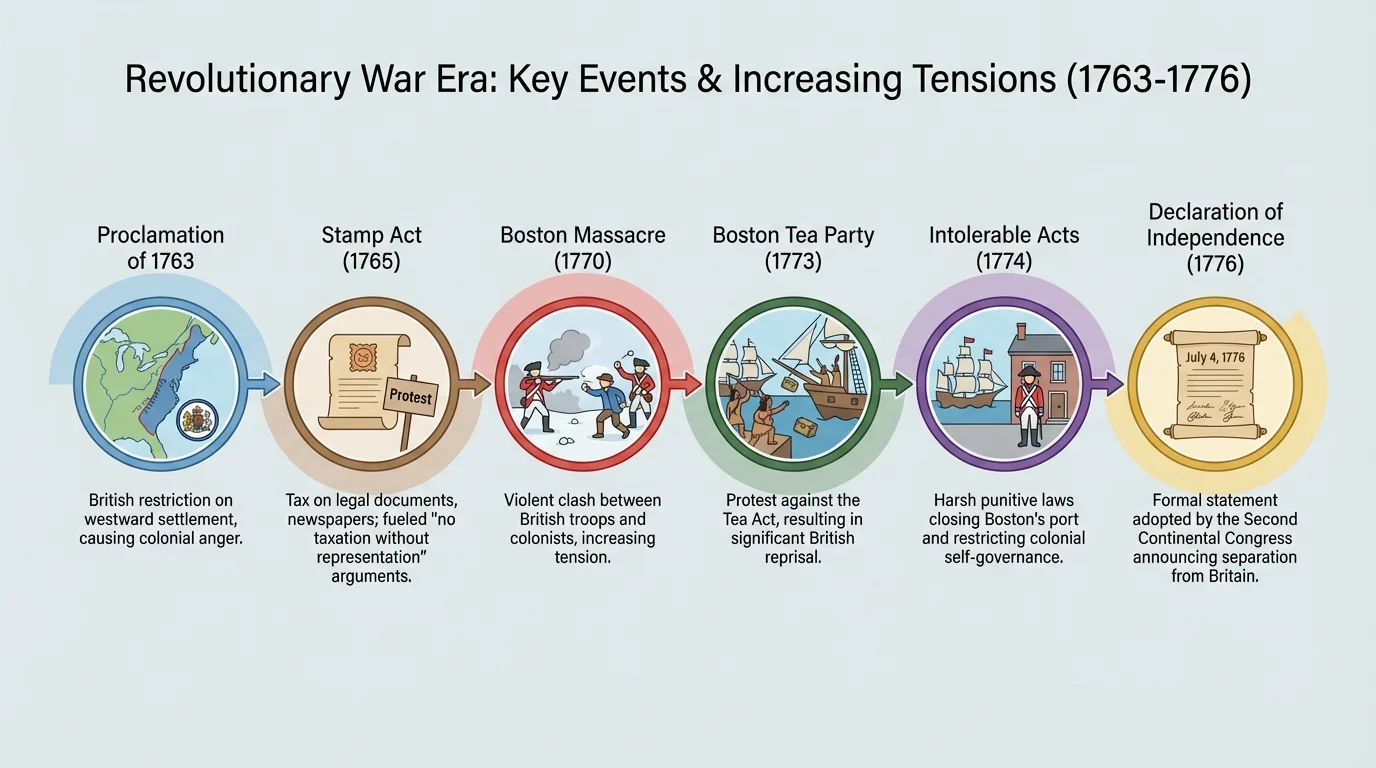
[Figure 1] shows how tensions between Britain and its North American colonies, which had been building for years by the 1760s, turned frustration into open resistance through a sequence of new policies and colonial reactions. Britain had just fought the French and Indian War, which left it deeply in debt. British leaders believed the colonies should help pay for defense and administration.
Many colonists objected to new taxes and controls. Their complaints, often called colonial grievances, included the Stamp Act, taxes on printed materials; the Townshend Acts, which taxed imported goods; and the Tea Act, which led to the Boston Tea Party. Colonists also protested the presence of British soldiers and the idea of taxation without representation in Parliament. They argued that English subjects should not be taxed by a legislature in which they had no elected representatives.
British officials saw the issue differently. Parliament claimed it had the right to govern the empire and that colonists benefited from British protection. Many in Britain believed the colonists were refusing to share the costs of empire. This clash was not simply about money; it was about who had the authority to rule.
Not all colonists wanted independence. Loyalists remained loyal to Britain for many reasons. Some feared chaos, some had business ties to Britain, and some believed rebellion was dangerous or immoral. Patriots, by contrast, argued that British actions violated their rights. This difference reminds us that "the colonists" were never one single united group.
Indigenous nations also viewed the growing conflict through their own interests. After the Proclamation of 1763, Britain tried to limit colonial settlement west of the Appalachian Mountains. Many colonists hated this rule because they wanted western land. But for many Indigenous peoples, colonial settlement threatened homelands, hunting grounds, and political independence. In that sense, some British policies that angered colonists seemed less harmful to Indigenous nations than colonial expansion itself.
"No taxation without representation."
— Common Patriot argument in the years before the Revolution
The Declaration of Independence in 1776 listed complaints against King George III and announced that the colonies were free and independent states. It expressed powerful ideas about natural rights and government by consent. Yet even this famous document reflected limits. It spoke of equality in broad terms, but many people in the new nation remained excluded from political power.
The American Revolution was both a military conflict and a battle over ideas. Key figures included George Washington, who led the Continental Army; Thomas Jefferson, a principal author of the Declaration; Benjamin Franklin, who helped gain French support; and King George III, the British monarch whom Patriots blamed for oppression. Important events included Lexington and Concord, Saratoga, Valley Forge, and Yorktown.
But the meaning of freedom was not the same for everyone. For many Patriots, freedom meant self-government and protection from tyranny. For many Loyalists, freedom meant order under lawful rule. For enslaved African Americans, freedom often meant literal escape from slavery. During the war, both the British and the Americans made promises to Black people, though those promises were uneven and often broken.
In 1775, Lord Dunmore, the royal governor of Virginia, offered freedom to enslaved men who escaped Patriot owners and joined the British side. Thousands sought that chance. Others served the Patriot cause, hoping that revolutionary ideals would lead to greater liberty. These choices show how African Americans used the conflict to pursue survival and freedom in a society built on slavery.
Women also played important roles. Some managed farms and businesses while men were away at war. Others produced goods, carried information, or followed armies as workers and caregivers. Abigail Adams famously urged her husband John Adams to "remember the ladies," reminding us that revolutionary talk about rights raised questions far beyond independence from Britain.
Some Indigenous nations tried to stay neutral during the Revolution, but neutrality was difficult. The war spread across their lands, and both Britain and the United States wanted Native alliances.
For many Native communities, the Revolution was a disaster. Different nations chose different sides based on strategy, geography, and prior relationships. Many supported Britain because they believed a British victory might slow colonial settlement. After the United States won independence, however, western settlement increased. The new republic's freedom often came at the expense of Indigenous lands.
[Figure 2] outlines the shift from a loose alliance of states to a stronger national system. Winning independence did not solve the problem of how to govern a new nation, and this shift grew out of serious weaknesses in the first plan of government. The Articles of Confederation created a weak central government with no president and no power to tax directly. Many Americans feared strong central authority because they associated it with British oppression.
Over time, the Articles proved too weak to handle national problems. Congress struggled to raise money, regulate trade, or respond effectively to unrest such as Shays' Rebellion, an uprising by farmers in Massachusetts in 1786–1787. Leaders worried that the young nation might fall apart.
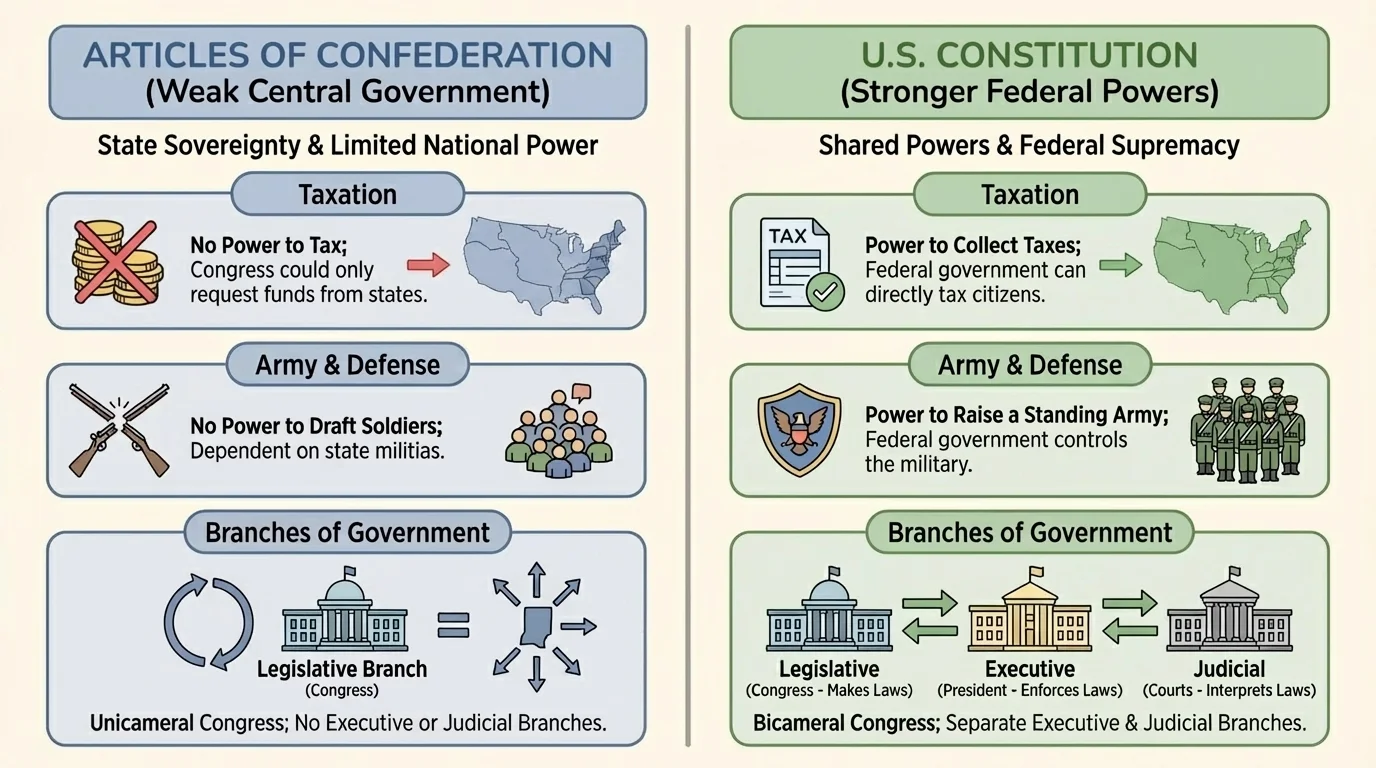
In 1787, delegates met at the Constitutional Convention in Philadelphia. Officially, they were supposed to revise the Articles, but instead they created a new Constitution. The new system included three branches of government—legislative, executive, and judicial—with checks and balances meant to prevent any one branch from becoming too powerful.
The Convention involved major disagreements and compromises. Large states and small states argued over representation, leading to the Great Compromise, which created a two-house Congress. Delegates also argued over slavery. The Three-Fifths Compromise counted enslaved people as three-fifths of a person for representation and taxation, even though enslaved people had no political rights. This compromise increased the political power of slaveholding states and revealed how deeply slavery was built into the nation's system.
Debate continued during ratification. Federalists supported the Constitution because they wanted a stronger national government. Anti-Federalists feared that the new government might threaten liberty. Their pressure helped lead to the Bill of Rights, the first ten amendments, which protected freedoms such as speech, religion, press, assembly, and due process.
Reading different perspectives at the Convention
A historian comparing views at the Constitutional Convention might examine speeches, notes, and letters.
Step 1: Identify the problem.
The nation under the Articles could not tax effectively and could not easily solve disputes between states.
Step 2: Compare priorities.
Federalists want stronger national power. Anti-Federalists want stronger protections for individual rights and state authority.
Step 3: Examine who benefits and who does not.
The Constitution creates a stronger government, but compromises over slavery protect the interests of slaveholders more than the rights of enslaved people.
As we can also see from the comparison in [Figure 2], the Constitution was not simply an improvement in efficiency. It was a political decision about where power should be located and whose interests would be protected.
After the Constitution took effect, the United States expanded in size and power, but this growth intensified old conflicts. The new nation faced questions about banking, foreign policy, and federal power under leaders such as George Washington, Alexander Hamilton, Thomas Jefferson, and James Madison. At the same time, expansion westward increased pressure on Indigenous nations.
The Louisiana Purchase in 1803 doubled the size of the United States, and later settlement pushed farther west. For settlers and many politicians, expansion represented opportunity. For Indigenous peoples, it often meant forced removal, broken treaties, warfare, and loss of sovereignty. The policy of Indian Removal reached a brutal peak in the 1830s under President Andrew Jackson. The Cherokee and other southeastern nations were forced west along routes remembered as the Trail of Tears.
Meanwhile, the economy was changing. The North became more industrial and urban, while the South relied increasingly on plantation agriculture and enslaved labor, especially after the invention of the cotton gin made cotton production more profitable. This difference helped create sectionalism, a strong loyalty to one region's interests rather than to the nation as a whole.
As new states entered the Union, Americans argued over whether slavery would expand into western territories. These debates mattered because the balance of power in Congress affected national policy. The Missouri Compromise, Compromise of 1850, and Kansas-Nebraska Act were attempts to manage the issue, but each compromise also showed how explosive the conflict had become.
The movement to end slavery grew stronger in the first half of the 1800s. Abolitionists were people who demanded an end to slavery, though they did not all agree on strategy. Some believed in gradual emancipation, while others called for immediate abolition. Their arguments were moral, political, religious, and economic.
Important abolitionist figures included William Lloyd Garrison, who published The Liberator; Frederick Douglass, who escaped slavery and became a powerful speaker and writer; Harriet Tubman, who helped enslaved people escape through the Underground Railroad; Sojourner Truth, who linked abolition and women's rights; and Harriet Beecher Stowe, whose novel Uncle Tom's Cabin influenced public opinion in the North.
Free Black communities played a vital role in the abolitionist movement. Black churches, newspapers, speakers, and mutual aid networks helped organize resistance and spread information. Enslaved people also resisted slavery directly through work slowdowns, sabotage, preserving family ties, learning secretly, escaping, and sometimes rebelling. Their actions mattered because they were not passive victims waiting for others to save them.
Why abolitionism was controversial
Abolitionists challenged not only slavery but also the political and economic systems that protected it. Many white Northerners who disliked slavery still opposed abolitionists because they feared social change, sectional conflict, or racial equality. In the South, abolitionist ideas were seen as a direct threat to wealth and power.
Slaveholders and many Southern politicians defended slavery as necessary for the economy and, increasingly, as a "positive good." They argued that cotton exports enriched the nation and claimed that slavery was protected by the Constitution. These arguments ignored the violence and human suffering at the center of the system. Reading speeches by Douglass next to pro-slavery speeches from Southern leaders shows how sharply Americans disagreed over the meaning of liberty and human rights.
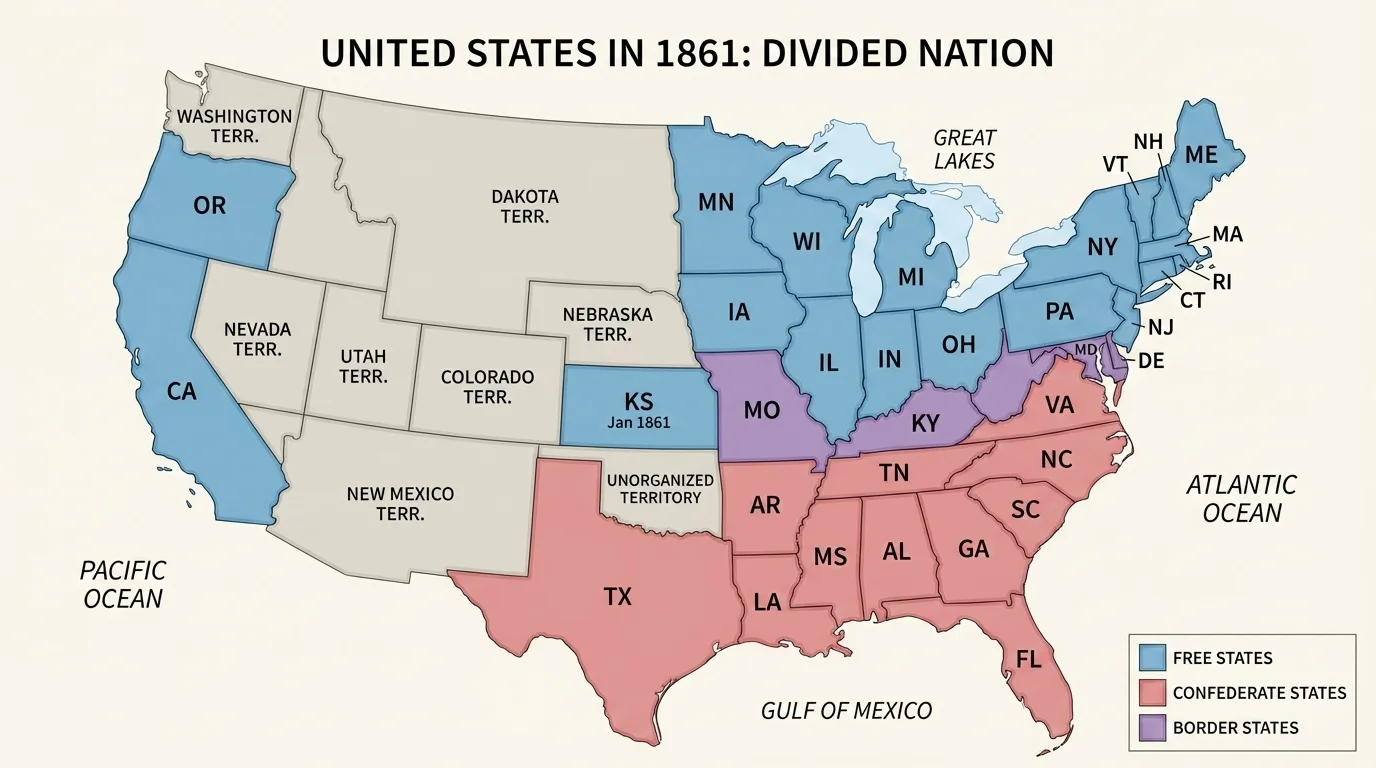
[Figure 3] shows the geographic divide in 1861, when the United States had split into regions with sharply different labor systems, political goals, and visions of the future. The long-term cause of the Civil War was slavery, especially the fight over whether slavery would expand into western territories. Sectionalism, states' rights arguments, and economic differences were important, but they were deeply tied to slavery.
Several major events pushed the nation closer to war. The Kansas-Nebraska Act led to violence in "Bleeding Kansas." The Supreme Court's Dred Scott decision said that African Americans were not citizens and that Congress could not ban slavery in the territories. John Brown's raid on Harpers Ferry frightened many white Southerners. Then Abraham Lincoln won the election of 1860 without carrying most Southern states.
Southern leaders feared that Lincoln's presidency threatened slavery, even though he initially focused on preventing its expansion rather than abolishing it where it already existed. After his election, Southern states began to secede from the Union and formed the Confederate States of America. They stated clearly in secession documents that the protection of slavery was a central reason.
The war began in 1861 at Fort Sumter. Key figures included Abraham Lincoln, Jefferson Davis, Ulysses S. Grant, and Robert E. Lee. Major turning points included Antietam, Gettysburg, and Vicksburg. The Union had advantages in industry, railroads, and population, while the Confederacy fought mainly on familiar territory and hoped to wear down Northern will.
The war changed over time. At first, Lincoln's main goal was preserving the Union. But the conflict increasingly became a war against slavery. The Emancipation Proclamation in 1863 declared freedom for enslaved people in areas rebelling against the Union. It did not immediately free all enslaved people, but it transformed the war's meaning and allowed African American men to serve in the Union military in large numbers.
Black soldiers made major contributions to Union victory. About 180,000 African American men served in the Union Army and many more in the Navy. They fought bravely despite lower pay at first, discrimination, and extreme danger if captured by Confederate forces. Their service strengthened both the Union war effort and the case for citizenship.
When historians explain the Civil War, they separate causes from triggers. A long-term cause develops over many years, while a trigger is an event that helps set the conflict off. Slavery was the central long-term cause; secession and the attack on Fort Sumter were immediate triggers.
The effects of the Civil War were enormous. The Union was preserved. Slavery was destroyed with the 13th Amendment. More than 600,000 people died, and much of the South was devastated. The war also increased the power of the federal government and raised urgent questions about freedom, equality, and citizenship that Reconstruction would try to answer.
[Figure 4] highlights the major turning points of Reconstruction, the period after the Civil War. From 1865 to 1877, the United States tried to rebuild the South and define the rights of formerly enslaved people. The central question was whether freedom would include land, safety, voting rights, education, and equal protection under the law.
The Freedmen's Bureau helped some formerly enslaved people by supporting schools, labor contracts, and aid. The 14th Amendment established birthright citizenship and equal protection of the laws. The 15th Amendment said states could not deny the right to vote based on race. During Reconstruction, African American men voted, held office, helped write state constitutions, and built institutions such as churches and schools.
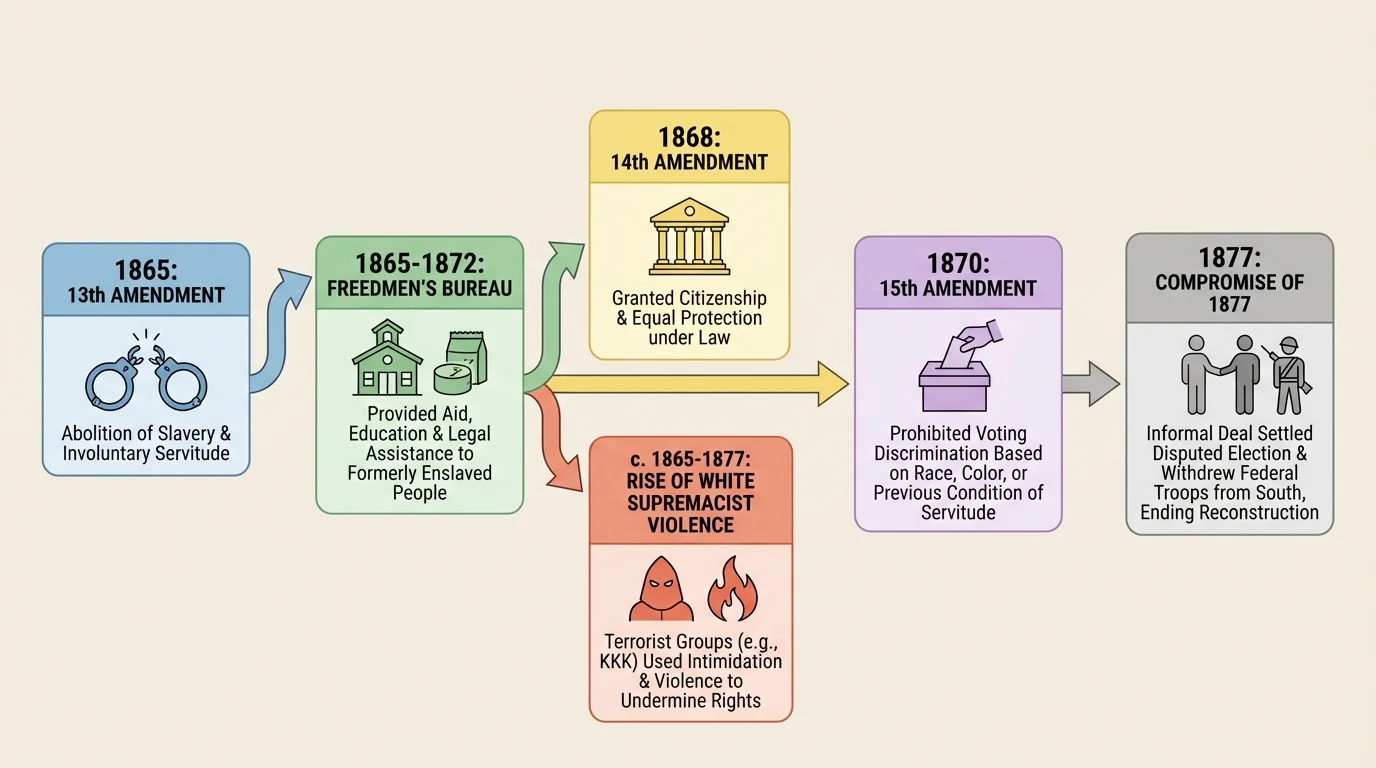
These were major achievements, but Reconstruction also faced fierce resistance. White supremacist groups such as the Ku Klux Klan used terror and violence to attack Black citizens and their allies. Many Southern states passed Black Codes to limit African American freedom and keep labor under white control. Even in the North, support for Reconstruction weakened over time.
By the late 1870s, political compromise and declining Northern commitment helped end Reconstruction. Federal troops withdrew from the South in 1877. After that, white Southern governments imposed segregation, voter suppression, and unequal laws that lasted for generations. This failure shows that changing laws is not always enough to change society.
When we look back at the sequence in [Figure 4], Reconstruction stands out as both a breakthrough and a missed opportunity. The amendments created a constitutional foundation for later civil rights struggles, but the nation did not fully protect those rights in the nineteenth century.
From the Revolution through Reconstruction, different groups experienced the same era in sharply different ways. Patriots celebrated independence, but Loyalists often lost property and status. The Constitution created a stronger government, but its compromises protected slavery. Westward growth brought opportunity for settlers but dispossession for Indigenous nations. The Civil War ended slavery, but freedom after the war remained contested.
That is why historians compare perspectives. A speech by Patrick Henry, a Cherokee petition, a plantation ledger, a runaway slave advertisement, the secession declarations of Southern states, and a memoir by Frederick Douglass all reveal different pieces of the same national story. No single source tells everything. Historical understanding grows when we ask who created a source, what they wanted, and whose voices are missing.
| Group | Major goals or concerns | How events affected them |
|---|---|---|
| Patriots | Self-government, resistance to British control | Won independence but disagreed over how to govern |
| Loyalists | Order, loyalty to Britain, fear of rebellion | Many faced exile, loss of property, or suspicion |
| Indigenous peoples | Protect land, sovereignty, and community survival | Faced growing settlement, warfare, removal, and treaty violations |
| African Americans | Freedom, safety, family stability, citizenship | Used war and politics to seek liberty, but faced slavery and later racism |
| Women | Family survival, legal rights, influence in public life | Contributed in many ways but remained politically limited for much of the era |
Table 1. Comparison of major groups, their concerns, and how Revolutionary through Reconstruction-era events affected them.
Studying this era means more than memorizing dates. It means understanding how ideas about liberty and equality developed alongside exclusion, violence, and conflict. The period from the 1760s to 1877 shaped debates that continued long after Reconstruction ended.
