Have you ever looked at baby pictures and laughed because the tiny baby was you? That is a fun way to learn about time. You were a baby before you were a school-aged child. Some things happened long ago, some happened more recently, and some are happening now. When we put events in the right order, we can better understand our own lives and the past.
Chronological order means putting events in the order they happened. We begin with the event that happened first. Then we add what happened next. We finish with the event that happened last.
Time words help us talk about order. We can say past for things that already happened, present for what is happening now, and future for what will happen later.
Chronological order is the order in which events happen, from earliest to latest. Earlier means something happened first or before something else. Later means something happened after something else.
When we think about our lives, we can often remember a pattern. First we were babies. Later we learned to sit, crawl, walk, and talk. After that came more events, like birthdays, holidays, and the first day of school.
A timeline is a line that shows events in time order, as shown in [Figure 1]. The event on the left happened earlier. The event on the right happened later. A timeline helps us see the order clearly.
Some timelines show only a few events. Some show many events. A simple timeline for a child's life might begin with birth and then show a first birthday, a first tooth, and a first day of school.
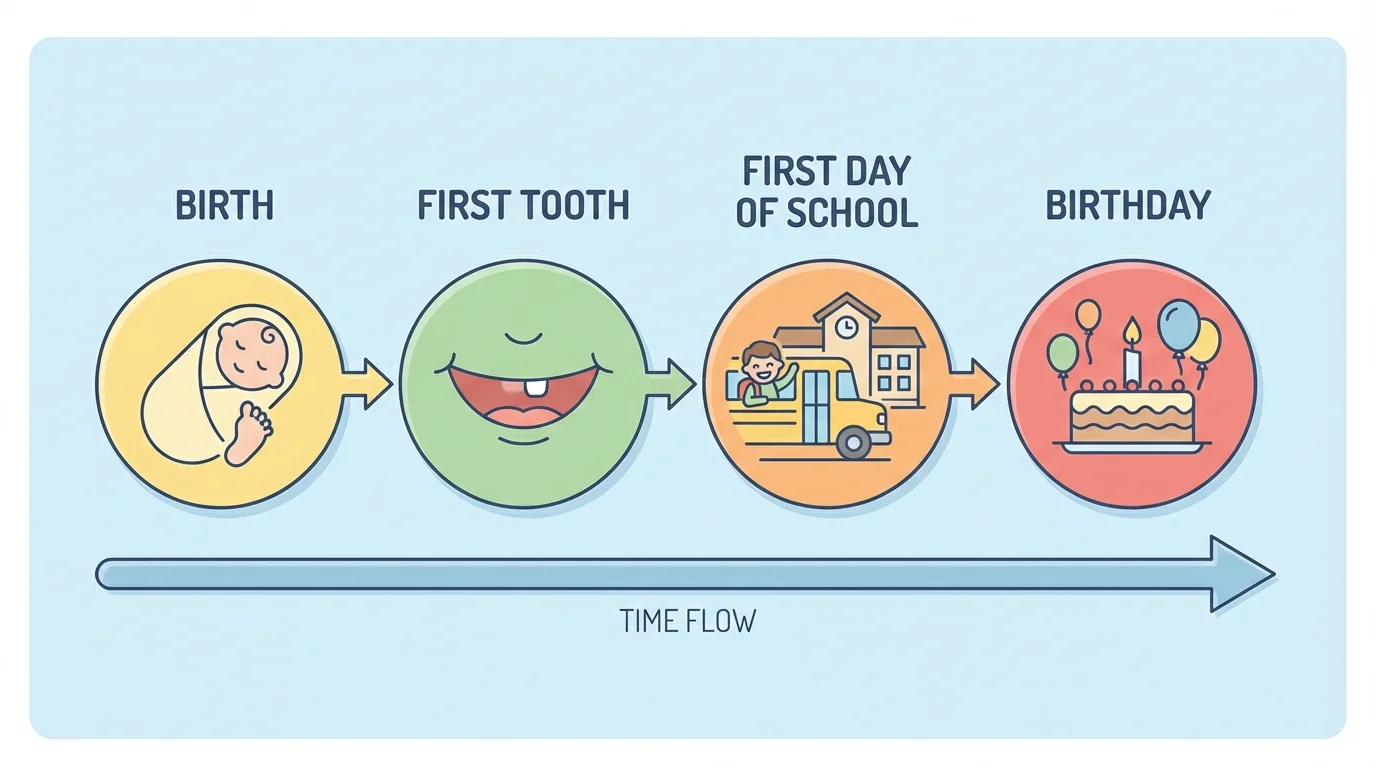
We can read a timeline by starting at the beginning and moving across the line. We ask, "What happened first?" Then we look for what happened next. This helps us tell an accurate account of the past in the right order.
Old photographs, baby books, and family stories can help us remember when important events happened. These are clues from the past.
Timelines are used in history too. Historians put events in order so they can understand what happened over time. First graders can start with their own lives and families.
Life events are important moments in a person's life, and [Figure 2] gives examples that many children know. Not every child has the same events, but many children have special moments they can place in order.
Important life events may include being born, learning to walk, saying a first word, celebrating a birthday, losing a tooth, getting a new pet, moving to a new home, or starting school. These events are special because they help tell the story of a person's life.
For example, a child may say: "First I was born. Next I learned to walk. Then I had my first day of kindergarten. Later I started first grade." That is chronological order.
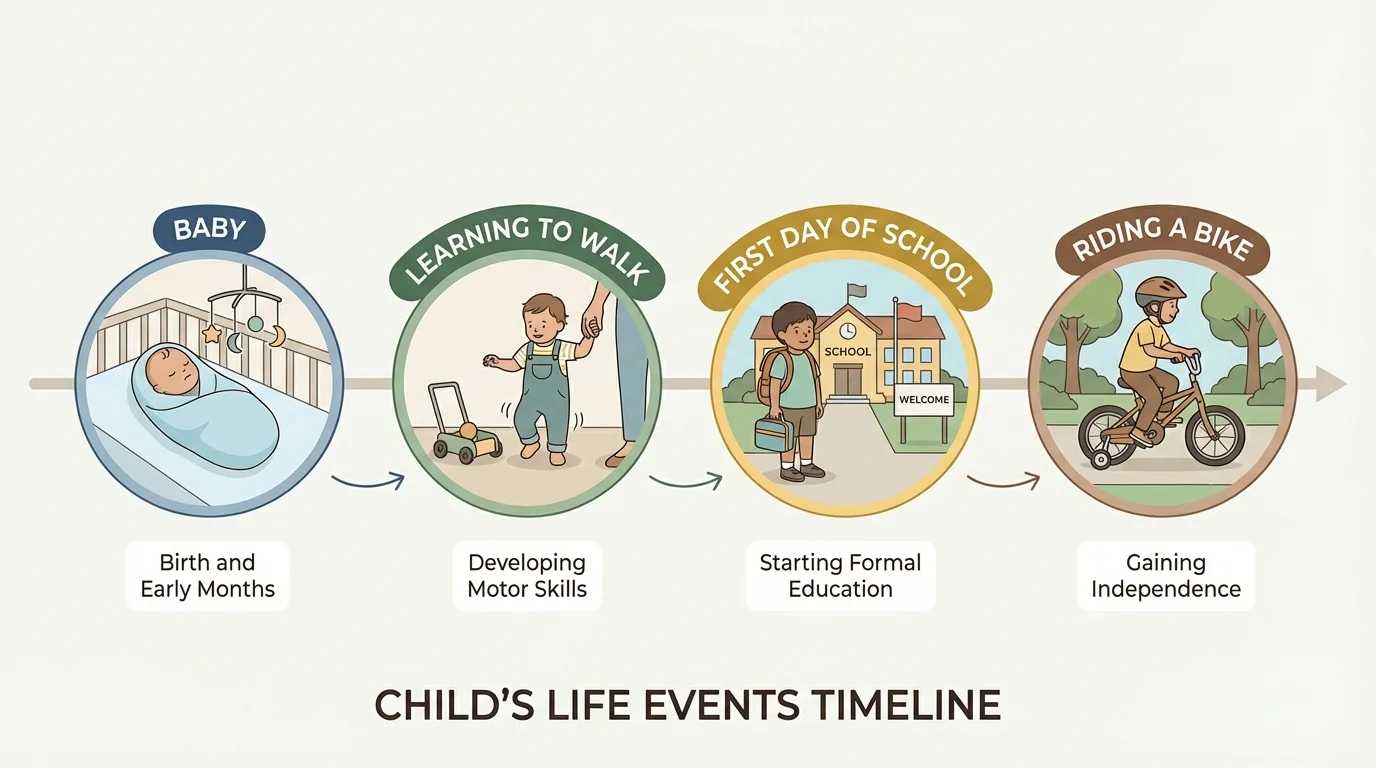
Sometimes two children have different life stories. One child may move to a new city before starting school. Another child may start school before moving. Both stories are fine. What matters is putting each child's events in the order they really happened.
Example of putting life events in order
Step 1: Listen to the events.
Events: first day of school, birth, learning to ride a bike.
Step 2: Think about which event happened earliest.
Birth happens first.
Step 3: Put the other events after it.
First day of school happens after birth. Learning to ride a bike may happen after starting school for many children.
The order is: birth, first day of school, learning to ride a bike.
We can also use family events. A family wedding, a new baby in the family, or a trip to a new place can all be part of a timeline if they are important to the story being told.
To put events in order, think carefully about what happened first, next, then, and last. These words are called sequence words. They help us talk about time in a clear way.
You can ask simple questions: "Was I a baby before I started school?" "Did I lose my first tooth before or after I learned to read?" These questions help us compare events.
Using clues to decide order
Sometimes you remember the order right away. Sometimes you need clues. A smaller body in a photo may mean the picture is from long ago. A school backpack may show that the event happened after a child was old enough for school. Adults can also tell us what happened earlier and later.
Words such as earliest and latest are helpful. The earliest event is the one that happened first. The latest event is the one that happened most recently.
When we talk about order, we do not need exact dates every time. A first grader can still place events correctly by knowing what came before and what came after.
When you read a timeline, look from left to right, as [Figure 3] illustrates. Left means earlier. Right means later. This pattern helps us see the flow of time.
If a timeline shows "born," "first birthday," "first day of school," and "today," then "born" is earliest. "Today" is latest. The events in the middle happened between them.
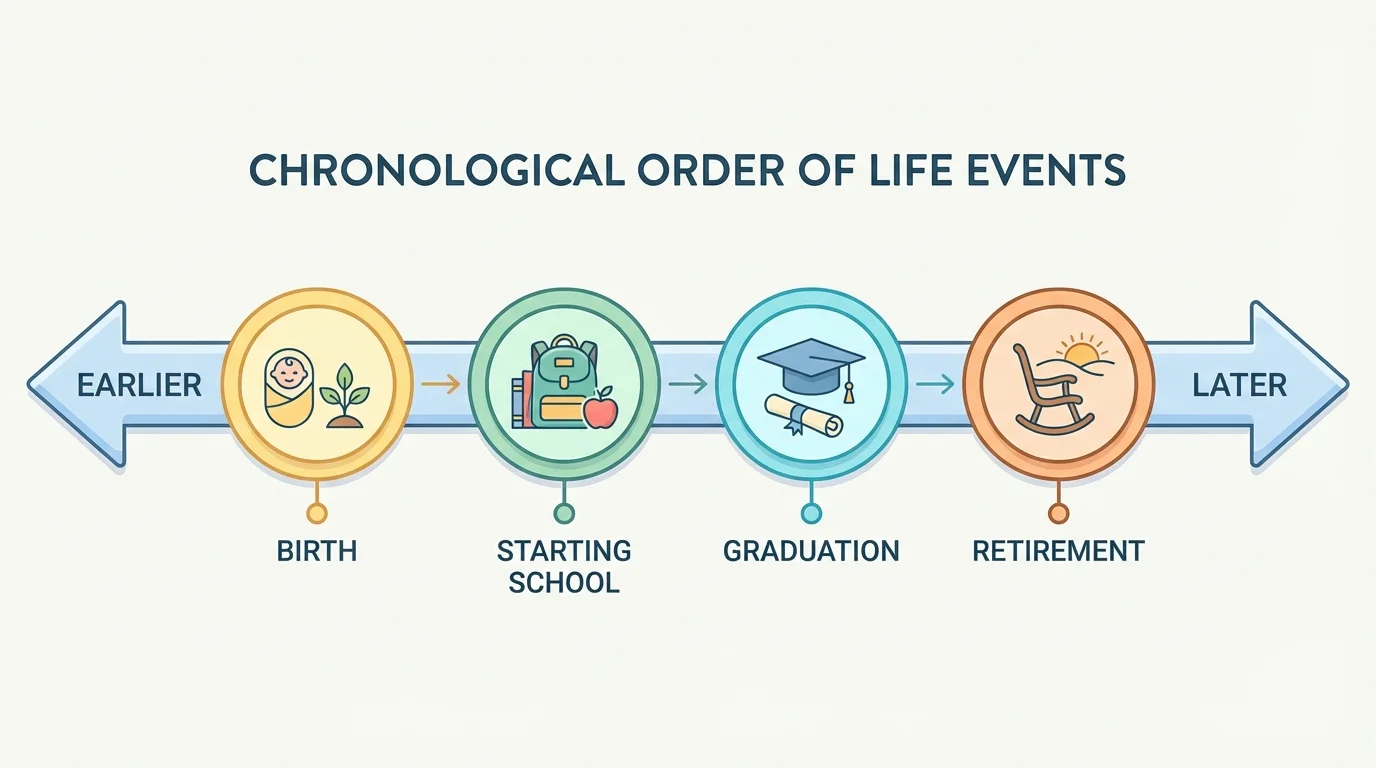
Timelines can also help us notice patterns. Birthdays happen every year. School begins each year. Holidays may come each year too. These repeated events help us understand how time moves forward.
Later, when students study bigger history topics, they will use the same skill. They will place events from communities, countries, and the world in chronological order, just as they place events from their own lives.
| Time Word | What It Means | Example |
|---|---|---|
| First | The earliest event | First I was born. |
| Next | The event after the first one | Next I learned to walk. |
| Then | Something that happened after that | Then I started school. |
| Last | The latest event | Last I started first grade. |
| Earlier | Before another event | My baby picture was taken earlier. |
| Later | After another event | First grade is later than kindergarten. |
Table 1. Time-order words and simple examples for talking about life events.
History begins with questions. We can ask, "What happened first?" "What happened later?" "How do we know?" These are important questions when learning about the past.
A source is something that gives us information. A photograph, a baby book, a report card, or a family member's memory can all be sources. They help us learn about events that already happened.
You already know how to tell the order of events in a story. The same idea works for real life and history. We tell what happened first, next, then, and last.
Some sources come from the time of the event, like a photo taken on a birthday. Other sources are created later, like a person telling a story about that birthday. Both can help us understand the past.
As we saw with the life-event timeline in [Figure 1], putting events in order makes a story easier to understand. It also helps us speak clearly when we share family history.
Chronological order matters because it helps us make sense of life. If events are mixed up, the story becomes confusing. If they are in order, we can understand change over time.
For example, looking at the life events in [Figure 2], we can tell that a child is a baby before becoming a student. Looking again at [Figure 3], we can quickly see which events are earlier and which are later.
This skill is useful every day. We use it when we tell what happened on a trip, when we share how we learned a new skill, and when we study family and community history. Learning to place important life events in order is one of the first steps in learning history.
