Have you ever found an old photo and wondered, "Who is this?" or "When did this happen?" That is what historians do. They look for clues from long ago. Those clues help us learn about people, places, and events from the past.
A source is something that gives us information. A source can be a picture, a book, a letter, a video, a drawing, or an object. If we want to learn about the past, we look at sources carefully and ask questions about them.
Some sources come straight from the time we are learning about. Other sources are made later by someone who studied the past. That is why we sort sources into two big groups: primary and secondary.
Primary source means a source from the time being studied or made by someone who was there.
Secondary source means a source made later by someone who learned about the event from other sources.
When we know what kind of source we are using, we can understand it better. We can also decide what questions to ask.
A primary source gives us direct clues about the past. [Figure 1] shows some real items from long ago. It was made during the event or by a person who saw, heard, or did it.
An old class picture is a primary source. A birthday card saved from years ago is a primary source. A diary, a letter, a newspaper from that day, or a toy from long ago can also be primary sources. These things come from the time we are studying.
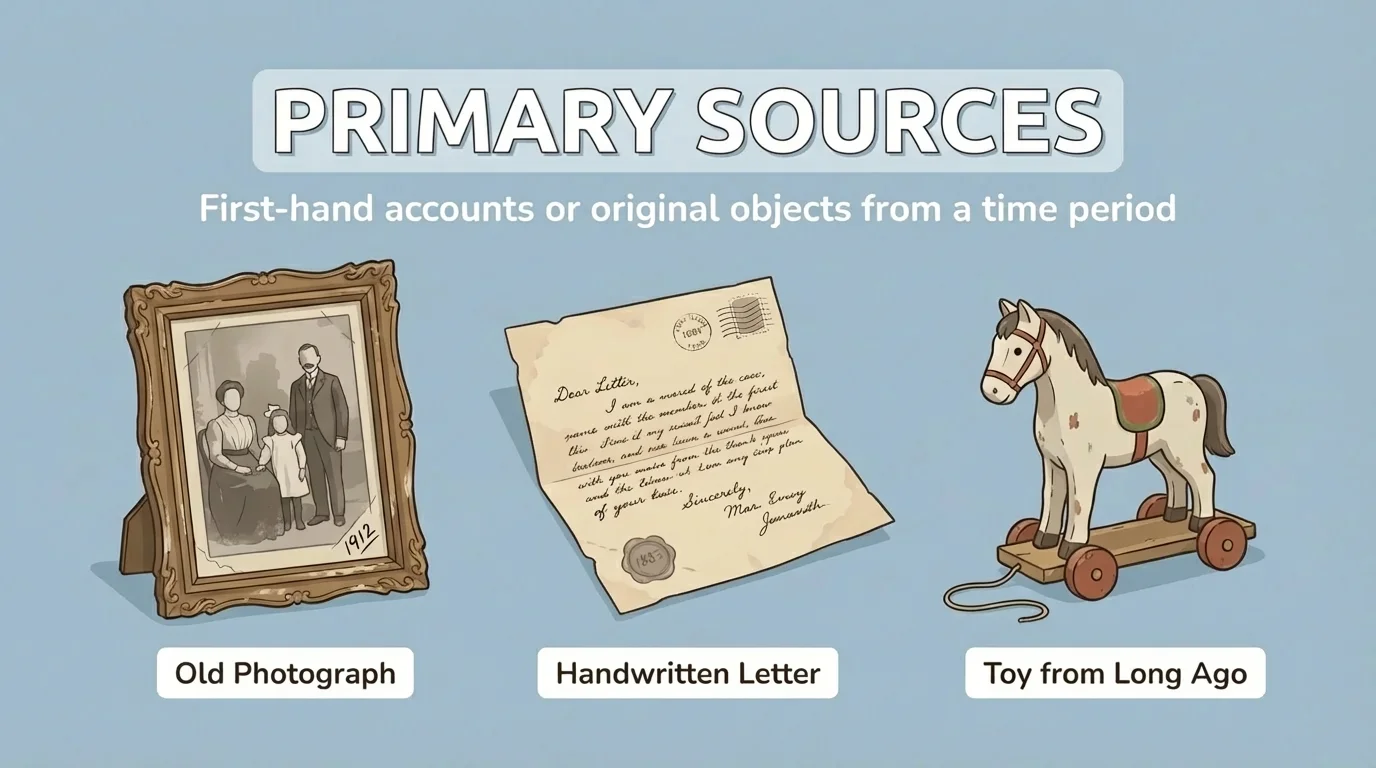
Primary sources are special because they are close to the event. They can show us what people wore, what they wrote, what they used, and sometimes how they felt.
But primary sources do not always tell the whole story. One photo shows only one moment. One person's letter tells only what that person thought. We still need to ask questions and look at more than one source.
Example: A family photo
Step 1: Look at the item.
You find a photo of your grandparent as a child.
Step 2: Ask when it was made.
The photo was taken long ago, at the time of that person's childhood.
Step 3: Decide what kind of source it is.
Because it comes from that time, it is a primary source.
Later, when we compare sources, we can remember those objects. They come right from the past, so they help us see history up close.
A secondary source tells about the past after it happened. [Figure 2] illustrates this idea. The person who made it usually learned from primary sources and other information first.
A history book for children is a secondary source. A teacher telling a story about a famous person is often using a secondary source. A video made today about long ago events is usually a secondary source too.
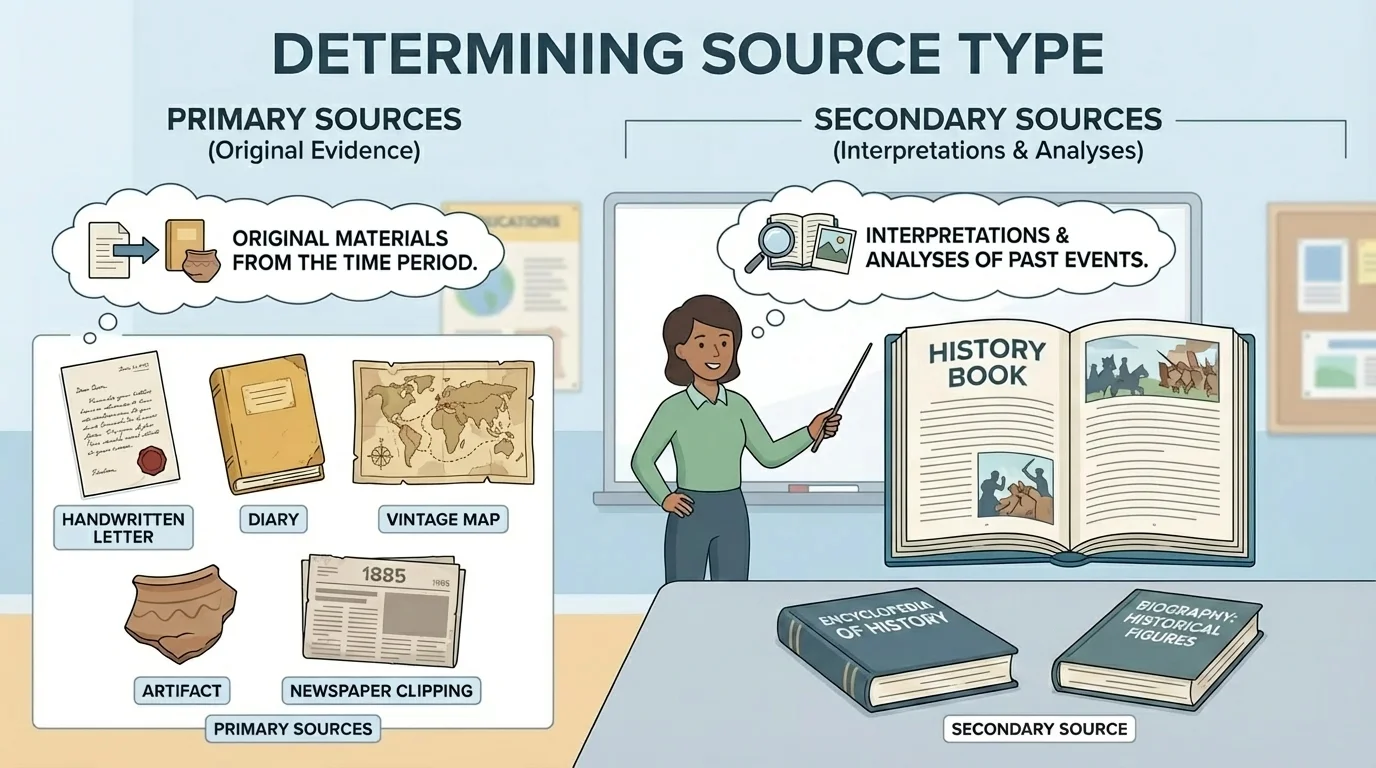
Secondary sources are helpful because they put many facts together. They can explain events in easy ways. They can help us understand what happened first, next, and last.
For example, a book about the first day of school long ago may use old photos, letters, and records. The old photos and letters are primary sources. The book made later is a secondary source.
Example: A book about Abraham Lincoln
Step 1: Think about when the book was made.
The book was written many years after Abraham Lincoln lived.
Step 2: Ask who made it.
An author studied information and wrote the book later.
Step 3: Decide what kind of source it is.
The book is a secondary source.
When a teacher uses a book, a chart, or notes to explain the past, that is much like this idea: someone is sharing history after learning from earlier clues.
You can ask simple questions when you look at a source. These questions help you decide if it is primary or secondary.
Ask: Was it made during the time I am studying? Was it made by someone who was there? If the answer is yes, it is probably a primary source.
Ask: Was it made later by someone who learned from other sources? If the answer is yes, it is probably a secondary source.
| Source | What it is | Type |
|---|---|---|
| Old letter | Written at that time | Primary |
| Diary | Written by a person who was there | Primary |
| History book | Written later about the past | Secondary |
| Video made today about long ago | Tells about the past later | Secondary |
Table 1. Examples of sources and whether they are primary or secondary.
Helpful thinking rule
Primary means from the time. Secondary means about the time, but made later. This simple rule helps you sort many sources.
Sometimes the same kind of thing can be different depending on what you are studying. A newspaper from long ago is a primary source for that day's events. But if a new newspaper today tells about something that happened 100 years ago, that new article is a secondary source for the older event.
Sources also help us put events in chronological order. [Figure 3] shows this on a simple timeline. Chronological order means putting things in time order: first, next, and last.
If you have a baby photo, a preschool drawing, and a first-grade class picture, you can place them in order. Those sources help you see how a person grows over time. Historians do the same thing with the past.
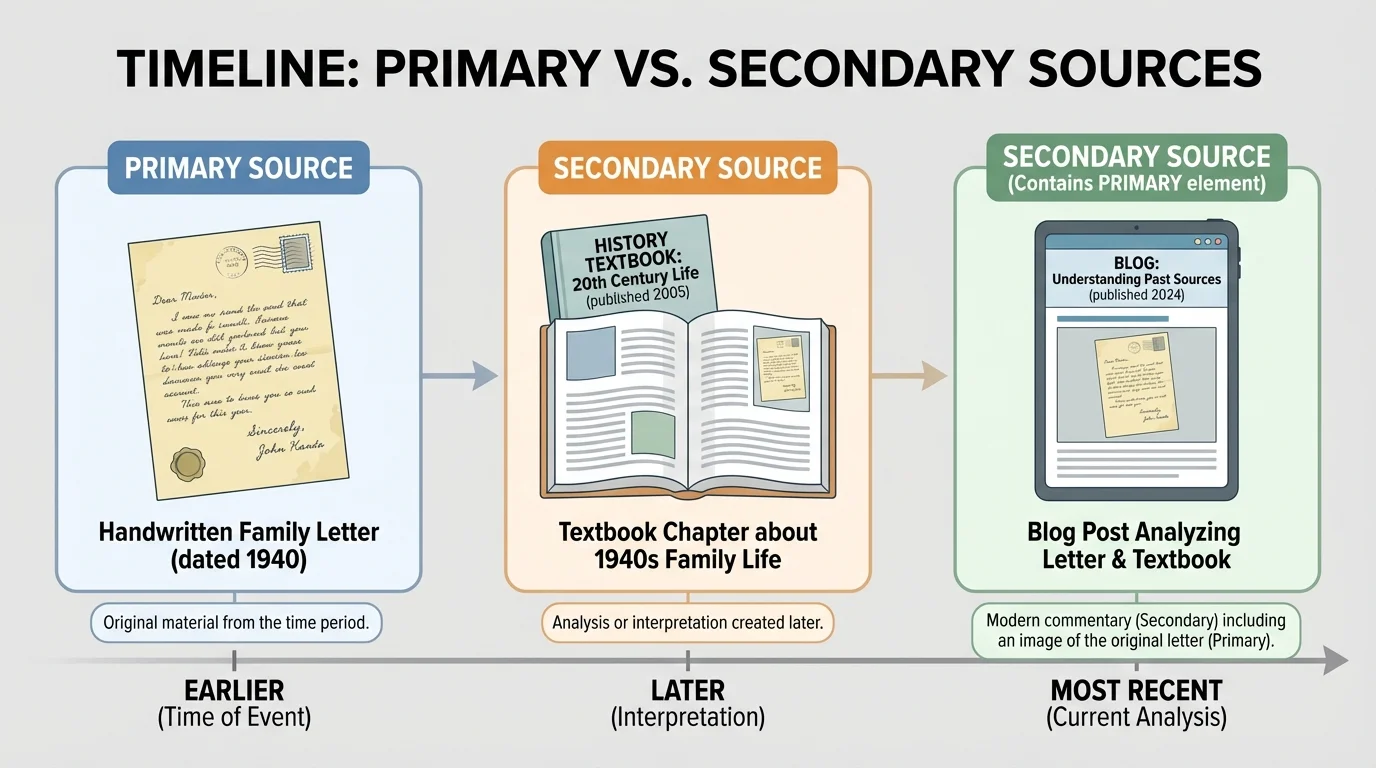
When we put sources in order, we can notice patterns. A pattern is something that happens again and again. For example, school photos may show that children get taller each year. Old pictures of a town may show more buildings over time.
Looking at order helps us answer questions such as: What happened first? What changed later? What stayed the same? The timeline makes it easier to see that the items belong in a sequence from earliest to latest.
Museums often use both primary and secondary sources. They may display an old shoe, a letter, or a photo, and they also add labels written later to explain what visitors are seeing.
That means historians do not just collect things. They ask questions, compare clues, and put events in order to learn about the past.
A historian is a person who studies the past. Historians use primary and secondary sources to learn what happened. Teachers, librarians, museum workers, and families use sources too.
When a family keeps an old recipe card, a photo album, or a letter, they are saving history. When a museum worker writes a sign to explain an old object, that sign is a secondary source that helps people understand the primary source.
Some sources can feel tricky, and that is okay. A drawing made by a child during a trip long ago is a primary source for that trip. But a drawing made today of a trip that happened long ago is a secondary source.
The best thing to do is ask, Who made this? and When was it made? Those two questions are powerful. They help you become a careful history thinker.
Example: A video about your school from long ago
Step 1: Look at the parts.
The video includes old photos from the school and new talking by a narrator.
Step 2: Sort the information.
The old photos are primary sources. The new video that explains them is a secondary source.
Step 3: Think carefully.
One project can include both kinds of sources.
When you look at history, you are like a clue finder. You learn not just what happened, but also how we know what happened.
