What would happen if one person got to make every rule, carry out every rule, and decide whether every rule was fair? That might sound fast and simple at first, but it would be dangerous. The United States government was designed to avoid that problem. Instead of giving all power to one person or one group, the country divides power among three parts of government. That system helps protect freedom and makes leaders answer to the law.
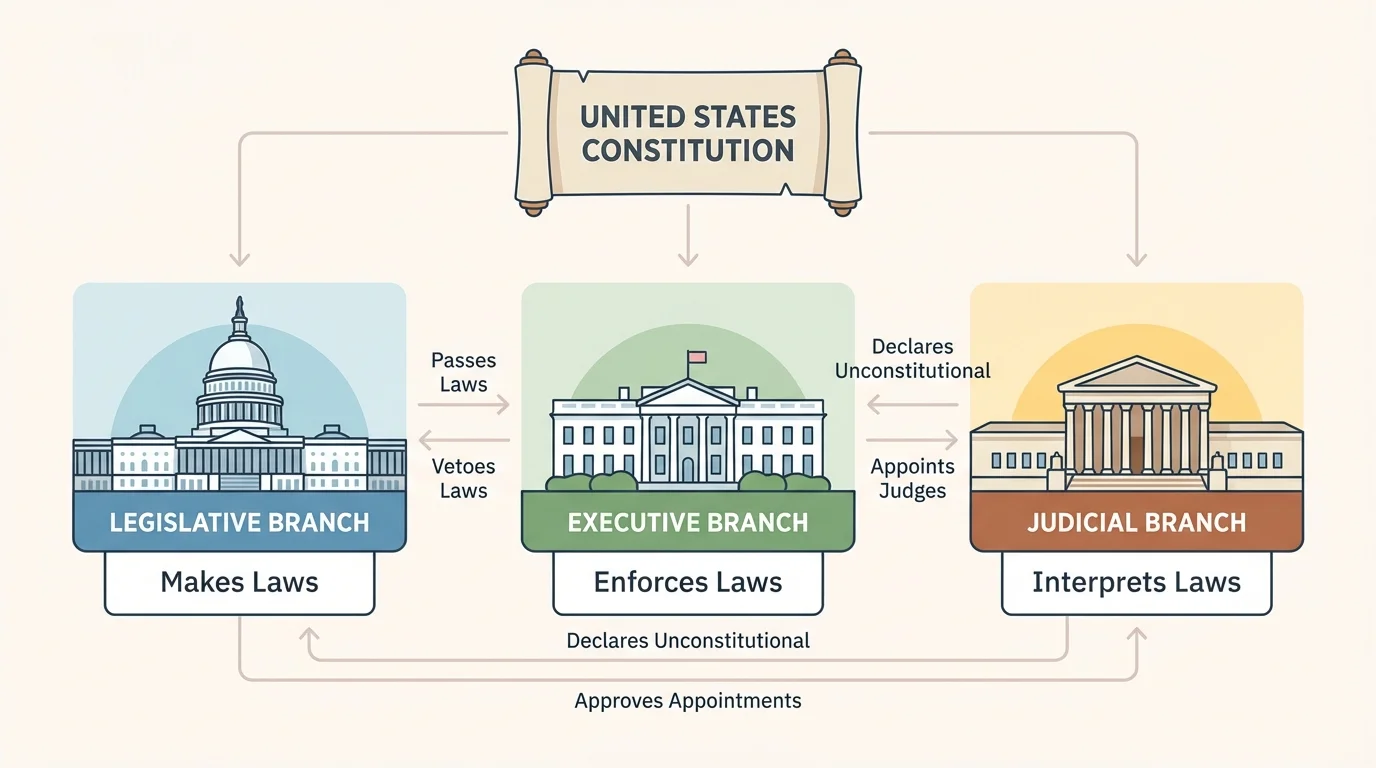
The United States is guided by the Constitution, the nation's highest law. It creates three branches of government and gives each one its own main job, as shown in [Figure 1]. This idea is called separation of powers. Instead of putting all government power in one place, power is divided so the branches must work together.
The three branches are the Legislative Branch, the Executive Branch, and the Judicial Branch. A simple way to remember them is this: the legislative branch makes laws, the executive branch carries out laws, and the judicial branch interprets laws and decides whether they follow the Constitution.
The Three Branches of Government are the three main parts of the United States government. The legislative branch makes laws, the executive branch enforces laws, and the judicial branch interprets laws.
Long ago, many American colonists were angry because a king held too much power over them. After the colonies won independence, the nation's leaders wanted a government strong enough to run the country but not so strong that it could easily take away people's rights. That is why they created a government with separate branches and shared power.
This system does not make government perfect or always quick. In fact, it often slows decisions down. But that is part of the design. When several branches must agree, leaders have to debate, explain, and justify their choices. That can stop unfair or careless actions.
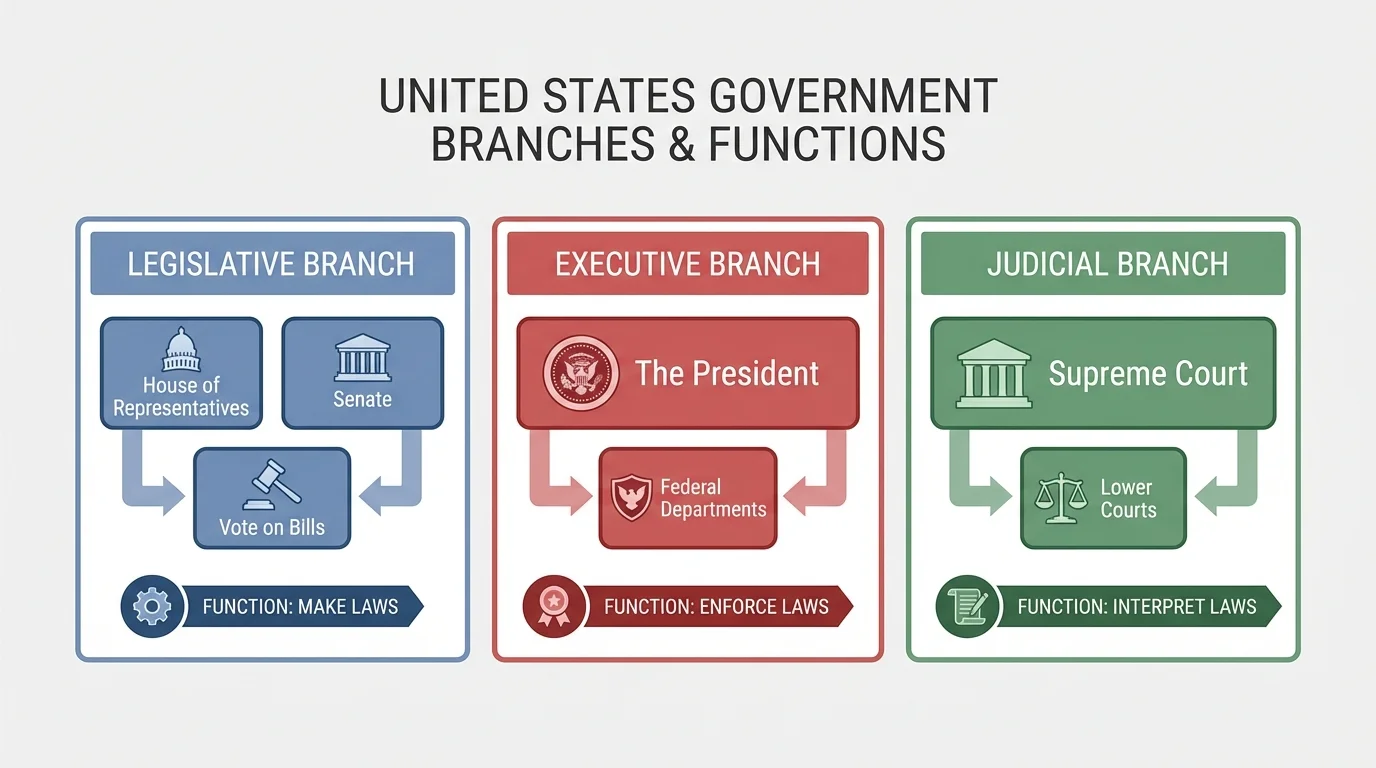
The legislative branch is the part of government that makes laws. At the national level, this branch is called Congress. Congress has two parts, as [Figure 2] shows: the House of Representatives and the Senate. Both parts help write, discuss, and vote on bills, which are proposed laws.
The House of Representatives has members from each state, and the number depends on the state's population. States with more people have more representatives. The Senate has two senators from each state, no matter how big or small the state is. This means one part of Congress is based more on population, while the other gives equal representation to every state.
Members of Congress do not just create laws from nothing. They listen to people in their states and districts, study problems, and debate possible solutions. For example, if people are worried about unsafe roads, members of Congress might propose a bill about transportation safety. Then both the House and Senate must consider it.
A bill usually goes through many steps before it becomes law. Committees may study it. Members may argue for or against it. Changes may be made. If both the House and Senate pass the same bill, it goes to the president. This means the legislative branch starts the lawmaking process, but it does not finish it alone.
Why Congress Has Two Parts
The House of Representatives and the Senate were created so different needs could be balanced. The House responds more directly to population because states with more people have more representatives. The Senate treats every state equally because each state has two senators. Together, these two chambers help keep lawmaking balanced.
Congress also has other important powers. It can declare war, collect taxes, approve government spending, and make rules for the country. The Senate has special jobs too, such as approving many presidential appointments. Later, when we study checks and balances, we will see that these powers help Congress limit the other branches, much like the arrows in [Figure 4].
The executive branch carries out and enforces laws. The leader of this branch is the president. The vice president and many other officials also work in the executive branch. These include cabinet members and people who lead departments and agencies.
When Congress passes a bill, the president decides whether to sign it. If the president signs it, the bill becomes law. If the president disagrees, the president can reject it with a veto. That does not always end the matter, because Congress may still be able to pass the law over the veto in some cases.
The executive branch does far more than one person standing at a desk and signing papers. It includes many workers and agencies that help run the country every day. For example, executive departments help with education, transportation, defense, agriculture, and public safety. They make sure laws are put into action.
Example: How the executive branch enforces a law
Suppose Congress passes a law about cleaner drinking water.
Step 1: Congress writes and passes the law.
Step 2: The president signs the bill.
Step 3: Executive agencies create plans and rules to carry out the law.
Step 4: Officials check whether people and businesses are following the law.
This shows that the executive branch turns written laws into real action.
The president is also the commander in chief of the military, meets with leaders from other countries, and helps guide the nation during emergencies. Even so, the president does not rule alone. The Constitution limits executive power, and the other branches can respond if the president goes too far.
Students sometimes think the president "makes all the laws," but that is not correct. The president can recommend ideas and sign or veto bills, but Congress is the branch that officially makes laws. This is one reason the branches must work together instead of operating independently.
The judicial branch includes the nation's courts. Its job is to interpret laws, settle disputes, and decide whether laws and government actions follow the Constitution, as shown in [Figure 3]. The highest court in the United States is the Supreme Court.
When people disagree about what a law means, or whether a law is fair under the Constitution, courts can hear the case. Judges listen to both sides, study the law, and make decisions. The judicial branch does not make laws or enforce them. Instead, it explains how laws should be understood and applied.
The Supreme Court is the top court, but it is not the only one. There are lower federal courts too. Many cases are decided in lower courts first. Some cases may move upward if they are especially important or if people appeal a decision. That court structure helps the judicial branch handle many different legal questions.
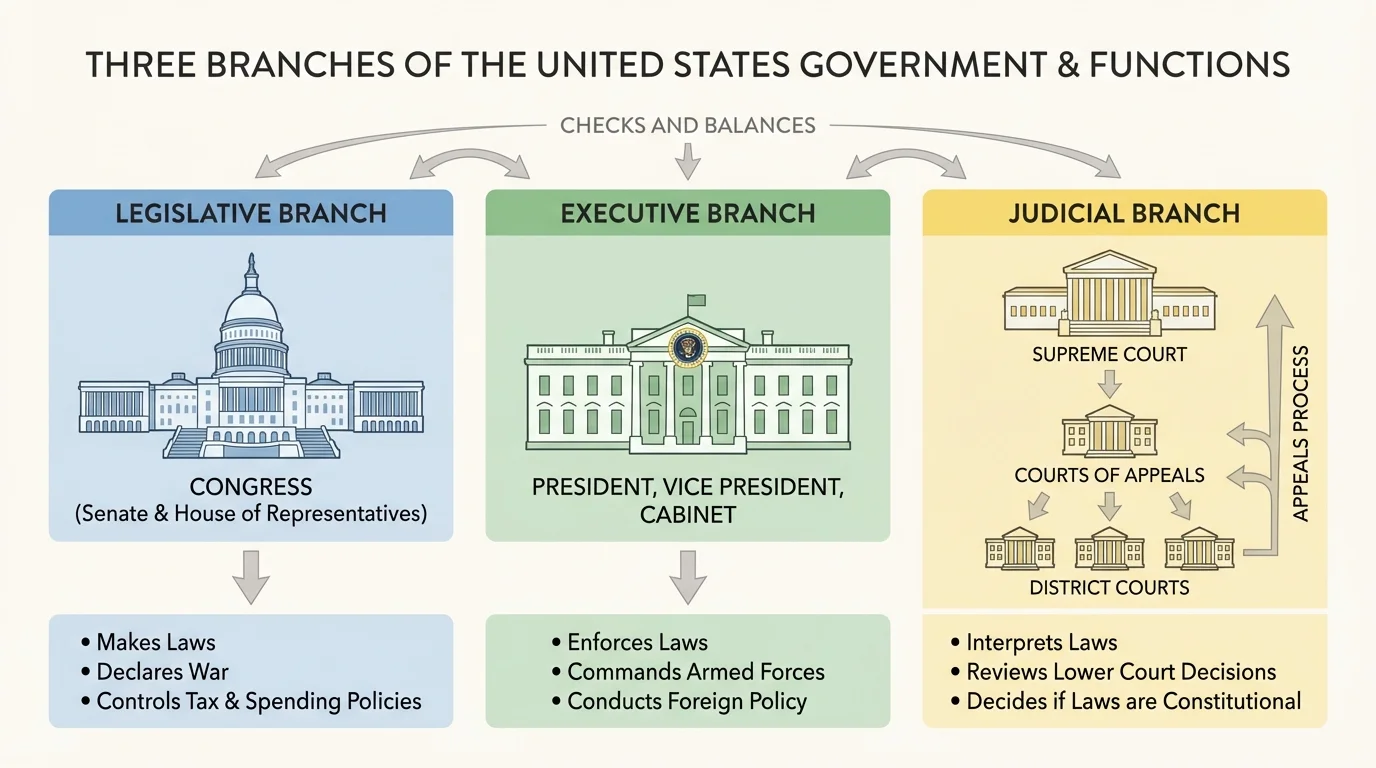
One of the most powerful jobs of the judicial branch is deciding whether a law or action breaks the Constitution. If a court rules that something is unconstitutional, that law or action cannot continue in the same way. This is a major check on the other branches.
The Supreme Court hears only a small number of the many cases people ask it to review. Most legal cases in the United States are decided in lower courts.
The judicial branch affects daily life in many ways. Courts deal with issues involving schools, free speech, voting, safety, and rights. When courts make decisions, those decisions can shape how laws are used across the country. That is why the court system in [Figure 3] matters so much.
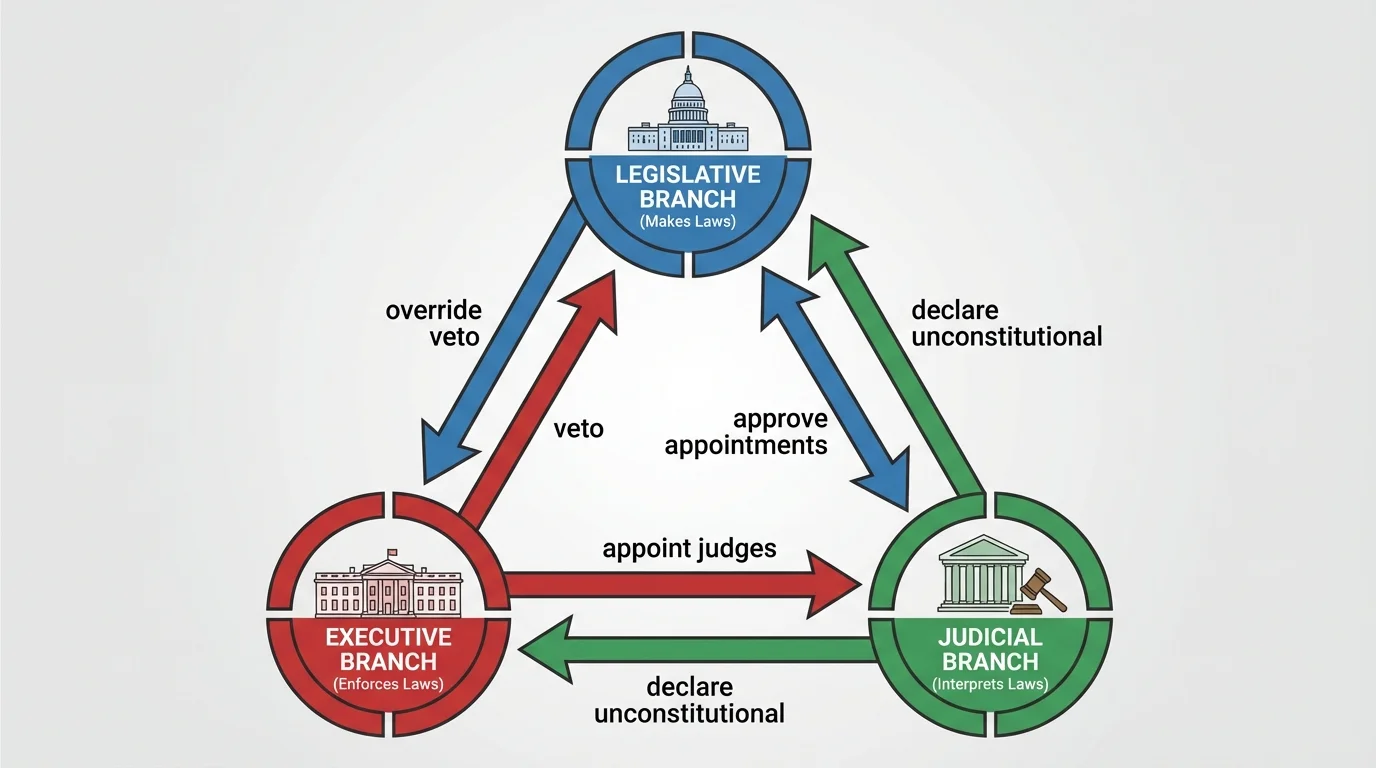
Dividing power into branches is only part of the system. The Constitution also uses checks and balances, which means each branch has ways to limit the powers of the others, as [Figure 4] illustrates. This helps keep any branch from becoming too powerful.
For example, Congress can pass a bill, but the president can veto it. That is the executive branch checking the legislative branch. However, Congress can sometimes override a veto if enough members vote for the bill again. That is the legislative branch checking the executive branch.
Another example is that the president can appoint judges, including Supreme Court justices, but the Senate must approve many of those appointments. That means the executive branch cannot fill important positions completely on its own. The legislative branch has a role too.
The judicial branch can check both of the other branches by declaring laws or executive actions unconstitutional. If Congress passes a law that goes against the Constitution, courts can stop it. If a president takes an action that is not allowed by the Constitution, courts can rule against that action as well.
Checks and balances can make government slower, but they also make it safer. Big decisions usually require more than one branch to agree. That means ideas are tested from different sides. A law may be debated in Congress, reviewed by the president, and later examined by courts. The process is not always easy, but it helps protect the country from unfair uses of power.
| Branch | Main Job | One Check on Another Branch |
|---|---|---|
| Legislative | Makes laws | Can override a presidential veto |
| Executive | Enforces laws | Can veto bills from Congress |
| Judicial | Interprets laws | Can declare laws unconstitutional |
Table 1. Main jobs of the three branches and one example of checks and balances for each branch.
When you look again at [Figure 4], you can see that no branch stands alone at the top. Each one has important powers, but each one also faces limits. That balance is one of the most important ideas in American government.
A single issue can involve all three branches, as [Figure 5] shows. Think about a national law meant to improve safety on school buses. This kind of example helps us see how the branches connect instead of acting as completely separate parts.
First, members of Congress might hear concerns from families, teachers, and transportation experts. They could write a bill about bus safety rules. The House and Senate would debate the bill, possibly change it, and vote on it.
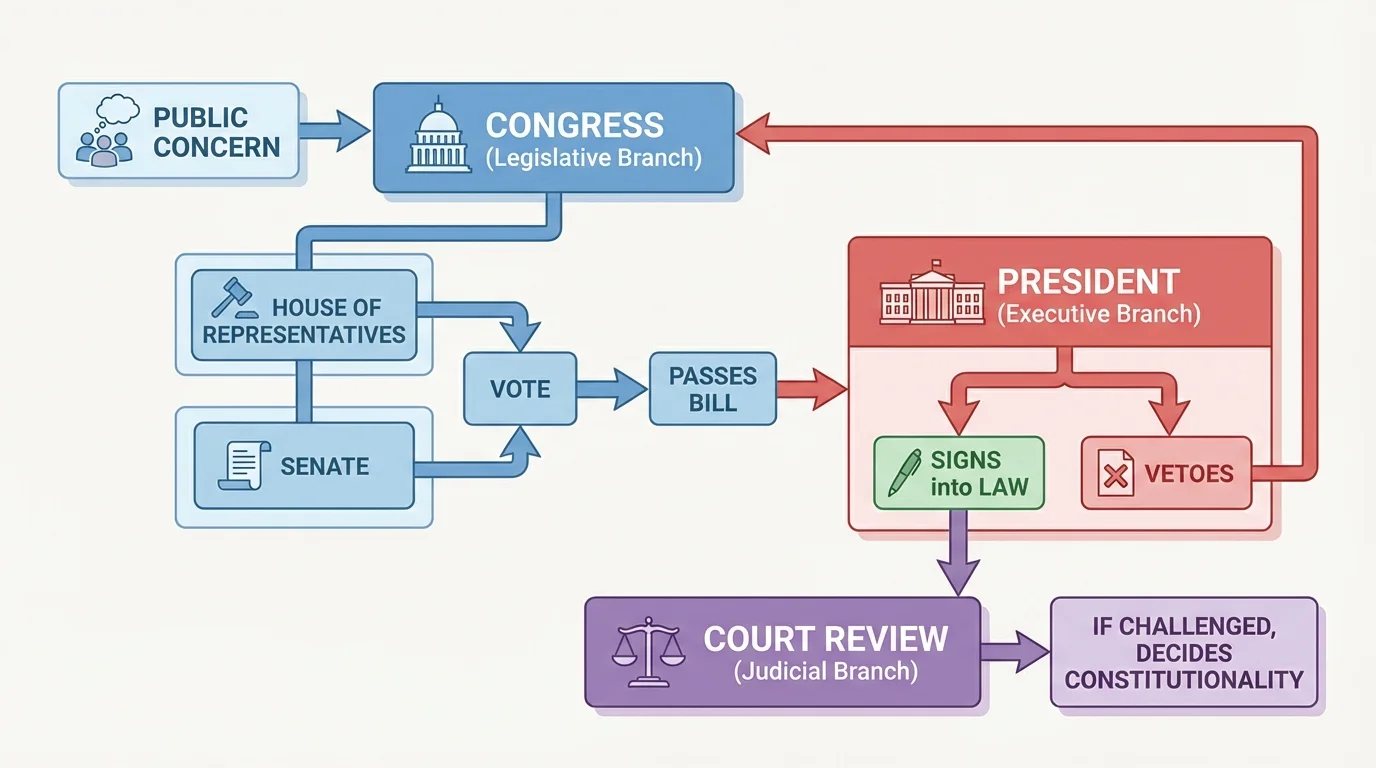
Next, the bill would go to the president. If the president signs it, the bill becomes law. Then the executive branch would begin enforcing it. Agencies might set safety standards, give instructions, or inspect whether rules are followed.
Later, someone might challenge the law in court. Maybe they believe part of it violates the Constitution. Then the judicial branch would review the case. A court might uphold the law, change how it is applied, or rule that part of it is unconstitutional.
Case study: One law, three branches
A law about school bus safety can involve all three branches.
Step 1: The legislative branch writes and passes the bill.
Step 2: The executive branch signs and enforces the law.
Step 3: The judicial branch reviews the law if someone challenges it in court.
This is a clear example of the branches working in sequence and also checking one another.
This process may seem long, but it shows why the government is organized the way it is. Writing a law, carrying it out, and reviewing it are different jobs. Keeping those jobs in different branches reduces the chance that one group can control everything at once. The flow in [Figure 5] helps make that idea easier to see.
The three branches are not just ideas in a book. They affect real life. Laws about schools, roads, health, taxes, safety, and the environment begin in government and often pass through these branches. When citizens vote, follow news, or speak up about issues, they are taking part in a system shaped by the three branches.
If people believe a law should change, they can contact lawmakers in Congress. If they want the executive branch to act on an issue, they may follow presidential decisions or agency actions. If they believe their rights have been violated, courts may become involved. That means understanding the branches helps citizens know where decisions are made.
"No one is above the law."
— A basic principle of American government
For fifth-grade students, one important idea is this: government power is strongest when it is limited by rules. The Constitution sets those rules. The branches carry out different jobs. Checks and balances keep them from taking too much power. Together, these ideas help protect liberty and fairness.
You may not vote yet, but the government still affects your life every day. Your school, community safety, public parks, and many rights are connected to laws and decisions made by these branches. Understanding how the system works is one step toward becoming an informed citizen.
