Few documents in history open with words so bold that they still shape arguments almost 250 years later. The Declaration of Independence, adopted on July 4, 1776, did more than announce that the American colonies were breaking away from Britain. It explained why they believed they had the right to do so. That made it both a political act and a statement of principles. Even today, people still return to its language when debating freedom, equality, government power, and the meaning of citizenship.
The Declaration is important in two major ways. First, it had enormous historical significance in its own time because it helped unite the colonies, justify the Revolution, and present the new nation to the world. Second, it has great present-day significance because its ideas continue to influence American law, politics, and movements for justice. To understand the document fully, we need to look at both its achievements and its limitations.
The Declaration is not the Constitution, and it is not a law code. But it is one of the clearest statements of the beliefs behind American government. It argues that people have rights, that governments get their power from the people, and that when government becomes destructive of those rights, the people may change it. Those ideas helped shape the nation's later commitment to a constitutional system based on limits, accountability, and the rule of law.
That connection is important in civics. In a constitutional system, leaders are not supposed to rule by personal will alone. Government must follow established laws and principles. The Declaration helped express the moral foundation for that idea: government exists to protect rights, not to control people without their consent.
Natural rights are rights people are believed to have simply because they are human, not because a ruler gives them those rights. Consent of the governed means that a government is legitimate only when it has the agreement of the people it governs. Grievances are formal complaints about wrongs or injustices.
These concepts may sound familiar because they continue to appear in debates about voting rights, equal treatment, freedom of speech, and the limits of government authority. The Declaration matters not only as history, but as a source of civic principles.
[Figure 1] Before independence, the Thirteen Colonies were part of the British Empire, stretched along the Atlantic coast of North America. Colonists were British subjects, but many believed that Britain was violating their rights. Parliament imposed taxes such as the Stamp Act and the Townshend Acts, while many colonists argued that they had no direct representation in Parliament.
This conflict intensified during the 1760s and 1770s. Events such as the Boston Massacre in 1770 and the Boston Tea Party in 1773 increased anger. Britain responded with harsh measures, often called the Intolerable Acts, which punished Massachusetts and tightened British control. More colonists began to think that their liberties were in danger.
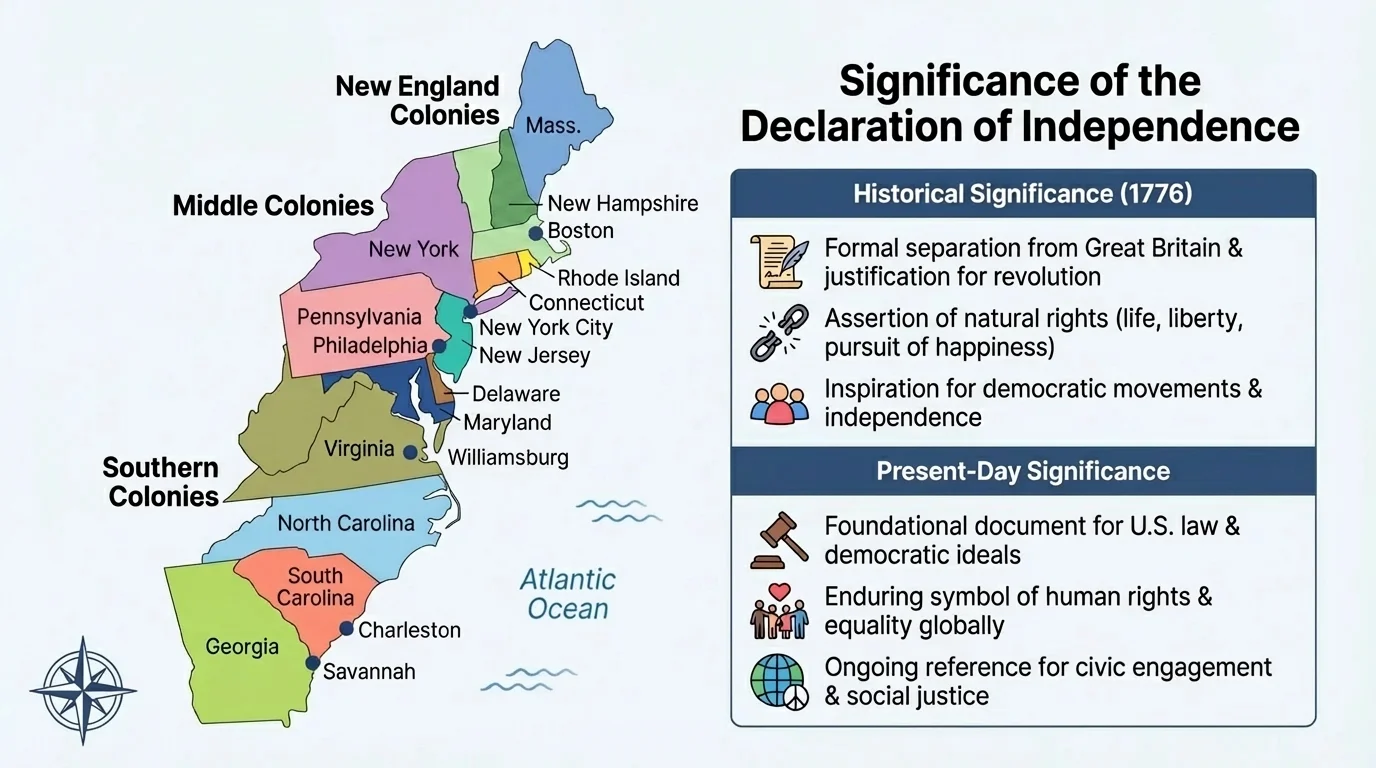
At first, many colonists did not demand full independence. They hoped for reconciliation with Britain. But fighting at Lexington and Concord in April 1775 changed the situation. Armed conflict had begun, and the colonies had to decide whether they were simply protesting British actions or creating a new nation.
As tensions rose, leaders met in the First and Second Continental Congresses. Writers such as Thomas Paine also shaped public opinion. In his pamphlet Common Sense, Paine argued that monarchy was unjust and that independence was the logical solution. His writing made complicated political ideas easier for ordinary readers to understand and helped build support for separation.
[Figure 2] The move toward independence happened through a series of steps, showing that July 4, 1776, was the result of an unfolding process, not a sudden decision. In June 1776, the Continental Congress appointed a committee to draft a statement explaining why the colonies should become free and independent states. The committee included Thomas Jefferson, John Adams, Benjamin Franklin, Roger Sherman, and Robert Livingston.
Thomas Jefferson wrote the first draft. Congress then reviewed and edited it carefully. Some phrases were changed, and some parts were removed. This reminds us that the Declaration was not just one person's work. It was a collective political document created to speak for the colonies as a whole.
On July 2, 1776, Congress voted for independence. On July 4, it adopted the final wording of the Declaration. That date became the one Americans celebrate. The document was then printed and shared publicly so that colonists, British officials, and foreign nations would understand the colonies' decision and reasoning.
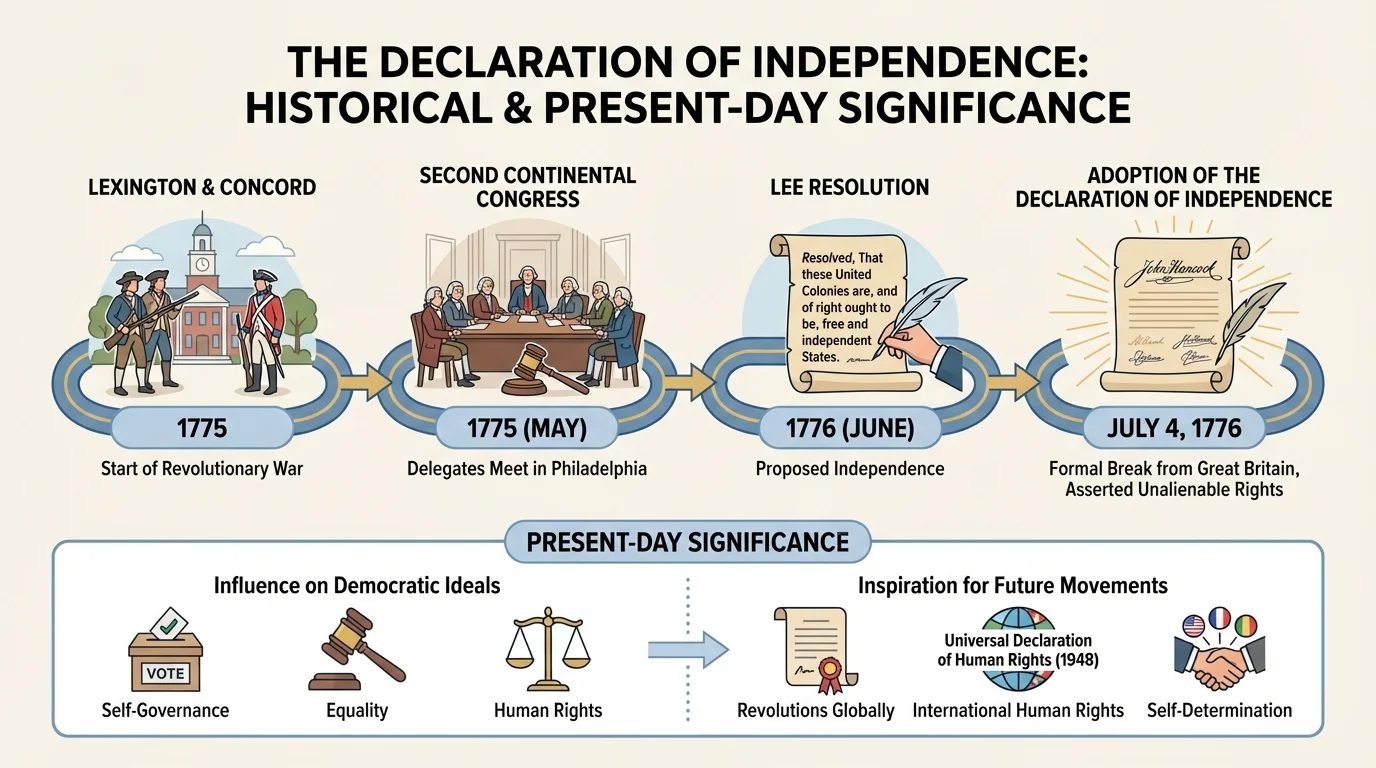
The key figures connected to the Declaration are worth remembering. Thomas Jefferson is most associated with its language. John Adams strongly supported independence in Congress. Benjamin Franklin helped edit the draft and was important in diplomacy. Richard Henry Lee introduced the resolution for independence. Together, these leaders helped turn colonial resistance into nationhood.
"We hold these truths to be self-evident, that all men are created equal..."
— Declaration of Independence
This famous line became one of the most quoted statements in American history. It has inspired people for generations, even though its meaning and application have been debated ever since.
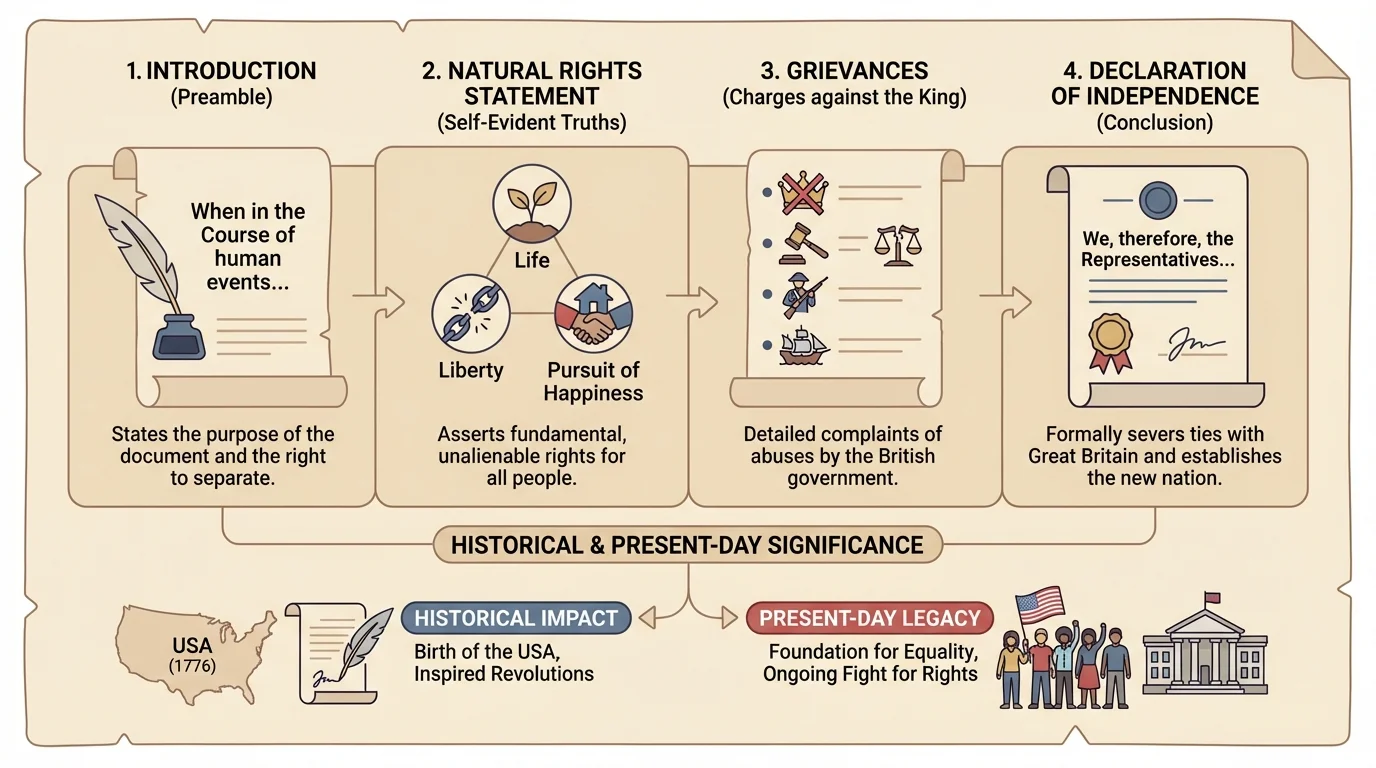
[Figure 3] The Declaration is not just a dramatic announcement. It is a carefully organized argument, and the figure illustrates its main parts. It begins with an introduction explaining that one people may need to dissolve political ties with another. It then presents broad principles about equality and rights. After that, it lists grievances against King George III. Finally, it declares that the colonies are "Free and Independent States."
One of the most important ideas is that all people are created equal in the sense that no one is born with a natural right to rule others absolutely. The document also says that people are endowed with certain unalienable rights, including "Life, Liberty and the pursuit of Happiness." These are examples of natural rights. According to the Declaration, governments are created to secure these rights.
Another major principle is consent of the governed. Government is legitimate only if it rests on the agreement of the people, not merely on force, inheritance, or tradition. The Declaration also states that when a government becomes destructive of rights, the people have the right to alter or abolish it and establish a new government.
This was a revolutionary claim. Kings in Europe often ruled by the idea of divine right, the belief that monarchy was established by God and not answerable to ordinary people. The Declaration challenged that way of thinking. It argued that the people are the true source of political power.
The list of grievances is also important. The authors did not simply say they were unhappy. They tried to build a case, almost like a prosecutor presenting evidence. They accused the king of interfering with colonial laws, obstructing justice, keeping standing armies without consent, taxing without representation, and denying trial rights. This legal and political style gave the Declaration strength as a public argument.
The Declaration as an argument about legitimate government
The document does not claim that people may overthrow government whenever they are annoyed. It says that people should be cautious and not change long-established governments for "light and transient causes." Only after a long pattern of abuses, the authors argue, do the people have the right to replace a government that no longer protects their rights.
That point matters because it connects liberty with responsibility. The Declaration presents independence as a serious response to repeated violations, not as an excuse for disorder.
In 1776, the Declaration had immediate importance. First, it unified many colonists around a common cause. Different colonies had different economies, religious traditions, and local identities. A shared declaration helped them think of themselves as one people acting together.
Second, it justified the Revolution. War was already happening, but the Declaration explained why the colonists believed their actions were lawful and morally right. This was vital for support at home and abroad. If the colonies wanted alliances, especially with France, they needed to present themselves as a legitimate new nation rather than a rebellion without principles.
Third, the Declaration marked the birth of the United States as an independent country. It did not win the war by itself, but it gave clear political meaning to the struggle. It announced that the goal was not better treatment within the British Empire, but full independence from it.
The Declaration also influenced other countries. Its language about rights and government by the people helped inspire later democratic movements. The American example did not solve every problem, but it showed that subjects could reject monarchy and create a republic.
The Declaration that Congress adopted on July 4 was not the same as Jefferson's original draft. Congress removed and revised sections, showing that even famous historic documents often result from debate, compromise, and editing.
When historians study this period, they often place the Declaration in a timeline of major events.
| Year | Event | Why it matters |
|---|---|---|
| 1765 | Stamp Act | Raises colonial anger over taxation |
| 1770 | Boston Massacre | Increases tension between colonists and British troops |
| 1773 | Boston Tea Party | Shows direct colonial resistance |
| 1774 | First Continental Congress | Colonies coordinate response to British actions |
| 1775 | Lexington and Concord | War begins |
| 1776 | Declaration adopted | Colonies formally announce independence |
Table 1. Major events leading to the adoption of the Declaration of Independence.
The Declaration did not create the American constitutional system by itself. That came later through the Articles of Confederation, the Constitution, and the Bill of Rights. However, the Declaration provided a philosophical foundation for those developments. It said government exists to protect rights and must rest on the people's consent. Those ideas fit closely with the rule of law.
Under the rule of law, government officials are not above the law. Decisions should be made according to established rules, not personal favoritism or unchecked power. The grievances in the Declaration show what the colonists thought happened when power was not properly limited. They believed British authorities had ignored fair processes and abused authority.
Later, the Constitution built structures to prevent that problem: separation of powers, checks and balances, federalism, and written protections of rights. The Declaration helps explain why Americans thought these protections were necessary. As the organization of the Declaration makes clear, the issue was not only independence from Britain but also the kind of government that should replace arbitrary rule.
For example, if government derives its just powers from the people, then leaders should be accountable through elections. If people have rights, then laws should protect due process and equal treatment. If government can become destructive, then a constitutional system should limit power before abuses become severe.
Case study: Connecting the Declaration to constitutional government
Step 1: Start with the Declaration's principle.
The Declaration says government exists to secure rights and gains legitimacy from the people.
Step 2: Ask what kind of system can support that principle.
A system with written laws, elections, divided powers, and courts can help prevent one ruler from acting without limits.
Step 3: See the civic connection.
The Constitution and Bill of Rights do not repeat the Declaration word for word, but they turn many of its ideals into governing structures and legal protections.
This is one reason the Declaration remains important even though it is not the nation's main legal framework.
So, in civics, the Declaration is often studied alongside later founding documents. It helps students see that freedom depends not only on inspiring ideals but also on institutions strong enough to uphold them.
The Declaration's most famous statement says that all people are created equal, but in 1776 that principle was not applied equally. Enslaved Africans were denied freedom. Women did not have equal political rights. Native Americans were often treated as obstacles or enemies rather than as peoples with rights of their own. These facts reveal a deep contradiction between the document's ideals and the nation's practices.
This contradiction is one of the most important parts of studying the Declaration honestly. Admiring its principles does not require ignoring its failures. In fact, understanding both is necessary. The document set a high standard, and later generations used that very standard to criticize injustice.
Frederick Douglass, an abolitionist and formerly enslaved man, exposed the hypocrisy of celebrating liberty in a slaveholding nation. Women's rights leaders at Seneca Falls in 1848 echoed the Declaration's language in the Declaration of Sentiments, arguing that women, too, deserved equality and rights. Civil rights activists in the 1950s and 1960s appealed again to the promise of equality.
Primary sources come directly from the time being studied, such as letters, speeches, laws, or the Declaration itself. Secondary sources are later works by historians who analyze and interpret primary sources.
This pattern is powerful: a document created in a time of exclusion also became a tool for inclusion. That does not erase the harm done in the past, but it helps explain why the Declaration remains central to debates about justice.
[Figure 4] Many later reform movements drew strength from the Declaration's language, and the figure connects abolition, women's suffrage, civil rights activism, and modern voting to the same core ideals of equality and rights. People who were excluded from full citizenship often argued that the nation should finally live up to its founding words.
Today, the Declaration still matters in public life. Politicians quote it. Judges and lawyers refer to its principles when discussing liberty and equality, even though the Constitution is the primary legal authority in court. Teachers use it to discuss what makes government legitimate. Citizens use it to debate what rights mean in practice.
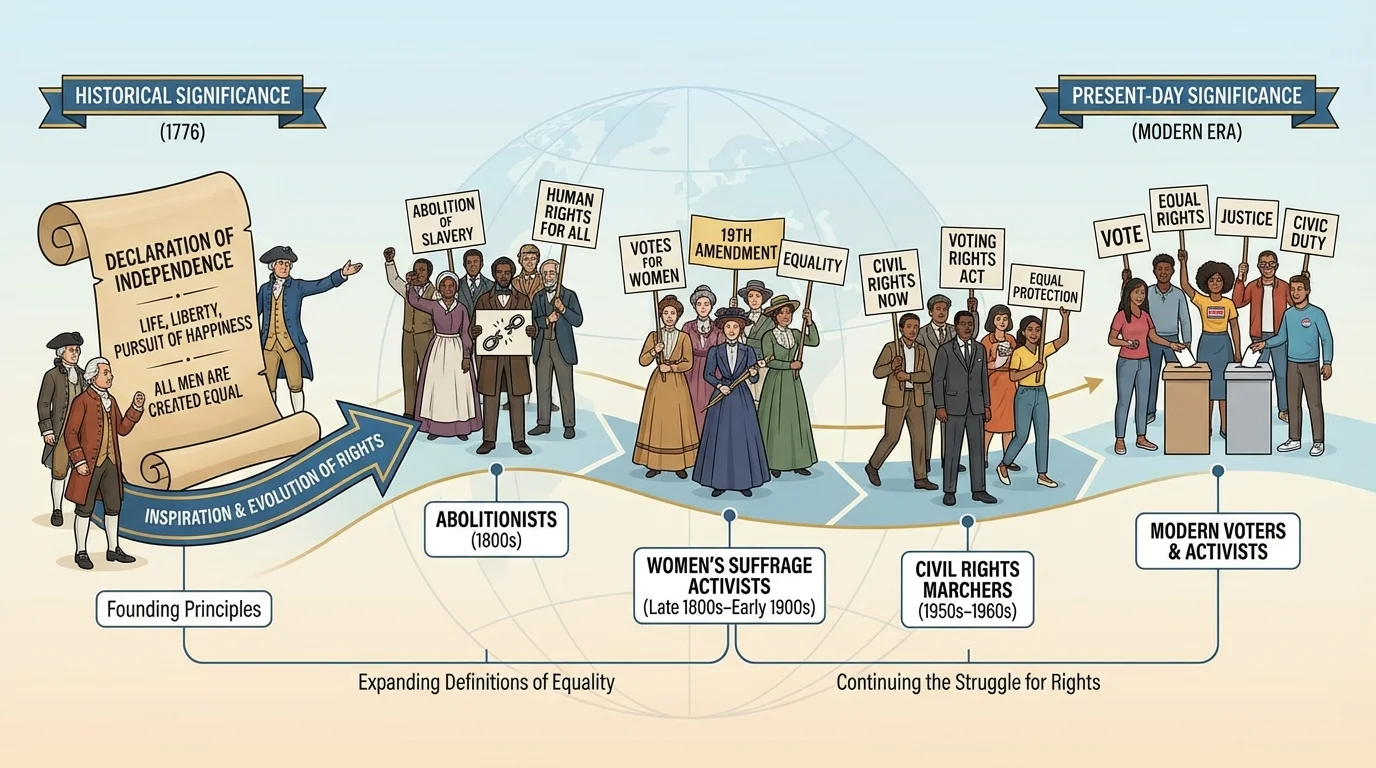
Its present-day significance also appears in everyday civic questions. How much power should government have in emergencies? How should minority rights be protected? What does equality require in schools, workplaces, and voting systems? The Declaration does not answer every modern policy question directly, but it gives people a shared language for asking them.
When Americans disagree about justice, they often still agree on one basic idea: government should protect rights and serve the people rather than dominate them. That idea comes straight from the Declaration. The reform movements shown in [Figure 4] demonstrate how each generation has tested whether the nation truly honors that principle.
Why historical documents still shape the present
Some documents matter only in their own time. Others continue to influence public values, political arguments, and national identity. The Declaration belongs to the second group because it expresses broad ideas that later generations can apply to new situations.
For that reason, the Declaration is often read on Independence Day, quoted in speeches, and studied in schools. It is part of how Americans understand the country's purpose, even while arguing over whether the nation has fully lived up to that purpose.
The Declaration is a primary source, which means it comes directly from the period being studied. Reading it as a primary source helps students notice its wording, tone, audience, and purpose. It was meant to persuade several audiences at once: colonists, British leaders, and foreign governments.
When historians use the Declaration, they ask questions such as: Who wrote it? Why was it written? What claims does it make? What evidence does it present? What does it leave out? These questions help students move beyond memorizing famous lines and begin evaluating the source critically.
Secondary sources, such as history textbooks or scholarly articles, help explain context and consequences. By comparing primary and secondary sources, students gain a fuller understanding. For example, the Declaration itself states ideals and grievances, while later historical studies explain how ordinary people reacted and how foreign nations responded.
Using evidence from the Declaration
Step 1: Identify a claim.
The document claims that governments derive their just powers from the consent of the governed.
Step 2: Find supporting evidence in the text.
The long list of grievances is meant to show that British rule had violated that principle.
Step 3: Evaluate significance.
If the claim is accepted, then independence appears not as random rebellion but as a reasoned political response.
This is how historians and civics students use documents to build arguments based on evidence.
Studying the Declaration this way also helps students practice democratic habits of mind: reading carefully, evaluating claims, and comparing principles with real-world actions.
The Declaration of Independence matters because it joins action with ideals. Historically, it announced the birth of a new nation and justified separation from Britain. Politically, it argued that rights come before government and that legitimate power depends on the people. Civically, it still challenges each generation to ask whether laws and institutions truly protect liberty and equality.
Its legacy is therefore not simple. It is inspiring because of its powerful principles. It is troubling because those principles were denied to many people at the time. It is enduring because later generations kept returning to it, demanding that the nation make its practices match its promises.
