Have you ever tried to build something and noticed that your first idea was not your best one? That happens to engineers all the time. Engineers do not usually stop after one plan. They think of several ways to solve a problem, then they compare those ideas carefully. A solution might look exciting, but if it breaks easily, costs too much, or is too big, it may not be the best choice. Good engineering means choosing a design because it fits the problem well, not just because it is your favorite.
When engineers solve problems, they use a process called engineering design. This means they ask what the problem is, think of possible solutions, make plans or models, and compare which ideas are most likely to work. In grades 3 to 5, an important part of this process is learning how to generate more than one solution and compare those solutions using evidence.
A single problem can often be solved in many different ways. Think about a classroom problem: papers keep blowing off a table near a fan. One solution might be a paper tray. Another might be clips. A third might be a box with sides. All three ideas might help, but some may work better than others.
Creating several ideas gives engineers choices. If one idea is weak, another may be stronger. If one idea is too expensive, another may cost less. If one idea is hard to build, another may be simpler. Making multiple possible solutions helps people avoid getting stuck with a poor design.
Possible solution means one design idea that might solve the problem. Compare means to look at two or more ideas and decide how they are alike, how they are different, and which one best fits the needs of the problem.
Engineers do not guess wildly. They compare solutions by looking at what the problem asks for. That is where two important ideas come in: criteria and constraints.
Every design problem has goals and limits. Engineers use criteria to describe what a successful solution should do, and they use constraints to describe the limits they must stay within. These work together, as [Figure 1] shows in a simple classroom design example. A design is not truly successful unless it meets the goals and also respects the limits.
Criteria are the features you want. For example, if you are designing a book holder, the criteria might be that it holds several books, stands up without tipping, and makes it easy to grab a book quickly. Constraints are the limits. The holder may need to be made only from cardboard, fit on a small desk, and use a small amount of tape.
| Part of the problem | Meaning | Example |
|---|---|---|
| Criteria | What the design should do well | Hold at least 5 books, stay upright, be easy to use |
| Constraints | Limits the design must follow | Use only cardboard, fit in a 30 cm space, use little tape |
Table 1. The table shows the difference between criteria and constraints in a simple design problem.
Sometimes there are several criteria. Sometimes there are several constraints. Engineers have to pay attention to all of them. A design that is very strong but far too large does not meet the full challenge. A design that is cheap but cannot do its job also does not meet the challenge.
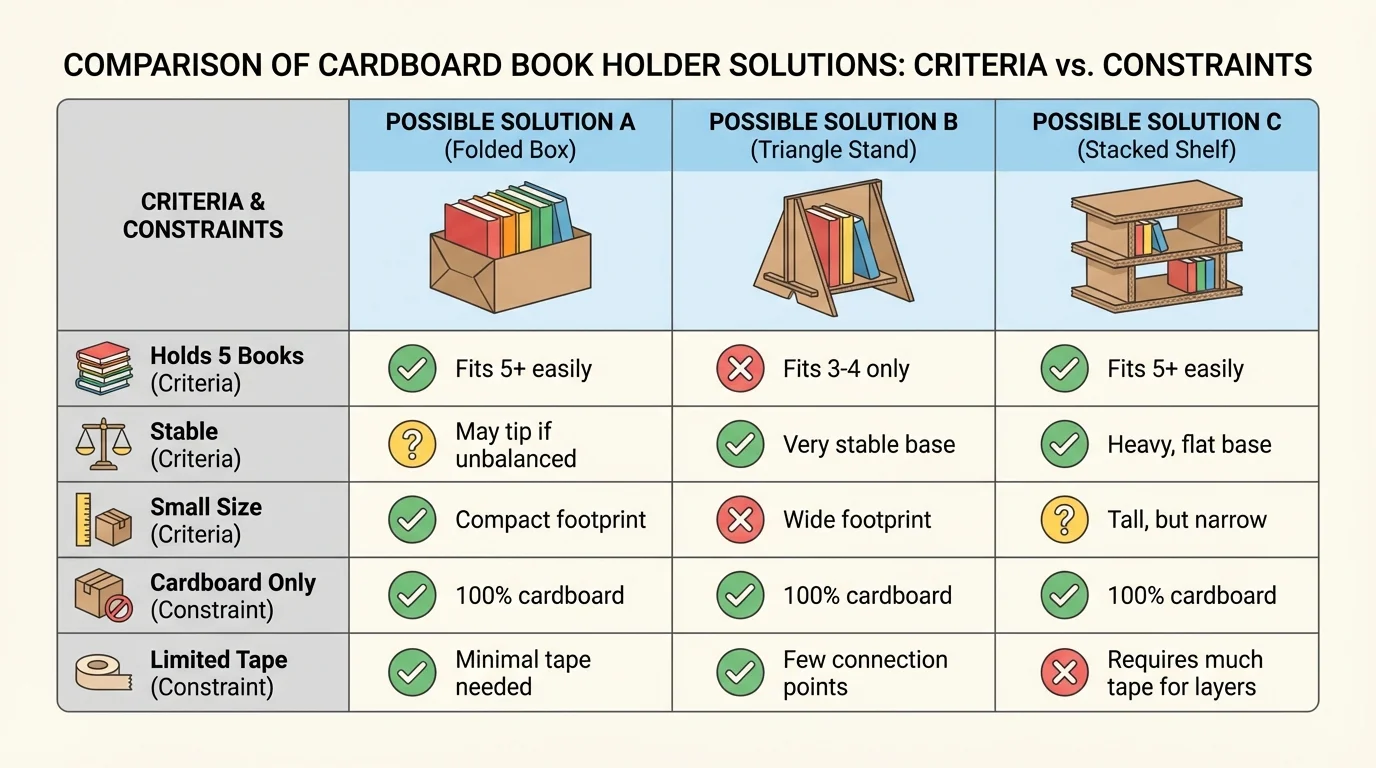
Learning to separate criteria from constraints helps students make better design choices. It turns a vague idea like "build something good" into a clear challenge with real goals and limits.
After engineers understand the problem, they think of many possible solutions. This is sometimes called brainstorming. During brainstorming, it helps to think freely at first. A wide idea list gives you more options to compare later.
Possible solutions can begin as quick sketches, labeled drawings, or simple plans. For younger engineers, a model might be a paper drawing, a folded cardboard shape, or a small mock-up made from classroom materials. The important idea is not fancy building. The important idea is showing how the design would work.
Generating ideas before choosing
When engineers create several solutions first, they increase the chance of finding a better answer. One design may be strongest, another may be cheapest, and another may be easiest to use. Comparing them helps reveal which one best fits the problem.
Suppose students need to design a container to carry art supplies from one table to another. They might think of a basket with one handle, a flat tray with raised edges, and a box with small compartments. None should be chosen right away. Each one should be checked against the criteria and constraints.
A good design notebook often includes at least 2 or 3 ideas. Even if one idea seems clearly better at first, drawing several options helps students notice details they may have missed. It also makes comparing fairer because the choice is based on evidence instead of a quick opinion.
Engineers compare ideas in an organized way. One useful tool is a decision matrix, which is a chart that helps people judge how well each solution meets the criteria and constraints. A simple version for elementary students may use check marks, stars, or words such as "good," "okay," and "needs work," as shown in [Figure 2].
To compare fairly, students should ask the same questions about each design. Does it meet the size limit? Is it easy to carry? Will it likely stay strong? Does it use allowed materials? Looking at the same criteria for every solution makes the comparison more honest.
Sometimes students use numbers to help compare. For example, if a design meets 4 out of 5 criteria, that gives useful information. If another design meets all the criteria but breaks an important constraint, that matters too. The goal is not just to count points. The goal is to decide which solution is most likely to succeed.
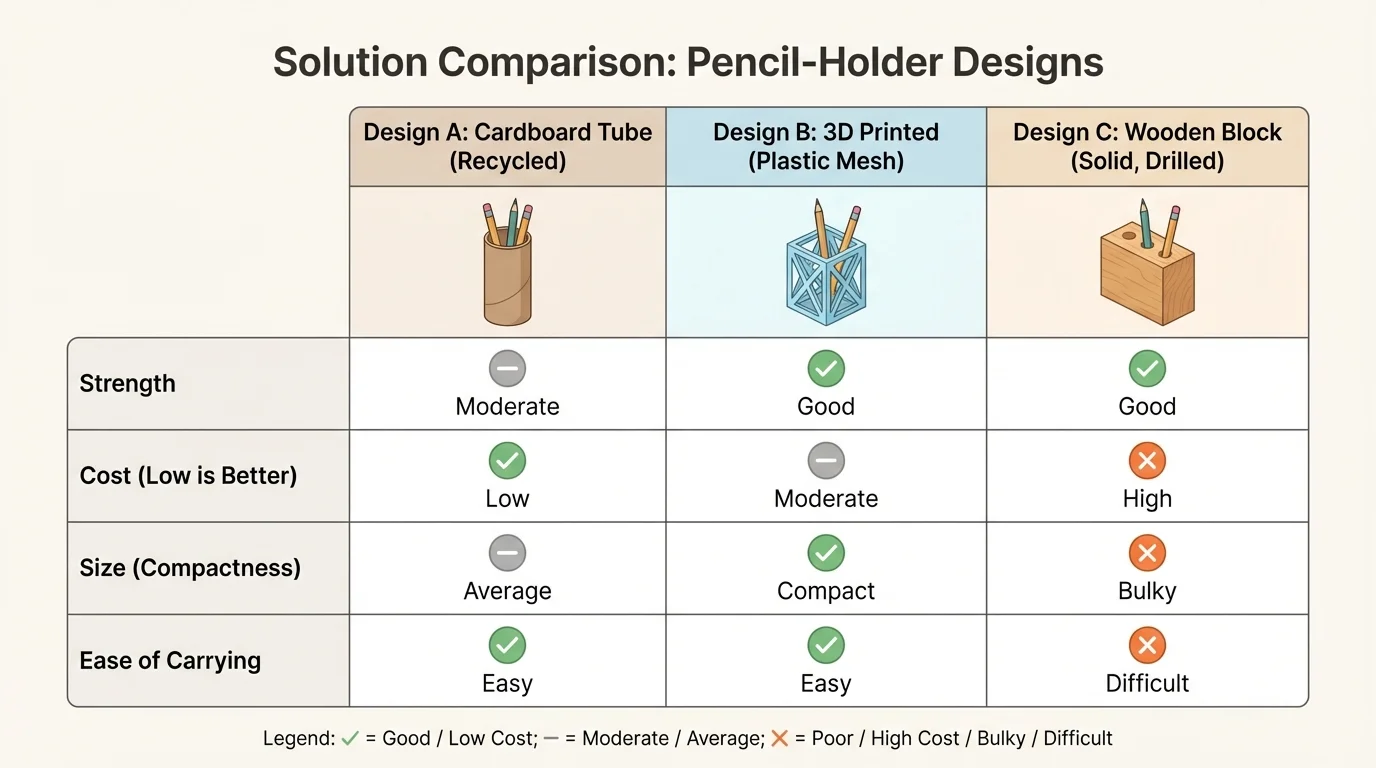
Comparing solutions does not mean there is always one perfect answer. Sometimes two designs are both strong choices, but one may be a little better for this problem. Engineers look for the design that best matches the full set of needs.
Many real engineers compare several designs before anything is built at full size. They often reject ideas that look impressive because the ideas do not fit cost, size, safety, or material limits.
This is why evidence matters. A student might say, "I like this design best," but an engineer asks, "What shows that this design will meet the criteria and constraints better than the others?"
Here is a design problem: a school wants a carrier that helps students move lunch trays from one counter to another without dropping them. The carrier should hold one tray steadily, be easy for a child to lift, and be made from cardboard and tape only. It also must fit through a narrow space.
Comparing three possible solutions
Three ideas are proposed: Design A is a flat board with side walls, Design B is a box with a front opening, and Design C is a carrier with one bottom support and a tall handle.
Step 1: List the criteria and constraints.
Criteria: holds one tray steadily, easy to lift, easy to place tray in and take tray out. Constraints: cardboard and tape only, must fit through the narrow space, should not be too heavy.
Step 2: Check each design against the problem.
Design A is light and fits easily, but the tray might slide out. Design B holds the tray more securely, but it may be bulky. Design C is easy to carry, but the tall handle may bend and make the tray tip.
Step 3: Decide which design is most likely to succeed.
Design B may be the best choice if the size stays within the limit, because it supports the tray well and keeps it steady. If it is too bulky, Design A might be improved by adding a small front lip to stop sliding.
The best choice comes from comparing how well each idea meets the full problem, not from choosing the most unusual shape.
This example shows an important truth: sometimes the best solution is not a completely new idea. It may be a simple design that matches the criteria well and stays within the constraints.
It also shows why comparison can lead to improvement. A design that is not chosen can still teach something useful. Maybe one handle shape from Design C can be added to Design B. Engineers often combine helpful parts of different ideas.
Now consider a different problem. A bench on the playground gets too hot in the sun. Students need a shade design that blocks sunlight, stays standing in light wind, and uses only paper, straws, string, and tape in the model. The model must fit on a small base.
Thinking through another comparison
Students create three model ideas: a flat roof on 2 posts, a triangle tent shape, and a curved roof over 4 supports.
Step 1: Focus on the main criteria.
The design should create shade over the bench area and stay upright. It should also fit on the base.
Step 2: Notice the trade-offs.
The flat roof may make good shade but tip easily. The triangle tent shape may be more stable but could shade less area. The curved roof may cover well, but it may use more materials and be harder to build neatly.
Step 3: Choose the strongest option for this problem.
If staying upright is most important, the triangle tent shape may be most likely to succeed. If shade coverage is the top criterion and the design can still stay stable, the curved roof may be better.
Good comparison means looking at the whole problem and deciding which features matter most together.
Notice that students are not required to test wind speed with machines or use exact measurements beyond the design process. The focus is on planning, comparing, and modeling solutions, which is a central part of elementary engineering.
Once engineers compare solutions, they can improve them. Maybe one design meets most criteria but not all. A student can ask, "What small change might help?" This is one of the most powerful parts of design thinking.
For example, if a paper supply container is easy to carry but too shallow, the sides could be made taller. If a shade model is stable but blocks too little sunlight, the roof could be widened. Comparing solutions helps students see exactly what to improve.
Strong scientific and engineering thinking depends on evidence. Observations, drawings, and organized comparisons help you explain why one solution is likely to work better than another.
Improvement does not mean starting over every time. It often means adjusting a design after noticing which criteria and constraints it already meets well and which ones still need attention.
Engineers often use a model to explore ideas before making a final product. A model can be a sketch, a labeled diagram, or a small physical version. Models help people think clearly, share ideas, and compare solutions. [Figure 3] illustrates several forms of the same design.
In elementary engineering, models are especially useful because they allow students to show shape, size, supports, openings, handles, or other important parts. A drawing may reveal that a design is too wide. A cardboard model may reveal that a support is too weak. These discoveries help students compare ideas better.
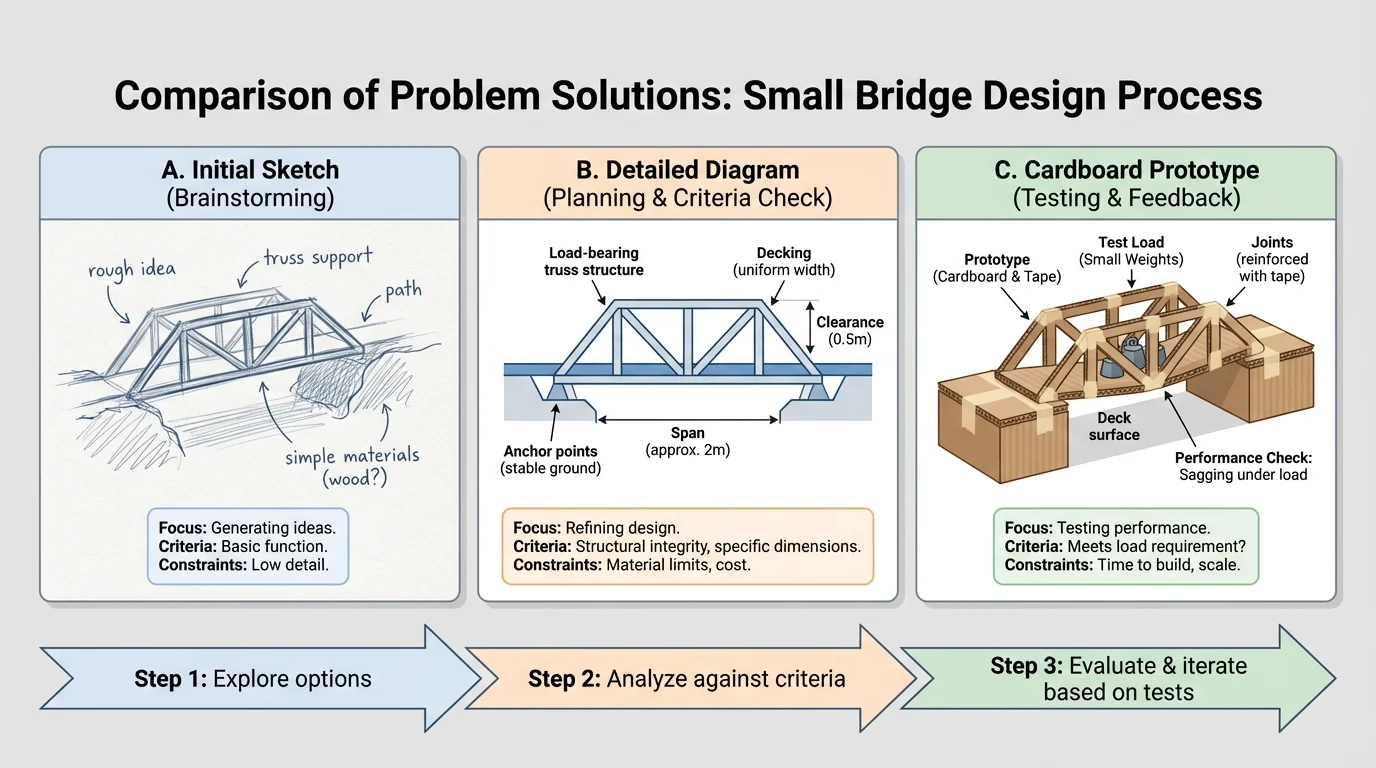
Models do not need to be perfect. Their job is to represent the important features of a design. A model is like a thinking tool. It lets engineers ask, "Will this likely work?" before making a final choice.
Later, when students compare several possible solutions, these kinds of models help them explain their ideas clearly. Instead of saying only "mine is better," they can point to the structure, support, or shape shown in the model.
One common mistake is choosing a favorite idea too early. A design may look cool but fail an important criterion. Another mistake is ignoring a constraint because it seems inconvenient. In engineering, constraints matter just as much as goals.
Another mistake is comparing solutions in an unfair way. If students test one design for strength but judge another only by appearance, the comparison is not balanced. Using the same questions for each design helps avoid this problem. The charting approach first introduced in [Figure 2] remains useful whenever students need to make a fair choice.
Smart design habits include drawing more than one plan, writing down criteria and constraints clearly, using simple models, and explaining choices with evidence. These habits help students think like engineers.
"The best design is the one that best fits the problem."
That idea may sound simple, but it is powerful. Engineering is not about picking the flashiest idea. It is about solving a problem in a way that works well within real limits.
People use this kind of thinking every day. Backpack designers compare straps, pocket shapes, and materials. Playground engineers compare slide shapes and support structures. Builders compare bridge designs. Even a reusable water bottle can be redesigned in different ways to improve grip, prevent spills, or reduce cost.
When real engineers work, they often begin with many possible solutions. They compare how safe, useful, strong, simple, and affordable each one is likely to be. The same kind of thinking can happen in a classroom with paper, tape, and cardboard.
Understanding criteria and constraints, generating multiple ideas, and comparing them with models prepares students to solve problems thoughtfully. The same skills can help with school projects, inventions, and everyday challenges where one idea is not enough.
