Have you ever noticed that some things make you say, "I want to do that again"? Maybe you love animals, drawing, singing, building, running, or telling funny stories. Those special interests are part of what makes you who you are. They can help you learn new things and help you connect with other people, too.
Your interest is something you like a lot or want to learn more about. Your strength is something you do well or are getting good at with practice. You may have a strength in drawing pictures, listening carefully, noticing details, helping others, or remembering songs.
Interests are things you enjoy and want to explore. Strengths are things you do well or can do well with practice. Both are important parts of knowing yourself.
Not everyone has the same interests and strengths, and that is a good thing. One child may love bugs. Another may love dancing. One child may be great at making people laugh. Another may be great at staying calm when a game is hard. Being different helps people learn from one another.
Your favorite things can make learning feel easier and more fun, as [Figure 1] shows. If you love animals, you may enjoy reading animal books. If you like building, you may enjoy solving puzzles. When something connects to what you already like, it is easier to pay attention.
For example, if you love music, you can sing directions to help remember them. If you like drawing, you can sketch a picture of what you are learning. If you like nature, you can look outside and talk about clouds, birds, or leaves while learning new words.
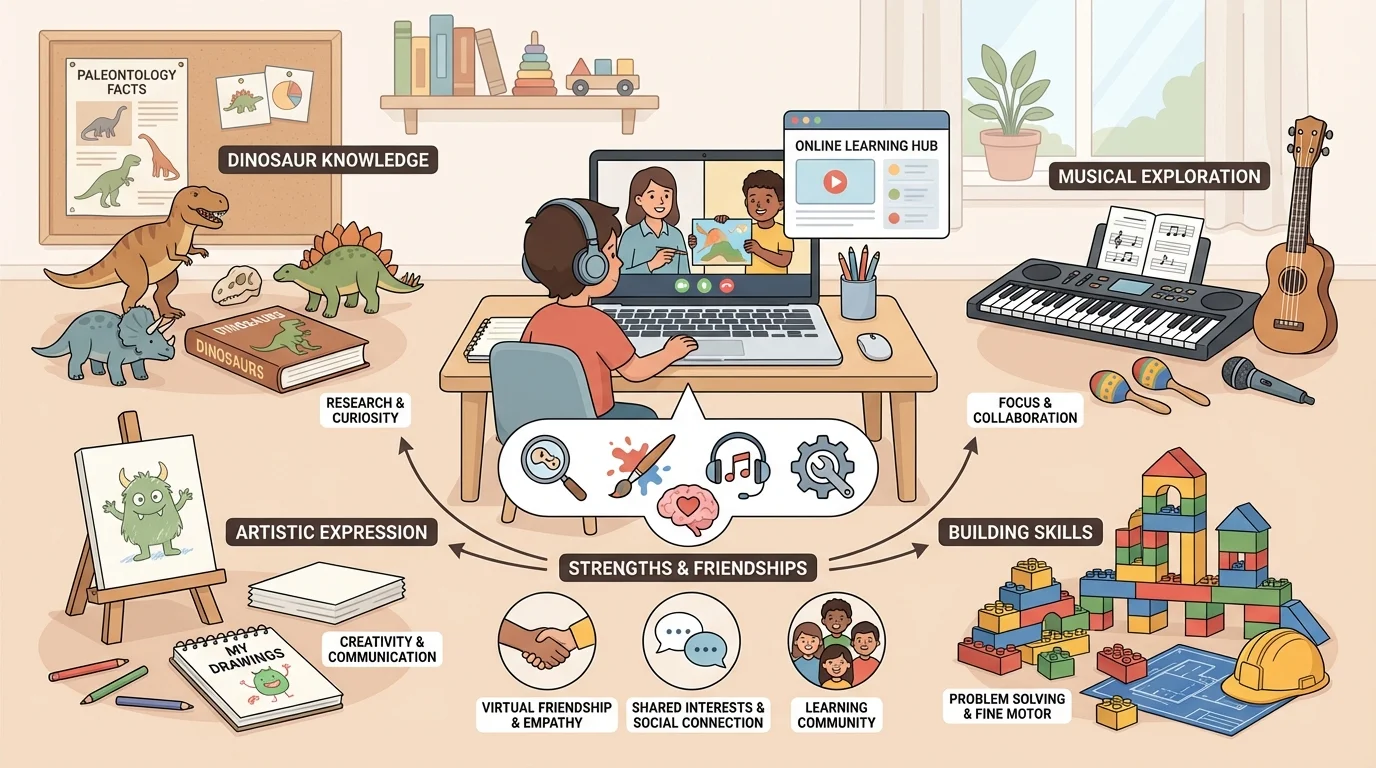
Interests can also help when schoolwork feels tricky. A child who does not want to write a sentence might feel more ready if the sentence is about dinosaurs or soccer or a pet. A favorite topic gives you a comfortable starting point.
Your brain often remembers things better when they connect to something you already enjoy. That is one reason favorite topics can be powerful learning helpers.
Later, when you need to try something new, you can use the same idea we saw in [Figure 1]: connect the new thing to something you already love. That can help you feel brave, curious, and ready to begin.
Your strengths can help other people feel happy, safe, and included, as [Figure 2] illustrates. A friend does not have to be the fastest runner or the best artist. A good friend can be someone who listens, shares, smiles, waits for a turn, or invites others to join a game.
Maybe one of your strengths is being gentle. That helps when someone feels sad. Maybe your strength is thinking of fun ideas. That helps when you want to start a game on a video call or at a club. Maybe your strength is noticing when someone is left out. That helps you include them.
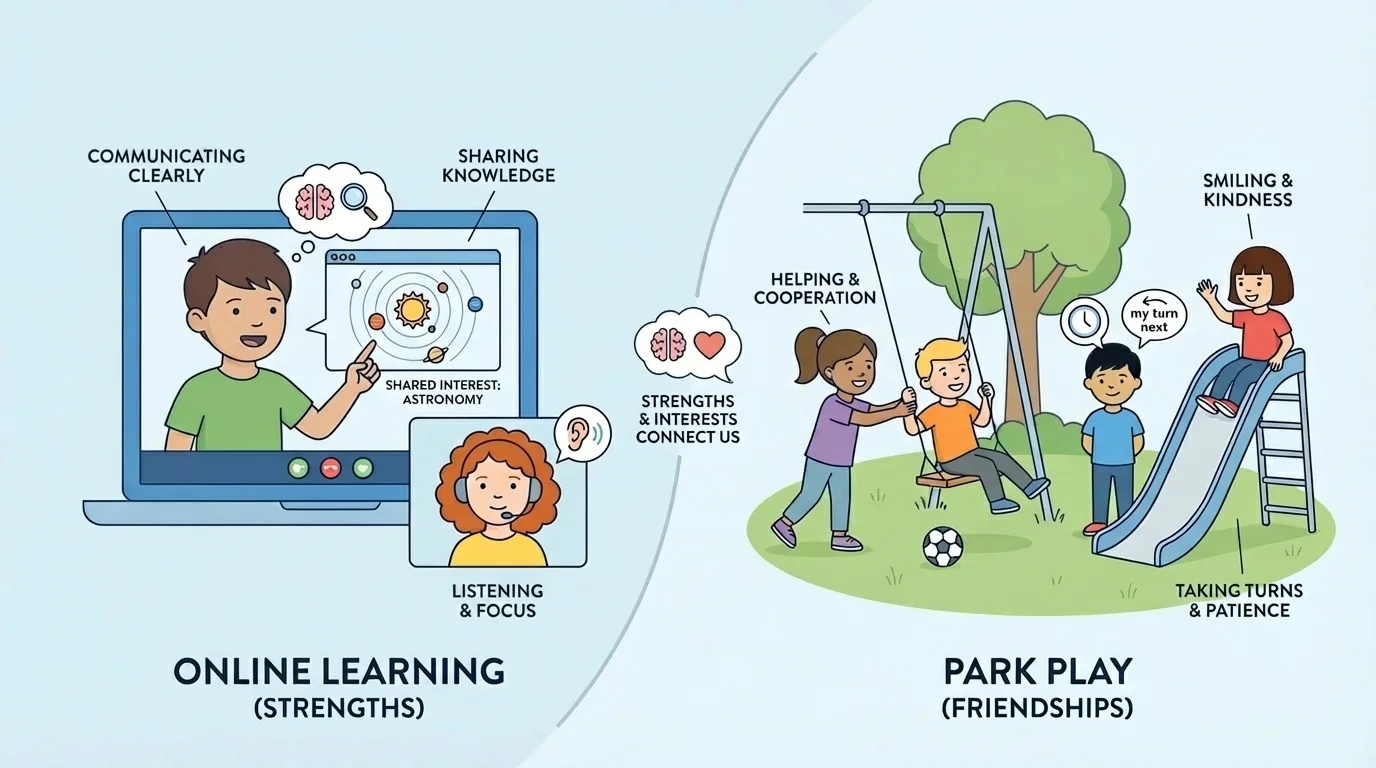
Friendships grow when people feel cared for. If you talk the whole time and never listen, a friend may feel ignored. If you listen, take turns, and use kind words, a friend is more likely to feel comfortable with you.
Different strengths help in different ways. Some strengths help with learning, like focusing, noticing details, or asking questions. Some strengths help with friendships, like kindness, patience, humor, and listening. Many strengths help with both.
If you are good at making pictures, you might draw a birthday card for someone. If you are good at explaining, you might help a younger child understand a game. Just as in [Figure 2], your strengths can be gifts you share with others.
[Figure 3] You can learn more about yourself by asking three simple questions: "What do I like?" "What am I good at?" and "What am I still practicing?" These questions help you build self-awareness, which means knowing yourself better.
Think about your day at home, your hobbies, your games, your video calls, and your time with family or community groups. Notice what makes you smile. Notice what feels easy. Notice what you choose again and again.
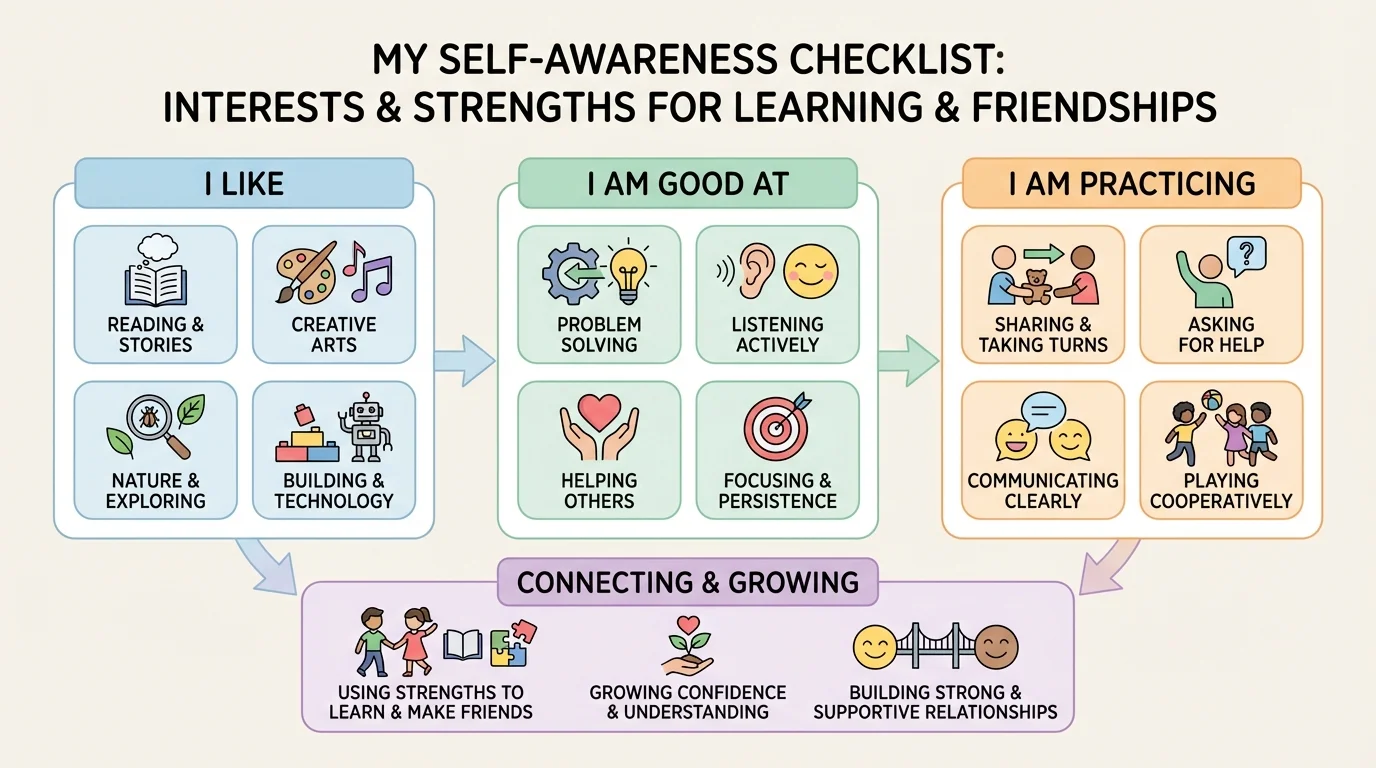
A simple way to notice your interests and strengths
Step 1: Say, "I like..."
You might say, "I like bugs," "I like singing," or "I like helping bake."
Step 2: Say, "I am good at..."
You might say, "I am good at sharing," "I am good at kicking a ball," or "I am good at remembering stories."
Step 3: Say, "I am practicing..."
You might say, "I am practicing reading," "I am practicing waiting," or "I am practicing speaking on video calls."
This helps you see that you already have strengths and you are still growing, too.
You can ask a trusted grown-up, "What do you think I am good at?" Sometimes other people notice strengths that you do not see yet. They might say, "You are very caring," or "You keep trying when something is hard."
It is okay to tell people about what you like and what you do well. You do not need to brag. You can just share in a friendly way. For example, you can say, "I really like whales," or "I am good at building tall block towers," or "I can help you if you want."
"You can be proud and kind at the same time."
When you share your interests, it helps people know you better. A new friend might say, "I like whales too!" or "Can you show me your drawing?" Shared interests can start conversations. Shared strengths can lead to teamwork.
Here are some kind ways to share: "Do you want to hear about my favorite bug?" "I like making up songs." "I am good at finding tiny details." "Would you like help?" These words open a door instead of making you sound better than other people.
You may see a friend do something easily that feels hard for you. That can happen to everyone. Maybe your friend reads fast, and you are still practicing. Maybe you are great at caring for pets, and your friend is still learning. People do not all grow in the same way or at the same speed.
You do not have to be good at everything right away. Practice, patience, and asking for help are important parts of growing.
If something feels hard, do not say, "I am bad at everything." Try saying, "This is hard for me right now." That little word now matters. It means you are still learning. You can have strong parts and growing parts at the same time.
The self-check in [Figure 3] helps here, too. You can remember: some things fit under "I am good at," and some things fit under "I am practicing." Both belong in your story.
If you like stories, read to a younger sibling or tell a story on a video call. If you like art, make a kind picture for a grandparent. If you are good at listening, let a friend finish talking before you answer. If you are good at noticing feelings, ask, "Are you okay?"
At home, your strengths can help with chores and family life. A careful child can help sort socks. A helpful child can carry napkins to the table. A child who loves numbers can help count apples. A child who loves animals can help feed a pet. These are real ways your interests and strengths matter every day.
| Interest or Strength | How It Helps You Learn | How It Helps with Friends |
|---|---|---|
| Drawing | Make pictures to remember ideas | Create cards or draw together |
| Listening | Hear directions carefully | Help others feel heard |
| Building | Solve problems with hands-on play | Work together on a project |
| Kindness | Ask for help politely | Make others feel safe and welcome |
| Curiosity | Ask questions and explore | Learn about what others like |
Table 1. Examples of interests and strengths and how they can help with learning and friendships.
Try This: Today, say one sentence that starts with "I like...," one sentence that starts with "I am good at...," and one sentence that starts with "I am practicing...." Then use one of those things to help someone or help yourself learn.
You are not meant to be exactly like anyone else. Your interests and strengths are clues about who you are. When you notice them, use them, and share them kindly, you grow as a learner and as a friend.
