Have you ever finished something and wanted to smile really big? Maybe you cleaned up your toys, finished a picture, or completed your online work all by yourself. That warm, happy feeling is called feeling proud. Proud moments help you see that you can do hard things, one step at a time.
Being proud means you feel good about something you did. It does not mean bragging or saying you are better than other people. It means you notice your own work and say, "I did it," or "I kept going."
Proud means feeling happy about something you did or worked hard to do.
Effort means the hard work, time, and energy you use to do something.
Finish means you complete a task and do not stop before it is done.
A task can be big or small. You might zip your coat, put your dish in the sink, read a book page, build with blocks, or finish an online drawing activity. When you finish, you can think about how you did it, not just what you did.
That is important because effort matters. Sometimes a task is easy. Sometimes it takes extra effort. Both can feel good, but a hard task often gives you a bigger proud moment because you know how much work you used.
Many jobs happen one small step at a time, as [Figure 1] shows. When you look back at the steps, you can see your effort more clearly. Maybe you first found your crayons, then chose colors, then kept coloring, and then put everything away.
You can ask yourself simple questions: What did I start? What did I keep doing? What was hard? What helped me finish? These questions help you notice that finishing is not magic. It happens because you do something, then another thing, then another thing.
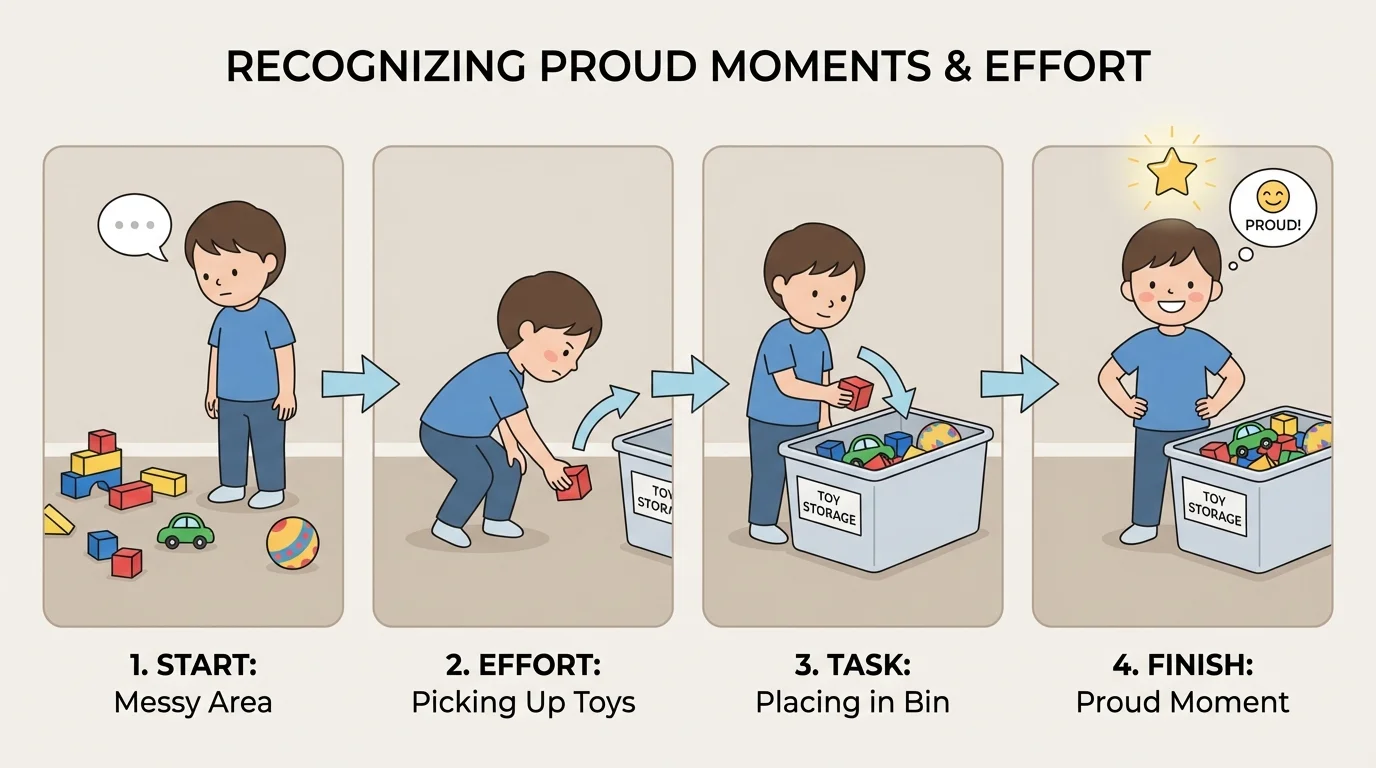
For example, if you made your bed, your steps may have been: pull up the blanket, fix the pillow, smooth the sheet, and look at your finished bed. Each step counts. Even small steps are real work.
Small steps build big pride. When you break a task into little parts, it feels easier to do. Afterward, you can say, "I finished because I kept doing the next step." This helps you trust yourself the next time a job feels big.
Sometimes you may forget how much work you used. Looking back at the steps helps you remember. Just like the child in [Figure 1], you do not jump from a messy space to a finished job in one second. You move through the steps.
You can have proud moments every day at home, in your neighborhood, or while learning online. You do not need a prize or a gold star to have one. You only need to notice what you did.
Here are some real-life examples:
| Task | Effort You Used | Proud Thought |
|---|---|---|
| Finished an online lesson | Listened, clicked carefully, stayed with it | I finished my work. |
| Put toys away | Picked up items, sorted them, kept going | I helped clean up. |
| Drew a picture | Tried details, chose colors, did not quit | I worked hard on this. |
| Learned to tie a shoe | Tried again and again | I kept practicing. |
| Helped make a snack | Followed directions, waited, stayed careful | I was helpful and responsible. |
Table 1. Examples of everyday tasks, the effort used, and simple proud thoughts.
A proud moment can also happen when you help someone. Maybe you muted your microphone during a video class, waited for your turn to speak, or sent a kind message in an online club. Finishing a social task counts too, because it takes self-control and care.
Your brain grows when you keep trying. Every time you practice a skill, you are helping yourself get stronger at it.
You may feel proud for different reasons on different days. One day, you may be proud because you finished quickly. Another day, you may be proud because you kept going even when it was hard. Both kinds of pride matter.
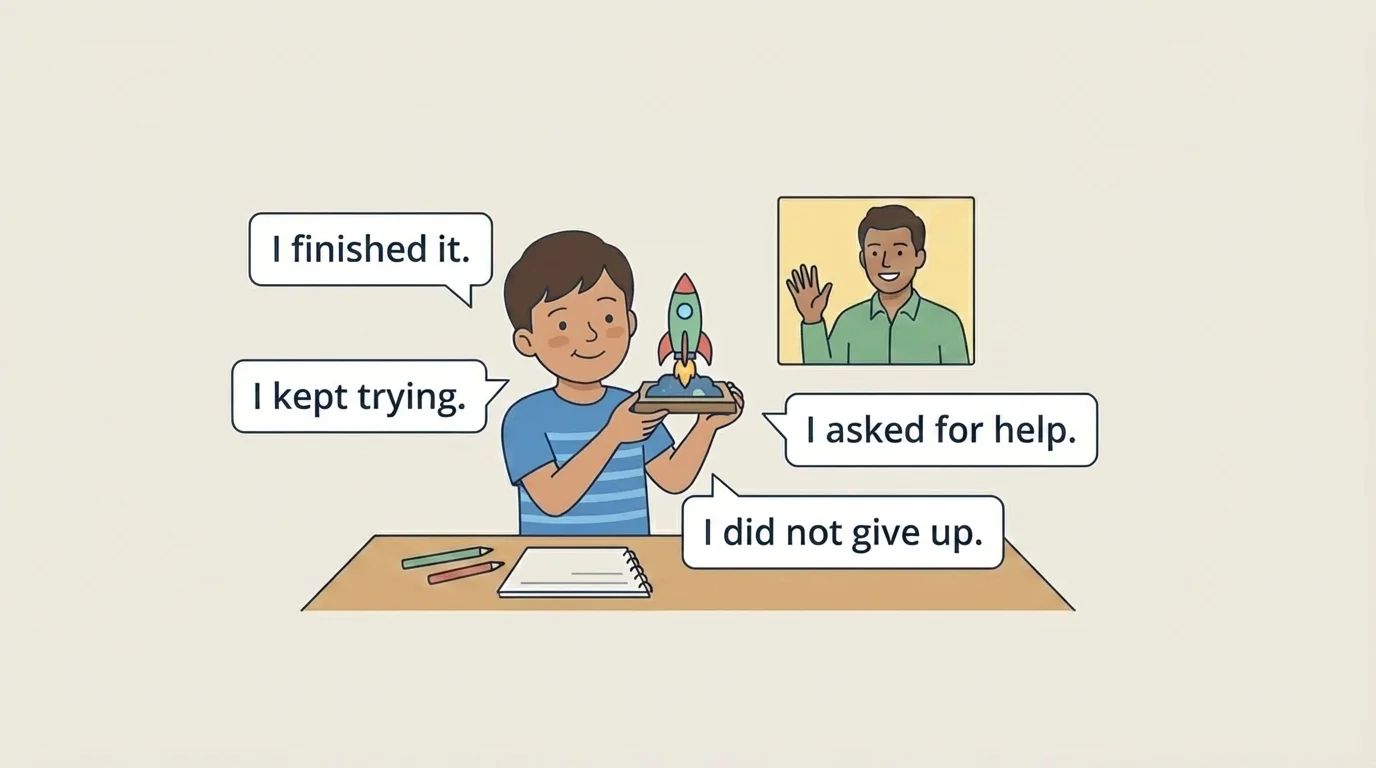
Sometimes the best way to notice a proud moment is to say it out loud. Simple words can help, as [Figure 2] illustrates. You can tell a parent, caregiver, sibling, or teacher what you finished and what effort you used.
Try short sentence starters like these: "I am proud because I finished ____." "I kept trying when ____." "I asked for help and then I finished." "I made a mistake, but I tried again." These words help you explain your work clearly.
Talking about a proud moment
Step 1: Name the task.
Say, "I finished my reading page."
Step 2: Name the effort.
Say, "I sounded out the hard words and kept going."
Step 3: Name the feeling.
Say, "I feel proud of myself."
This helps you see both the job and the hard work behind it.
You do not have to use big words. Small, true words are enough. You can say, "I did it." You can say, "It was hard, but I finished." You can say, "I kept trying." These are strong words because they tell the truth.
Later, when you are on a video call or sharing your work online, you can use the same sentence starters from [Figure 2]. They help you talk about yourself in a calm, confident way.
Not every task feels fun. Some tasks feel slow, messy, or frustrating. That is normal. When work feels hard, you can follow a calm plan, as [Figure 3] shows. A hard moment does not mean you cannot do it. It means you may need more time, more practice, or some help.
Mistakes are part of learning. If your tower falls, your letters look messy, or you click the wrong thing in an online activity, that is not the end. You can stop, breathe, and try one more step.
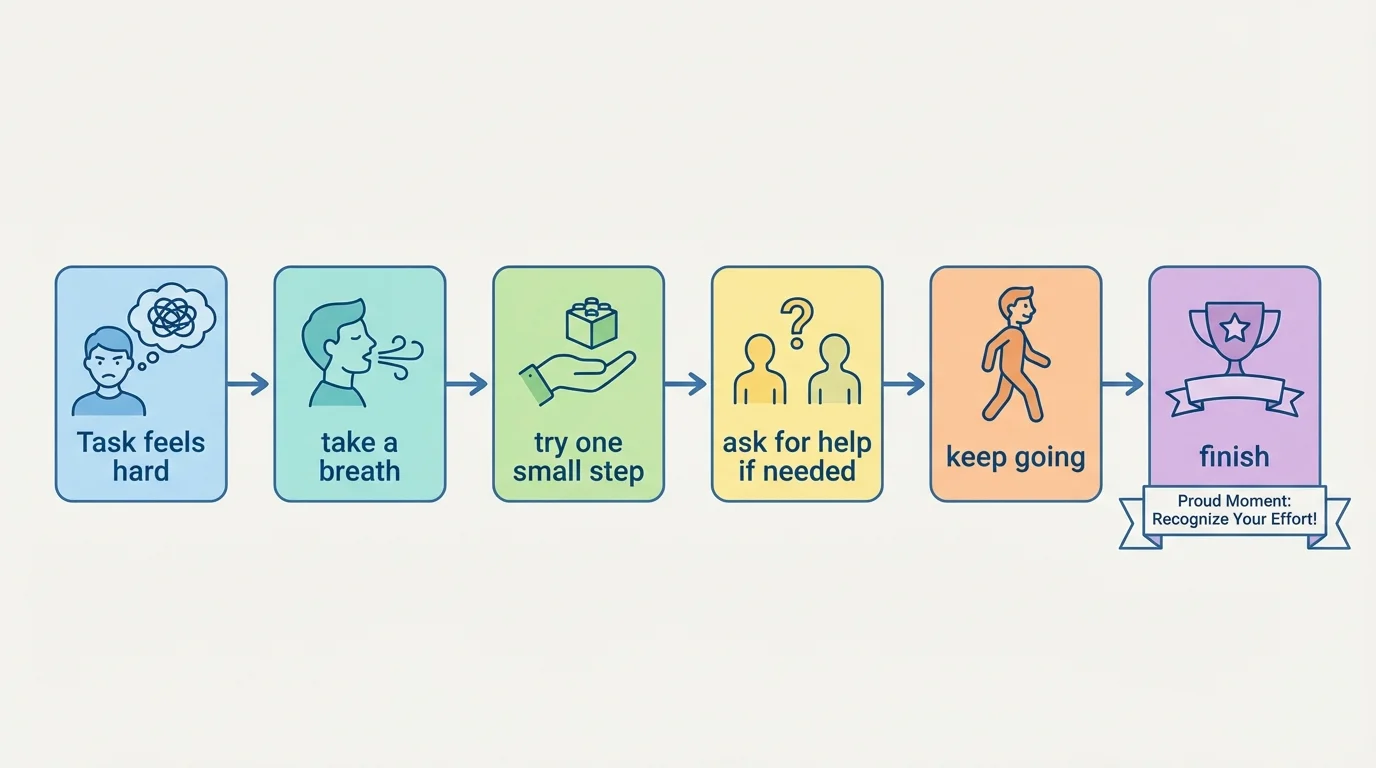
Asking for help is also part of effort. If you ask, "Can you show me the first step?" or "Can you help me understand this part?" you are still working hard. Getting support helps you keep moving instead of giving up.
"I can try again."
— A strong thought for hard moments
Think about learning to button a shirt or use scissors. You probably did not do it perfectly the first time. You practiced. You improved. Then one day, you noticed a proud moment. The same thing happens with many tasks.
The flow in [Figure 3] reminds you that you can take a breath, do one small step, and keep going. That plan helps you stay calm and finish more often.
You can build this skill every day by paying attention to what you finish. After a task, pause for a moment. Ask yourself: What did I do? What effort did I use? How do I feel now?
Here are a few simple ideas you can use right away:
Try This: After you finish one job today, say, "I am proud because I ____."
Try This: If a task feels hard, say, "I can do one more step."
Try This: Tell someone at home about one thing you finished and one way you kept trying.
Try This: Before you stop, check: Is the job really finished, or is there one last step?
You are growing every time you notice your work. Proud moments are not only for huge things. They can come from brushing your teeth without reminders, feeding a pet, finishing a puzzle, or cleaning up art supplies. Small jobs help build a strong, confident you.
When you notice effort, you learn something important: you can do hard things. Maybe not all at once. Maybe not perfectly. But step by step, with practice, patience, and help when needed, you can finish.
