Have you ever had a small problem turn into a big one because someone used a mean voice or angry words? That can happen quickly. A tiny disagreement about a game, a toy, a turn, or a message online can grow when people feel hurt. The good news is that you can help solve problems in a kind way. You can use clear words, a calm voice, and respectful actions.
A conflict is a problem or disagreement between people. It can happen with a sibling, friend, teammate, neighbor, or someone in an online game or on a video call. Conflict does not always mean people are being bad. Sometimes two people want different things. Sometimes someone makes a mistake. Sometimes feelings get big.
What matters most is respectfully solving the problem. Respectfully means you treat the other person with care, even when you are upset. You do not need to agree with everything. You do need to be safe, kind, and clear.
Conflict is a disagreement or problem between people.
Respectfully means in a kind, calm, and safe way.
When conflict is handled well, people can fix problems, feel heard, and move on. When conflict is handled poorly, feelings can get hurt, trust can shrink, and the problem can last longer.
You have three big helpers when a problem starts: words, tone, and actions. As [Figure 1] shows, the same problem can go in two very different directions depending on how you speak and act. Clear words tell what happened. A calm tone helps the other person listen. Respectful actions keep everyone safe.
Clear words sound simple and honest. Instead of saying, "You are mean," you can say, "I did not like that," or "Please stop." A calm tone means your voice is not yelling, mocking, or whining. Respectful actions mean using safe hands, giving space, and looking ready to listen.
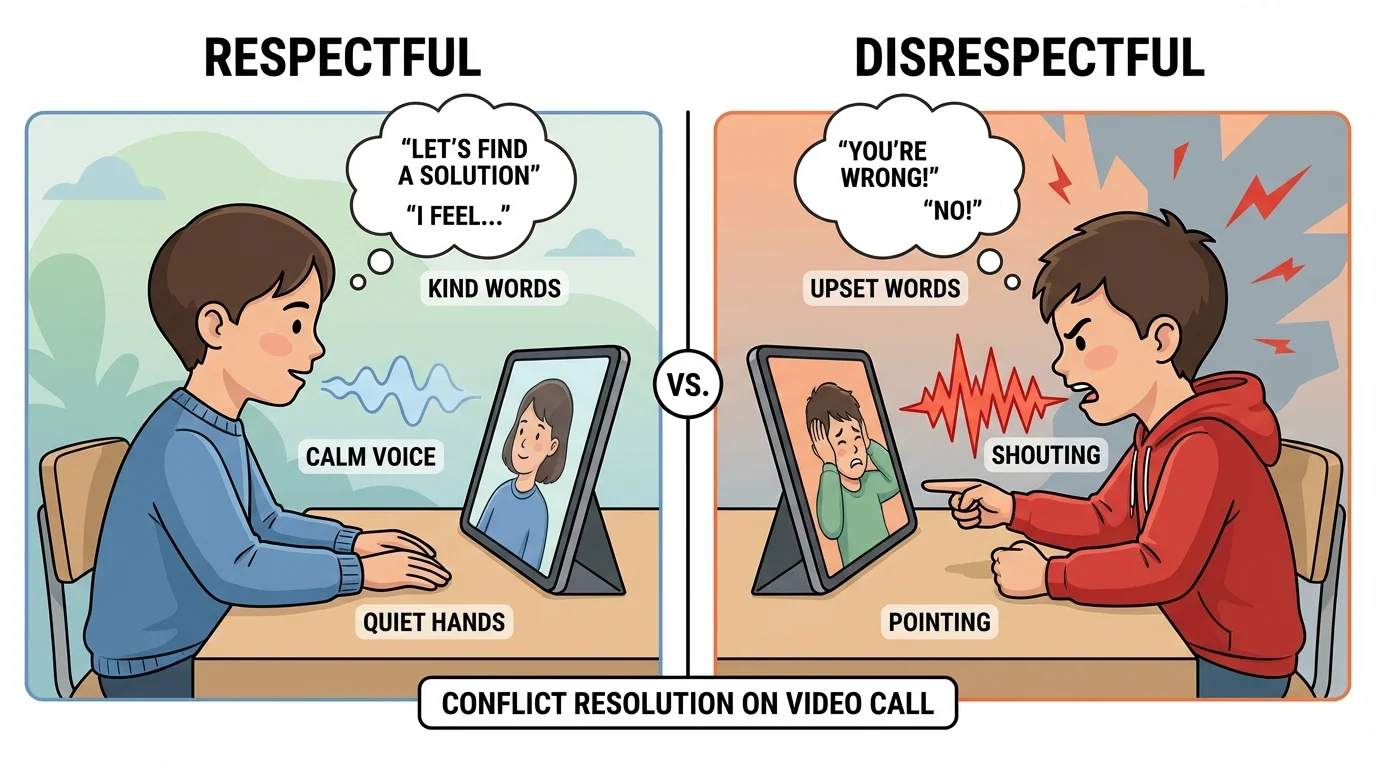
If one helper is missing, the problem can get bigger. You may choose good words, but if your voice sounds angry, the other person may still feel hurt. You may stay quiet, but if you slam a door or grab something, your actions still send a message.
Your brain can understand kindness faster when it hears a calm voice and sees safe actions. People listen better when they feel safe.
That is why respectful conflict solving is not only about what you say. It is also about how you say it and what your body does.
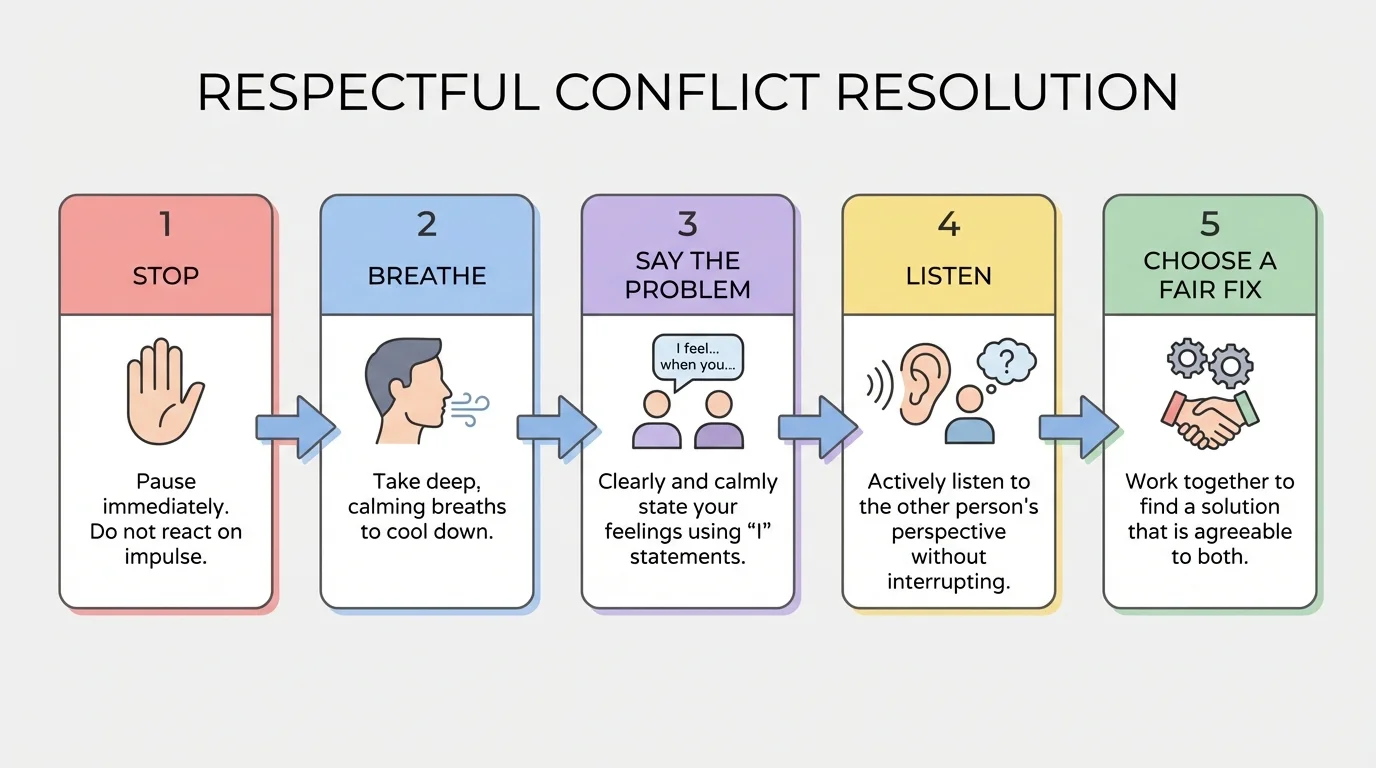
When you feel mad, sad, or frustrated, it can be hard to think. A simple plan helps. The steps in [Figure 2] give you something easy to do when a disagreement begins.
Step 1: Stop. Do not grab, hit, yell, or send a rude message.
Step 2: Breathe. Take a slow breath in and out.
Step 3: Say the problem with clear words.
Step 4: Listen to the other person.
Step 5: Choose a fair fix together.
This plan works at home, during a playdate, in an activity group, or on a video call. It also works if you are upset in a game chat. You can pause before typing. You can reread your message and make it kinder.
Example: A turn-taking problem
Your cousin is using the tablet and you want a turn.
Step 1: Stop and breathe.
You notice that you feel upset, so you pause instead of grabbing the tablet.
Step 2: Use clear words.
You say, "I want a turn too. Can I have it when you are done?"
Step 3: Listen.
Your cousin says, "I need two more minutes."
Step 4: Choose a fix.
You agree to wait two minutes and then switch.
The problem gets solved without yelling or grabbing.
Sometimes the fix is taking turns. Sometimes it is saying sorry. Sometimes it is using different items, waiting, or asking an adult to help make a fair plan.
Clear words are short, true, and kind. They tell the problem without name-calling. They also tell what you need. This helps the other person understand you better.
Good sentence starters can help. You can say, "I feel sad when you turn off my game." You can say, "Please ask before you use my crayons." You can say, "I need a turn," or "I want to solve this." These are called I-messages because they start with your own feeling or need.
Why I-messages help
I-messages keep the focus on the problem and your feelings instead of blaming. They help the other person listen without feeling attacked right away.
Try to avoid blaming words like "always" and "never." If you say, "You always ruin everything," the other person may stop listening. If you say, "I feel upset when my picture gets scribbled on," you are clearer and kinder.
As shown earlier in [Figure 1], clear words work best when they match a calm voice and safe body. The three helpers work together.
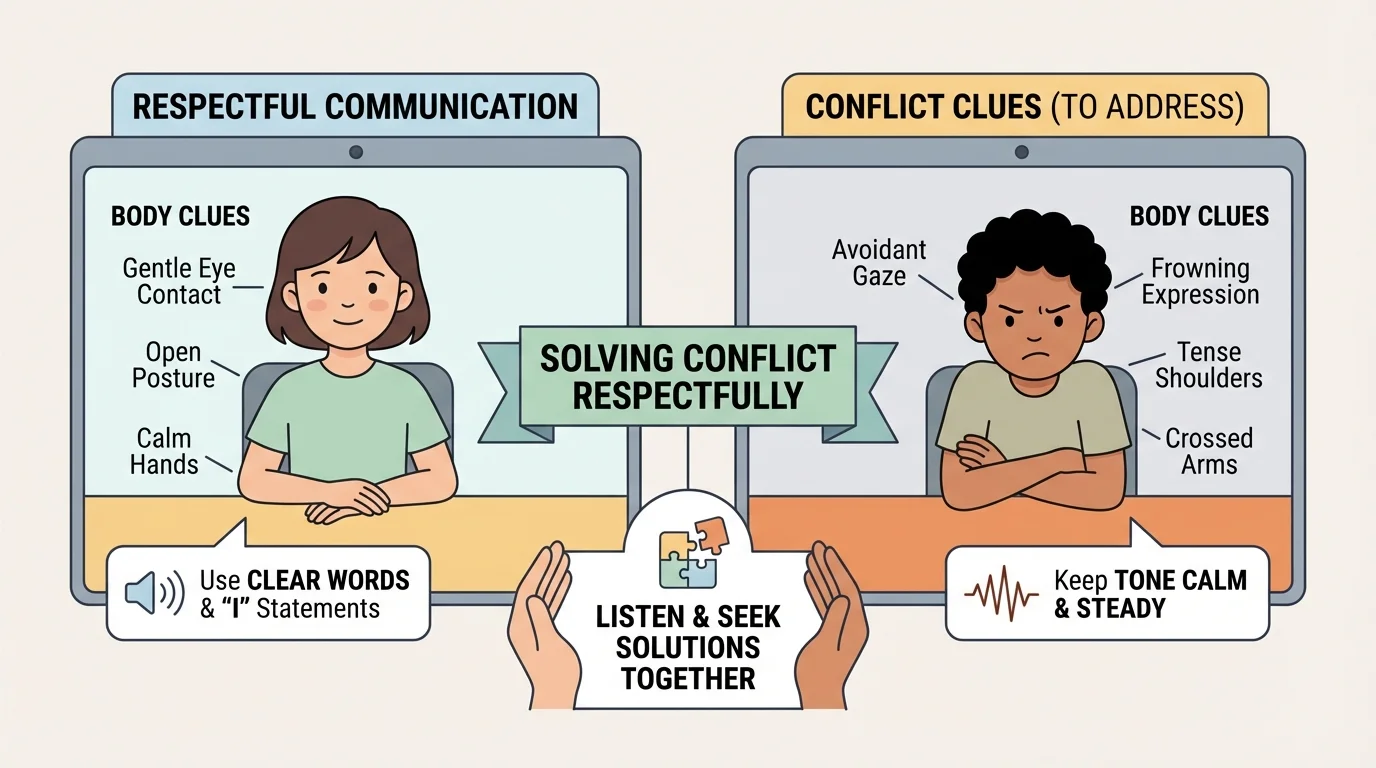
Your tone and body give clues about how you feel, as [Figure 3] illustrates. Even if your words are polite, a loud or sharp voice can still feel unfriendly. On a video call, people can hear your voice and see your face. In a message, people cannot hear your voice, so your words need to be extra clear and kind.
Helpful body clues include looking calm, keeping hands to yourself, and giving space. Respectful body language might include standing still, uncrossing your arms, or taking one step back if someone needs room. Unsafe body clues include stomping, getting too close, grabbing, or throwing things.
If you are typing instead of talking, tone still matters. Words in all capital letters can seem like shouting. Sending many angry messages in a row can make the problem worse. A better choice is to write one calm sentence, then wait for a reply.
Example: Fixing a message before sending it
First message: "GIVE IT BACK NOW!"
Step 1: Pause.
Take your hands off the keyboard for a moment.
Step 2: Rewrite with respect.
Change it to: "Please give it back. I am using it."
Step 3: Check the tone.
Ask yourself, "Does this sound calm and clear?"
The second message is more likely to solve the problem.
When your feelings are very big, your body may need help calming down first. You can take a breath, hug a pillow, count slowly, or sit in a quiet spot for a minute. Then talk.
Conflicts happen in many places, not just one. You might disagree about whose turn it is, what game to play, who gets the blue marker, or whether a joke was funny. You might also have a problem in an online game if someone is not following the rules.
Here are some respectful choices you can make:
| Problem | Respectful words | Respectful action |
|---|---|---|
| Someone interrupts you on a video call | "I was still talking. Please let me finish." | Wait, then speak in a calm voice |
| A friend takes your turn in a game | "It is my turn now." | Point to the turn order, not at the person |
| A sibling uses your item | "Please ask before using my things." | Hold out your hand and ask for it back safely |
| Someone sends an unkind message | "I do not like that message. Please stop." | Do not send a mean message back |
Table 1. Everyday conflicts and respectful ways to respond.
The conflict-solving steps from [Figure 2] help in all of these situations. First calm your body, then use simple words, then listen, then look for a fair answer.
Some problems are too big to solve by yourself. You should get an adult right away if someone is hitting, threatening, breaking important things, being very unsafe online, or refusing to stop after you used clear words. Asking for help is smart, not weak.
You can say, "I tried to solve this respectfully, but I need help now." Tell what happened with clear facts. Say who was there, what was said or done, and what you already tried.
It is always okay to protect your safety. Respectful conflict solving never means staying in a dangerous situation.
Adults can help when both people are too upset, when the problem keeps happening, or when a fair solution is hard to find.
No one solves every problem perfectly the first time. Respect is a skill, and skills grow with practice. Each time you stop, breathe, speak clearly, and use safe actions, you get stronger at solving conflict.
When you make a mistake, you can repair it. You can say, "I am sorry I yelled. Let me try again." That is respectful too. Learning to restart is part of growing.
"Kind words, calm voices, and safe actions help people solve problems."
Using clear words, a calm tone, and respectful actions helps people feel heard. It protects friendships, helps families work together, and makes online and home spaces feel safer.
