Have you ever looked at schoolwork and thought, "That is a lot"? The good news is this: you do not need a big, fancy plan. You just need a few small steps. When you make a simple plan, your work feels calmer, your brain knows what to do next, and you are more likely to finish on time.
Planning means thinking about what you need to do before you start. It is like getting ready for a game or a trip. A little planning helps you begin faster and keep going.
When you do not plan, you might forget your pencil, leave your tablet uncharged, or stop in the middle because you are not sure what comes next. When you do plan, you can begin with confidence. You know where to sit, what to get, and what to do first.
Planning is making a simple idea for what to do first, next, and last. Finish on time means your work is done before it is too late. Task means a job you need to do.
This matters in online school because you are working from home. You are the one who clicks into your lesson, opens your work, and gets ready. A good plan helps you be more independent.
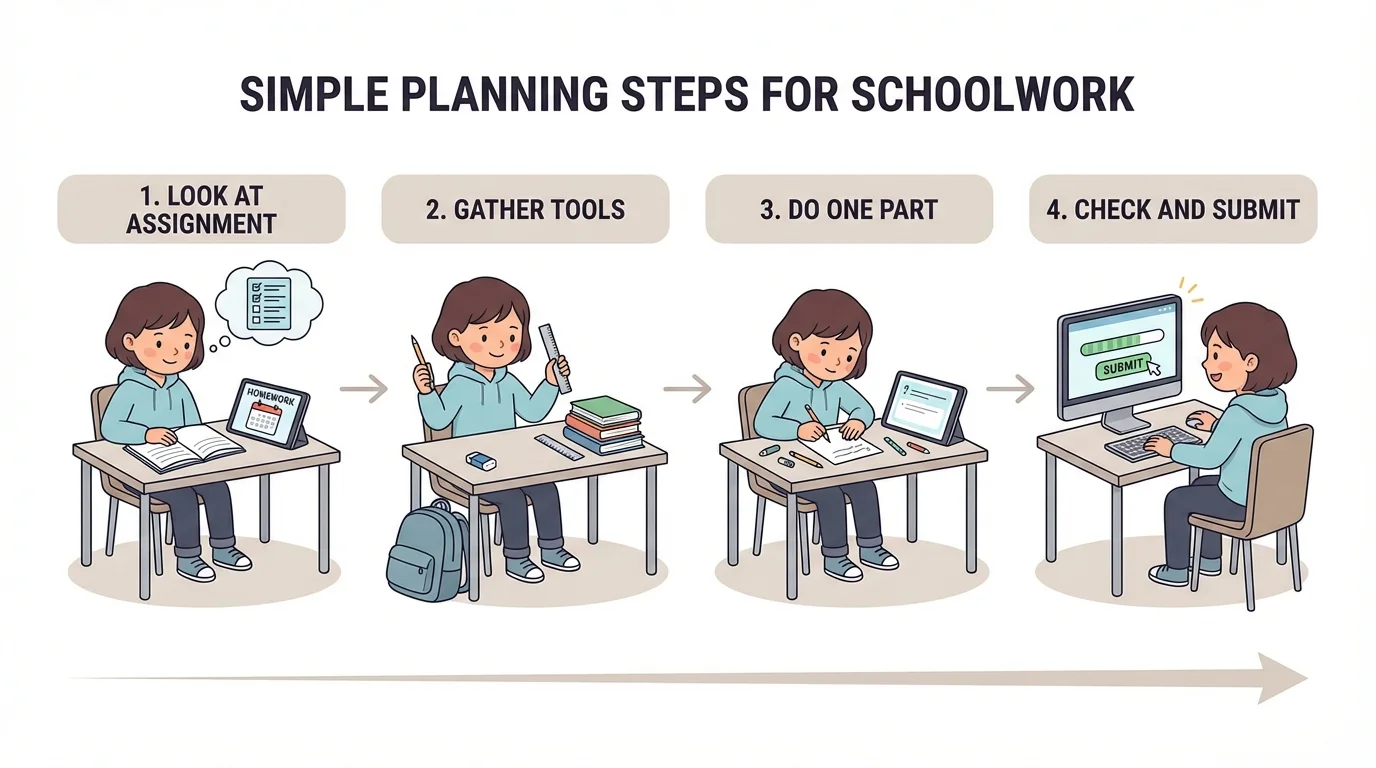
You can use the same little routine every day, as [Figure 1] shows. If you remember these four steps, starting and finishing schoolwork becomes much easier.
Step 1: Look. Read or listen to the directions. Ask yourself, "What am I supposed to do?"
Step 2: Get ready. Gather what you need. That might be a pencil, paper, headphones, or your computer.
Step 3: Do. Start with the first part only. You do not have to think about the whole job at once.
Step 4: Check. Look over your work, make sure your name is there if needed, and turn it in.
If your assignment is to watch a short video and answer three questions, your plan can be very simple: look at the directions, get your headphones, answer question one, answer question two, answer question three, then check and send.
A small routine is powerful because you can use it again and again. Later, when you feel stuck, you can think back to [Figure 1] and remember that every job has a first step, a middle step, and a last step.
Before you begin, make your space ready. Sit in a spot where you can pay attention. Put your water nearby. Open the tab or app you need. If your device needs power, plug it in.
This is called being prepared. Being prepared saves time. Instead of getting up again and again, you can stay with your work.
Example: Getting ready for reading work
Step 1: Open the reading lesson on your computer.
Step 2: Get your headphones and a pencil.
Step 3: Sit down with paper for your answers.
Step 4: Begin the first question right away.
This kind of setup helps you start quickly instead of wandering around the house looking for things.
If you need help, it is okay to ask an adult at home. You can also send a message to your teacher in the online classroom if that is how your school works. Asking for help is smart planning, not giving up.
Sometimes the hardest part is not starting. It is staying with the job until it is done, as [Figure 2] shows. A short timer can help because it tells your brain, "This is work time now."
You might work for a small amount of time, like a short work time chosen by your grown-up or teacher, and then take a quick break when the task is done or at an approved stopping point. During work time, try to do one task at a time. If a toy, game, or extra tab is calling your name, move it away or close it.
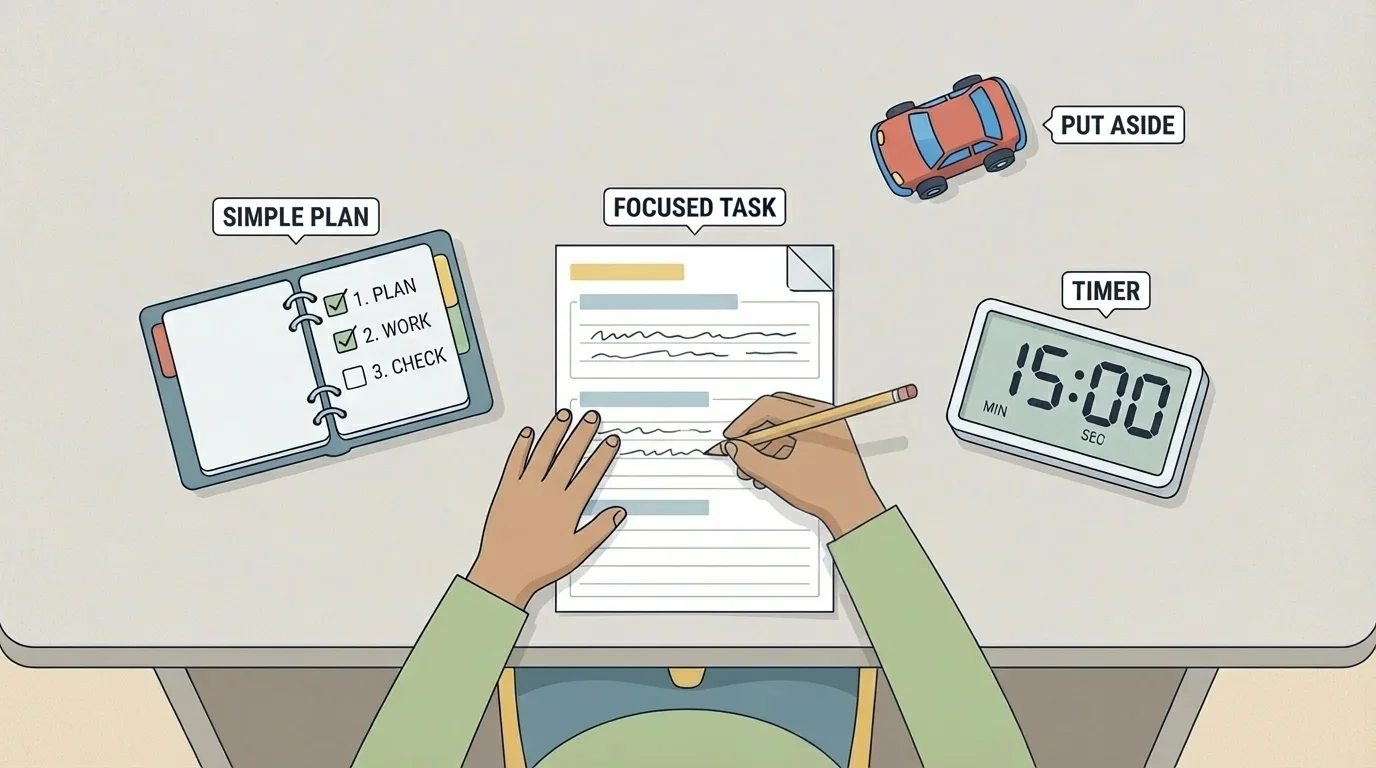
Focus means paying attention to what you are doing right now. When you focus on one thing, you make fewer mistakes and finish faster.
For example, if you keep stopping to play, your work takes longer. But if you stay with one question, then the next, then the next, you keep moving forward. That is the same one-task idea shown in [Figure 2].
Your brain often feels happier when a job is finished. Checking off one small step can make the next step feel easier.
A good way to finish on time is to say the next step out loud in a quiet voice: "First I answer this one. Next I check it. Last I send it." Simple words help your brain stay organized.
Sometimes work feels too big. That does not mean you cannot do it. It means you need to make the task smaller.
This strategy is called chunking. If you have six questions, do not stare at all six. Cover the others if you need to and do only question one. Then do question two. Little pieces feel safer and easier.
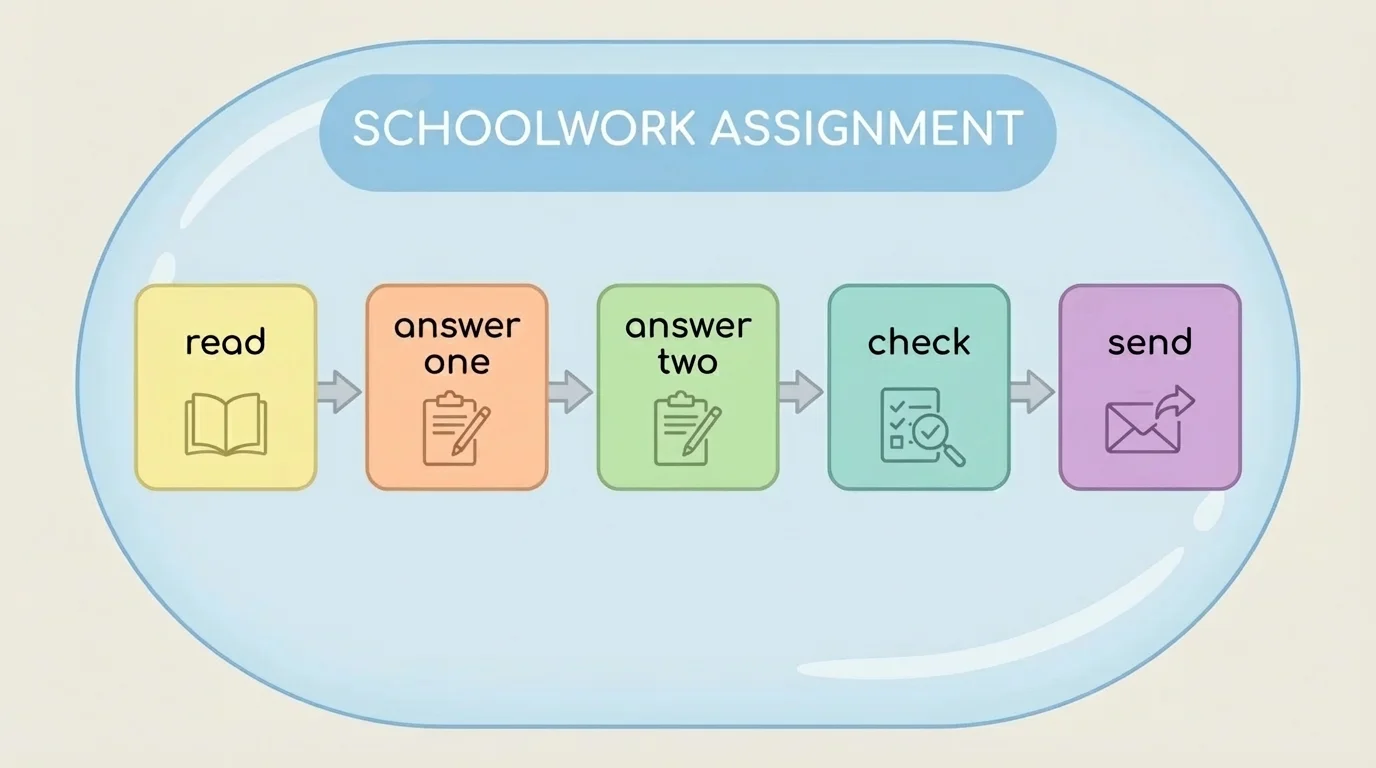
If you feel upset, stop for a moment. Take a slow breath. Stretch your hands. Get a sip of water if an adult says that is okay. Then come back and do the next tiny part. [Figure 3] shows how a big job can be split into smaller steps.
You can also use a simple check plan: read, do one, check, keep going. The small-box idea in [Figure 3] helps you see that even big work is really many little jobs together.
Small steps build strong habits
When you use the same planning steps again and again, your brain starts to remember them. Then you do not have to guess how to begin. Your routine becomes a helpful habit.
When work feels hard, do not wait too long without help. If directions are confusing, ask a grown-up or send a message in your class platform. Planning includes knowing when to ask.
Here are some real-life schoolwork moments from home.
Good planning: Maya logs in, reads the directions, gets her crayons, finishes one page, checks it, and uploads it. She feels proud because she is done before play time.
Poor planning: Eli opens his lesson but starts watching other videos. Then he cannot find his paper. He rushes later and feels frustrated.
Example: A simple after-lunch work plan
Step 1: Sit down and open the lesson.
Step 2: Read the directions with care.
Step 3: Get the tools you need.
Step 4: Do one part at a time.
Step 5: Check and turn in your work.
This plan is easy to remember and works for many kinds of assignments.
When planning goes well, you usually feel calm, ready, and successful. When planning is skipped, work may feel messy, late, or stressful.
You do not need a huge chart or long list. You can use a tiny routine each day: Look. Get ready. Do. Check. Say it before you begin.
You can even keep a small note near your work space with these words. Over time, you will need the note less because the routine will live in your mind.
"Start small. Keep going. Finish strong."
Try This: Before your next assignment, pause for a few seconds and say, "What do I do first?" Then do only that first step.
Try This: Put away one distraction before work starts. Maybe close a game tab, move a toy, or put your device on the right lesson page.
Try This: When you finish, check once before turning in your work. A quick check can catch small mistakes.
