Have you ever looked for a pencil, your favorite book, or one shoe, and it seemed to disappear? That can happen when things do not have a special place. Organizing means putting things where they belong so you can find them fast, use them safely, and keep your home feeling calm.
When you organize well, your day gets easier. You can start schoolwork faster, get ready for bed more smoothly, and help your family keep spaces neat. When things are not organized, you may waste time searching, feel upset, or leave a mess for someone else to fix.
Organize means to sort things and put them in the right place. Personal items are things that belong to you, like your shoes or books. Shared spaces are places everyone in your home uses, like a table, sofa area, or bathroom counter.
A good rule is simple: every item needs a home. A home can be a shelf, basket, drawer, hook, or box. If you know an item's home, you know where to put it back.
Organizing helps you in real life. You can find your socks in the morning, your crayons during art time, and your headphones before your online class starts. It also helps you take care of your things. Books are less likely to get bent, crayons are less likely to break, and chargers are less likely to get lost.
It also shows respect. When you clean up after yourself, you make the space nicer for the next person. If you leave blocks on the floor or papers on the table, someone could trip, lose room to work, or feel frustrated.
Many people clean faster when they organize by small groups first. Putting all books together and all art tools together is often easier than cleaning one random item at a time.
You do not need to make everything perfect. You just need a system that is easy to use every day.
Your personal items are a great place to start. [Figure 1] shows how each one needs a home so you know exactly where it goes after you use it. That makes cleanup faster and helps you feel in charge of your space.
Step 1: Pick up one kind of thing at a time. Start with shoes, then books, then toys, then clothes. Sorting by kind keeps your brain from feeling too busy.
Step 2: Choose where each group belongs. Shoes can go by the door or on a shoe mat. Books can go on a shelf. Pajamas can go under a pillow or in a drawer. Stuffed animals can go in a basket.
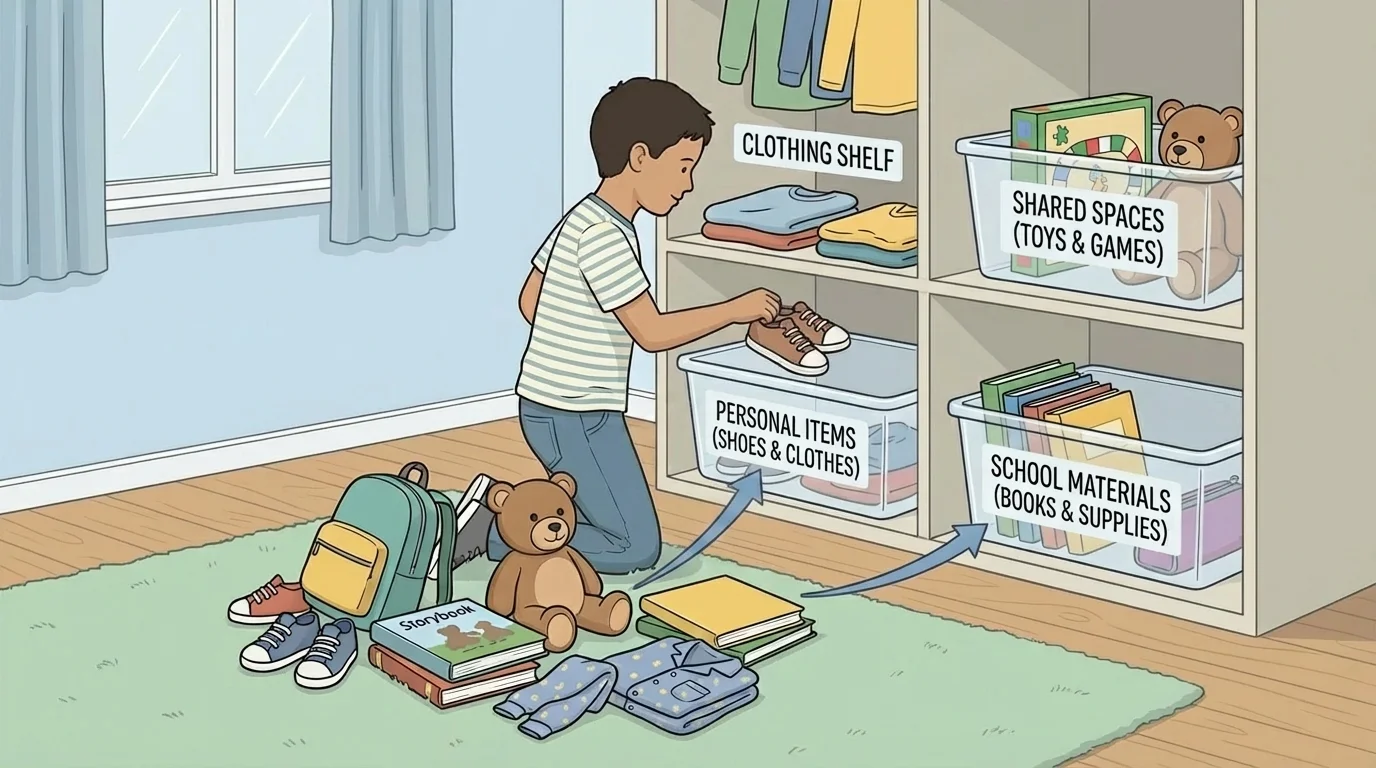
Step 3: Put items back the same way each time. If your red book goes on the lower shelf today, try to return books to that shelf tomorrow too. A repeatable spot helps you remember.
Step 4: Keep only what belongs in that place. Your bed is for sleeping, not for holding papers, socks, and blocks. Your floor is for walking, not for storing toys.
Later, when your room starts to look busy again, think back to [Figure 1]. The grouped items are easier to manage because similar things stay together. That is why baskets, hooks, and shelves can help so much.
Example: Cleaning up your bedtime area
Step 1: Put your blanket on the bed.
Step 2: Place your bedtime book on a shelf or table.
Step 3: Put pajamas in their spot.
Step 4: Check the floor for anything left behind.
Now your bedtime space is ready for later.
If you are not sure where something belongs, ask, "Where should this live?" That question helps you make a smart choice instead of dropping it anywhere.
Your learning space works better when your school materials are ready before you begin. [Figure 2] shows how a neat setup helps you start quickly instead of searching for supplies while class is beginning.
Keep the things you use most often close together. Pencils, crayons, scissors, and erasers can go in a cup or small box. Notebooks and folders can be stacked on one side of your desk or table. Headphones can hang on a hook. Your device charger can stay in one safe place.
Step 1: Clear your work area. Move away toys, snack wrappers, and random papers.
Step 2: Group supplies by job. Writing tools go together. Papers go together. Technology items go together.
Step 3: Put daily items where your hand can reach them easily.
Step 4: Put less-used items in a nearby drawer, basket, or bin.
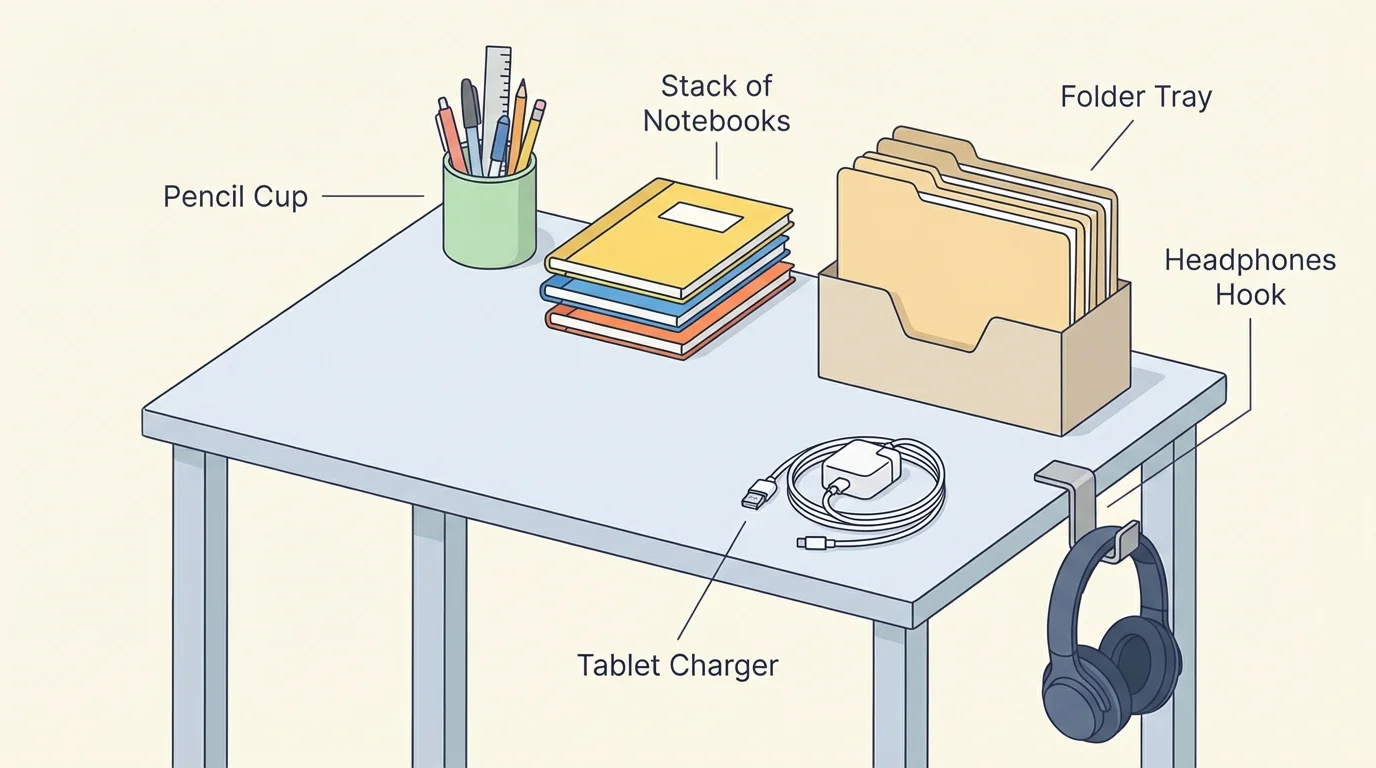
Step 5: At the end of learning time, reset the space. Close folders, cap markers, plug in your device if needed, and throw away trash.
This kind of routine helps on busy days. If your class starts soon, you already know where your notebook is. If your tablet needs power, the charger is in its place. Just like the organized desk in [Figure 2], your learning space should help you feel ready.
A good learning spot is simple and safe. You do not need a fancy desk. You need enough room to work, a place for supplies, and a habit of putting things back. The best organizing system is one you can use by yourself.
If you use folders, you can keep one for finished work and one for work you still need to do. That makes papers easier to find and keeps them from getting crumpled.
[Figure 3] shows that a shared space is any place your family uses together. That means you should leave it ready for the next person. Organizing shared spaces is not just about neatness. It is about kindness and safety too.
Think about a table where you do art. When you finish, close the markers, stack the paper, throw away scraps, and wipe the table if it is sticky. Think about the sofa area. Fold the blanket, return books to the shelf, and put game pieces back in the box.
Bathrooms can be shared spaces too. Put the cap back on toothpaste, hang the towel, and place your brush or comb where it belongs. Small actions help everyone.
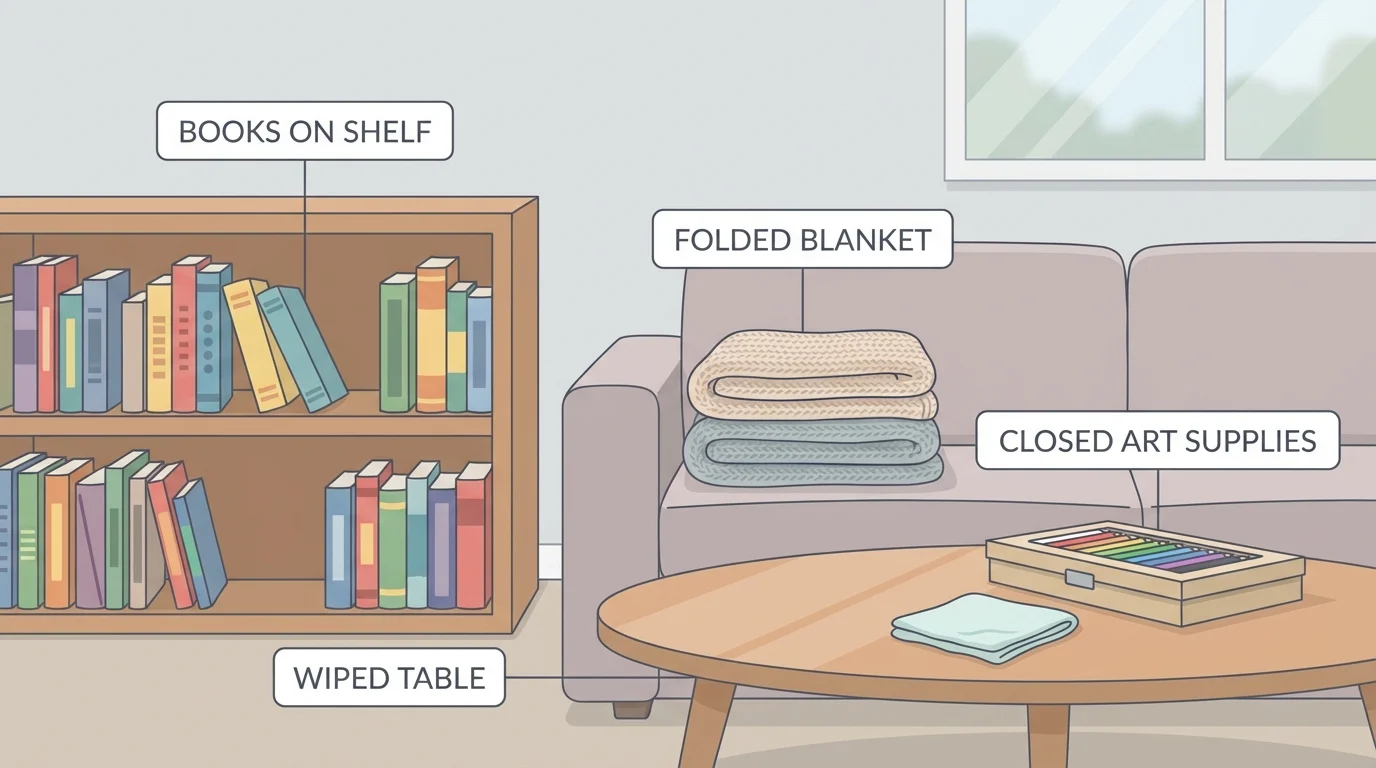
If you leave a mess in a shared space, another person may have less room, less time, or more work. But when you clean up, the room feels welcoming. The tidy room in [Figure 3] reminds us that organized spaces help everyone, not just one person.
Example: Cleaning up after a snack at a shared table
Step 1: Throw away trash.
Step 2: Put the plate or cup in the right place.
Step 3: Wipe crumbs from the table.
Step 4: Push in your chair.
Now the table is ready for the next person.
Sometimes shared spaces need family rules, such as "books go back on the shelf" or "art supplies are put away before screen time." Rules help everyone remember what to do.
You can use the same easy routine almost anywhere: sort, put away, check.
Sort: Make small groups. Books with books. Clothes with clothes. School papers with school papers.
Put away: Take each group to its home. Use shelves, bins, hooks, or drawers.
Check: Look around once more. Is anything on the floor? Is anything left on the table? Are lids on tight? Is your device where it belongs?
You do not have to clean everything at once. Starting with one small group helps you finish without feeling stuck.
This routine works in your room, at your learning table, and in shared spaces. The more you practice, the faster it gets.
Every space gets messy sometimes. That is normal. Organizing is not something you do only one time. It is something you do again and again in little ways.
If a mess feels big, start small. Pick up only books first. Then pencils. Then clothes. A small start can lead to a big cleanup.
If you feel confused, stop and ask two questions: What kind of item is this? and Where is its home? Those questions help you make a plan.
"Put it back, and future-you will smile."
You can also ask for help when needed. A grown-up can help you decide where things should go, label a basket, or make a cleanup time each day. Asking for help is part of learning.
Try This: Before bed, do a quick room check. Put away just a few things: one book, one toy, one piece of clothing, and one school item. Small habits make a big difference over time.
