Have you ever seen a job that needed to be done and thought, "I can help"? That is a special skill. It means you do not just wait. You notice, you care, and you act. When you help a group without waiting to be asked, you show kindness, responsibility, and leadership.
Initiative means starting a helpful action on your own. A group is two or more people doing something together. You can show initiative when you help your family clean up after lunch, when you help during an online club activity, or when you share ideas during a community event.
Initiative is noticing what needs to be done and starting to help without waiting to be told. Leadership means guiding with kind actions and good choices. Teamwork means people helping each other to do something together.
Showing initiative does not mean taking over. It does not mean bossing people around. It means using your eyes, ears, and heart to find a small helpful job and do it in a kind way.
When you show initiative, the group can feel calmer and happier. Jobs get done faster. People feel supported. When no one helps, people can feel stuck, tired, or upset. Small helpful actions can make a big difference.
Good helpers watch for clues, as shown in [Figure 1]. You might see that supplies are not ready, toys are still on the floor, papers are mixed up, or someone is carrying too many things. In an online group, you might notice people are talking at the same time, nobody is answering a question, or someone looks confused.
Try looking for three kinds of clues: messy clues, quiet clues, and busy clues. A messy clue means something needs to be put in order. A quiet clue means the group may be waiting or unsure. A busy clue means one person is doing too much alone.
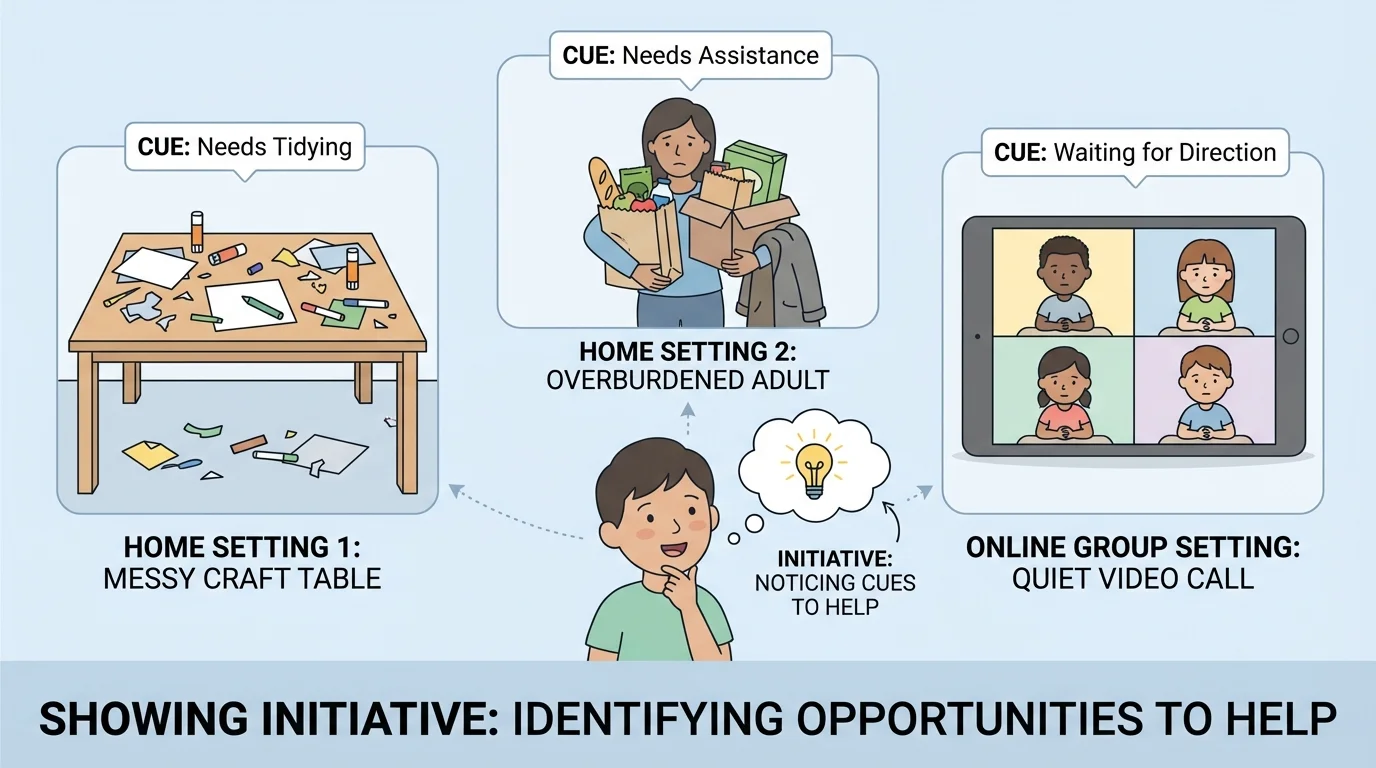
You can ask yourself simple questions: "What job needs to be done?" "Can I do it safely?" "Will this help the group?" These questions help you choose a good action.
Strong leaders are often people who do small helpful things before anyone asks. They do not need a big job to make a big difference.
Sometimes the best helpers are quiet helpers. They replace napkins, put markers back in the box, open the meeting link for a family club, or help everyone take turns speaking. These actions may seem small, but they help the whole group.
Helping should be responsible. That means you choose actions that are safe and kind. If a job is too heavy, too sharp, too hot, or meant for an adult, do not do it alone. Ask an adult first.
You can use a quick check-in sentence: "I can help with that," or "Would it help if I do this part?" This is still initiative because you noticed the need first. You are not waiting for a command. You are offering help in a respectful way.
If someone says, "Yes, please," you can begin. If someone says, "No, thank you," that is okay too. A good helper stays calm and kind.
The four-step helping plan in [Figure 2] makes initiative easy to remember. You do not need to guess wildly. You can follow a simple path each time you want to help.
Step 1: Notice. Look and listen carefully.
Step 2: Think. Choose a safe, helpful job.
Step 3: Help. Start kindly, or offer kindly.
Step 4: Check. See if the group needs one more small thing.
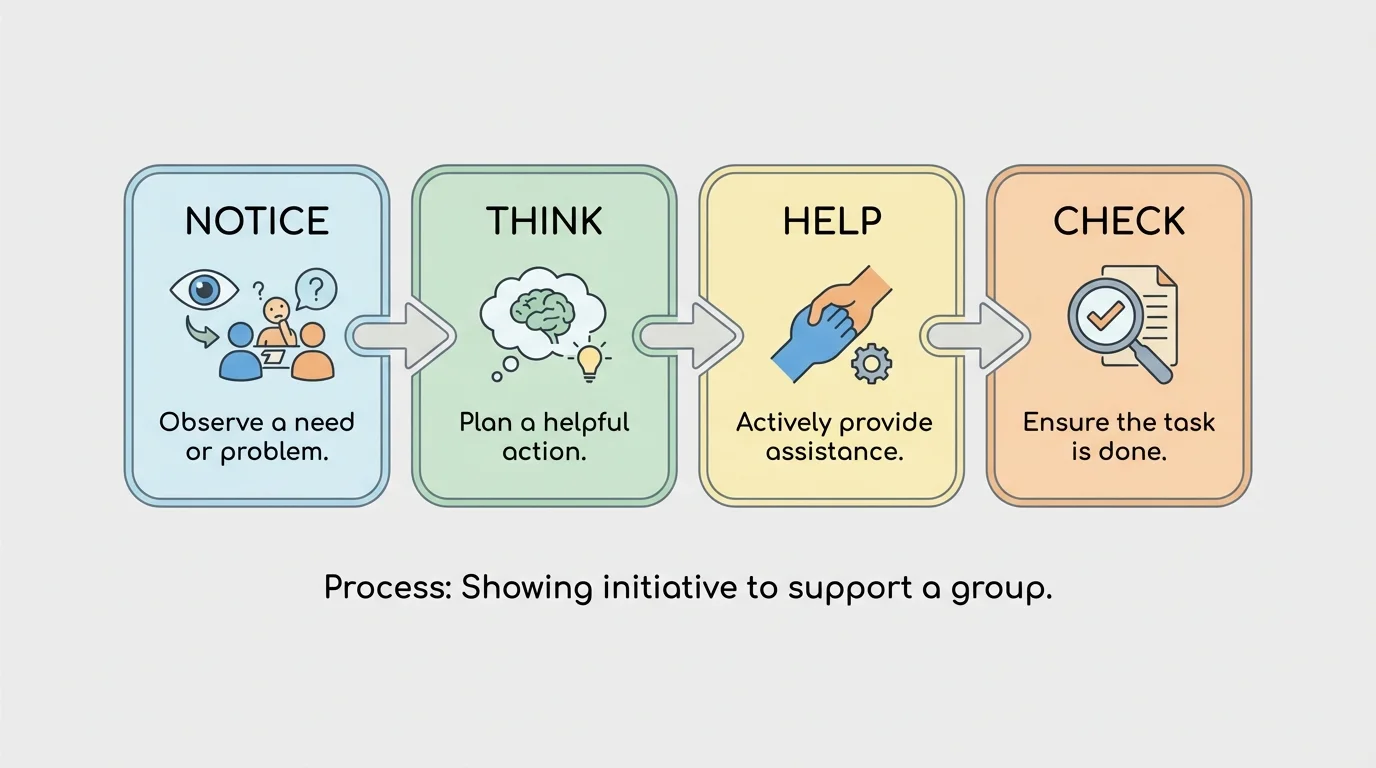
Here is what that can look like in real life. You see art supplies all over the table after a family project. You notice the mess. You think, "I can sort crayons and stack paper." You help by cleaning part of the table. Then you check if anything else still needs to be put away.
Example: Helping during a family game night
Step 1: You notice people are ready to play, but the cards and score paper are missing.
Step 2: You think of a safe job you can do by yourself.
Step 3: You bring the cards, pencils, and paper to the table.
Step 4: You ask, "Do we need anything else before we start?"
This helps the group begin faster and shows leadership.
You can use the same plan online. If your club leader asks a question and everyone stays quiet, you might raise your hand first. If a younger sibling cannot find the mute button for a family video call, you might kindly help them find it.
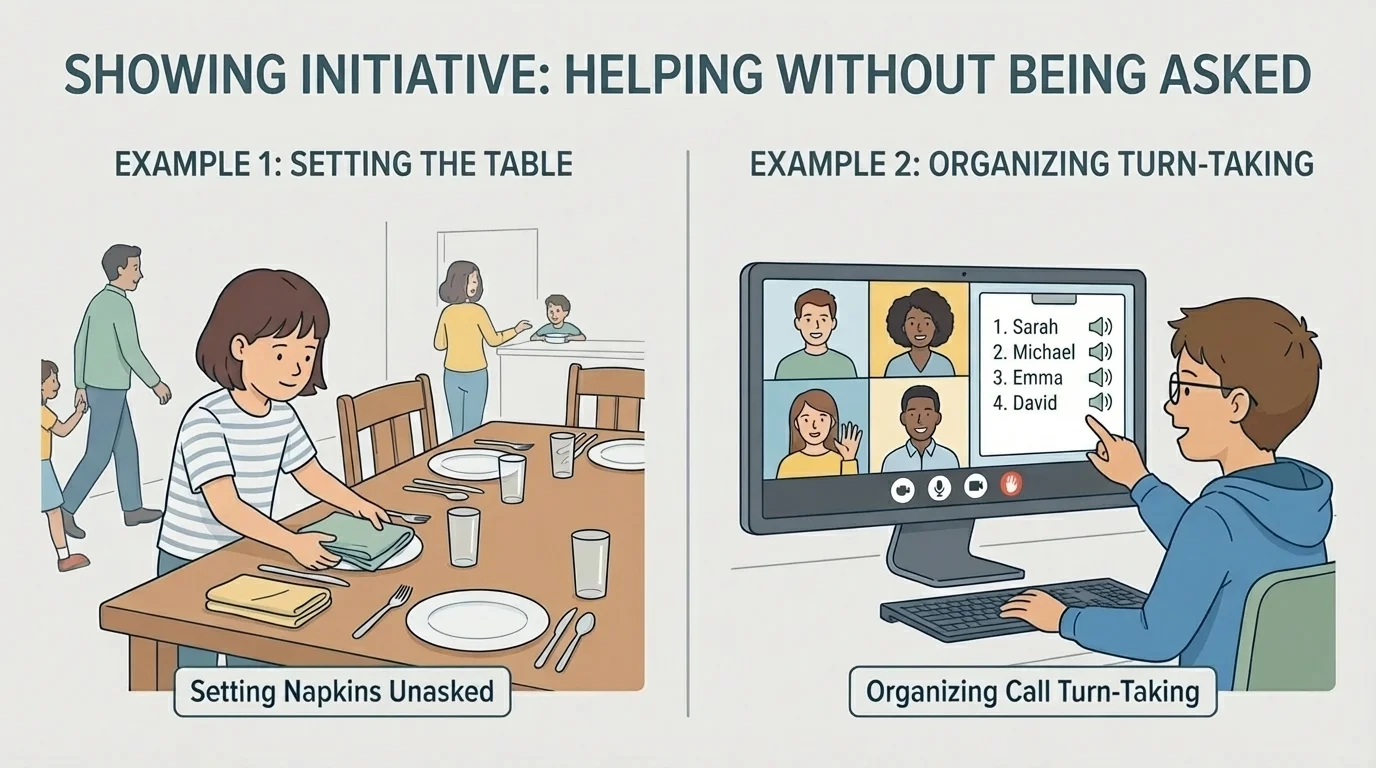
Everyday examples in [Figure 3] show that initiative can happen in different places. You do not need a special title to be a helper. You just need to notice and act kindly.
At home, your family is getting ready for dinner. One person is cooking, one person is setting drinks, and one person is busy with a baby. You notice the napkins are missing. You put napkins on the table without being asked. That is initiative.
In an online activity, children are taking turns sharing their drawings. One child forgets whose turn is next. You say, "I think Maya is next." You help the group stay organized. That is initiative too.
In your neighborhood or community, maybe people are packing snacks for an event. You see empty bags on one side and fruit on the other. You start placing one item into each bag to help the team move along. As in [Figure 2], you noticed, thought, helped, and checked.
Sometimes helping means helping feelings too. If someone looks left out during a group activity, you can say, "You can join us," or "Do you want to do this part with me?" That kind action helps the whole group feel stronger.
Helping and leadership go together
Leadership is not only being first or being loud. Real leadership often looks like service. Someone who sees what the group needs and helps in a kind way is already practicing leadership.
When you keep doing this, people learn they can trust you. Trust grows when your actions are helpful, gentle, and steady. That trust helps groups work better together.
Sometimes you may offer help, and someone may say, "We are okay," or "I already have a plan." That does not mean you did something wrong. It just means your help is not needed right then.
You can answer kindly: "Okay," "Let me know if you need me," or "I can help with something else." This shows respect. Initiative includes listening, not just doing.
If you started helping the wrong way, you can fix it. Maybe you began putting items away, but the group still needed them out. You can stop, smile, and ask what would help more. Mistakes can teach you.
A leader is often someone who helps others do well. You can be a leader at age six by doing small things with care. You can carry light supplies, sort materials, remind people of turns, include someone new, or clean your part of a shared space.
These actions build a strong community. Community means people who care for one another. Families, clubs, teams, neighbors, and friend groups all grow stronger when people help without waiting.
"See a need. Do a kind thing."
Try This: Today, look for one small job you can do without being asked. Maybe you put books back on a shelf, bring cups to the table, or help a group take turns on a call. Start small, be safe, and be kind.
Try This: Use the words "I can help" once today when you notice someone is busy. These three words are simple, but they show courage and care.
Try This: At the end of the day, think about one time you noticed a need. Even if you did not help yet, noticing is the first step. Next time, you can act.
