What makes people want to play and learn with you again? It is not being the fastest or the loudest. It is making fair and respectful choices. When you choose fairly and respectfully, people feel safe, included, and happy. That helps games go better, learning feels calmer, and daily routines work more smoothly.
Every day, you make choices. You choose how to speak, how to wait, how to share, and how to solve little problems. Good choices show responsibility. That means you do the right thing, even when it is hard.
Fair and respectful choices help build a strong community. A community is a group of people who care about one another. Your family, your online class, your sports team, your club, and your neighborhood can all be communities. When you are kind and fair, you help your community feel better for everyone.
Fair means giving people a chance, sharing turns, and following the same rules.
Respectful means using kind words and actions, listening, and caring about other people's feelings and space.
Being fair does not always mean everyone gets the exact same thing. Sometimes it means everyone gets what they need to join in. Being respectful also means remembering that other people may think, feel, or play in different ways.
[Figure 1] Play is more fun when everyone knows the rules and gets a turn. During a game, a routine can help: first choose the game, then hear the rules, then take turns. Fair turn-taking helps each person feel included instead of left out.
If you are playing a board game at home, you can wait for your turn instead of moving your piece early. If you are playing an online game, you can let another player choose a character sometimes. If you are at soccer practice or dance class in your community, you can follow the coach's directions and let others have a chance too.
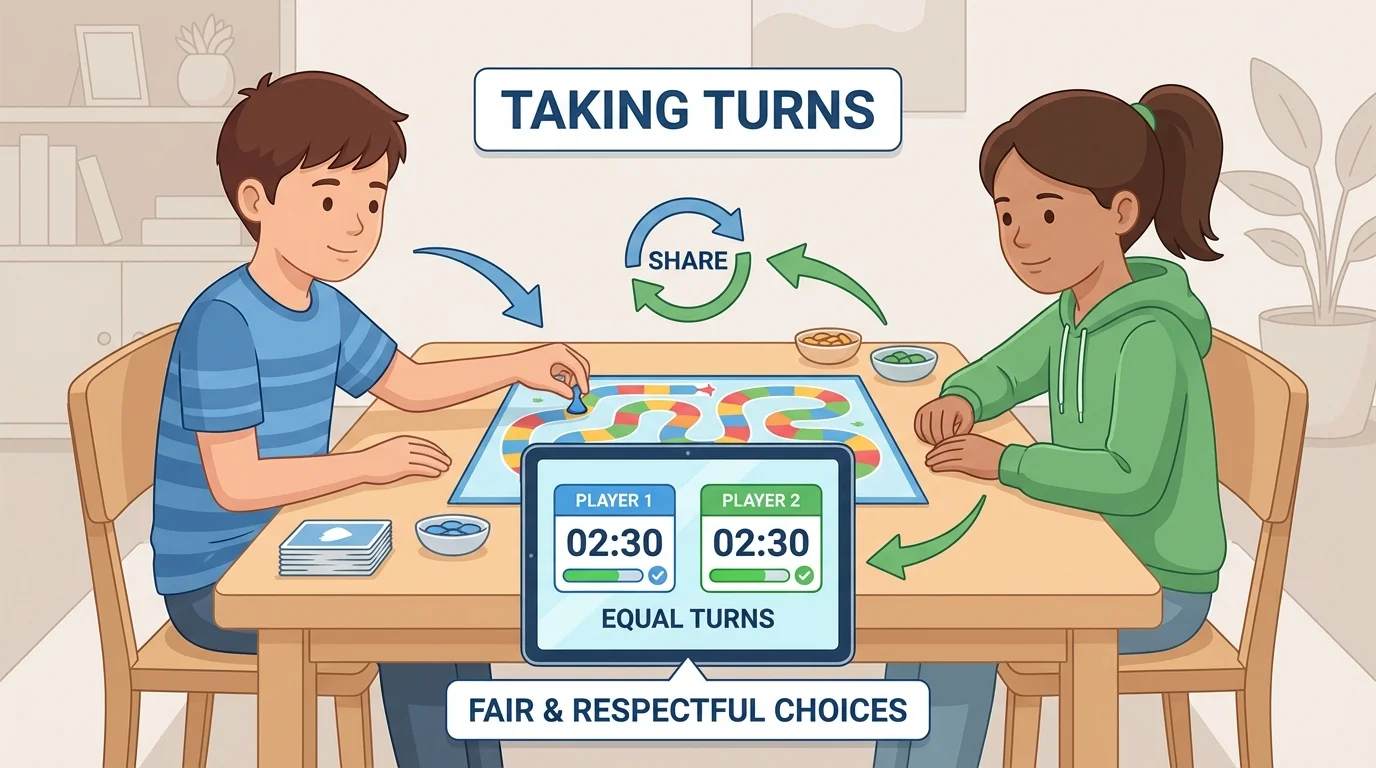
Respectful play also means using kind words. You can say, "Your turn," "Good job," or "Let's try again." You should not grab, shout mean words, or laugh when someone makes a mistake.
Winning and losing are both times to be respectful. If you win, you can smile and say, "Good game." If you lose, you can still stay calm and say, "Maybe next time." That shows respect.
Play-time example
You and your cousin both want the same toy car.
Step 1: Stop your body.
Keep your hands calm. Do not grab.
Step 2: Use words.
Say, "Can we take turns?"
Step 3: Make it fair.
One person uses it first, then the other person gets a turn.
Step 4: Keep it respectful.
Use a calm voice and kind face.
Later, when you are in another game, remember the turn-taking idea from [Figure 1]. Fair play is not just for one game. It works in many places.
[Figure 2] Learning online also needs fair and respectful choices. On a video call, respectful learning means listening while someone else talks, waiting for your turn, and staying focused on the lesson.
You can show respect by looking at the screen, muting when needed, and using a quiet voice when it is your turn. If the teacher asks a question, you can use the raise hand button or wait until the speaker is finished. That is fair because everyone gets a chance to speak.
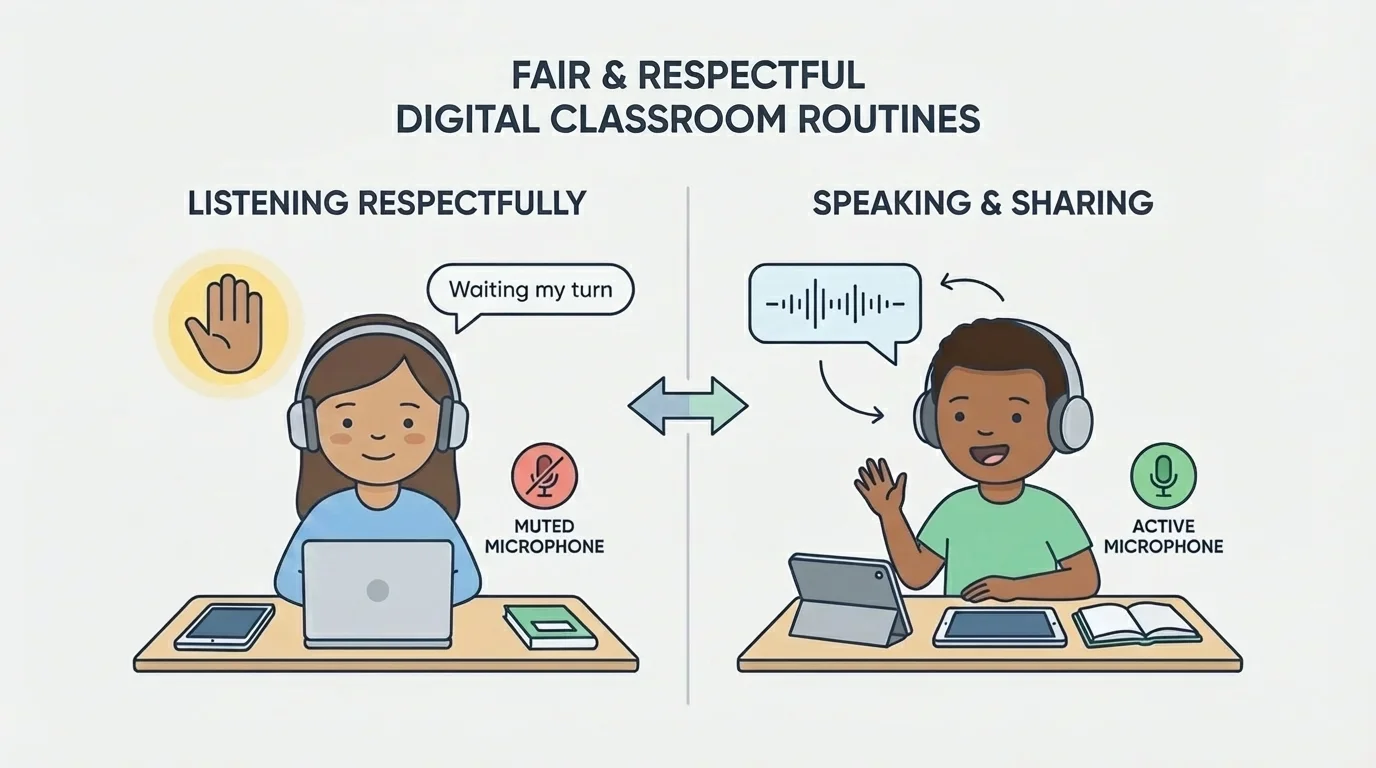
If a family member helps you with schoolwork, respectful learning means accepting help without getting angry. It also means trying your own best instead of making someone else do the work for you.
Sometimes another student online may answer before you. That can feel disappointing. You can take a breath and remember there will be another turn. The calm listening shown in [Figure 2] helps everyone learn better.
People often remember kind behavior for a long time. A child who waits, listens, and includes others is someone people usually want to work and play with again.
Respectful learning also means caring for supplies and technology. Put pencils back, close your tablet gently, and keep your learning space neat enough to use again later.
Routines are the things you do again and again. Morning check-in, washing hands, putting away crayons, getting ready for a club, and cleaning up after a snack are all routines.
Fair and respectful choices during routines help the whole day go more smoothly. You can wait while another person finishes in the bathroom. You can clean up your own materials instead of leaving a mess for someone else. You can follow family directions the first time when possible.
These small choices matter. When you do your part, you show others they can count on you. That is part of good character.
| Situation | Fair and Respectful Choice | Unfair or Disrespectful Choice |
|---|---|---|
| Snack time | Take one serving and wait | Take extra before others get some |
| Cleanup | Put your things away | Leave your mess for others |
| Video class | Listen and wait to speak | Talk over others |
| Game | Take turns | Grab first every time |
Table 1. Examples of fair and respectful choices compared with unfair or disrespectful choices.
[Figure 3] Sometimes you know the right choice right away. Sometimes you need a simple plan. The four-step choice guide helps you slow down and choose well: stop, think, choose, and fix.
Step 1: Stop. Make your body still. Keep hands to yourself. Take a slow breath.
Step 2: Think. Ask, "Is it fair?" "Is it kind?" "Would I like it if someone did this to me?"
Step 3: Choose. Pick the action that helps, not hurts. Use kind words, wait, share, or ask for help.
Step 4: Fix. If you made a poor choice, you can repair it. Say sorry, return the item, help clean up, or try again the right way.
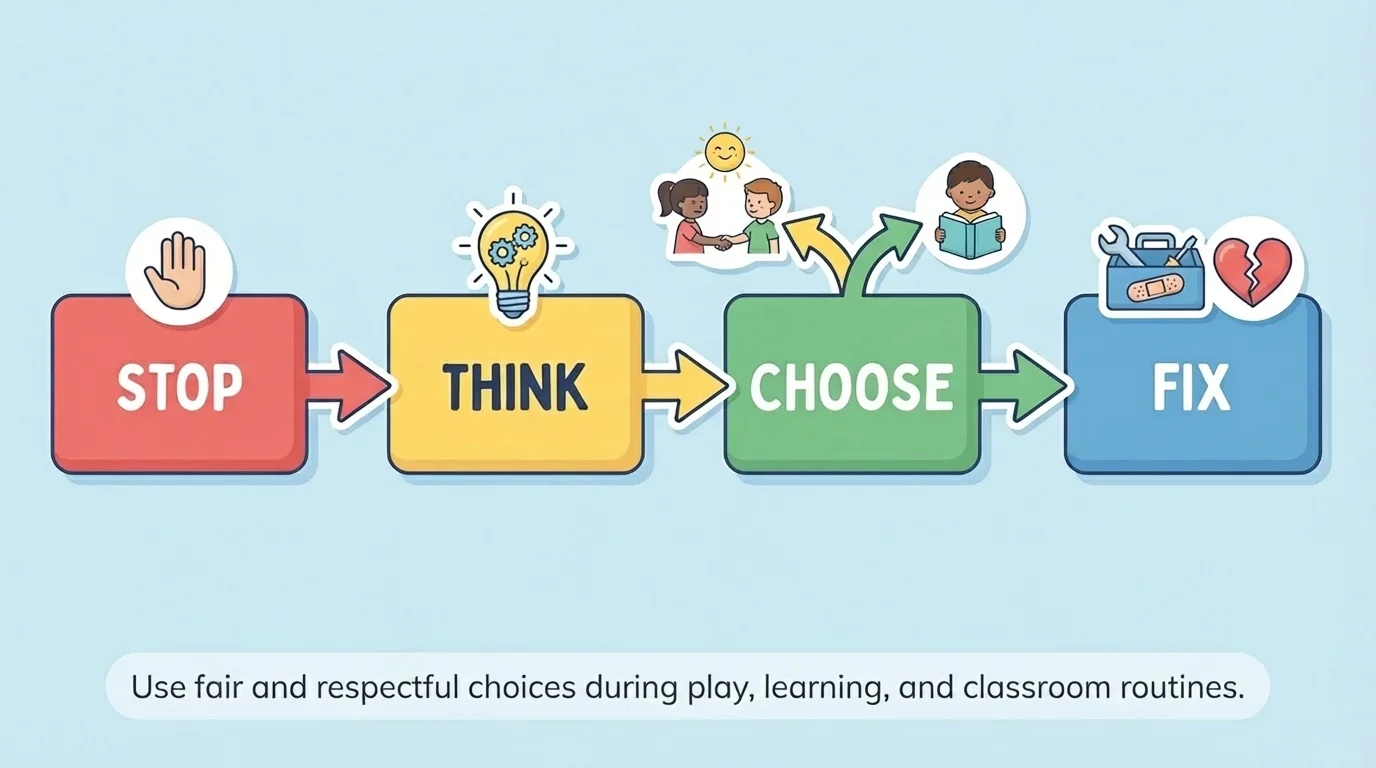
This guide works in many places: at home, in online school, at the park, or in a club. The steps in [Figure 3] are simple, but they are powerful.
Why stopping first helps
When feelings get big, your body may want to shout, grab, or stomp. Stopping first gives your brain time to choose a better action. A small pause can prevent a big problem.
You do not have to be perfect. Everyone makes mistakes. What matters is learning to notice, choose better, and keep practicing.
Sometimes unfair or disrespectful choices happen anyway. Maybe you interrupted. Maybe you would not share. Maybe you used a rude voice. You can still make things better.
First, tell the truth. Next, say what you will do to fix it. You might say, "I am sorry I grabbed the marker. You can use it first." A real apology uses honest words and better actions after.
If the problem feels too big, ask an adult for help. Asking for help is a strong choice, not a weak choice. It keeps everyone safer and calmer.
"Treat others the way you want to be treated."
Each fair and respectful choice helps build trust. Trust grows when people know you will be kind, honest, and careful with their feelings.
Try this today: choose one time to practice waiting, one time to practice kind words, and one time to clean up without being asked. Small actions can make a big difference.
