Some students think success comes mostly from talent. In real life, talent matters far less than most people assume. A student with average talent but strong confidence, a real sense of belonging, and the ability to use feedback often grows faster than someone who is naturally skilled but shuts down under pressure. These three factors shape how you study, how you speak up, how you handle mistakes, and how you build relationships.
Confidence, belonging, and feedback are not separate parts of your life. They affect each other every day, as [Figure 1] illustrates. If you feel capable, you are more likely to try. If you feel like you matter in a group, you are more likely to participate. If you receive helpful feedback and use it well, you improve, and that improvement strengthens confidence.
The opposite can happen too. Low confidence can make you avoid difficult assignments. A weak sense of belonging can make online classes feel distant and pointless. Harsh or unclear feedback can make you think, "Why bother?" When all three go badly, growth slows down. When all three improve, your academic and social life usually improves with them.
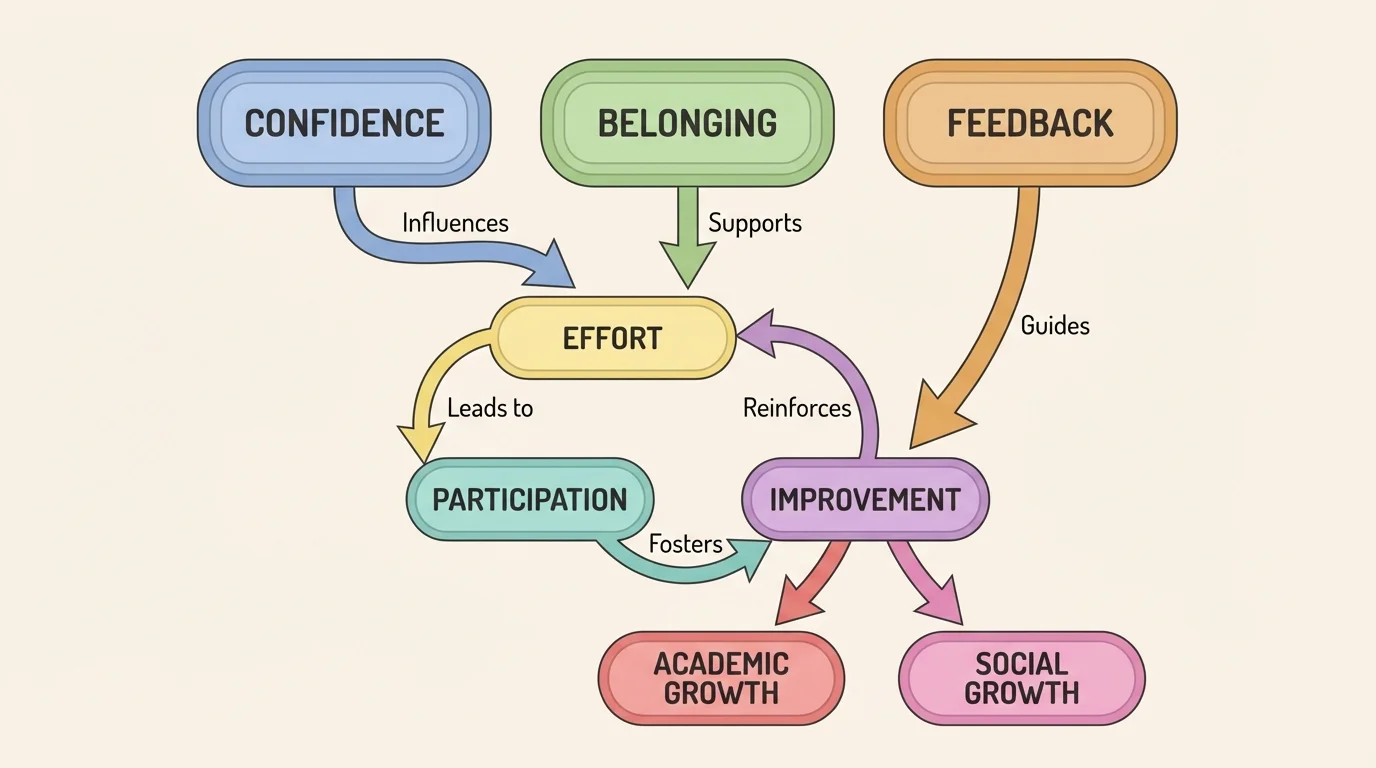
Think about a student in an online history course. If that student believes, "I can learn this if I stick with it," they are more likely to ask questions in a discussion board, revise an essay, and attend support sessions. If they also feel respected by classmates in a group chat and noticed by their teacher, school feels more meaningful. When they get specific comments on their writing and use those comments, their progress becomes visible. That progress then feeds motivation.
Confidence is your belief that you can handle a challenge, learn, or improve through action. Belonging is the feeling that you are accepted, included, and valued in a group or community. Feedback is information about your performance or behavior that helps you understand what is working and what needs to change.
These ideas matter in school, but they also matter in friendships, jobs, sports, creative projects, volunteering, and family communication. If you can evaluate how they affect you, you can make better choices instead of just reacting to how a moment feels.
Real confidence is not pretending you are great at everything. It is not being the loudest person on a call. It is not acting like mistakes do not matter. Real confidence is quieter and stronger than that. It sounds like: "I may not know this yet, but I can learn it."
Self-efficacy is a useful idea here. It means believing you can take action that leads to results. A student with healthy self-efficacy might say, "If I plan my study time and review the teacher's comments, my next quiz score can improve." That belief changes behavior. Instead of freezing, the student does something.
Low confidence often leads to avoidance. You may delay starting work because you are afraid of proving you are "bad" at it. Socially, low confidence can make you overthink every message, avoid joining group discussions, or assume people dislike you without evidence. Overconfidence has its own problem: it can make you ignore preparation, dismiss advice, and stop improving.
So confidence affects both academic and social growth because it shapes whether you participate, persist, and recover. A confident student is more likely to ask for help, revise work, and join a conversation. A student with weak confidence may stay silent, miss chances to improve, and misread setbacks as proof they should quit.
Research on learning often shows that students' beliefs about whether they can improve affect performance almost immediately. When you expect growth to be possible, you are more likely to use strategies that actually create it.
That does not mean confidence magically causes success. It means confidence changes your actions, and those actions change outcomes. In practical terms, confidence is most useful when it is tied to evidence: your preparation, your habits, your ability to adapt, and your willingness to keep going.
Confidence is a skill, not a personality type. Some people seem naturally confident, but most lasting confidence is built through repeated experiences of trying, adjusting, and seeing progress. That process is much more reliable than waiting to "feel ready."
As [Figure 2] shows, one of the best ways to build confidence is to shrink the challenge into actions you can control. Instead of saying, "I need to become good at biology," say, "Tonight I will review my notes for twenty minutes, answer five practice questions, and send one question to my teacher if I get stuck." Specific action creates evidence. Evidence creates stronger confidence.
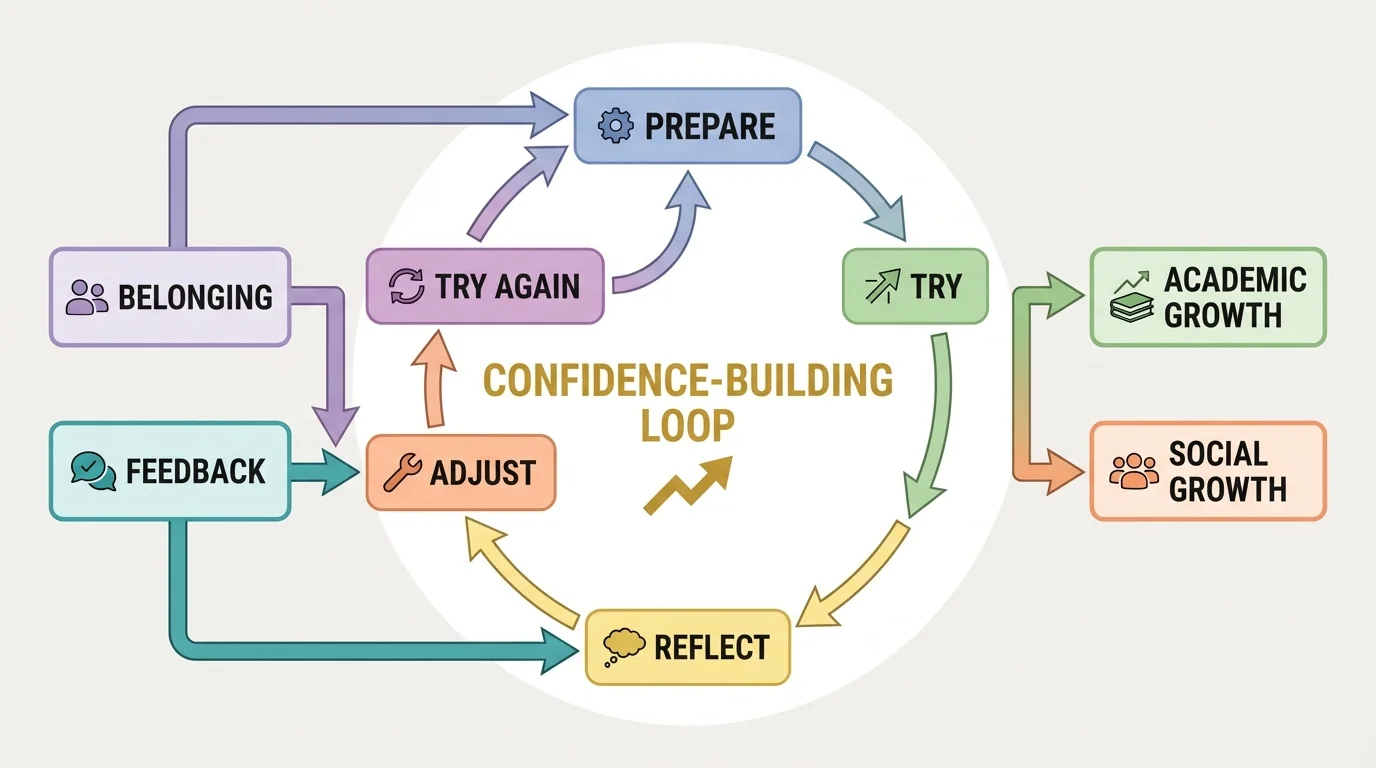
Another strategy is to watch your self-talk. If your inner voice says, "I always mess this up," your brain treats the situation like a threat. Replace that with something honest but useful: "This is hard, but I can improve by practicing." Notice that this is not fake positivity. It is realistic and action-focused.
Keep a simple record of progress. For example, if your essay score rose from one assignment to the next, or if you spoke once in an online discussion after staying silent for weeks, write that down. Confidence grows when you remember proof. Otherwise, your brain may focus only on what went wrong.
Real-world example: Building confidence before an online presentation
You have to give a short presentation on a video call and feel nervous.
Step 1: Prepare what you can control.
Write a brief outline, rehearse twice, test your microphone, and keep notes nearby.
Step 2: Replace fear-based thoughts.
Change "Everyone will notice if I mess up" to "Most people care more about the idea than one mistake."
Step 3: Use evidence after the event.
Even if you felt shaky, note what went well: you finished, explained your main point, and answered one question.
Step 4: Build the next step.
Use that experience to make the next presentation easier instead of treating it like a one-time test of your worth.
Try This: before your next challenge, write three lines: what you can prepare, what you can say to yourself when stressed, and what evidence you will look for afterward. This turns confidence from a feeling into a plan.
Belonging matters more than many students realize. In an online school setting, you are not walking into a building full of people each day, so connection does not happen automatically. You often have to build it intentionally through messages, video calls, discussion boards, clubs, work teams, sports, faith communities, creative groups, or volunteer spaces.
As [Figure 3] illustrates, when you feel that you belong, you are more likely to stay engaged. You ask questions sooner. You take part in group work more comfortably. You recover from awkward moments more easily because one bad interaction does not make you feel like an outsider. Socially, belonging lowers stress and helps you trust other people more appropriately.
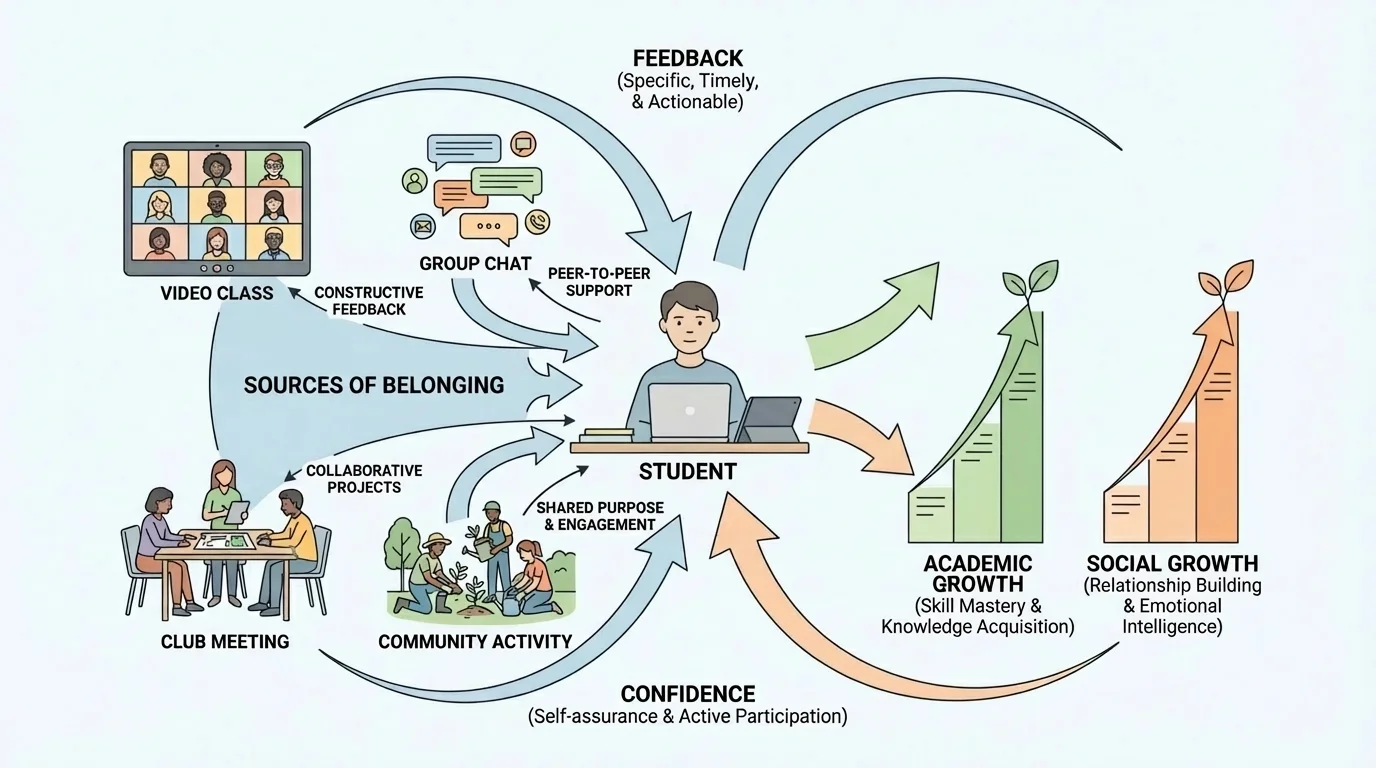
When belonging is missing, people often pull back. In academics, that can look like skipping optional sessions, not replying in group projects, or doing the minimum because school feels emotionally distant. Socially, it can look like feeling invisible, assuming others do not care, or trying too hard to fit in by hiding your real opinions and interests.
Belonging does not mean everyone must agree with you. It does not mean you have to be popular. It means you can be yourself, contribute honestly, and feel respected. Healthy belonging supports individuality; fake belonging demands that you act like someone else to stay accepted.
Belonging and identity work best together when you are both connected and authentic. If you only chase acceptance by copying what others say, you may feel included on the surface but disconnected inside. Real belonging lets you participate without losing your values, interests, or boundaries.
This is especially important at your age because identity is still developing. The groups you spend time with can strengthen your confidence or weaken it. A supportive study group, online club, or community team can help you grow. A group that mocks mistakes, pressures you to act different, or makes you feel replaceable can damage both learning and self-respect.
You cannot control whether every group feels right, but you can increase your chances of finding and building healthy connection. Start by showing up consistently. In online spaces, that might mean turning work in on time, responding in group chats, asking a thoughtful question, or thanking someone who helped you. Reliability helps people trust you.
Next, contribute instead of waiting to be noticed. If you join a club video call or a community activity, make one useful comment or ask one real question. Belonging often begins with small repeated interactions, not dramatic moments. Many friendships start because someone was respectful, consistent, and easy to work with.
You also need boundaries. If you are changing your personality to keep a group's approval, that is not healthy belonging. If an online space is full of sarcasm, exclusion, or pressure, leaving may protect your growth. Belonging should support you, not shrink you.
Case study: Two versions of the same student
A student joins an online coding group.
Version A: The student keeps the camera off, never posts, assumes everyone is better, and quietly leaves after two meetings. Their belief becomes: "I do not fit here."
Version B: The student introduces themselves in chat, asks one beginner question, shares a small project, and thanks another member for advice. After several meetings, people begin recognizing their name and responding warmly.
The second version does not become popular overnight. But by participating consistently, the student gives belonging a chance to grow.
Try This: choose one place where you want stronger connection this month. It could be a course discussion space, a youth group, a job training program, or a hobby group. Decide on one repeatable action you will take each week to become more present and more known.
Many people think feedback is just criticism. It is broader than that. Feedback includes anything that tells you how your performance or behavior is landing. A quiz grade, a teacher's comment, a coach's suggestion, a friend saying "That came off harsher than you meant," or even noticing that someone stops replying after a rude message can all be forms of information.
Constructive feedback is especially valuable because it is specific, useful, and focused on improvement. "This essay is weak" is not very helpful. "Your argument is clear, but your evidence needs more detail in paragraph two" is useful. Socially, "You're annoying" is not helpful, but "When you interrupt, people may feel unheard" gives you something you can actually work on.
Useful feedback supports growth because it reduces guessing. Without feedback, you may repeat the same mistakes. With strong feedback, you can adjust faster. That is why feedback matters academically and socially: it helps you see what you cannot always see on your own.
"Feedback is not a verdict. It is information."
Still, not all feedback deserves equal weight. Some feedback is careless, biased, vague, or meant to hurt. Part of growing up is learning to sort feedback instead of swallowing every opinion whole.
Feedback becomes powerful when you process it in a sequence instead of reacting instantly. The first step is to pause. Your emotions may spike before your thinking catches up. That is normal. Feeling defensive does not mean the feedback is wrong, and feeling ashamed does not mean it is true.
As [Figure 4] shows, next ask: Is this feedback specific? Is it about something I can change? Is it coming from someone informed, trustworthy, or affected by my behavior? These questions help you separate useful information from noise.
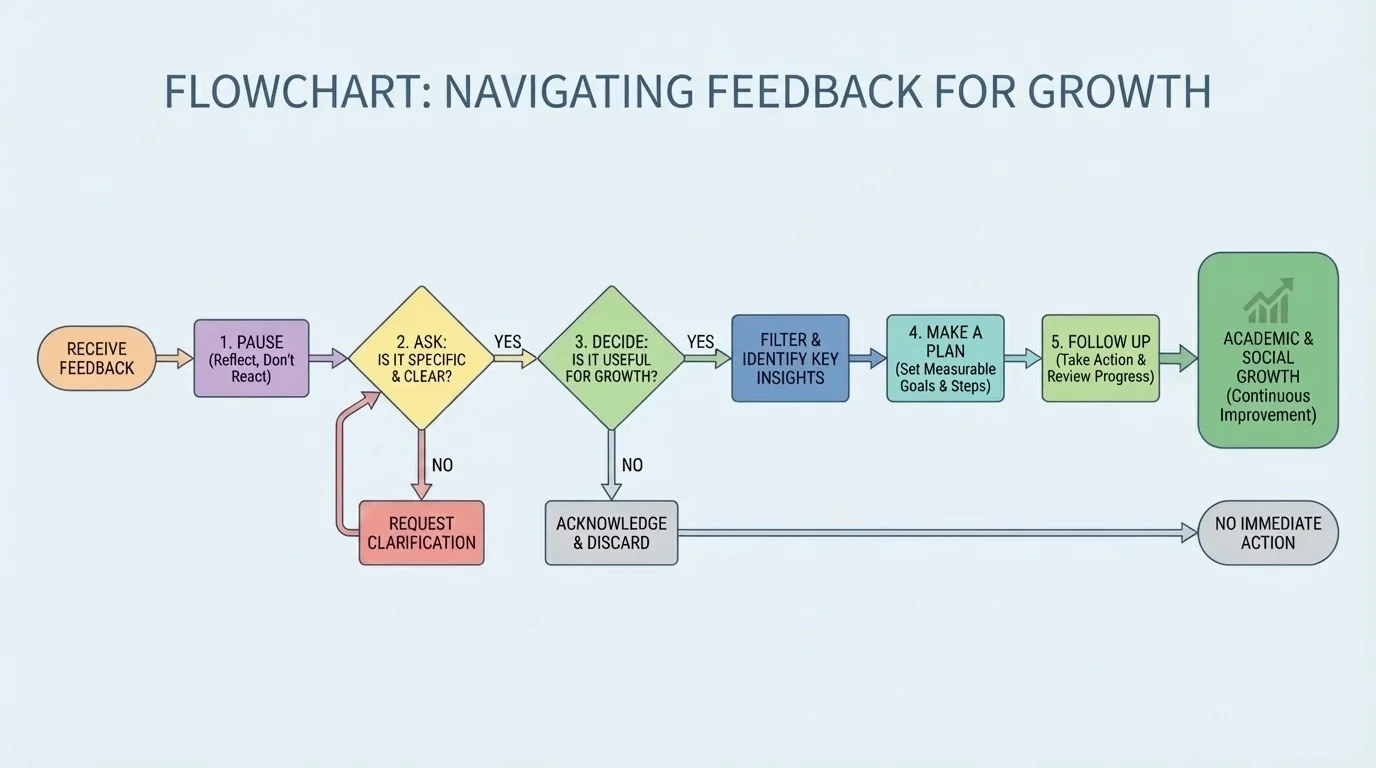
If the feedback is useful, turn it into action. For school, that might mean revising a paragraph, changing your note-taking method, or reviewing missed questions to spot a pattern. For relationships, it might mean apologizing, listening longer before replying, or changing how you phrase messages.
If the feedback is vague, ask for clarity. You can say, "Can you give me one example?" or "What would improvement look like?" This moves the conversation from emotion to action. In online school, this can be as simple as sending a message to a teacher asking which part of an assignment needs the most attention.
If the feedback is unfair or disrespectful, you do not have to absorb it as truth. You can still ask whether there is any useful part hidden inside it. If not, let it go. Protecting your self-respect is different from refusing to grow.
Step-by-step example: Using feedback on a written assignment
Your teacher comments that your response is thoughtful but unclear in organization.
Step 1: Pause before judging yourself.
Instead of thinking, "I am bad at writing," focus on the actual message: the ideas may be strong, but the structure needs work.
Step 2: Identify the changeable part.
Organization can be improved with topic sentences, paragraph order, and clearer transitions.
Step 3: Make one revision plan.
Rewrite the introduction, label each paragraph's main point, and add transitions between ideas.
Step 4: Follow up if needed.
Ask, "Does this revision make the structure clearer?" That turns feedback into a conversation about improvement.
Later, when you face another comment on your work, the process in [Figure 4] still applies. Pause, sort, choose, apply. That is how feedback helps you grow instead of just making you feel judged.
These factors are strongest when they support one another. Picture two students in the same online course. Both get a lower grade than expected on a project. The first student has some confidence, feels connected to the class, and sees teacher comments as useful. That student thinks, "This is disappointing, but I can fix it." They ask a question, revise, and improve.
The second student feels unsure, disconnected, and embarrassed by criticism. That student thinks, "This proves I do not belong here." Instead of using the comments, they avoid the next assignment and pull away from discussions. The same event leads to very different outcomes because the three factors are working differently.
The same pattern shows up socially. Suppose a friend tells you that your message sounded rude. If you have confidence, you can hear that without falling apart. If you have belonging, you trust that one awkward moment does not erase the relationship. If you know how to use feedback, you can apologize and communicate better next time.
That is why evaluating these factors matters. You are not just asking, "Am I confident?" You are asking, "How does my confidence affect what I do? Where do I feel a sense of belonging, and where do I not? What kind of feedback helps me improve, and how do I react when I receive it?" Those questions lead to better decisions.
| Factor | When it is strong | When it is weak | Result for growth |
|---|---|---|---|
| Confidence | You attempt challenges and recover from mistakes | You avoid, delay, or give up quickly | Strong confidence supports progress through action |
| Belonging | You participate and stay engaged | You withdraw and feel disconnected | Belonging supports motivation and resilience |
| Feedback | You adjust based on useful information | You ignore, fear, or misuse input | Good use of feedback speeds improvement |
Table 1. Comparison of how confidence, belonging, and feedback influence academic and social growth.
Even strong students have days when confidence drops, belonging feels shaky, or feedback hurts. What matters is having a reset plan.
For low confidence: return to evidence. Ask, "What have I done before that shows I can make progress?" Then choose one small action. Action is often the fastest way to rebuild belief.
For weak belonging: reconnect on purpose. Send a message, reply in a group space, attend one session, or spend time with a healthier community. Isolation grows when it goes unchallenged.
For painful feedback: wait before reacting. Read it once, step away, then come back and highlight the parts that are specific and usable. If needed, ask one clarifying question instead of spiraling.
You do not have to feel fully ready before taking a healthy step. In many life skills, action comes first and confidence follows. The same is true here.
Try This: create a three-line reset note in your phone. Line one: what to tell yourself when confidence drops. Line two: one action to rebuild belonging. Line three: how to respond to feedback calmly. Use it when emotions run high.
These skills matter far beyond grade ten. In college, training programs, and jobs, people who grow the fastest are usually not the ones who never struggle. They are the ones who can learn publicly, recover from mistakes, build trust with others, and use feedback without collapsing or becoming defensive.
In adult life, confidence helps you interview, advocate for yourself, and try new responsibilities. Belonging helps you build healthy teams and relationships. Feedback helps you improve quickly and avoid repeating problems. As we saw earlier in [Figure 1], these forces keep feeding one another over time.
If you learn to evaluate them honestly, you gain a major advantage. You stop seeing success as luck or personality. You begin seeing growth as something shaped by your habits, your environments, and your responses. That makes change possible.
