A lot of people think resilience means being naturally tough. It doesn't. Real resilience is much less dramatic and much more useful: it is your ability to get hit by stress, disappointment, extra pressure, or unexpected change and still respond in a steady, effective way. That matters when your internet fails during a timed assignment, when your week suddenly fills with deadlines, when a family responsibility cuts into your study time, or when a goal you cared about no longer fits your life.
For an online student, resilience is especially important because so much depends on self-management. No one is standing beside you reminding you what to do next. You often have to notice your own stress signals, reset your focus, and make a plan before small problems become larger ones. The good news is that resilience is not a personality trait you either have or do not have. It is a set of skills you can practice.
Setbacks happen in normal life. A grade may come back lower than expected. A group project partner may stop replying. A sports season, job schedule, health issue, or family situation may force you to change your plans. When you know how to respond well, you protect more than your grades. You protect your confidence, your relationships, your time, and your ability to keep going.
When resilience is weak, people often do one of three things: they panic, they avoid, or they give up too early. Panic leads to rushed choices. Avoidance causes missed deadlines and more stress later. Giving up too early can make one difficult week feel like proof that you are not capable. Strong resilience interrupts that pattern.
Resilience is the ability to recover, adapt, and keep functioning during stress, setbacks, and change.
Setback is a problem, delay, mistake, or disappointment that makes progress harder.
Emotional regulation is the skill of noticing and managing your feelings so they do not completely control your decisions.
Notice what these terms have in common: they are about response, not perfection. You do not need to enjoy stress or stay calm every second. You just need to recover faster and choose your next step more wisely.
Catastrophizing is one reason setbacks feel bigger than they are. It happens when your mind jumps from one problem to the worst possible conclusion: "I missed one assignment, so I'm failing everything," or "This plan changed, so my whole future is ruined." Resilience does not mean ignoring the problem. It means seeing the problem at its real size.
A resilient response usually includes five actions: notice what you feel, calm your body, name the actual problem, choose one useful action, and stay flexible if the situation changes. That sequence sounds simple, but it is powerful because it stops you from reacting on impulse.
"You do not have to control everything to move forward. You only need to control your next choice."
That idea is important during pressure. If you focus on controlling every outcome, you will feel overwhelmed. If you focus on the next smart move, you regain momentum.
The first job during a setback is not solving everything instantly. The first job is to stabilize yourself enough to think clearly. Stress affects attention, memory, and decision-making. If your body is in panic mode, your planning gets worse.
Start with a short reset. Put both feet on the floor. Unclench your jaw and shoulders. Take slow breaths in and out. Count to four on the inhale and six on the exhale for five rounds. This does not erase the problem, but it lowers the intensity so your thinking becomes more accurate.
Then use a grounding sentence. Try one of these: I can handle this one step at a time. This is stressful, not impossible. I do not need a perfect plan; I need a useful one. A good grounding sentence is realistic, not fake positivity.
Try This: Save a note on your phone called "Reset Script." Write three breathing reminders, two grounding sentences, and one person you can message if you feel stuck. During stress, it is easier to use a script than invent one.
After you calm down, you need to understand the problem correctly. A setback becomes easier to handle when you sort it into clear categories, as [Figure 1] shows. If you mix facts, fears, and guesses together, everything feels equally urgent.
Ask yourself four questions: What happened? What am I telling myself about it? What part can I control? What is the next action? For example, if you miss a deadline, the fact is: "I submitted late." The story you may tell yourself is: "I always mess things up." Those are not the same thing. Only the first one is evidence.
Another useful skill here is self-talk. Your inner voice affects your outer behavior. Helpful self-talk sounds like: "I made a mistake, and now I need to repair it." Unhelpful self-talk sounds like: "I'm lazy and there's no point trying." One version leads to action; the other leads to shame and avoidance.
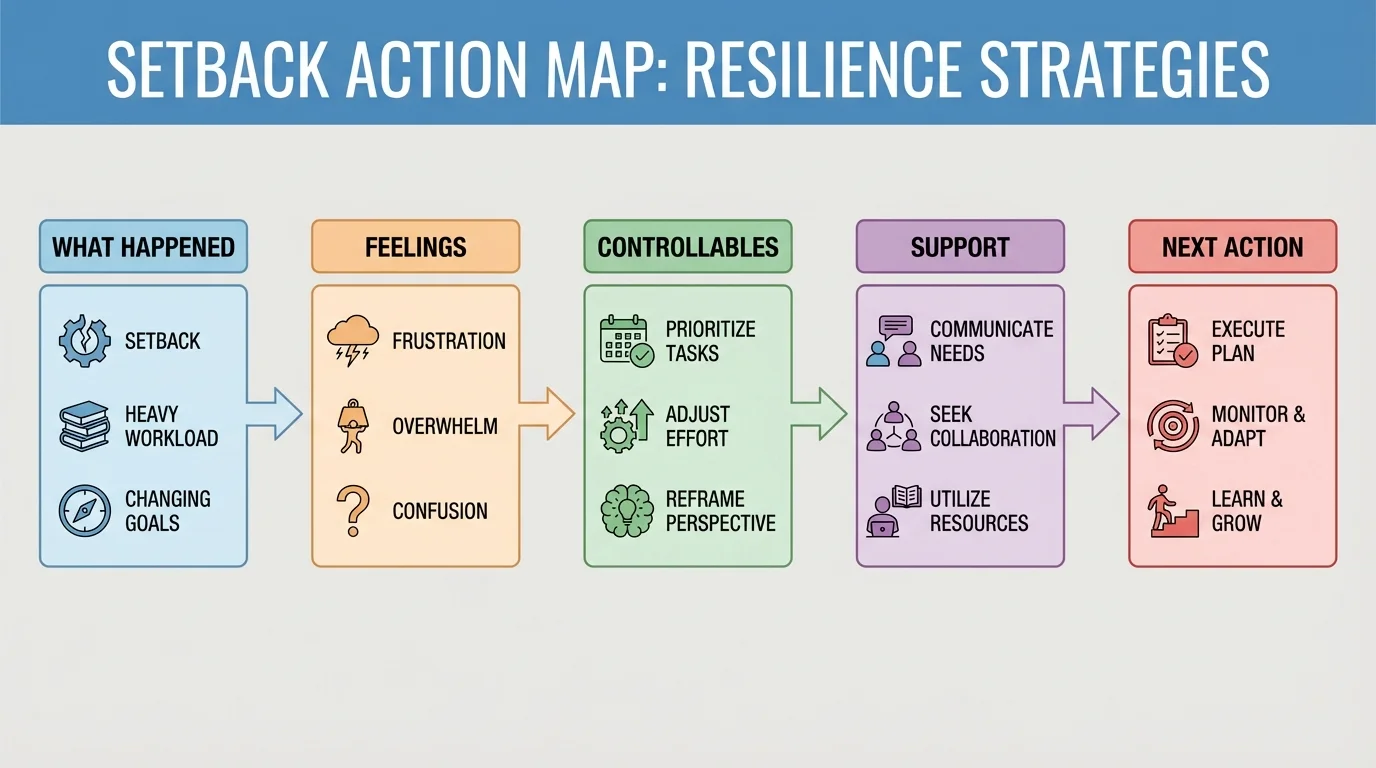
When you identify what is controllable, your options become clearer. You may not control the original problem, but you often control your response time, your communication, your schedule for the next few days, and whether you ask for support.
Here is a simple way to sort a setback:
| Part of the situation | Example | Best response |
|---|---|---|
| Fact | You scored lower than expected on a quiz. | Review mistakes and ask what to improve. |
| Feeling | You feel embarrassed or frustrated. | Name the feeling without letting it run the plan. |
| Controllable | You can revise, retake if allowed, or change study habits. | Choose one action with a deadline. |
| Not controllable | The quiz has already happened. | Stop spending energy trying to undo the past. |
Table 1. A practical way to separate a setback into manageable parts.
Later, when you face another problem, return to the same structure from [Figure 1]. Resilience grows when your response becomes repeatable, not when every stressful moment feels totally different.
Example: Turning a bad day into a repair plan
You planned to finish two assignments, but your internet went out for several hours and now one assignment is overdue.
Step 1: Name the facts.
The internet outage was real. One assignment is late. One assignment is still unfinished.
Step 2: Name the feelings.
You feel stressed, annoyed, and behind.
Step 3: Identify what you control.
You can message your teacher, submit what is complete, and move the second assignment to a new time slot.
Step 4: Take the next useful action.
Send a clear message, submit the work you have, and create a realistic plan for the remaining task.
This response does not make the day perfect. It keeps one problem from multiplying into three.
A common mistake is waiting too long to act because you feel bad. Feelings matter, but delay usually makes setbacks harder to fix. The earlier you switch from shame to action, the more options you keep.
A heavy workload can create a special kind of stress because everything may feel important at once. But not every task deserves the same amount of time and attention, as [Figure 2] makes clear. Resilience during busy periods is less about working nonstop and more about choosing wisely.
Start by doing a full task dump. Write down everything on your mind: assignments, appointments, chores, messages, commitments, and personal goals. Your brain handles pressure better when tasks are visible instead of swirling around in memory.
Next, sort tasks by urgency and importance. A quiz due tonight is urgent and important. A long-term project due next week is important but not urgent yet. Random notifications may feel urgent but are often not important. This helps you spend energy where it matters most.
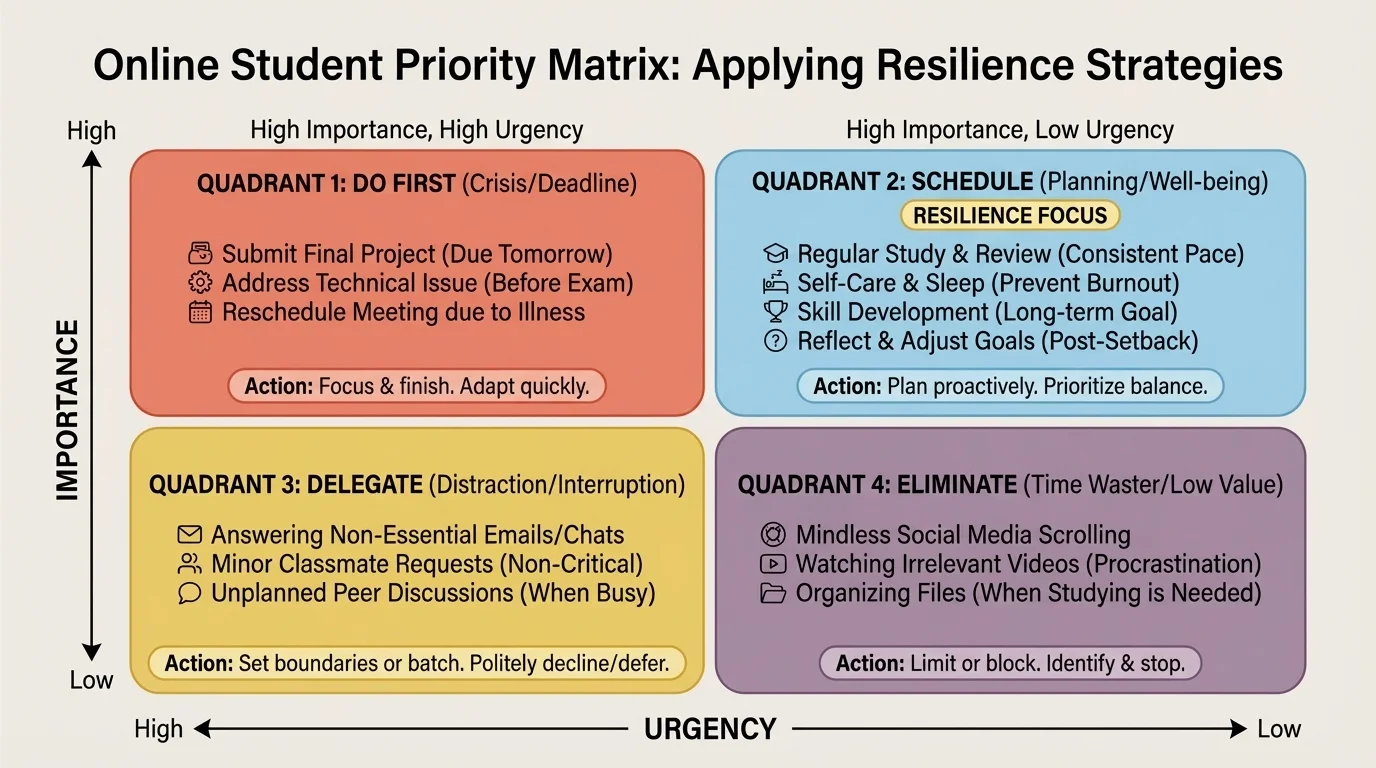
Then break large tasks into small actions. "Work on biology" is too vague. "Watch lesson video, take notes on three key ideas, answer questions 1 to 5" is much easier to start. Small steps reduce resistance and give you visible progress.
Use time blocks, but make them realistic. For example, instead of planning four straight hours of intense focus, plan two focused sessions of about 45 minutes with short breaks. Your schedule should match how attention actually works. If you overpack your day, the plan itself becomes discouraging.
Try This: At the start of a busy day, choose your priority three: the three tasks that would make the day count as productive even if other smaller tasks remain unfinished. This protects your energy from getting scattered.
It also helps to think in terms of available capacity. If you slept badly, had a difficult family day, or already spent hours concentrating, your capacity is lower. Lower capacity does not mean "do nothing." It means adjust the plan. A resilient student asks, "What is the best use of the energy I actually have?"
Workload management is an energy skill, not just a time skill. Two students can have the same number of tasks and experience them very differently depending on sleep, stress, distractions, and emotional load. Managing workload well means protecting focus, reducing decision fatigue, and planning breaks before burnout forces them on you.
Communication matters here too. If you know a deadline may become a problem, say something early. A short, respectful message is often enough: "I'm working on this, but I'm behind because of a schedule conflict at home. I can submit Part 1 tonight and Part 2 tomorrow. Does that work?" Early communication shows responsibility.
The priority matrix in [Figure 2] is especially helpful when your brain tells you everything is urgent. Usually, that is not true. Some tasks need action now, some need scheduling, some need a quick response, and some need to be ignored for the moment.
Example: Building a realistic plan for a busy week
You have a math test on Friday, an English discussion post due Thursday, household responsibilities every evening, and a club meeting online on Wednesday.
Step 1: Put deadlines in order.
English discussion post comes first, then the club meeting, then the math test.
Step 2: Break the biggest task down.
For math: review notes on Monday, practice problems on Tuesday, check mistakes on Wednesday, short review on Thursday.
Step 3: Protect high-focus time.
Study math earlier in the day when your concentration is strongest.
Step 4: Leave buffer time.
Keep one short block open in case something takes longer than expected.
This kind of planning lowers stress because you are no longer relying on last-minute effort to save the week.
Sometimes resilience is not about pushing harder. Sometimes it is about changing direction on purpose. Changing a goal does not mean quitting if the change is thoughtful and values-based, as [Figure 3] illustrates. A resilient person can say, "This path changed, but what matters to me still matters."
Maybe you planned to finish a course early, but your schedule became more demanding. Maybe you wanted one specific extracurricular opportunity, but it no longer fits your time or budget. Maybe you realized your original goal was based more on pressure from others than on what you actually want. In all of these cases, flexibility is a strength.
To adjust a goal well, ask: What part of this goal still matters? What conditions changed? What is the new timeline, method, or version that fits reality better? For example, if your original goal was "finish a certification by summer," your revised goal might be "complete the first module by summer and finish the certification by fall."
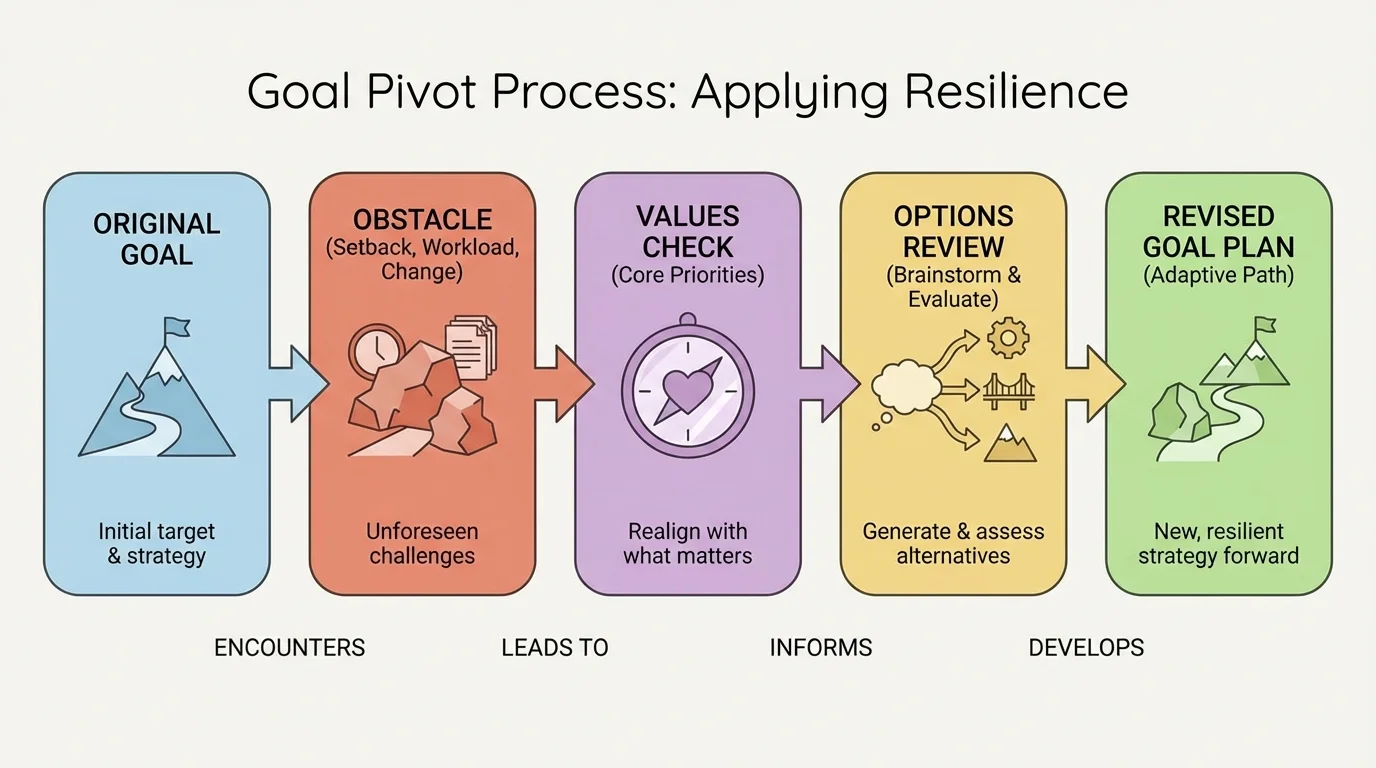
This is where adaptability matters. Adaptability means adjusting effectively when circumstances shift. It is not random changing. It is flexible problem-solving without losing sight of what matters most.
Try not to tie your identity to one exact plan. If you believe "If this one path fails, I fail," then any change will feel like a personal collapse. A healthier view is: "I am committed to the bigger purpose, and I can use different routes to get there."
People who stay committed to meaningful long-term goals are often more successful when they change strategy sooner, not later. Sticking to a broken plan just because it was the original plan can waste time and confidence.
Think about a student whose goal is to earn money for future training. One plan might be a part-time job, but if transportation or schedule problems make that unrealistic, a revised path could be freelance online work, neighborhood services, or a slower savings timeline. The value behind the goal stays the same even though the method changes.
When you review your own plans later, the path shown in [Figure 3] can help you pivot without panicking. Review the obstacle, keep the core purpose, and redesign the route.
You do not have to handle everything alone. In fact, one sign of maturity is knowing when to reach out. Resilience includes social skills: asking for help clearly, updating people early, and staying respectful when you are stressed.
If you need support, be specific. Instead of saying, "I'm overwhelmed," try, "I'm behind on two assignments and need help deciding what to do first," or "I'm having trouble understanding this lesson and need a quick explanation of the main idea." Specific questions are easier for others to answer.
Boundary-setting matters too. If messages, notifications, or other people's requests keep interrupting your work, say so directly and politely. For example: "I'm offline for the next hour to finish schoolwork. I'll reply after that." Protecting focus is not rude; it is responsible.
Professional communication becomes especially important during setbacks. A strong message is short, honest, and solution-focused. It explains the issue, takes responsibility where appropriate, and suggests a next step. That style builds trust.
Example: A strong message during a setback
"Hello, I wanted to let you know that I'm behind on today's assignment because of a family schedule issue. I have completed most of it and can submit tonight by 8:00 p.m. I'm sorry for the delay, and I wanted to communicate before the deadline passed."
This works because it is respectful, specific, and focused on action rather than excuses.
Good communication also lowers stress. When you avoid sending a message because you feel embarrassed, you usually stay anxious longer. Clear communication replaces uncertainty with information.
Some habits make setbacks heavier than they need to be. One is perfectionism. If your rule is "If I cannot do it perfectly, I should not start," then progress slows down and pressure grows. Another trap is all-or-nothing thinking: "If today went badly, the whole week is ruined." Real life is more flexible than that.
Comparison is another problem, especially online. You may see other people posting achievements, routines, or productivity tips and assume they are doing everything better. But you are seeing a limited version of their life, not their full reality. Compare yourself mainly to your own previous habits, not to someone else's highlight reel.
Watch for burnout signals too: constant exhaustion, irritability, loss of motivation, difficulty concentrating, and feeling numb toward responsibilities you usually care about. Burnout does not always come from doing too much once. It often comes from doing too much for too long without enough recovery.
If you notice those signals, resilience means responding early: sleep more consistently, reduce unnecessary commitments, talk to a trusted adult, and rebuild a manageable routine. Pushing through endlessly is not always strength. Sometimes it is a warning sign that your system needs support.
The strongest resilience strategy is not one dramatic response. It is a routine you use over and over. Build your own short system for stressful weeks.
A practical routine might look like this:
1. Notice the problem early.
2. Calm your body for a few minutes.
3. Separate facts from fears.
4. Pick the next useful action.
5. Re-plan your day or week realistically.
6. Communicate if someone needs an update.
7. Review what helped so you can repeat it next time.
Try This: Create a "resilience checklist" in your notes app with those seven steps. During your next stressful week, use it before reacting. The point is not to feel perfect. The point is to become steady and effective faster.
Over time, resilience builds confidence. Not fake confidence based on everything going well, but real confidence based on knowing that when things go wrong, you can recover, adapt, and continue.
