People can spend hours raising money, collecting supplies, or posting support online and still fail to help much at all. That sounds harsh, but it is true. A project can look generous from the outside and still miss the real problem. A box of donated items no one asked for, a fundraiser without transparency, or a public "awareness" post that shares someone's private struggle can all create more stress instead of relief. Responsible service starts when you stop asking only, "How can I help?" and start asking, "What is actually needed here?"
That question matters because service is not just about being kind. It is about being effective, respectful, and aware of how your choices affect other people. In real life, communities have different priorities, different strengths, and different challenges. If you want your actions to matter, you need to understand the situation before jumping in.
A community can be your neighborhood, a local organization, a sports team, an online support group, a faith group, or a group connected by shared experience. A community is not just a place. It is a group of people connected in some way.
A need is something important that is missing, limited, or under pressure. Some needs are basic, like food, shelter, safety, and transportation. Some are social, like connection, inclusion, and emotional support. Others are informational, like access to tutoring, job resources, mental health resources, or accurate public information.
Responsible action means choosing help that is thoughtful, respectful, safe, and based on real needs rather than assumptions.
Service means giving time, effort, skills, or resources to support others or improve a community.
Empathy means trying to understand what another person may be feeling or experiencing, without making their situation about you.
When community needs influence your actions, your service becomes more targeted. Instead of offering random help, you are responding to actual priorities. That increases trust and makes your effort more useful.
For example, suppose a local shelter says its biggest shortage is hygiene products. Bringing canned food may still be kind, but it does not solve the most urgent problem. Or suppose teens in an online community say they feel isolated and need peer connection. Posting generic motivational quotes may not help as much as helping organize a moderated virtual check-in group. The closer your action matches the need, the more responsible your service is.
One of the most important life skills in service is social awareness. That means paying attention to what other people are experiencing, noticing patterns, and understanding that your point of view is only one part of the picture.
Listening comes before helping. That sounds simple, but many people skip it because they are excited to act quickly. Fast action can feel productive. But if you do not understand the context, speed can lead to mistakes.
Listening can look different depending on the situation. You might read a community center's posted list of urgent needs. You might attend a virtual information session. You might ask a coordinator, "What would be most useful right now?" You might follow updates from a mutual aid group or youth organization. You might simply observe carefully before offering suggestions.
Good listening also requires perspective-taking. This means trying to see the situation from another person's point of view. If a family declines public attention during a crisis, their need may be privacy and dignity, not visibility. If a community resists outside volunteers, the issue may not be lack of caring. It may be previous bad experiences with people who came in, took over, and left.
Why empathy must be practical
Empathy is not just feeling bad for someone. Practical empathy asks, "What response would actually support this person or group?" Sometimes that means doing something active. Other times it means stepping back, protecting privacy, following instructions, or supporting a plan already created by the community itself.
A useful rule is this: the people closest to the problem usually understand the need best. That does not mean outside help is never welcome. It means good helpers do not assume they know more than the people living with the issue.
When you are unsure how to respond, use a simple process. This structure, shown in [Figure 1], helps you move from good intentions to responsible action. It keeps you from acting on impulse and reminds you to check whether your plan fits the real need.
Step 1: Notice the need clearly. What exactly is the problem? Be specific. "People need help" is too broad. "A neighborhood pantry is low on baby formula and diapers" is clearer.
Step 2: Gather information. Find out who is affected, what is already being done, and what support is being requested. Use reliable sources, especially when information is spreading online.
Step 3: Listen to the community. Ask what would be useful. Read the organization's instructions. Pay attention to concerns, boundaries, and preferences.
Step 4: Check your role. What can you realistically offer? Time, skills, organization, outreach, money, transportation help through a trusted adult, or digital support? Responsible service includes knowing your limits.
Step 5: Choose an action that fits. Match your response to the need instead of choosing the most visible or easiest option.
Step 6: Act safely and respectfully. Follow guidelines, protect privacy, and communicate clearly.
Step 7: Reflect afterward. Did your action help? What feedback did you receive? What should change next time?
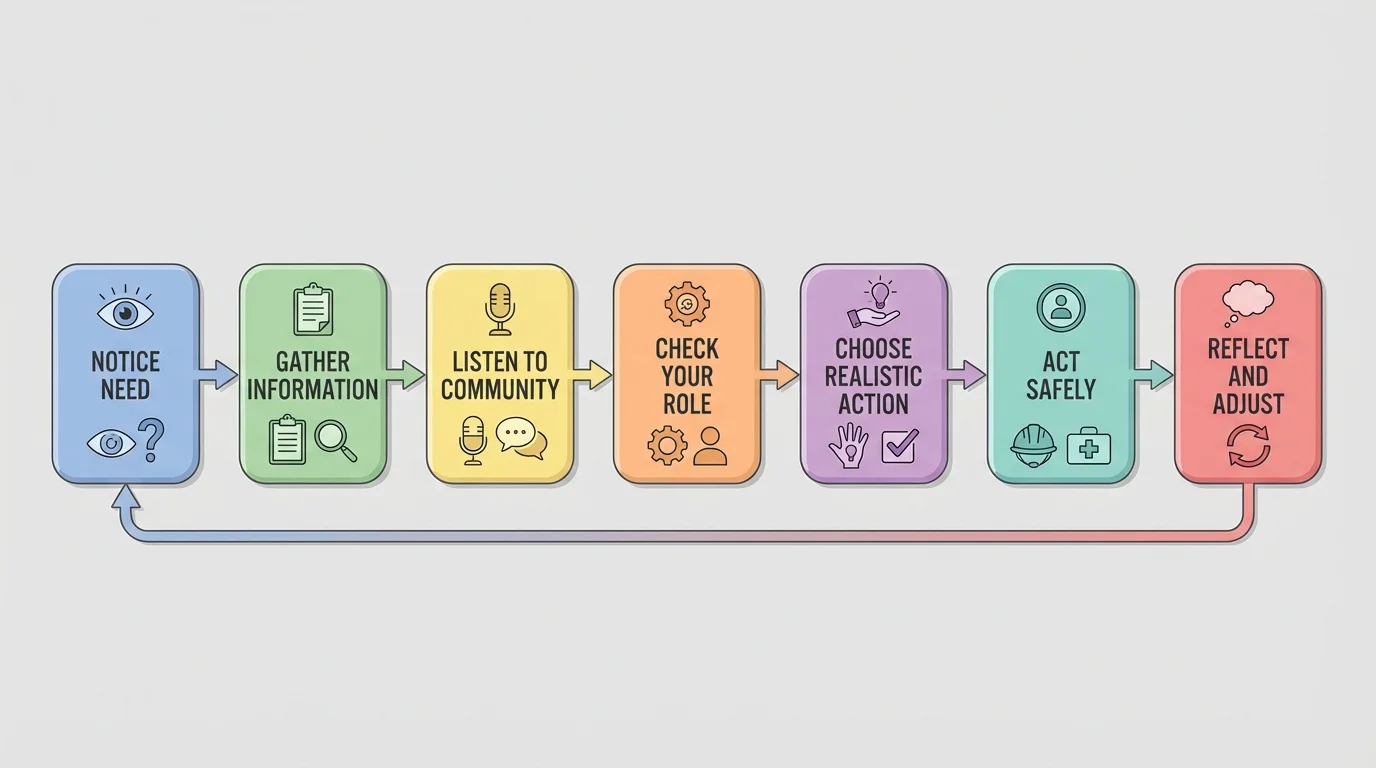
This process is useful in both local and digital communities. If you see a post claiming a family needs emergency help, do not immediately repost private details or send money to an unverified account. First confirm the source, check what has already been organized, and see whether the family or a trusted coordinator has requested a specific kind of support.
Responsible service is not passive. It still leads to action. But it replaces impulsive action with informed action.
Different problems call for different responses, as [Figure 2] illustrates. One of the biggest mistakes in service is using the same kind of help for every situation. Real needs vary, so responsible action should vary too.
Some needs require direct service. This means immediate hands-on support, such as packing food boxes, tutoring younger students online, helping an animal rescue with supply sorting, or calling isolated seniors through a supervised outreach program.
Some needs require advocacy. That means speaking up to influence decisions, policies, or awareness around a problem. If a community lacks safe pedestrian spaces, collecting evidence, contacting officials, and helping spread accurate information may matter more than a one-day event.
Some needs require capacity-building. This means strengthening a group so it can keep helping over time. Designing flyers, organizing a volunteer schedule, creating a sign-up system, or teaching basic digital skills can all support long-term impact.
Some needs require fundraising or donation drives. But even those should be specific. A vague "help people in need" campaign is less responsible than a verified drive for a named program with a clear goal, timeline, and list of accepted items.
| Community need | Less effective response | Better matched responsible action |
|---|---|---|
| Food insecurity | Donating random items without checking | Providing the exact foods or products requested by a pantry |
| Students falling behind | Posting general advice online | Offering scheduled tutoring or study support through a trusted program |
| Community misinformation | Sharing emotional rumors | Posting verified resources from reliable local sources |
| Loneliness among older adults | One-time public visit for photos | Consistent, approved phone or video check-ins |
| Unsafe public area | Complaining online only | Joining organized cleanup, reporting hazards, and supporting improvement plans |
Table 1. Examples of how different community needs should lead to different kinds of responsible service.
The key idea is fit. If the need is ongoing, the action may need to be ongoing. If the need is private, the action should protect privacy. If the need is complex, the response may need trained adults or organizations involved.
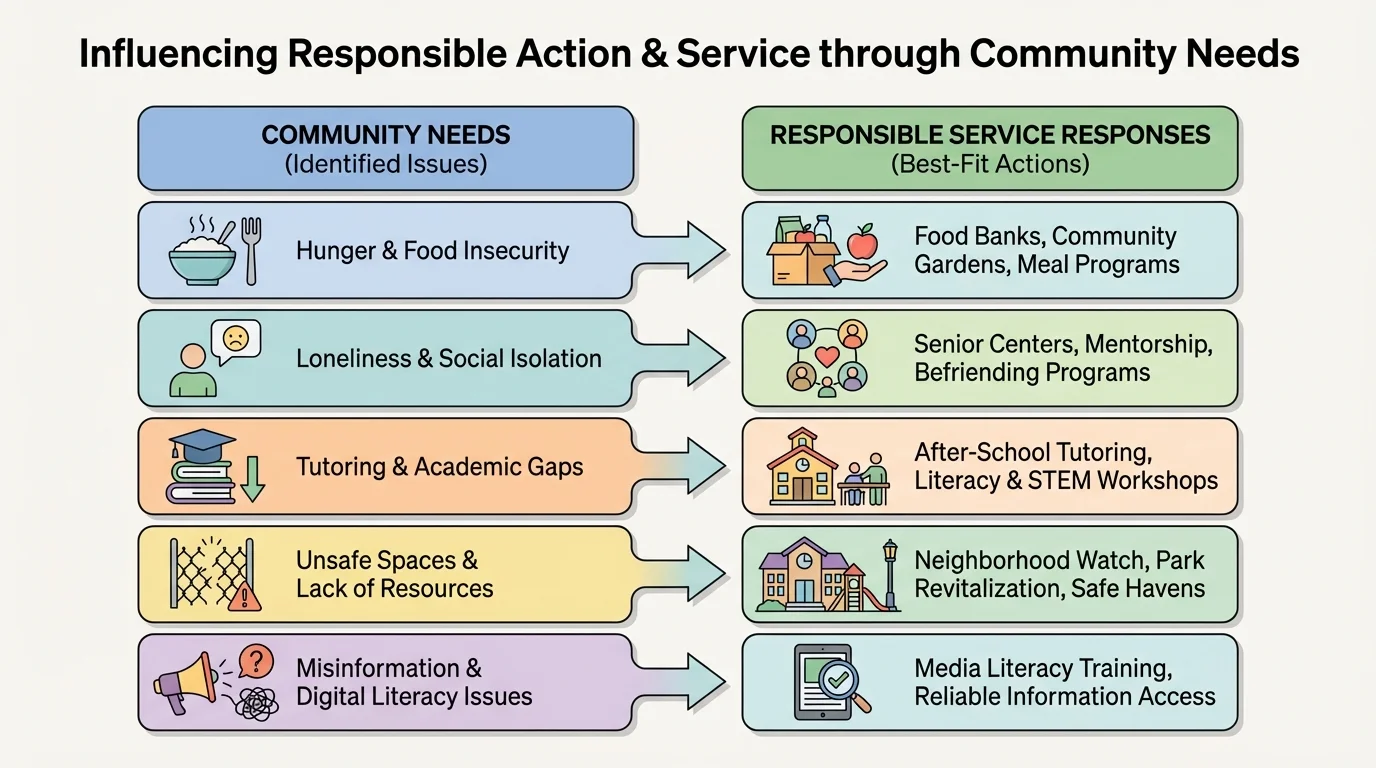
Later, when you choose between volunteering, fundraising, organizing, or sharing information, think back to [Figure 2]. It reminds you that "help" is not one thing. Responsible service is about selecting the right form of help for the situation.
Good intentions do not automatically create good outcomes. [Figure 3] shows the contrast between respectful support and attention-seeking behavior. Several common mistakes can make service less helpful or even harmful.
One mistake is the savior mindset. This happens when someone focuses on being seen as the rescuer instead of respecting the people they want to help. It can sound like, "I know what this community needs," even when the community has already explained otherwise.
Another mistake is performative service. This is help done mostly for image, praise, likes, or credit. Posting selfies with donations, sharing private stories without consent, or making promises just to look caring can damage trust.
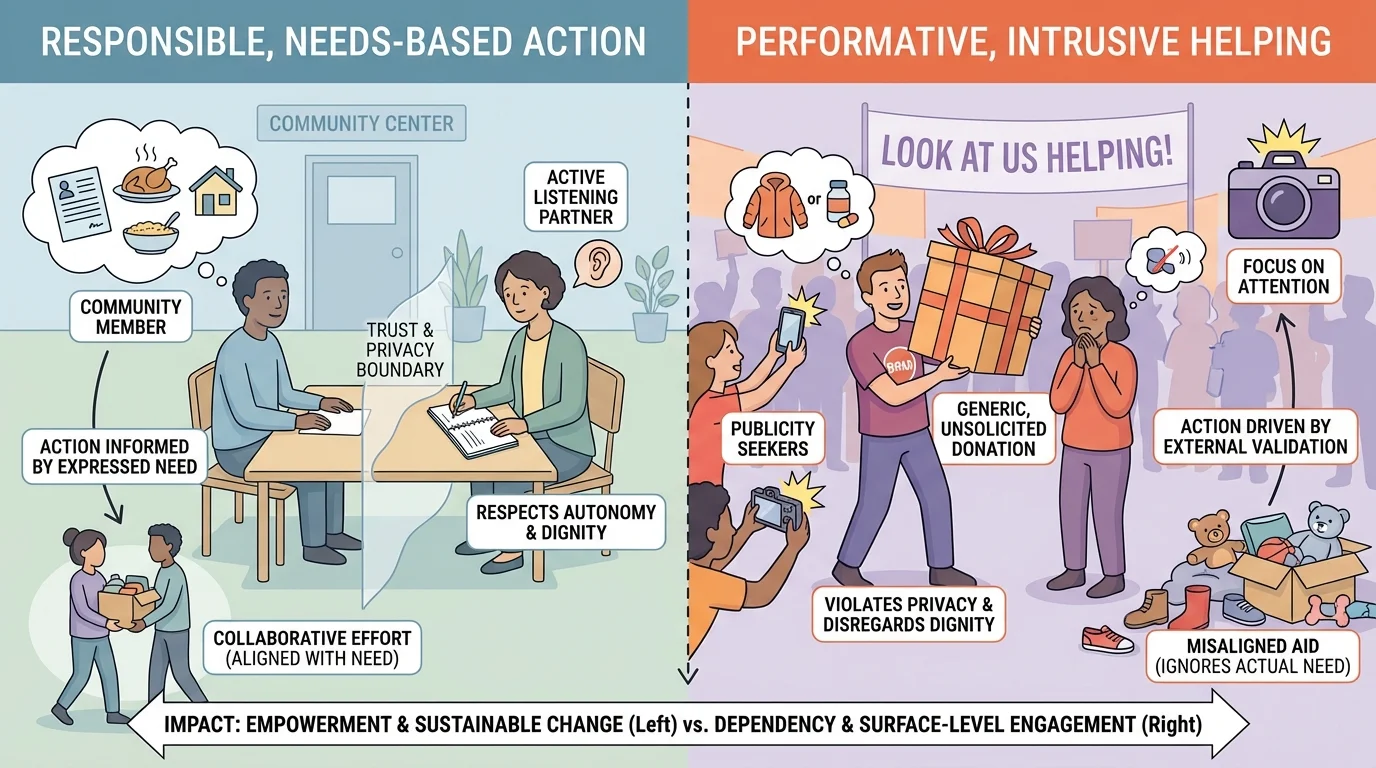
A third mistake is ignoring safety and boundaries. If a task involves legal rules, health risks, transportation, money handling, or sensitive personal information, you need adult guidance and trusted systems. Responsible service includes knowing when not to act alone.
A fourth mistake is offering what is convenient for you instead of what is useful for others. For example, you might enjoy designing posters, but if the organization urgently needs database help or volunteers to pack supplies, your preferred task may not be the priority.
A fifth mistake is treating a one-time action as a complete solution. Some service does need only one event. But many problems are ongoing. If your action creates excitement for one afternoon and no support afterward, the actual need may remain unchanged.
These mistakes often grow out of poor community impact analysis. Before acting, ask: Who benefits? Who decides? Could anyone be embarrassed, excluded, or burdened by this? What happens after the event ends?
Some organizations spend valuable time sorting unusable donations after public drives. Items that are expired, broken, inappropriate, or not requested can create extra work for staff instead of helping the community.
That is why responsible service is not just about generosity. It is also about discipline, planning, and respect.
Here are a few situations that show how community needs should guide action.
Scenario 1: Online tutoring
You hear that middle school students in your area are struggling with math. You want to help.
Step 1: Check whether a library, youth center, or local nonprofit already runs tutoring sessions.
Step 2: Ask what subjects, grade levels, and times are actually needed.
Step 3: Offer only the subjects you can teach well and the hours you can reliably keep.
Step 4: Use approved platforms and follow safety expectations for online contact.
This is stronger than simply posting "Message me if you need help," because it is structured, safe, and connected to a real need.
A second situation is this: your neighborhood social feed says many families need food support. Instead of launching your own separate drive immediately, you check with existing pantry organizers. They explain that storage space is limited and they urgently need gift cards and baby supplies, not canned vegetables. Your action changes because the information changed.
Scenario 2: Social media fundraiser
A classmate from an extracurricular group shares a fundraising post for a family after a house fire.
Step 1: Verify the fundraiser through a trusted adult, organization, or direct contact.
Step 2: Share only information the family has agreed to make public.
Step 3: If money is not the only need, help organize meals, clothing requests, or temporary housing support through approved channels.
Step 4: Follow up later to see whether support is still needed after the first wave of attention fades.
This protects dignity and keeps the support focused on real priorities.
A third situation: there is litter and broken glass in a local park. A cleanup may be appropriate, but responsible action still means checking first. Is there a local group already handling supplies and disposal? Are gloves and adult supervision needed? Does the space also have a larger issue, like missing trash bins or poor lighting, that should be reported along with the cleanup? Effective service often combines immediate action with longer-term thinking.
Service is rarely a solo effort. Even if you start an idea, you usually need to work with coordinators, families, volunteers, or community members. That requires communication and humility.
Humility means you do not need to be the center of the project. You can be useful without being in charge. Sometimes the most responsible role is supporting someone else's plan, showing up consistently, and doing the less visible work well.
Reliability matters too. If you commit to helping regularly, keep your word. Communities are affected when volunteers disappear, arrive late, or stop responding. Trust is built through follow-through.
Cultural humility also matters. Different communities have different values, communication styles, and experiences with institutions. If you are serving people whose background differs from yours, be careful not to judge quickly or assume your way is best. Ask, listen, and adapt.
Respect also includes privacy. Do not share names, photos, screenshots, medical details, housing struggles, or personal stories unless you have clear permission and it is appropriate to do so. A caring act can become harmful if it turns someone's hardship into public content.
When you collaborate well, your service is more likely to create the kind of positive community impact discussed earlier and reflected in [Figure 3]. Respectful teamwork often matters just as much as the service task itself.
"Ask not only what you can offer, but what is wanted, what is useful, and what is respectful."
This mindset keeps your actions grounded in community reality instead of personal assumptions.
After you help, pause and evaluate. Reflection is not about congratulating yourself. It is about learning whether your effort actually met the need.
Ask yourself a few practical questions. Was the need clearly identified? Did I listen before acting? Did my action match the request? Was I reliable? Did I protect privacy? What feedback did I receive? If the action did not work well, what should change next time?
Reflection also helps you notice when the need is bigger than one project. Maybe your tutoring revealed a larger issue with internet access. Maybe your cleanup showed a repeated maintenance problem. Maybe a donation drive highlighted transportation barriers. Responsible service often begins with one act and then grows into better understanding.
That is the deeper point of analyzing community needs: it turns service from a moment of charity into a habit of responsible citizenship. You learn to pay attention, respond thoughtfully, and stay accountable for the effects of your choices.
When you let community needs guide your actions, you do more than help. You build trust, strengthen relationships, and become someone others can depend on.
