A single message can do a lot more than pass along information. It can calm someone down, start an argument, protect your privacy, damage your reputation, prove that you kept your word, or reveal more than you meant to share. Especially in online environments, your communication choices do not disappear when the moment is over. Screenshots, forwarded messages, public posts, and saved chats can turn one quick decision into something that affects your safety, your accountability, and your relationships for a long time.
That is why communication is not just about being "nice" or "good with words." It is a practical life skill. Every time you text, comment, send direct messages, email, join a group chat, speak on a video call, or post on social media, you make choices. Those choices shape whether people trust you, whether situations stay safe, and whether your relationships become healthier or more stressful.
People often focus on what was said, but the effect of communication also depends on how, when, where, and to whom it was said. A joke sent to one close friend may feel harmless, but the same joke posted publicly could embarrass someone or make you look careless. A serious concern shared in a private message might protect someone's dignity, while putting that same concern in a group chat could create pressure and conflict.
Strong communication choices support three major outcomes. First, they support safety by protecting personal information, reducing conflict, and helping you respond wisely in risky situations. Second, they support accountability by showing honesty, ownership, and follow-through. Third, they support healthy relationships by building respect, trust, and clear boundaries. When communication goes poorly, these same areas are often the first to be damaged.
Safety in communication means protecting your physical, emotional, social, and digital well-being.
Accountability means taking responsibility for your words, actions, promises, and impact on other people.
Healthy relationships are relationships where both people show respect, honesty, boundaries, and care, even during disagreements.
[Figure 1] If you want a practical way to think about this topic, ask yourself: "Will this message make the situation safer or riskier? Will it show responsibility or avoidance? Will it build trust or weaken it?" Those three questions can improve a surprising number of everyday choices.
Communication includes much more than the words themselves. Every message involves a chain of decisions: what you say, your tone, the timing, the platform you use, the audience who can access it, and the likely consequences. A short reply like "fine" may mean one thing in a calm voice on a call and something very different in a text after an argument.
Another important factor is context. The same sentence can feel helpful, rude, caring, sarcastic, dismissive, or threatening depending on the situation. Online communication makes this harder because body language and facial expressions may be missing. That means you often need to be more clear than you think, not less.
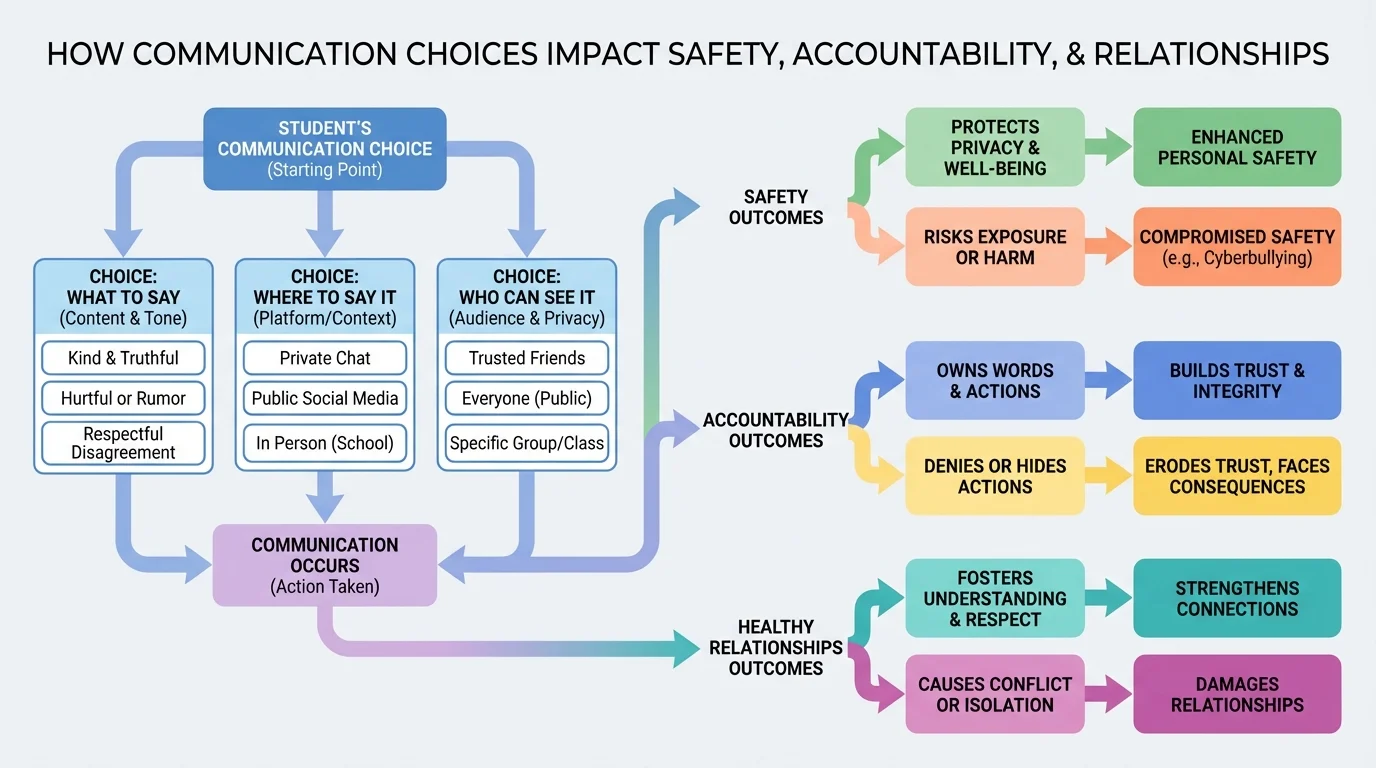
Here are some major communication choices you make every day:
When you start to notice these choices, you gain more control. Instead of reacting automatically, you can respond intentionally. That is a major part of personal maturity.
Your communication affects safety in direct ways, especially online. As [Figure 2] illustrates, some messages protect you while others expose you. Sharing your live location, your home address, your passwords, your schedule, private photos, or details about where you will be can create risks that feel small in the moment but become serious later.
Digital footprint matters here. What you send, post, or comment can often be copied, saved, or shared. Even "disappearing" messages may be screenshotted. A message you meant for one person can quickly reach people you never intended to involve. That is why safety is not only about strangers. Sometimes risk comes from people you know who pressure you, spread your information, or fail to respect privacy.
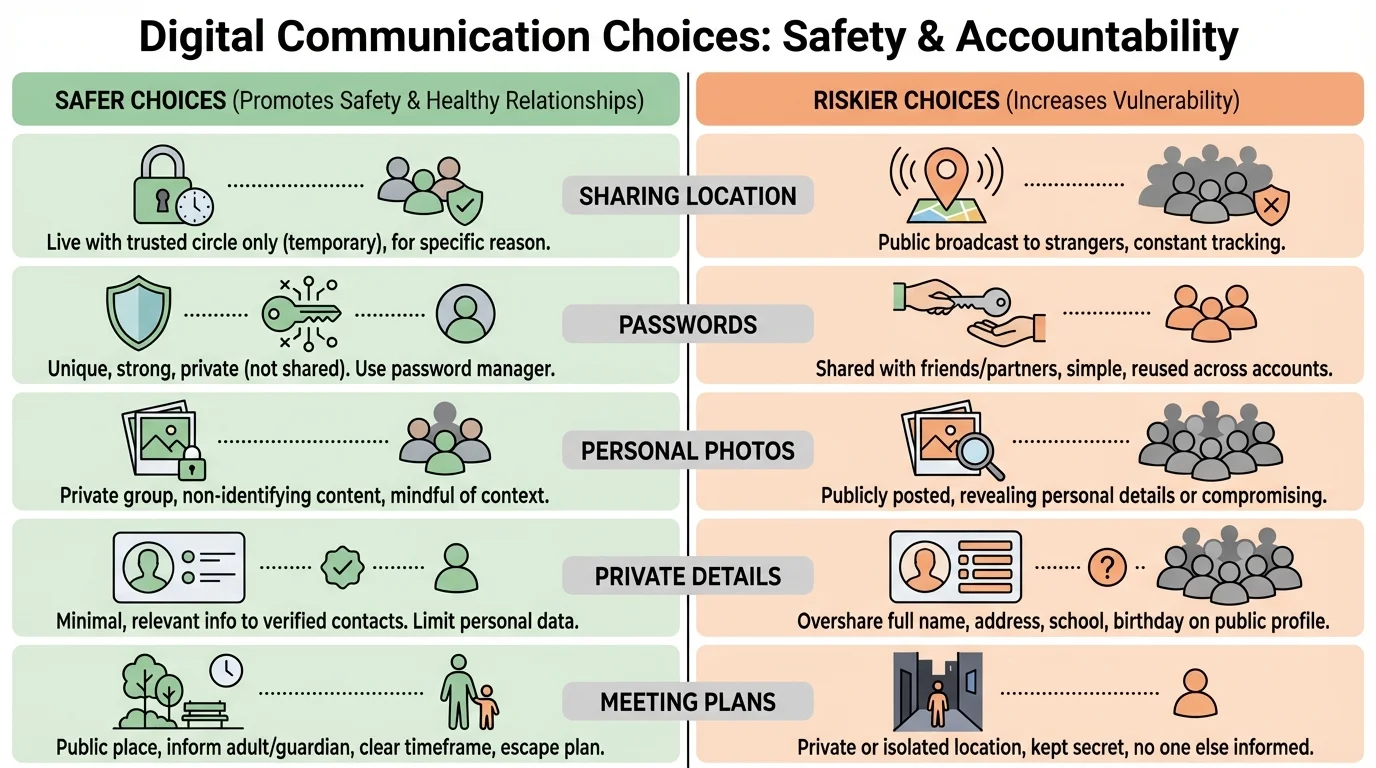
Unsafe communication choices can include:
Safer communication choices often look less dramatic, but they are more effective. They include using privacy settings, keeping personal details private, asking a trusted adult for input when a situation feels off, documenting threatening messages, blocking when needed, and refusing to move a conversation into a less safe space. For example, if someone you only know online asks to switch to a more private app and share personal photos, the safest choice is not to "be polite" and continue. The safest choice may be to stop responding, save evidence, and tell a trusted adult.
Safety is not rudeness. Many people, especially teens, worry that setting a boundary will make them seem mean. But a respectful "I'm not sharing that," "I'm not comfortable with this," or "I'm ending this conversation" can be exactly the right choice. Protecting yourself is responsible communication, not overreacting.
Safety also includes emotional safety. If a conversation is becoming cruel, humiliating, sexually pressuring, or threatening, continuing it may not help. Stepping back, muting, blocking, leaving a chat, or getting help can be the healthiest decision. As the comparison in [Figure 2] makes clear, not every response deserves access to you.
Communication is one of the main ways people judge whether you are responsible. If you say you will do something and then disappear, people notice. If you make a mistake and deny it, blame others, or edit the story to protect yourself, trust drops fast. If you communicate clearly, admit what happened, and follow through on next steps, trust can recover even after a problem.
Accountability in communication includes several habits:
Consider two versions of the same situation. You agree to help with an online volunteer project and then realize you cannot finish your part on time.
Case study: avoiding responsibility vs. showing accountability
Version 1: You ignore messages for two days, then say, "I was busy. It's not my fault."
This choice creates stress for the group, makes you seem unreliable, and shifts the burden onto other people.
Version 2: You message early: "I'm sorry. I won't finish my part by tonight. That affects the group, and I should have said something sooner. I can submit half by 7:00 p.m. and help with edits tomorrow."
This does not erase the problem, but it shows honesty, ownership, and a plan.
Notice that accountability is not the same as perfection. Responsible people still make mistakes. What matters is whether they hide, excuse, and deflect, or whether they communicate clearly and repair the situation.
A real apology usually has four parts: what you did, the effect it had, your responsibility, and what will change. For example: "I shared your message without asking. That broke your trust. I should not have done that. I won't forward private messages again." That is stronger than "Sorry if you were offended," which avoids responsibility.
Healthy relationships are built through repeated communication choices, not one grand speech. Trust grows when people feel heard, respected, and safe with each other. It weakens when communication becomes dishonest, controlling, dismissive, or unpredictable.
This applies to friendships, family relationships, dating relationships, community groups, gaming teams, and part-time jobs. The details may change, but the pattern stays similar: healthy communication includes listening, respect, honesty, boundaries, and repair after conflict.
Research on relationships consistently shows that small patterns matter. A person does not usually decide whether they trust you based on one perfect message. They notice whether your everyday communication is respectful, truthful, and consistent over time.
Some communication choices that support healthy relationships include:
Boundary setting is especially important. A boundary is not a threat or a punishment. It is a limit that protects well-being. For example: "I'm not available to text after 10 p.m." "Don't post photos of me without asking." "If we're upset, let's talk on a call instead of fighting in comments." Healthy people may not love every boundary, but they can respect it.
Another key relationship skill is active listening. That means paying attention, checking your understanding, and responding to the actual message instead of only preparing your defense. One useful sentence is: "What I'm hearing is ____. Is that right?" It slows conflict down and helps both people feel understood.
"Clear is kind. Unclear is unkind."
— Brené Brown
That quote matters because unclear communication often creates avoidable pain. Hinting instead of speaking honestly, ghosting instead of giving an answer, or acting passive-aggressive instead of naming the problem can leave people confused and hurt. Clarity is not always comfortable, but it is often more respectful.
[Figure 3] When emotions run high, your brain wants speed, not wisdom. That is why a repeatable framework helps. You can train yourself to pause and check your message before you send it. This does not need to take a long time. Even a pause of 30 seconds can prevent a bad decision.
Use this six-step check:
Step 1: Pause. If you feel angry, embarrassed, pressured, jealous, or afraid, do not answer instantly unless there is an urgent safety issue. Fast replies are often emotional replies.
Step 2: Check safety. Does this reveal personal information, increase conflict, or give someone access they should not have?
Step 3: Check truth. Is it accurate? Are you leaving out important facts? Are you spreading something you have not verified?
Step 4: Check tone. If someone read this out loud, how would it sound? Harsh? Mocking? Passive-aggressive? Clear and calm?
Step 5: Choose the right platform. Some conversations should not happen in comments or group chats. Sensitive issues often belong in a private and respectful space.
Step 6: Decide send, edit, wait, or don't send. Those are all valid choices.
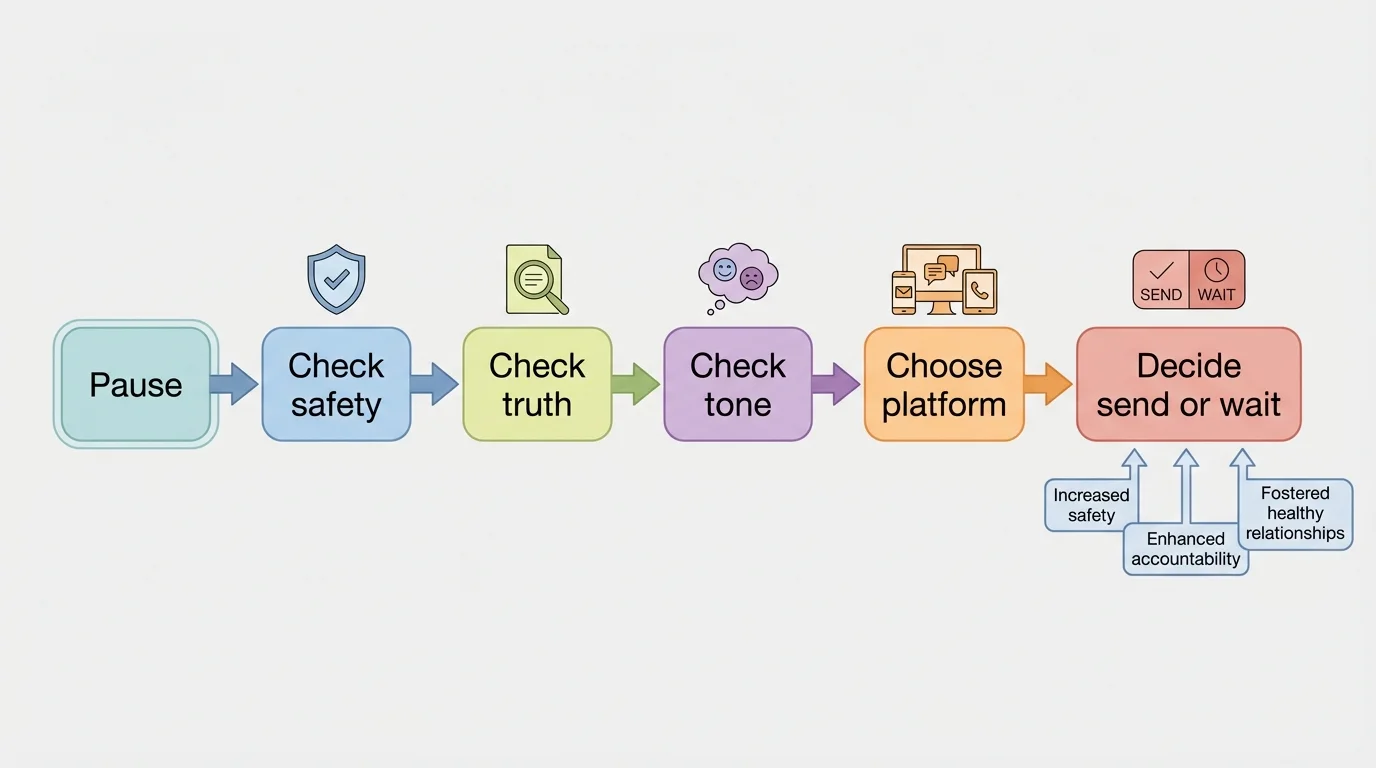
This framework is especially useful in moments when you feel tempted to "win" the interaction. What feels like a short-term win can create long-term consequences. A sharp post might get attention, but it can also damage trust, create screenshots, or escalate drama you then have to live with.
Later, when you are reviewing your own habits, [Figure 3] still helps because it turns communication into a set of choices you can improve. You are not "just bad at texting" or "just blunt." You can build better habits step by step.
Here are some realistic situations and what strong communication might look like.
Scenario 1: A friend sends you someone else's private screenshots.
Risky choice: Forwarding them, reacting publicly, or joining in the gossip.
Better choice: Do not spread them. You can say, "I'm not comfortable passing around private messages." This protects safety and shows accountability.
Scenario 2: Someone you are dating wants constant access.
Risky choice: Sharing passwords, live location all the time, or feeling forced to reply instantly to prove loyalty.
Better choice: Say, "Caring about someone doesn't mean giving up privacy. I'm okay sharing plans, but not passwords." Healthy relationships do not require surveillance.
Scenario 3: You are upset in a group chat.
Risky choice: Sending a paragraph while angry, using insults, or posting screenshots elsewhere.
Better choice: Pause. Ask to continue later in private or on a call. Public conflict often becomes performance instead of problem-solving.
Scenario 4: You forgot a responsibility.
Risky choice: Making excuses or pretending you never saw the message.
Better choice: Acknowledge it quickly, apologize clearly, and state your next step.
Scenario 5: Someone online pressures you for photos or secrecy.
Risky choice: Trying to calm them by giving in a little.
Better choice: End contact, save evidence, block, and tell a trusted adult. Pressure is a warning sign, not a compliment.
Not all communication problems are simple misunderstandings. Some patterns are unhealthy or dangerous. Watch for repeated pressure, guilt-tripping, threats, constant monitoring, humiliation, love-bombing followed by cruelty, demands for secrecy, sharing your private information, or making you responsible for their emotions. These are not signs of strong care. They are signs of control.
Manipulation often sounds like this: "If you loved me, you would prove it." "Don't tell anyone about this." "You made me act this way." "Reply right now or I'll do something extreme." These messages are designed to control your response by using fear, guilt, or pressure.
When communication becomes manipulative or unsafe, your goal is not to argue perfectly. Your goal is to protect yourself. That may mean ending the conversation, not explaining repeatedly, documenting messages, blocking, and involving a trusted adult, parent, guardian, counselor, coach, supervisor, or another safe support person in your community.
If a situation involves threats, coercion, sexual pressure, blackmail, stalking, or fear for your immediate safety, stop focusing on being polite. Focus on getting help from a trusted adult or emergency support right away.
One more important point: privacy and secrecy are not the same. Privacy is a healthy boundary. Secrecy that isolates you or protects harmful behavior is different. If someone tells you that you must keep something secret in order to protect the relationship, pay attention. Healthy relationships can handle appropriate outside support.
Try This: Before sending one important message today, use the six-step check. Ask whether it is safe, true, respectful, and in the right format.
Try This: Rewrite one message you recently sent in a calmer, clearer tone. Notice how small wording changes affect meaning.
Try This: Practice one boundary sentence out loud: "I'm not comfortable with that." "Please don't share that." "I need time before I respond."
Try This: If you owe someone a response or apology, keep it direct. Name what happened, own your part, and state what you will do next.
Try This: Review your privacy settings and think about what your posts, comments, and usernames reveal about you.
The strongest communicators are not the loudest or fastest. They are the people who know that communication has consequences and choose their words with intention. When you communicate in ways that protect safety, show accountability, and support healthy relationships, you make your life more stable and your connections more trustworthy.
