One of the fastest ways people lose control of a situation is not through anger, but through hesitation. A person pushes too far, a group chat turns intense, someone keeps asking even after you have already said no, or a disagreement starts pulling in screenshots, sarcasm, and pressure. In moments like that, your goal is not to win every argument or make everyone happy. Your goal is to respond in a way that protects your safety, your values, and your future.
This matters because pressure, conflict, and boundary problems show up in real life all the time. They can happen with friends, family members, teammates, coworkers at a part-time job, someone you are dating, or people online. Handling these situations well can protect your mental health, reputation, privacy, and relationships. Handling them poorly can lead to stress, regret, unsafe situations, or ongoing drama that keeps growing.
Pressure is when someone tries to push you toward a choice you do not fully want to make. That pressure can be obvious, like "Come on, just do it," or subtle, like guilt, teasing, silence, repeated requests, or making you feel left out.
Disagreement is a conflict of opinions, needs, or goals. Not all disagreement is bad. In healthy relationships, people disagree and still treat each other with respect.
Boundaries are the limits you set around your body, time, energy, privacy, values, emotions, and personal information. A boundary violation happens when someone ignores, crosses, or pressures you to move those limits.
Pressure pushes you toward a choice. Disagreement means people are not on the same page. Boundaries are your personal limits. A boundary violation happens when those limits are ignored or crossed.
These situations can overlap. For example, a friend may disagree with your decision not to share your password. If they keep pushing, the disagreement becomes pressure. If they try to get into your account anyway, it becomes a boundary violation.
The earlier you notice a problem, the easier it is to respond well. Many students wait until they feel overwhelmed, then react in a way they later regret. Pay attention to your body and your thoughts.
Warning signs include a tight stomach, racing thoughts, feeling cornered, wanting to disappear, suddenly apologizing for things you did not do, or feeling like you must answer right now. Online, warning signs can include repeated messages, demands for instant replies, pressure to send photos, guilt-tripping, threats to post private information, or someone acting like they deserve access to your time and attention.
Many unhealthy interactions do not start with a big red flag. They often begin with small tests, like ignoring a minor limit, teasing you for saying no, or acting offended when you ask for space.
If you notice these signs early, you can slow the moment down before it escalates. That is a big part of de-escalation: reducing tension instead of feeding it.
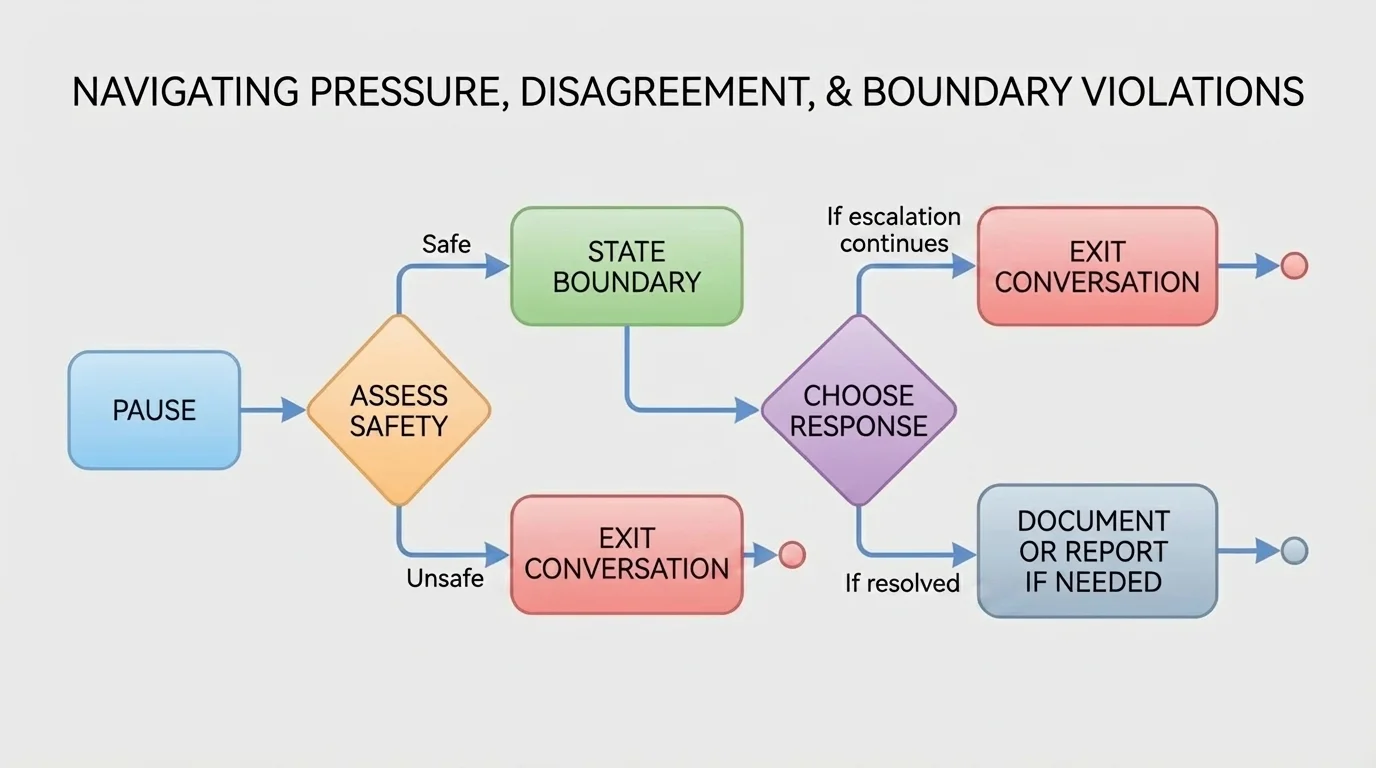
When emotions rise, it helps to have a plan ready. The process in [Figure 1] gives you a practical sequence: pause, assess safety, state the issue, choose your response, and leave or report if needed. You do not have to use perfect words. You just need a clear next step.
Step 1: Pause. Before replying, take one breath. If needed, wait a minute before typing or speaking. A short pause helps you respond instead of react.
Step 2: Assess safety. Ask yourself: "Am I just uncomfortable, or am I unsafe?" If there is a threat, intimidation, blackmail, stalking, or repeated harassment, safety comes first. You do not owe a long explanation.
Step 3: Name the issue. Be specific. Try: "I said no." "I am not comfortable with that." "Do not message me like that." "We can disagree, but do not insult me."
Step 4: Choose a response. You might restate your boundary, redirect the conversation, stop replying, leave the call, mute or block, document what happened, or contact a trusted adult.
Step 5: Follow through. A boundary only works if you act on it. If you say, "If you keep doing this, I am leaving the chat," then leave the chat if it continues.
A common mistake is overexplaining. You do not need a ten-minute speech to justify a clear limit. Short statements are often stronger because they are harder to argue with.
Clear, calm, brief communication is often more effective than emotional intensity. People who push boundaries may look for confusion, guilt, or long explanations they can debate. A short, steady response makes your position clear without adding extra fuel.
That does not mean being cold or rude. It means being direct. Respectful and firm can exist together.
Peer pressure is not just about risky behavior. It can include pressure to share personal information, join drama, mock someone, skip responsibilities, send money, reveal secrets, or act like you are okay when you are not.
One useful strategy is the assertive communication approach: say what you mean clearly, without attacking the other person or giving up your own rights. Assertive is different from aggressive. Aggressive tries to control others. Assertive protects your own limits.
Here are practical response scripts you can actually use:
"No, I am not doing that."
"I am not comfortable sharing that."
"Stop asking. My answer is still no."
"I am logging off now."
"If you are my friend, you will respect that."
"I do not need to prove anything."
Real-life example: pressure in a group chat
A friend keeps pushing you to send a private screenshot from another conversation.
Step 1: Name the pressure.
You recognize that this is not harmless curiosity. It is pressure to violate someone else's privacy and your own values.
Step 2: Respond clearly.
You say, "I am not sending that."
Step 3: Refuse the argument trap.
If they say, "Why are you being dramatic?" you do not debate. You repeat, "I said no."
Step 4: Follow through.
If the pressure continues, you mute the chat or leave it for a while.
This protects your privacy, your integrity, and the other person's trust.
If pressure keeps happening, that tells you something important about the relationship. Respectful people may feel disappointed, but they do not keep pushing after a clear no.
Not every conflict is a boundary problem. Sometimes people simply disagree. In that case, the skill is to stay focused, respectful, and honest. You are not trying to "destroy" the other person. You are trying to communicate effectively.
Start by listening long enough to understand the actual issue. Sometimes people argue about tone when the real issue is feeling ignored. Sometimes people argue about one event when the real issue is a repeated pattern.
Helpful phrases include: "Let me make sure I understand what you mean." "I see it differently." "I am willing to talk, but not if we are insulting each other." "Let's stay on the main issue." "I need a break, and I can continue later."
You do not have to choose between being silent and starting a fight. There is a middle option: speak honestly, stay respectful, and keep your focus on the issue instead of attacking the person.
Use "I" statements when possible: "I felt dismissed when my messages were ignored," instead of "You never care." This reduces blame and increases the chance that the other person will actually hear you.
Still, respectful communication does not guarantee a respectful response. If someone starts insulting, mocking, threatening, or twisting your words on purpose, the conversation may no longer be productive. At that point, stepping away can be a strong decision, not a weak one.
A boundary violation often feels different from ordinary disagreement. The other person acts as if your limit does not count. They may pressure you for access to your phone, demand your location, repeatedly contact you after you ask for space, go through your belongings, share your private messages, or try to make you feel guilty for wanting privacy.
When this happens, move from explaining to protecting. State the boundary once or twice if needed, then shift to action. Action might mean ending the conversation, blocking contact, changing passwords, taking screenshots, telling a parent or guardian, or involving a supervisor if the situation is connected to work, volunteering, sports, or another activity.
Real-life example: repeated unwanted contact
You tell someone you do not want to keep chatting, but they send message after message and start using guilt like, "Wow, I guess you never cared."
Step 1: Restate the limit once.
"I am not continuing this conversation."
Step 2: Stop engaging.
You do not keep explaining, defending, or arguing.
Step 3: Protect yourself.
You mute, block, or restrict contact, depending on the platform and the level of concern.
Step 4: Save evidence if needed.
If the messages become threatening, sexual, manipulative, or harassing, you take screenshots and tell a trusted adult.
The point is not to punish the person. The point is to stop the violation and protect your well-being.
Watch for coercion, which means pressure or manipulation meant to wear down your ability to choose freely. Coercion can sound like "If you loved me, you would," "Everyone else does this," or "I'll be upset unless you agree." A choice made under pressure is not a free choice.
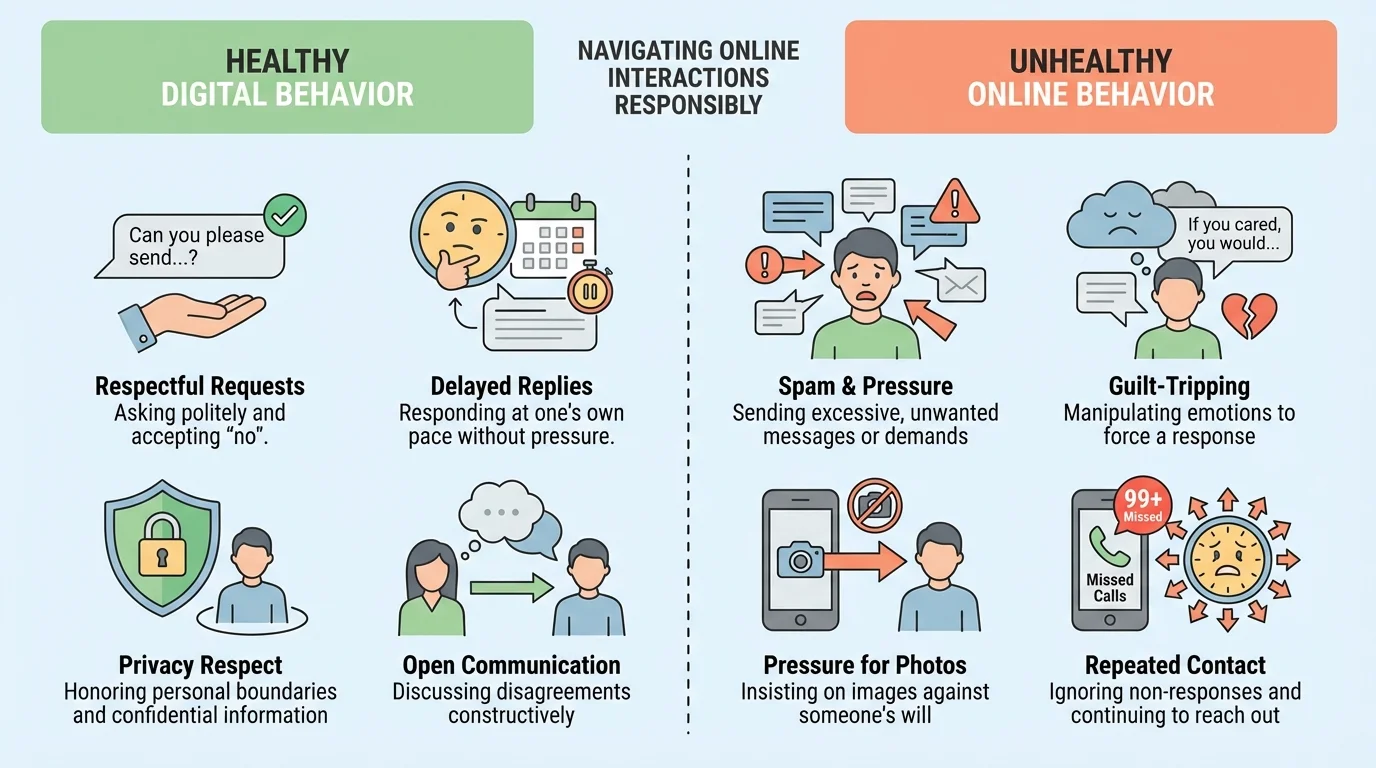
Online interactions can get intense fast because people have constant access to each other. As [Figure 2] shows, the difference between respectful contact and unhealthy digital behavior often comes down to consent, timing, privacy, and repetition. A single message is different from spam. A request is different from a demand. Interest is different from pressure.
Your digital boundaries may include who can follow you, who can message you, what personal details you share, whether people can tag you, whether they may repost your content, and how quickly you are willing to respond. You are allowed to have limits even if other people are more open online.
Practical digital safety strategies include using strong passwords, turning on privacy settings, limiting location sharing, not sending content you would not want copied, and avoiding emotional decisions when you are tired, upset, or trying to impress someone.
If a situation becomes harmful, document first if needed, then use platform tools like mute, restrict, block, or report. If there is any threat, blackmail, sexual pressure, or fear for your safety, tell a trusted adult right away.
One reason online boundary problems spread is that people confuse access with closeness. Just because someone can message you anytime does not mean they are entitled to your attention anytime.
"No" is a complete sentence, and silence after a clear boundary is not rude when safety or respect is at stake.
Later, when you review a digital situation, look for patterns. The chart in [Figure 2] helps you spot the difference between a normal misunderstanding and repeated disrespect.
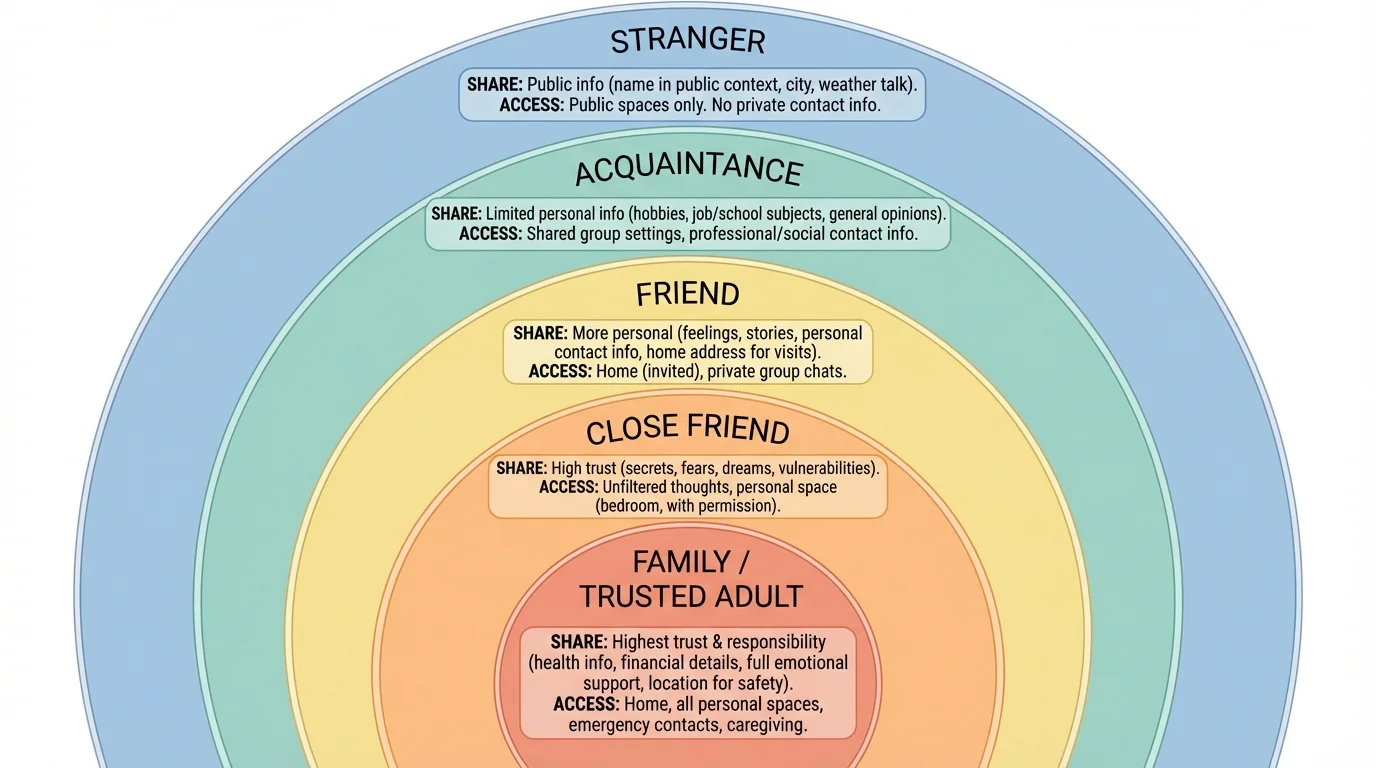
Your boundaries are not identical with every person. The relationship map in [Figure 3] helps explain why. A close friend may know personal details that you would never share with an acquaintance. A parent or guardian may need certain information for safety reasons. A stranger online does not automatically deserve personal access just because they seem nice.
Context matters too. The same message can feel okay from one person and invasive from another, depending on trust, history, and purpose. That is why boundaries are not about being secretive. They are about choosing appropriate levels of access.
With friends, a healthy response may be direct but casual: "I am not talking about that," or "Please do not post that photo." With family, you may need a calm but firmer approach: "I need privacy while I cool down. I can talk in 20 minutes." With a supervisor, coach, or adult leader, professionalism matters: "I am uncomfortable with that request," or "I would prefer communication stay in the group email."
In dating situations, boundaries matter even more because emotions and expectations can rise quickly. You never owe physical affection, personal photos, instant replies, passwords, location sharing, or emotional labor just because someone likes you or you are in a relationship.
The boundary map in [Figure 3] also reminds you that trust should build over time. Fast pressure for deep access is often a warning sign, not a compliment.
Some situations go beyond ordinary pressure or disagreement. Examples include threats, stalking, blackmail, sexual coercion, repeated harassment, impersonation, sharing private images, or attempts to isolate you from support. In those cases, your main job is safety, not politeness.
If you feel unsafe, use a simple plan: stop responding, leave the conversation or platform if needed, save evidence, tell a trusted adult, and contact appropriate help. Depending on the situation, that may include a parent or guardian, counselor, program leader, workplace supervisor, platform support team, or emergency services.
Safety overrides social pressure. You are never required to stay available, stay nice, or keep explaining yourself when someone is threatening, coercive, or repeatedly violating your boundaries. The responsible choice is to protect yourself and bring in support.
A lot of people hesitate to get help because they worry they are "making it a big deal." But if someone is ignoring your limits, trying to control you, or making you afraid, getting support is not overreacting. It is good judgment.
Strong boundaries are easier when they are part of your daily habits, not something you invent in the middle of stress. Decide ahead of time what matters to you: your privacy, your schedule, your sleep, your values, your body, your online presence, and your emotional energy.
Try this: write three boundary statements you could actually use this week. Keep them short. For example, "I am not available to text late at night." "I do not share private conversations." "Do not joke about that with me." Practice saying them out loud so they feel natural.
Try this: make a support list of at least three trusted people you could contact if something becomes too big to handle alone. Knowing who to reach out to makes it easier to act quickly.
Try this: review your privacy settings and message permissions on the apps you use most. Prevention is often easier than cleanup.
Real-life example: disagreement handled well
You and a friend argue because they think you ignored them during a video call. You feel accused and want to snap back.
Step 1: Pause.
You wait before replying so you do not react in anger.
Step 2: Clarify.
You say, "I want to understand what bothered you."
Step 3: State your view.
"I was distracted and handled it badly, but I was not trying to embarrass you."
Step 4: Set a boundary if needed.
"I am willing to talk about it, but not if you keep insulting me."
This keeps the focus on repair without accepting disrespect.
You will not handle every situation perfectly. That is normal. What matters is building a pattern: notice early, stay calm, speak clearly, protect your limits, and get help when needed. Those are real-life skills that make relationships healthier and your decisions stronger.
