A deadline that is three weeks away can feel strangely unreal, right up until it feels like a full emergency. That is one of the biggest challenges with long-term goals: your brain often reacts more strongly to what feels urgent today than to what matters most later. Whether you are finishing an online course project, saving for a new device, training for a sports season, or preparing application materials, the skill is not just "working hard." It is learning how to plan in a way that keeps future goals visible in the present.
Long-term goals are difficult because they require executive functioning skills. These are the mental skills that help you organize, prioritize, begin tasks, manage time, and follow through. If a goal is large and the deadline is far away, it is easy to think, "I still have plenty of time." Then smaller delays stack up. One missed day becomes three. A task you thought would take one hour actually takes three. Suddenly, a calm plan turns into stress.
Another challenge is time blindness, which means having trouble sensing how much time is passing or how long tasks really take. This is common, especially when your schedule is flexible or you learn from home. Without bells, classroom transitions, or in-person reminders, you may need stronger personal systems to notice time clearly.
Long-term goal means a result you want to achieve over weeks, months, or longer.
Deadline is the point by which something must be completed.
Milestone is an important checkpoint that shows progress toward a larger goal.
Task is a specific action step you can actually do.
When planning is weak, the consequences are real: rushed work, missed due dates, poor sleep, avoidable stress, and lower-quality results. When planning is strong, you gain something powerful: control. You know what to do next, when to do it, and how to tell whether you are on track.
A vague goal is hard to plan. "Do better in school" or "work on my project" sounds nice, but it does not tell you what to do. A strong goal is specific enough that you can picture the finish line. Ask yourself four questions: What exactly am I trying to complete? When is it due? What does success look like? What limits do I need to work around?
For example, compare these two goals:
Weak goal: "Get my history assignment done."
Better goal: "Submit my five-slide history presentation by Friday at 6:00 p.m. with all sources listed, images added, and one practice run completed by Thursday night."
The second version gives you a real target. It includes the final deadline, the quality standard, and a mini-deadline for practice. That makes planning possible.
Clear goals reduce decision fatigue. If you know exactly what "done" means, you spend less energy guessing. Instead of repeatedly asking yourself what to work on, you can move directly into action.
It also helps to notice constraints. Maybe you share a computer with a sibling, have sports practice three evenings a week, or focus better in the morning than late at night. Good planning is not fantasy planning. It is built around your actual life.
Once your target is clear, the next step is backward planning. Instead of starting with today and hoping you finish on time, you start with the deadline and work backward, as [Figure 1] illustrates. This helps you turn one intimidating finish line into a series of smaller checkpoints.
Say your final project is due in four weeks. You might create milestones like these: choose topic by the end of week 1, complete research by the middle of week 2, draft slides by the end of week 3, and revise and practice during week 4. Each milestone then gets broken into tasks. "Complete research" becomes things like finding three reliable sources, taking notes, and saving links in one document.
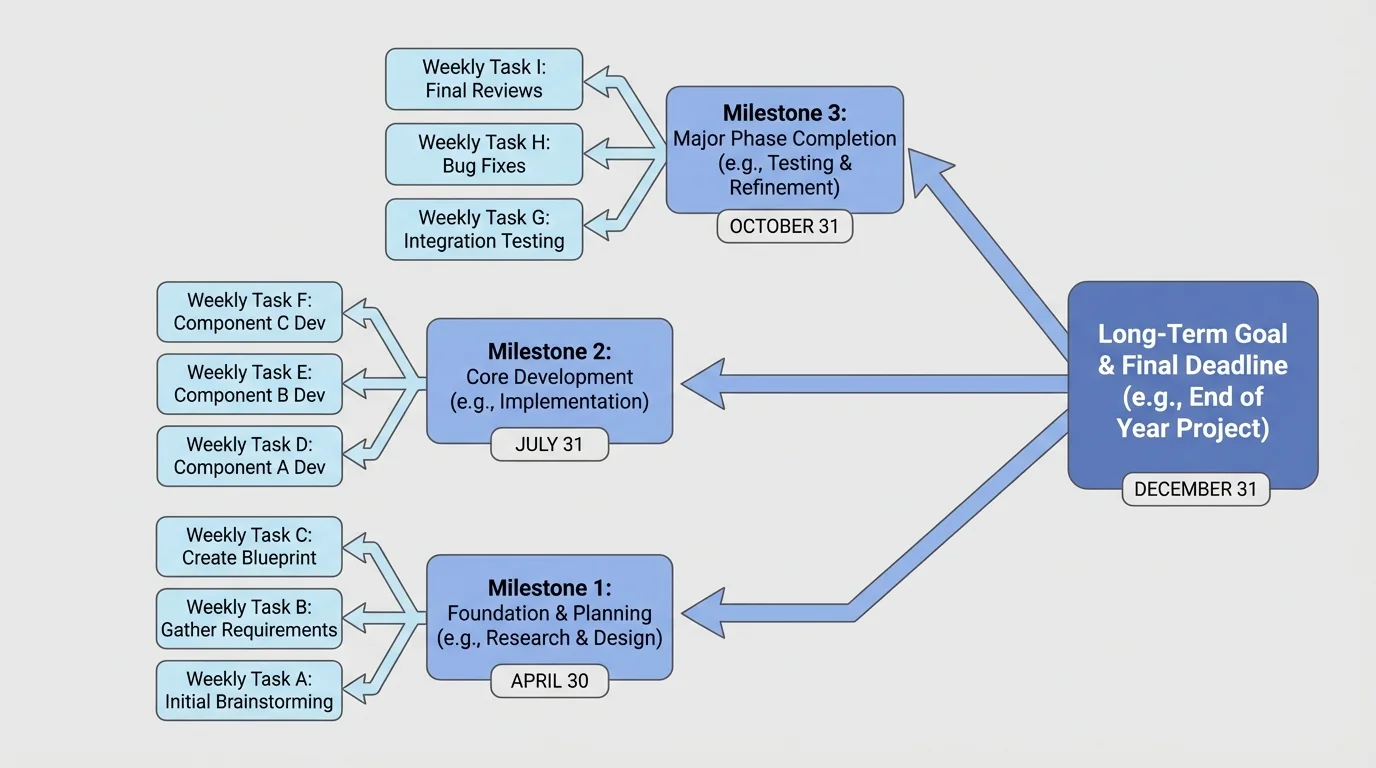
This matters because your brain handles specific actions better than vague intentions. "Work on project" is unclear. "Read source one and write three notes" is concrete. If a task feels hard to start, make it smaller until it feels obvious. A good next step should be so clear that you could begin it without needing to think much.
A useful test is this: can you answer, in one sentence, what you will do in the next work session? If not, the task is probably still too large.
Turning a big goal into workable tasks
Goal: Submit a personal finance presentation in two weeks.
Step 1: Define the finished product
Five slides, one voice recording, and one source list submitted by Sunday at 8:00 p.m.
Step 2: Set milestones
Topic chosen by Tuesday, research finished by Thursday, slides drafted by Saturday, recording done by Sunday afternoon.
Step 3: Break milestones into tasks
Search two articles, take notes, write slide titles, design visuals, rehearse once, upload files.
Step 4: Find the first action
Open the assignment page and list three possible finance topics.
Notice that the first action is simple. Strong planning always leads to a visible next move.
A plan becomes much stronger when it lives on a real timeline, not just in your head. A visible weekly schedule, like the one shown in [Figure 2], makes it easier to see what your days can actually hold. This is where many students overestimate future free time. They assume every evening will be productive, then forget about chores, family plans, fatigue, or the need for breaks.
Start by estimating how long tasks will take. Then add buffer time. A buffer is extra time built in for delays, mistakes, tech issues, or slower-than-expected progress. If you think a task will take two hours, it is often smart to block closer to three. The goal is not to be pessimistic. The goal is to be realistic.
Here is a simple planning idea: if a project is due Friday, aim to finish the main work by Wednesday or Thursday. That gives you room to revise instead of panic. If your internet fails, your file will not upload, or you realize a source is missing, you still have time to recover.
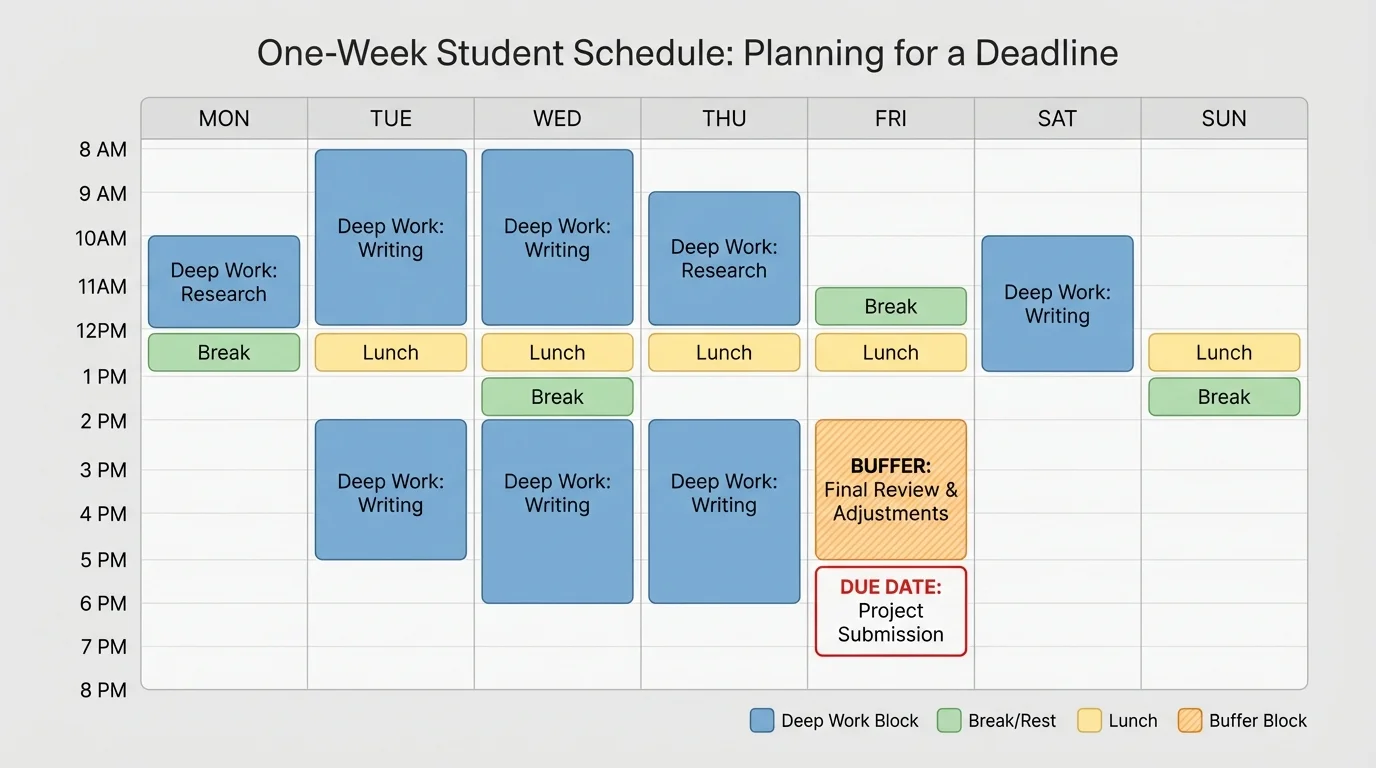
You can also divide work into time blocks. For example, from 4:00 p.m. to 4:45 p.m. you research, from 5:00 p.m. to 5:30 p.m. you outline, and from 7:00 p.m. to 7:20 p.m. you review tomorrow's plan. Time blocks are useful because they answer two questions at once: what you will do and when you will do it.
Be careful not to overschedule every minute. Empty space is not wasted space. It protects your plan. A timeline with no margin is fragile.
| Planning choice | Weak version | Stronger version |
|---|---|---|
| Task estimate | Guess quickly | Estimate, then add extra time |
| Deadline target | Finish at the last minute | Finish early enough to revise |
| Daily schedule | Hope you remember | Use specific time blocks |
| Unexpected problems | No backup plan | Include a buffer block |
Table 1. Comparison of weak planning habits and stronger timeline choices.
If you want a simple number-based method, use this check: if you have five tasks this week and each should take about one hour, your starting estimate is \(5 \times 1 = 5\) hours. If you add a half-hour buffer for each task, the total becomes \(5 \times 1.5 = 7.5\) hours. That extra \(2.5\) hours may be what saves you from a deadline rush.
The best planning system is not the most impressive one. It is the one you will reliably check. Some students work best with a digital calendar and reminders. Others prefer a notebook, wall calendar, or printed checklist. Many use a mix: a calendar for due dates, a task list for daily actions, and reminders for important checkpoints.
Your system should answer three things quickly: What is due soon? What am I doing today? What is the next step on my biggest goal? If your planner is cluttered, hidden in five apps, or too annoying to maintain, you will stop using it.
Planning tools do not do the work for you. Their job is to make decisions visible so you can act on them sooner and with less stress.
A strong setup for online learning often includes these parts: one place for deadlines, one running task list, one weekly review time, and one alarm or reminder for important transitions. Keep it simple enough that you can maintain it even on a busy week.
Planning is not just about organizing tasks. It is also about protecting your attention. You can have a perfect schedule and still fall behind if your focus gets pulled away every ten minutes. Phones, messages, videos, open tabs, and even your own thoughts can break momentum.
One effective method is to work in short, intentional sessions. For example, you might focus for \(25\) minutes, take a \(5\)-minute break, and repeat. Or you might prefer \(45\) minutes of work with a \(10\)-minute break. The exact numbers matter less than the pattern: focused time, then a real pause. This keeps your brain from drifting as easily.
Switching between tasks can make work feel busy while actually slowing you down. Even quick interruptions can reduce the quality of your focus because your brain has to re-enter the task each time.
Try setting up your environment before you begin. Close unrelated tabs. Put your phone in another room or on do-not-disturb. Open the one document you need first. Keep water nearby. These tiny actions reduce friction and make it easier to start.
If you struggle to begin, use a low-pressure starting rule: work for just five minutes. Often, starting is the hardest part. Once you are moving, continuing gets easier.
A plan is only useful if you check it. A simple progress tracker, as shown in [Figure 3], helps you notice whether tasks are done, delayed, or at risk. Without tracking, it is easy to assume you are "basically on track" when several small delays are already adding up.
Set a regular review time, such as every Sunday evening or every morning before coursework. During that check-in, ask: What did I finish? What is next? What is behind? What needs to be moved, simplified, or started earlier? Good planners do not just create plans. They update them.
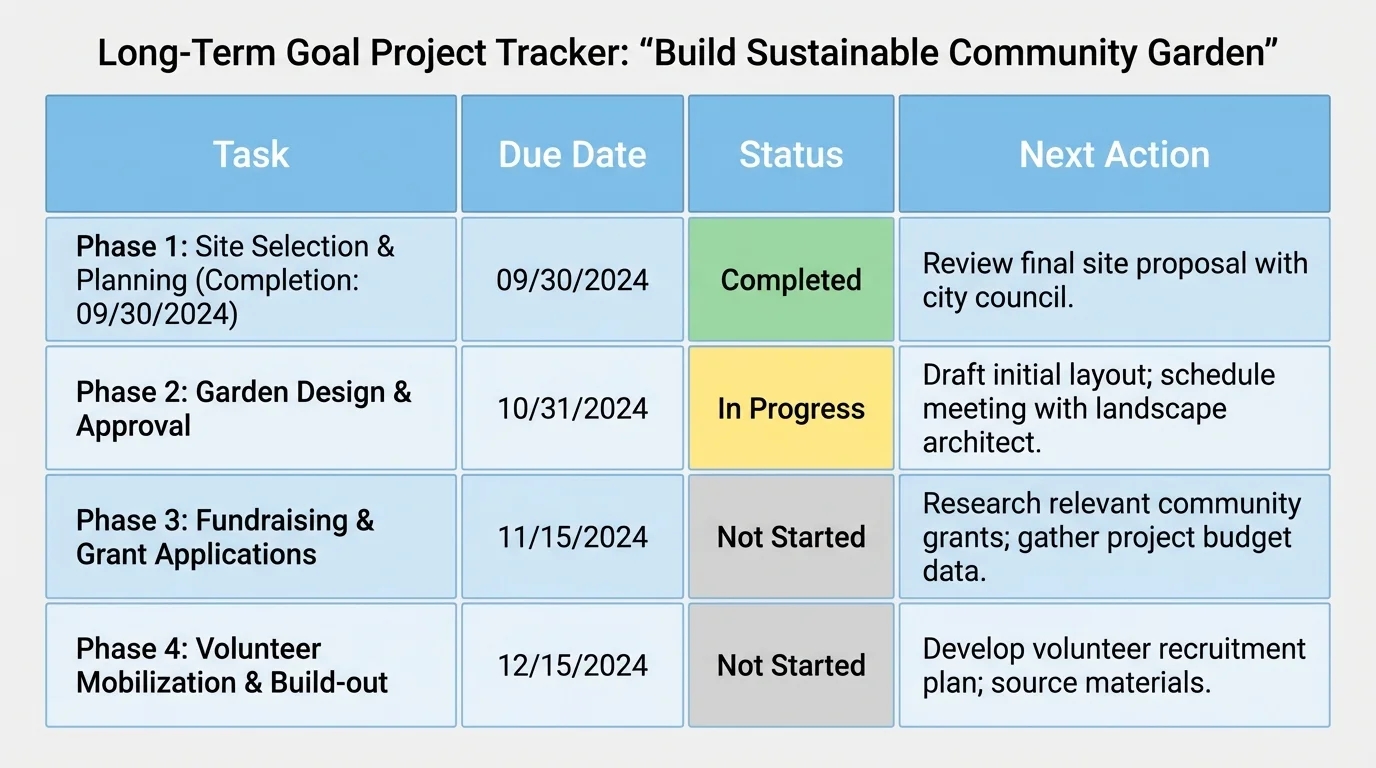
Watch for warning signs: skipping the same task multiple times, needing to "catch up" every day, feeling unsure what the next step is, or avoiding looking at the deadline. These are not signs that you are lazy. They are signs that your plan needs adjustment.
Sometimes the fix is practical. Maybe the task is too big, the estimate was too low, or the work block is scheduled at a time when you are always tired. In that case, change the plan. Break the task down further, move it earlier, or reduce distractions. As we saw in [Figure 3], a visible status check makes hidden problems easier to catch before they become urgent.
Early adjustment beats last-minute effort. A small correction made a week early is far more powerful than a burst of stress the night before a deadline. Productivity is not about heroic rescue missions. It is about steady correction.
If you need help, ask early. In online learning, that might mean messaging your teacher, checking posted instructions again, joining a virtual help session, or asking a parent or mentor to review your plan. Waiting until the due date is much riskier than asking one clear question earlier.
Motivation changes. That is normal. If your whole plan depends on "feeling like it," your progress will be inconsistent. Strong systems reduce the amount of motivation required. Instead of deciding every day whether to work, you follow a routine that makes work more automatic.
This is where accountability helps. Accountability means creating a structure where someone—or something—helps you stay responsible for your plan. That could be a weekly text update to a parent, a shared checklist with a friend, or a habit-tracking app that reminds you to complete your work block.
"You do not rise to the level of your goals. You fall to the level of your systems."
— James Clear
Rewards can help too, if you use them wisely. Finish your planned session, then watch an episode, play a game, or take a longer break. The reward should come after the planned work, not before. Otherwise, the fun activity can quietly replace the task itself.
If you fall behind, do not waste energy on guilt. Restart with honesty. Ask: What is still essential? What can be shortened? What is the next smallest step? A reset is much more useful than self-criticism.
These strategies are not just for school assignments. They work in everyday life too. If you are saving for a $240 purchase in six months, you can break the goal into monthly milestones. Saving the full amount means \(240 \div 6 = 40\), so your target is $40 per month. That turns a distant goal into a clear monthly action.
Example: planning an online project without last-minute stress
A student has a video presentation due in three weeks.
Step 1: Set the finish line
Submit the final video by Friday at 7:00 p.m., but aim to finish by Thursday night.
Step 2: Create milestones
Week 1: choose topic and outline. Week 2: script and slides. Week 3: record, edit, and upload.
Step 3: Add time blocks
Monday and Wednesday from 4:00 p.m. to 4:45 p.m. for writing, Saturday from 10:00 a.m. to 11:30 a.m. for recording.
Step 4: Add a buffer
Leave Thursday evening open for fixing audio, re-recording a section, or troubleshooting uploads.
Step 5: Review progress
Check every Sunday whether the current week's milestone is finished.
The same logic applies if you are planning a community event, preparing for a driving test, training for a race, or managing a part-time job schedule. Goals feel less overwhelming when they are broken into visible steps and attached to real dates.
Some planning mistakes are extremely common. One is making a to-do list that is really a wish list. If your list has \(18\) tasks and you realistically have only three focused hours, the list is not helping. Another mistake is confusing activity with progress. Color-coding notes, reorganizing folders, or rewriting the same checklist can feel productive while avoiding the task that actually matters.
A smarter approach is to pick a few priority actions. If you have three work blocks today, assign one meaningful task to each block. That is more effective than staring at a giant list and feeling behind before you begin.
| Common mistake | Smarter replacement |
|---|---|
| Waiting for motivation | Use a scheduled routine |
| Planning only the final deadline | Create milestones and mini-deadlines |
| Writing vague tasks | Define specific next actions |
| Ignoring delays | Review and adjust early |
| Filling every hour | Leave buffer time |
Table 2. Common long-term planning mistakes and more effective replacements.
The goal is not to become perfect. The goal is to become dependable. You want a system that helps you start sooner, stay steady, and recover quickly when life interrupts your plan.
