Some people spend years preparing for a job they end up not wanting. Others find careers they love because they paid attention to three things early: what interests them, where jobs are actually growing, and what training those jobs require. That combination matters more than picking a job title that just "sounds cool." Career planning is not about predicting your entire future at age 15. It is about making smarter choices now so your future options stay open.
When you assess career pathways well, you are less likely to waste time, money, and energy. You are also more likely to notice opportunities other people miss. A student who likes design, technology, and problem-solving might think only of "graphic designer," but could also fit fields like user experience design, web development, marketing, animation, or product design. The goal is to move from a vague idea to a realistic path.
A career pathway is not just one job. It is a route that can include entry-level work, training, certifications, promotions, and related roles. Think of it like a map instead of a single destination. For example, someone interested in health care might begin as a medical assistant, later train in radiologic technology, and eventually move into health administration. The path can change, but the direction still makes sense.
This matters because adult life includes real tradeoffs. You may care about income, schedule, flexibility, creative freedom, job stability, or helping other people. Some jobs offer strong pay but require long training. Others let you start sooner but may have lower wages or fewer advancement options. A smart decision does not mean choosing the "best" career overall. It means choosing a path that fits you and the real world.
Career pathway means a sequence of connected education, training, and work experiences that lead toward a career area. Labor trends are patterns in the job market, such as whether demand for workers is growing, staying steady, or declining. Education requirements are the training, credentials, or degrees needed to enter and advance in a field.
If you ignore these factors, the consequences can be frustrating. You might choose a field with shrinking job openings, assume a career requires a four-year degree when it does not, or chase a high salary without realizing the daily work does not fit your personality. Good planning helps you avoid these mismatches before they become expensive.
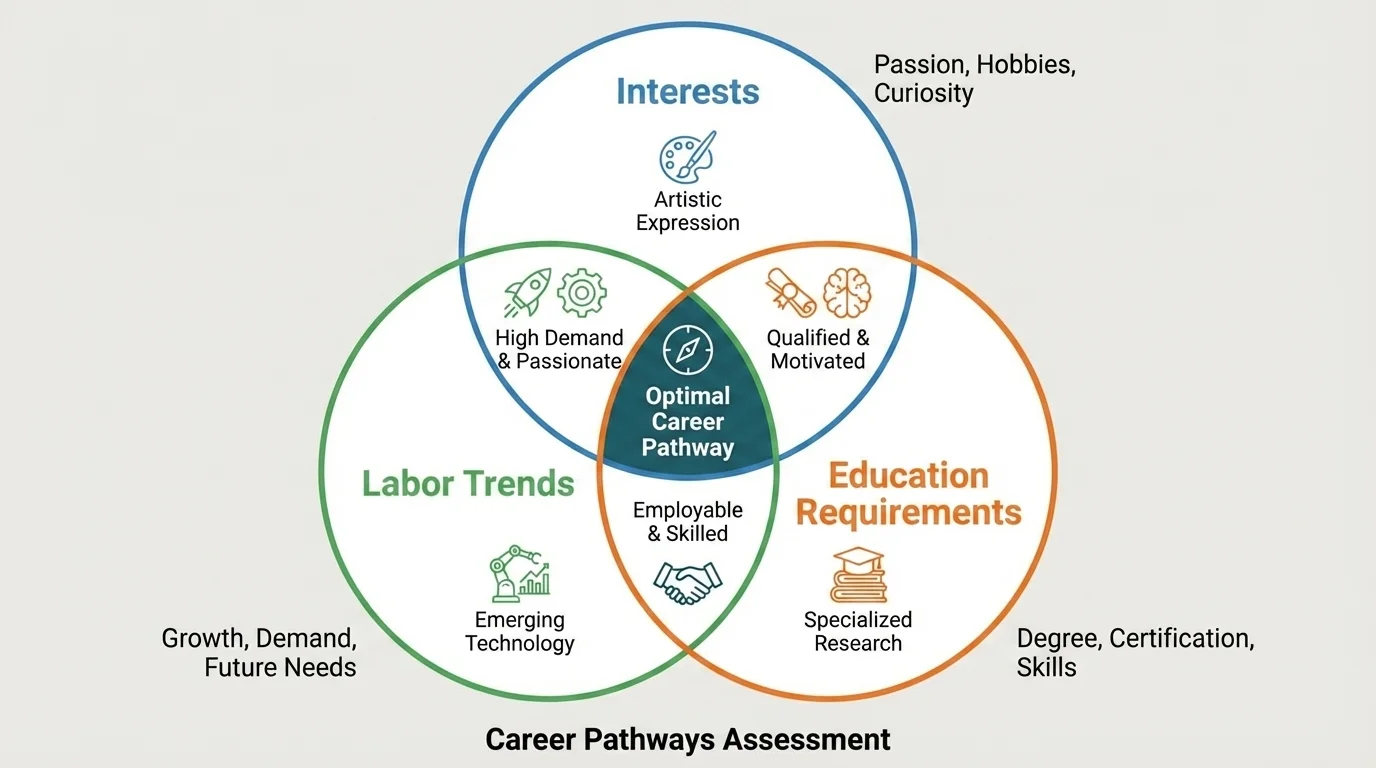
The best career assessments begin with self-knowledge. A strong option usually sits where your interests, skills, and values overlap, as [Figure 1] shows. Interests are the topics and activities that naturally hold your attention. Strengths are things you do well or can learn quickly. Work values are the conditions you care about, such as independence, teamwork, security, creativity, or helping others.
Notice that these are not the same thing. You can be interested in something without being skilled at it yet. You can be skilled at something and still not want to do it all day. You can also like a field but dislike the lifestyle that comes with it. For example, someone may enjoy sports and understand the game well, but not want a career with frequent travel, night schedules, and heavy competition for jobs.
A simple way to start is to ask yourself three practical questions. First, what do you choose to do even when no one makes you? Second, what kinds of tasks make you feel capable or confident? Third, what matters most in a future job: money, flexibility, purpose, stability, creativity, prestige, or something else? Your answers do not need to be perfect. They just need to be honest.
Here are some examples. If you enjoy solving puzzles, working with computers, and learning systems, technology pathways may fit. If you like helping people one-on-one, staying calm under pressure, and doing careful tasks, health care or counseling-related fields may make sense. If you like organizing events, persuading people, and communicating online, business, sales, marketing, or public relations could be strong options.
Interests point; they do not decide. Your interests give you clues, not final answers. Liking video games does not automatically mean game design is the right field. It might instead point toward coding, storytelling, digital art, sound design, marketing, or esports event management. The useful question is not only "What do I like?" but also "What kind of work inside that world fits my strengths and values?"
Be careful with identity labels like "I'm just not a math person" or "I'm only creative." Real careers mix skills. A nurse uses communication and science. An electrician uses hands-on work and problem-solving. A content creator uses creativity, planning, editing, analytics, and business skills. As you saw earlier in [Figure 1], strong matches usually come from overlap, not from one trait alone.
Try This: Make three short lists on your phone or in a notes app: "I enjoy…," "I'm good at…," and "I care about…." Add at least five items to each. Then look for patterns, not perfect answers.
Many students think career choice means picking one permanent job title. In reality, pathways often include multiple on-ramps and side routes. You might start in customer service and discover you like operations. You might study design and move into marketing. You might begin with a certificate, work for a few years, and later return for more education. Flexibility is normal.
Some pathways are built on stackable credentials. That means you can earn one credential, work, then build on it with another. For example, someone interested in information technology might start with a short certification, get an entry-level support job, then later earn a network or cybersecurity credential. This approach can reduce risk because you gain experience while deciding whether to continue.
Other pathways require a longer first step. Careers such as registered nursing, architecture, teaching, engineering, and many legal or medical roles require more formal preparation before entry. That does not make them bad choices. It just means the training timeline, cost, and commitment should be part of your planning.
When you look at a pathway, ask: How do people enter this field? What is the first realistic job? What helps people advance? Can skills transfer to related fields? The more connected options a pathway has, the more resilient it often is if your goals change later.
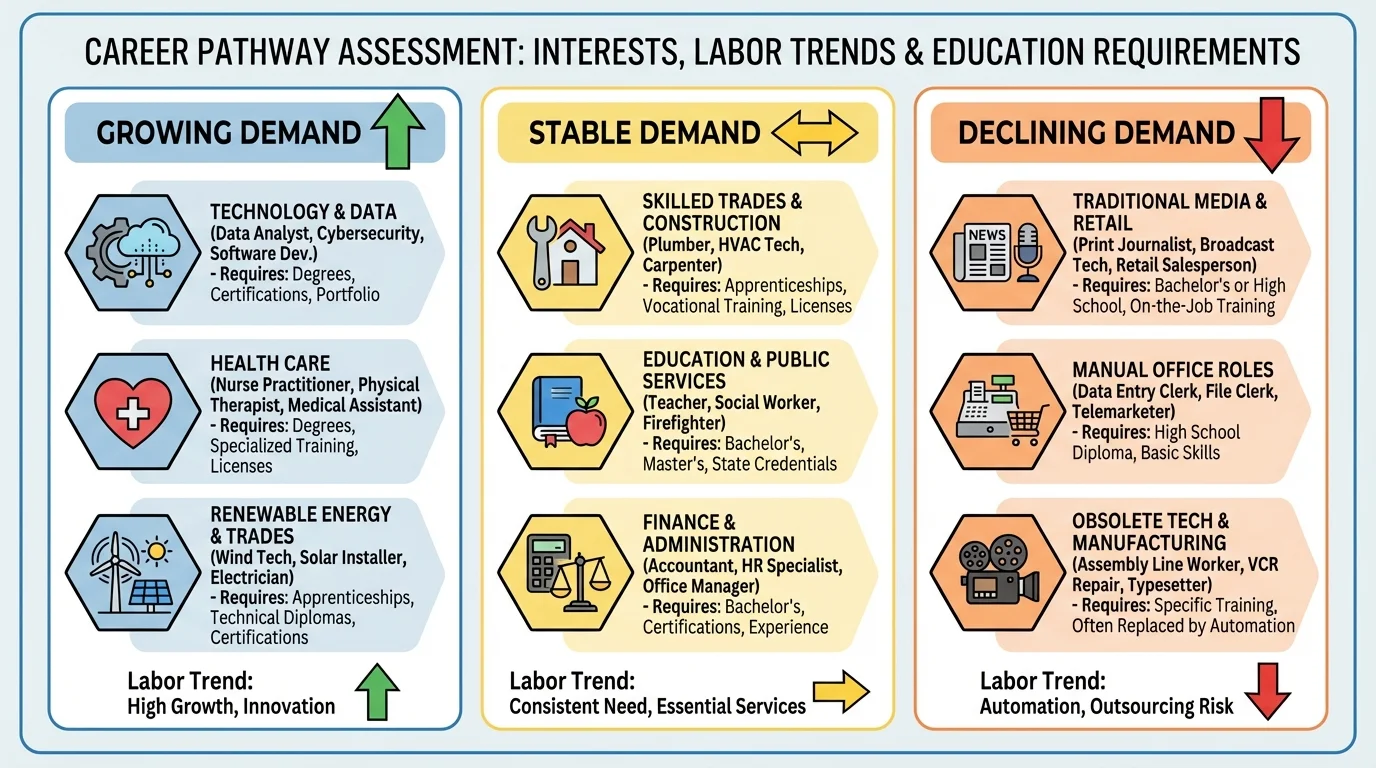
The labor market does not stay still. Some fields expand because technology, health needs, population changes, or business trends create more demand. Others shrink because of automation, outsourcing, or changing consumer habits. Not every interesting job has the same future, as [Figure 2] illustrates. That does not mean you should only chase the fastest-growing field, but you should know what kind of market you are entering.
Look at several trends, not just one. A career might have high pay but limited openings where you live. Another might be growing nationally but become crowded because many people want it. Some jobs are stable but changing in skill requirements. For example, many business and health care roles now require stronger digital skills than they did a few years ago.
Useful labor trend clues include job growth rate, number of openings, typical wages, remote or in-person expectations, and whether the field is concentrated in certain regions. Local information matters. A job that is common in a large city may be harder to find in a rural area, while trade careers may be in strong demand in many communities.
Also pay attention to what employers are asking for in real job postings. Do they want a degree, a certificate, a portfolio, a license, experience, or strong communication skills? Job postings can reveal whether a field is changing. For example, marketing jobs increasingly mention analytics, social media strategy, and content tools. Skilled trade roles may emphasize safety certifications and hands-on experience. Technology roles may ask for specific platforms or coding languages.
Fast growth does not always mean easy entry. Some fields grow quickly because they need highly trained workers, while others offer many openings because turnover is high. Looking only at one number can mislead you.
Another smart question is whether a career is vulnerable to automation. Tasks that are repetitive and predictable are more likely to change. Jobs that require human judgment, relationship-building, creativity, physical troubleshooting, or complex communication are often harder to replace fully. That is one reason many health care, technical support, skilled trade, and education-related roles continue to matter even as software improves.
Try This: Search three job titles you are curious about. For each one, write down the common skills, required training, and whether the jobs seem local, remote, or location-specific. This gives you a more realistic picture than social media career advice alone.
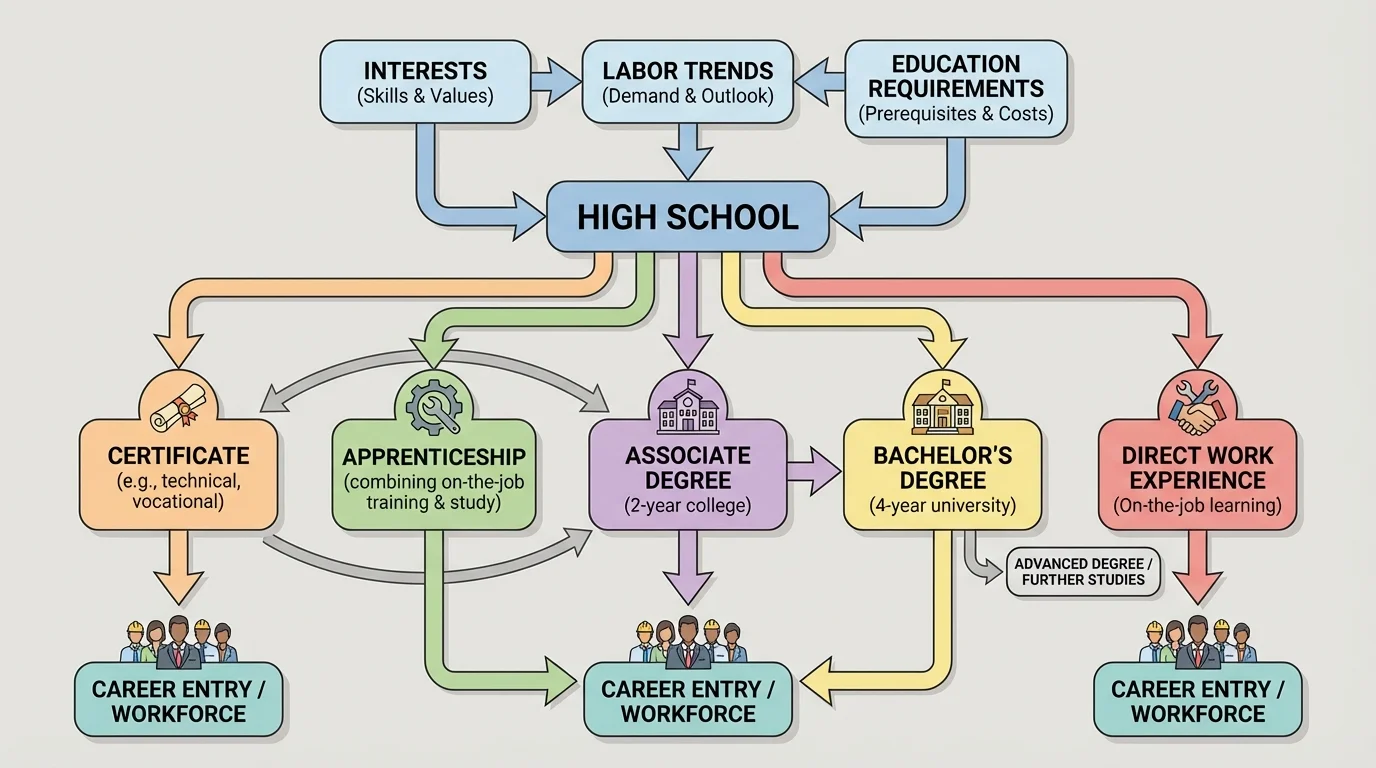
Many students hear "good career" and immediately think "four-year college." Sometimes that is true. Sometimes it is not. As [Figure 3] shows, There are multiple routes after high school, and the right option depends on the field and on your goals. Some careers require a bachelor's degree or more. Others can begin through certifications, apprenticeships, military training, community college programs, or paid on-the-job learning.
Apprenticeships are especially important to understand. They combine paid work with structured training and are common in many trade and technical fields. A certificate program is usually shorter than a degree and focuses on job-specific skills. Licensure or professional approval may be required in some fields, especially those involving public safety, health, or legal responsibilities.
Training length matters because time is a cost. If one pathway takes two years and another takes six, that affects when you can start earning full-time income. But short training is not always better. A longer path may open doors to higher pay, stronger job stability, or wider advancement choices. The key is to compare the investment with the likely return.
Cost matters too. Compare tuition, tools, transportation, exam fees, and time out of the workforce. Some programs have strong outcomes and reasonable costs. Others can leave students with debt and weak job prospects. Ask practical questions: What is the completion rate? How many graduates get jobs in the field? Are there paid internships? Can credits transfer later?
| Pathway Type | Typical Length | Best For | Examples |
|---|---|---|---|
| Certificate | Few months to about 1 year | Fast entry into specific skills | IT support, medical assisting, welding support training |
| Apprenticeship | Varies, often multiple years while working | Hands-on learners who want paid training | Electrician, plumbing, HVAC |
| Associate degree | About 2 years | Technical careers or transfer options | Dental hygiene, radiologic technology, business |
| Bachelor's degree | About 4 years | Fields requiring broader or deeper study | Teaching, engineering, accounting, many business roles |
| Direct work entry | Immediate | Jobs with on-the-job training | Retail operations, customer service, some entry-level logistics roles |
Table 1. Comparison of common education and training pathways after high school.
One more reality: education requirements can change over time. A role that once accepted only experience may now prefer credentials. A field that used to require a full degree may now accept a portfolio plus certification for certain entry roles. This is why current research matters. As shown in [Figure 3], pathways are often flexible rather than one-directional.
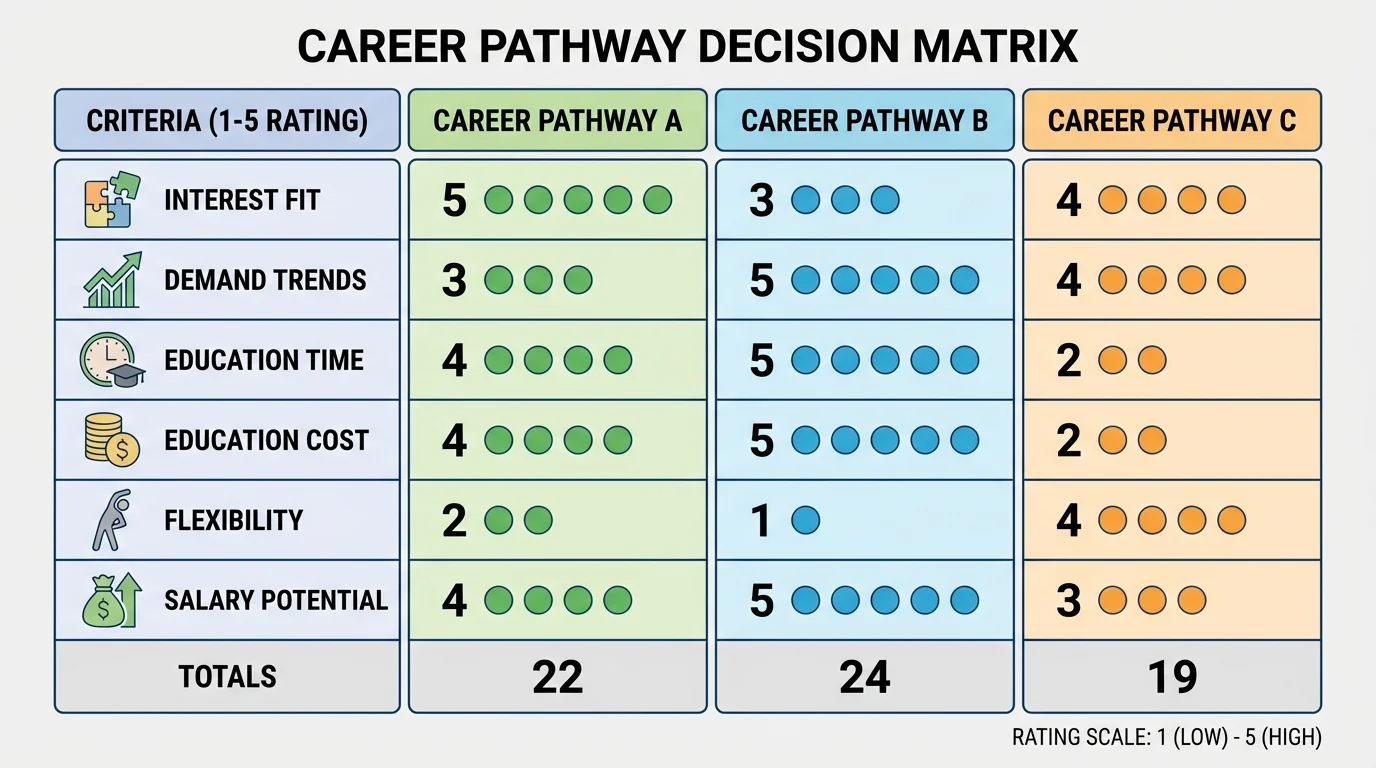
As [Figure 4] demonstrates, once you have a few possible options, do not just go with whichever sounds impressive. Use a simple comparison system. Pick three to five career options and rate each one on factors that matter to you. This turns a vague feeling into a practical decision.
A useful comparison checklist includes: interest match, strength match, work values match, job outlook, earning potential, education time, education cost, flexibility, and local demand. You can rate each factor from 1 to 5, where 1 means weak and 5 means strong. Then total the scores. The math is simple, but it helps you notice tradeoffs clearly.
Career comparison example
A student is deciding between physical therapist assistant, graphic designer, and electrician.
Step 1: Choose categories and score each career from 1 to 5.
The student uses interest match, job outlook, training time, cost, and flexibility.
Step 2: Record the scores.
Physical therapist assistant: interest 4, outlook 4, training time 3, cost 3, flexibility 3.
Graphic designer: interest 5, outlook 3, training time 4, cost 4, flexibility 4.
Electrician: interest 3, outlook 5, training time 4, cost 4, flexibility 3.
Step 3: Add each total.
Physical therapist assistant: \(4 + 4 + 3 + 3 + 3 = 17\)
Graphic designer: \(5 + 3 + 4 + 4 + 4 = 20\)
Electrician: \(3 + 5 + 4 + 4 + 3 = 19\)
This does not prove graphic design is the "correct" answer. It shows that, based on the chosen factors, it currently fits this student best. The student should still research real job demand, portfolio expectations, and location-based opportunities before deciding.
You can make this system even better by weighting categories. If job stability matters more to you than flexibility, give stability double weight. For example, if outlook has weight 2, then a score of 5 becomes \(5 \times 2 = 10\). Weighted scoring helps when some factors matter much more than others.
Be honest while scoring. If you do not know enough yet, do more research instead of guessing. A comparison system is helpful only when the information is reasonably accurate.
Consider a student who likes biology, wants meaningful work, and is open to structured training. Health care offers many pathways. One route could be certified nursing assistant to licensed practical nurse to registered nurse. Another could be medical assistant to sonography or radiologic technology. These options differ in time, cost, stress level, patient contact, and pay. The pathway matters as much as the career field.
Now consider a student who enjoys building things, solving practical problems, and not sitting at a desk all day. Skilled trades might fit well. Labor trends are strong in many areas because communities need electricians, plumbers, welders, and HVAC technicians. Education may involve technical school plus apprenticeship instead of a traditional four-year degree. For the right student, that can be a strong match financially and personally.
A different student may love writing, visuals, branding, and online communication. That points toward marketing, content creation, social media management, copywriting, or design-related paths. But this field requires careful labor trend research. Some roles are competitive. Portfolios, internships, and adaptable digital skills may matter as much as formal education. Looking only at "creative career" as a label is not enough.
Case study: matching fit and reality
Jordan likes technology and helping people, but does not want to spend many years in school before earning income.
Step 1: Identify fit clues.
Interests: computers, troubleshooting, explaining things clearly.
Values: stable income, practical learning, room to advance.
Step 2: Check labor trends.
Jordan finds that IT support, cybersecurity, and network roles have steady to strong demand in many regions, though requirements vary.
Step 3: Compare training routes.
Jordan sees options including entry-level certifications, community college programs, and later stackable credentials.
Step 4: Choose a realistic starting point.
Jordan decides to explore an IT support pathway first because it allows earlier entry while keeping later advancement open.
This is a smart pathway decision because it combines interests, labor trends, and education requirements instead of focusing on only one factor.
These examples show why career planning is not about copying someone else's choice. A pathway that is great for one person may be a poor fit for another. Your task is to compare options based on your real circumstances, not on pressure, trends, or stereotypes.
Watch out for career advice that is too simple. "Just follow your passion" can fail if it ignores pay, demand, or training. "Only choose jobs that pay a lot" can fail if the work makes you miserable. "Everyone needs a degree" is false, and "college is never worth it" is also false. Extreme advice usually leaves out the context that matters most.
Another red flag is assuming a job title tells you everything. Two people with the same title may do very different work depending on the company, region, and experience level. That is why you should research tasks, schedule, work environment, advancement, and requirements, not just names.
One practical move is to conduct small career tests in real life. Watch day-in-the-life videos carefully, but do not stop there. Read job postings. Follow professionals online. Join a virtual career talk. Try a short project connected to the field, such as coding a basic webpage, editing a video, designing a mock ad, or learning basic first aid. Small experiments reveal fit better than guessing.
Try This: Choose two careers and make a one-page comparison. Include what the job does, average pay range in your area, expected training, likely schedule, and one reason it matches your interests. This helps turn career curiosity into decision-making.
"Choose with both self-knowledge and market knowledge."
You do not need a final answer today. What you need is a process. Start with your interests, strengths, and values. Check labor trends so you understand opportunity and risk. Compare education requirements so you know the real cost and timeline. Then rank options and take a small next step. That is how informed career planning works.
