One screenshot can outlast a deleted post. That is the reality of modern digital life: what you say online can affect friendships, opportunities, trust, and safety long after you hit send. Whether you are messaging friends, joining a gaming server, commenting on videos, collaborating in a shared document, or creating content, your digital habits are not separate from your "real" life. They are part of your real life.
At your age, you are already building public and private identities online. People may form opinions about you from your profile, your comments, your humor, your reliability in group work, and how you handle conflict. Responsible digital habits are not about being fake or overly serious. They are about being thoughtful, respectful, safe, and aware of consequences.
Responsible digital habits are repeated behaviors that help you communicate safely, treat others respectfully, work effectively online, and protect your long-term reputation. Online reputation is the impression people form about you from your digital presence. A digital footprint is the trail of information created by your online activity, including posts, comments, likes, usernames, photos, and shared files.
A helpful mindset is this: every message has an audience, every post has a possible afterlife, and every online action says something about your judgment. That does not mean you should be afraid to participate. It means you should be intentional.
If you are kind in person but rude in comments, people still experience you as rude. If you are creative but careless with credit in shared work, people may see you as untrustworthy. If you are smart but constantly leave messages unanswered in team spaces, others may think you are unreliable. Digital spaces reveal habits quickly because they leave records.
Responsible digital behavior matters in everyday situations: applying for a part-time job, joining a volunteer program, trying out for an online creative team, building a portfolio, or asking an adult for a recommendation. Even outside formal situations, it affects whether people want to work with you, include you, or trust you.
Many employers, coaches, and program leaders search for public information about applicants. They may not learn everything about you, but they often learn enough to notice patterns: respectful communication, offensive jokes, mature interests, or careless oversharing.
That is why your goal is not just to "avoid getting in trouble." Your goal is to build a digital presence that matches the kind of person you want to become.
Responsible habits start with understanding two ideas: intent and impact. Intent is what you meant. Impact is what your words or actions actually did. Online, tone is harder to read, jokes travel farther than expected, and context disappears fast. You might mean "just kidding," but another person might read your message as insulting, threatening, or humiliating.
Another key idea is digital footprint. Your footprint includes obvious things like posts and videos, but also less obvious things like old usernames, tags, group chat screenshots, comments left on someone else's content, and accounts you forgot existed. A strong habit is to assume that anything digital may be copied, forwarded, or rediscovered later.
Intent vs. impact online
When you communicate online, your face, voice, and timing cues are often missing. That means people rely heavily on word choice, punctuation, emoji use, and context. A message like "wow okay" can sound playful, annoyed, sarcastic, or angry depending on the relationship and the moment. Responsible communication means checking not only what you mean, but how it is likely to land.
Responsible habits also involve boundaries. Not every thought belongs in a comment section. Not every argument deserves a reply. Not every private detail should become public content. Maturity online often looks like restraint.
[Figure 1] A simple pause before posting prevents a surprising number of problems through a quick decision path. Before you send a message, ask yourself: What is my goal? Who might see this? How might it sound without my voice or facial expression? Am I sharing anything private? That pause might take only a few seconds, but it can save you from drama, embarrassment, and unnecessary conflict.
Use the right channel for the situation. A public comment is not the place for a private correction. A group chat is not the best place to call someone out. A direct message may be better for a sensitive issue, and a video call may be better than a long argument through text. Responsible communication is not only about what you say. It is also about where and how you say it.
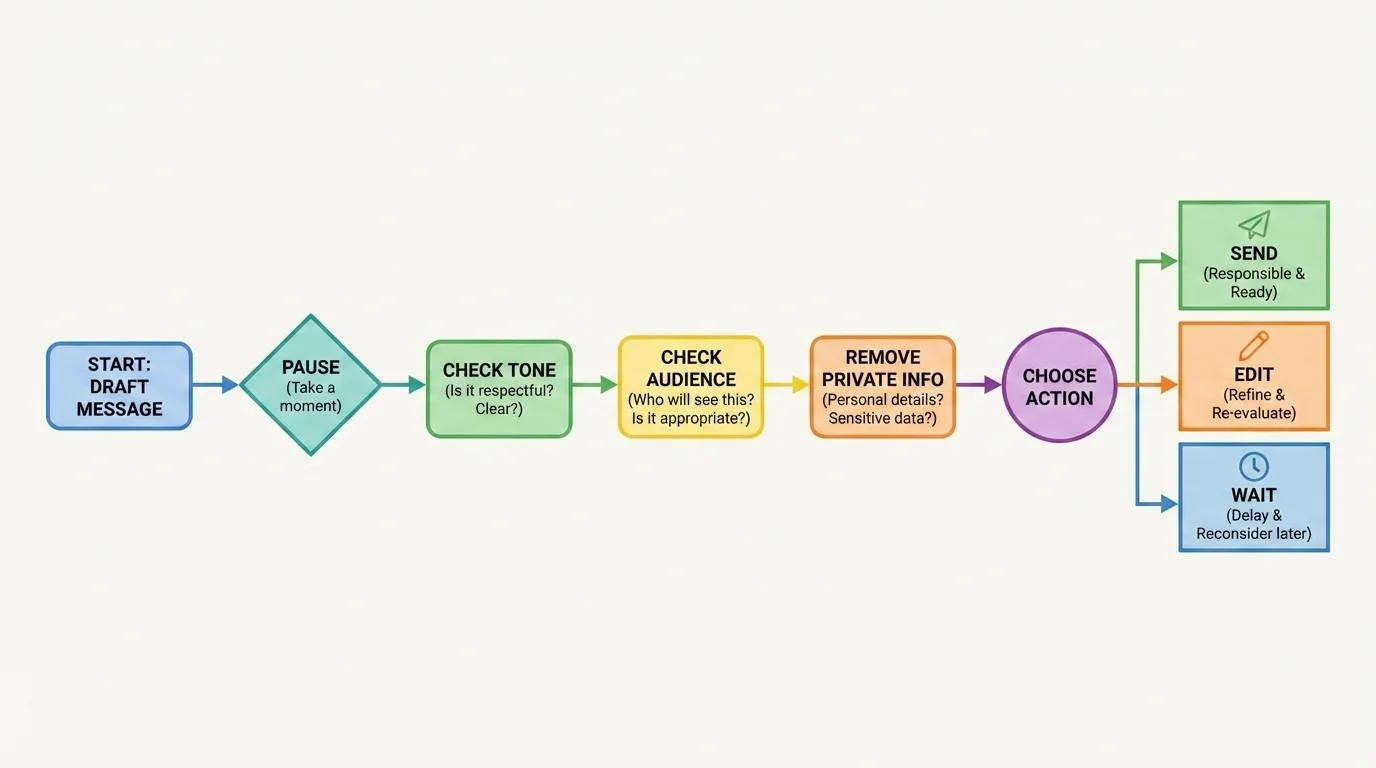
Be especially careful with humor, sarcasm, and anger. Sarcasm often fails in text. Anger makes people type fast and think slowly. If you are upset, do not answer immediately. Draft the message, step away, and return later. If you still want to send it, shorten it. If it still sounds sharp, rewrite it.
Good online communication also means being specific and respectful. Compare these two messages:
| Less Responsible | More Responsible |
|---|---|
| "You never do anything." | "I noticed the shared slides were still unfinished last night. Can we divide the last three sections today?" |
| "That idea is dumb." | "I do not think that approach will solve the problem. What if we try a shorter version?" |
| "Why are you ignoring me?" | "Just checking in on my last message. Let me know when you have time." |
Table 1. Comparison of unhelpful and responsible ways to communicate online.
Notice the pattern: responsible messages focus on the issue, not attacking the person. They are clearer, calmer, and more likely to get results.
Email and formal messaging deserve extra care. Use a clear subject line, greet the person, explain your purpose, and proofread. If you are contacting a teacher, supervisor, club leader, or organization, avoid slang, all lowercase writing, and vague messages like "hey I need help." A better version is: "Hello, I am having trouble uploading my file. I tried twice and checked the format. Could you tell me what to do next?"
Privacy matters too. Never share someone else's personal information, photos, secrets, or screenshots without permission unless safety is at risk and you need help from a trusted adult. Respecting privacy is part of respect itself.
Later, when you feel pressure to reply instantly, remember the pause-edit-send process in [Figure 1]. Fast is not always smart. Clear and calm usually beats immediate.
Real-world communication example: handling a tense group chat
You are in a group chat for a community volunteer event. One person writes, "I guess nobody cares enough to finish anything." You feel blamed because you were busy helping at home.
Step 1: Do not reply with your first emotional reaction.
Instead of typing "Maybe if you stopped complaining," pause and decide on your goal.
Step 2: Move from blame to clarity.
You could respond: "I saw the message. I can finish the sign-up list by 7:00 tonight. What still needs to be done after that?"
Step 3: If needed, shift channels.
If one person seems especially upset, send a private message: "I think the chat is getting tense. Want to sort out who is doing what?"
This protects the group mood and moves the conversation toward a solution.
Try This: Before sending your next message when you are annoyed, read it once as if you are the other person. If it sounds harsher than you intended, rewrite it.
[Figure 2] Online collaboration works best when everyone can see the process through shared roles, drafts, comments, and revisions. Without a clear system, people duplicate work, miss deadlines, overwrite each other's ideas, and blame one another when things fall apart.
Good collaboration starts with simple questions: Who is doing what? When is it due? Where is the shared file? How will we give feedback? What counts as "done"? These questions may seem basic, but skipping them causes most group problems.
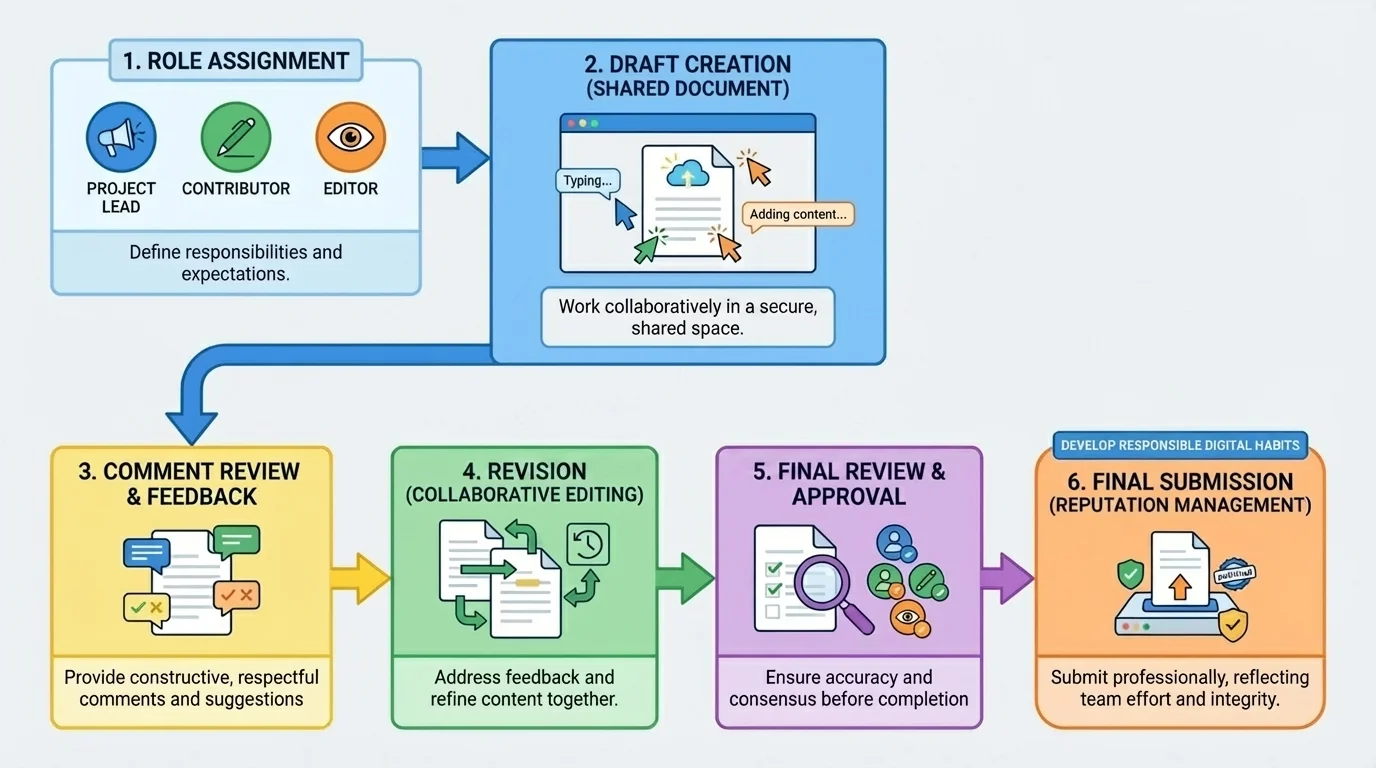
When you work in shared documents, name files clearly, use comments instead of randomly changing someone else's section, and check the latest version before editing. If a tool has version history, use it. If you are unsure about changing a teammate's work, ask first. Responsible collaboration is respectful and traceable.
Give credit honestly. If someone created the graphics, wrote the outline, researched the sources, or edited the final product, acknowledge that work. Taking credit for what others did damages trust quickly. The same is true in creative spaces like video editing, music production, coding, or fan projects. Ask permission before reposting, remixing, or using another person's work.
Be reliable in small ways. Join on time for calls. Reply if you will be late. Finish your assigned part before the real deadline, not at the exact last minute. If something goes wrong, say so early. Responsible people do not disappear and then reappear with excuses after others have had to cover for them.
Digital collaboration depends on visibility and accountability
In online work, people cannot always see your effort the way they might in person. That means your habits become your evidence: your comments, timestamps, edits, follow-up messages, and whether you do what you said you would do. Being organized is not just a personal skill; it is a way of showing respect for the group.
Collaboration also includes community spaces that are not school-related: gaming teams, youth organizations, online clubs, hobby forums, and content channels. The same rules apply. Read the rules, avoid spamming, stay on topic, and contribute more than noise. Communities become healthier when members act like they care about the shared space.
If you ever feel that collaboration is "not your fault" because the work is online, look again at the workflow in [Figure 2]. Most digital problems become manageable when people make responsibilities visible and communicate early.
Real-world collaboration example: shared document disaster avoided
Three students are making an online presentation for a youth leadership program. One person edits the same slide deck without checking messages, another changes the design, and a third cannot find the newest version.
Step 1: Create one official workspace.
Everyone agrees that only one shared folder and one main slide deck will be used.
Step 2: Assign roles.
One person writes, one designs, and one checks accuracy and final formatting.
Step 3: Use comments before major changes.
Instead of replacing whole sections, teammates comment: "Can we shorten this?" or "I want to change the color scheme—okay?"
Step 4: Set a buffer deadline.
If the final submission is Friday night, the team finishes by Thursday evening so there is time to fix problems.
The project feels smoother because the team stops guessing and starts coordinating.
Try This: The next time you work with someone online, send one message at the beginning that states the task, the deadline, and each person's role in one clear place.
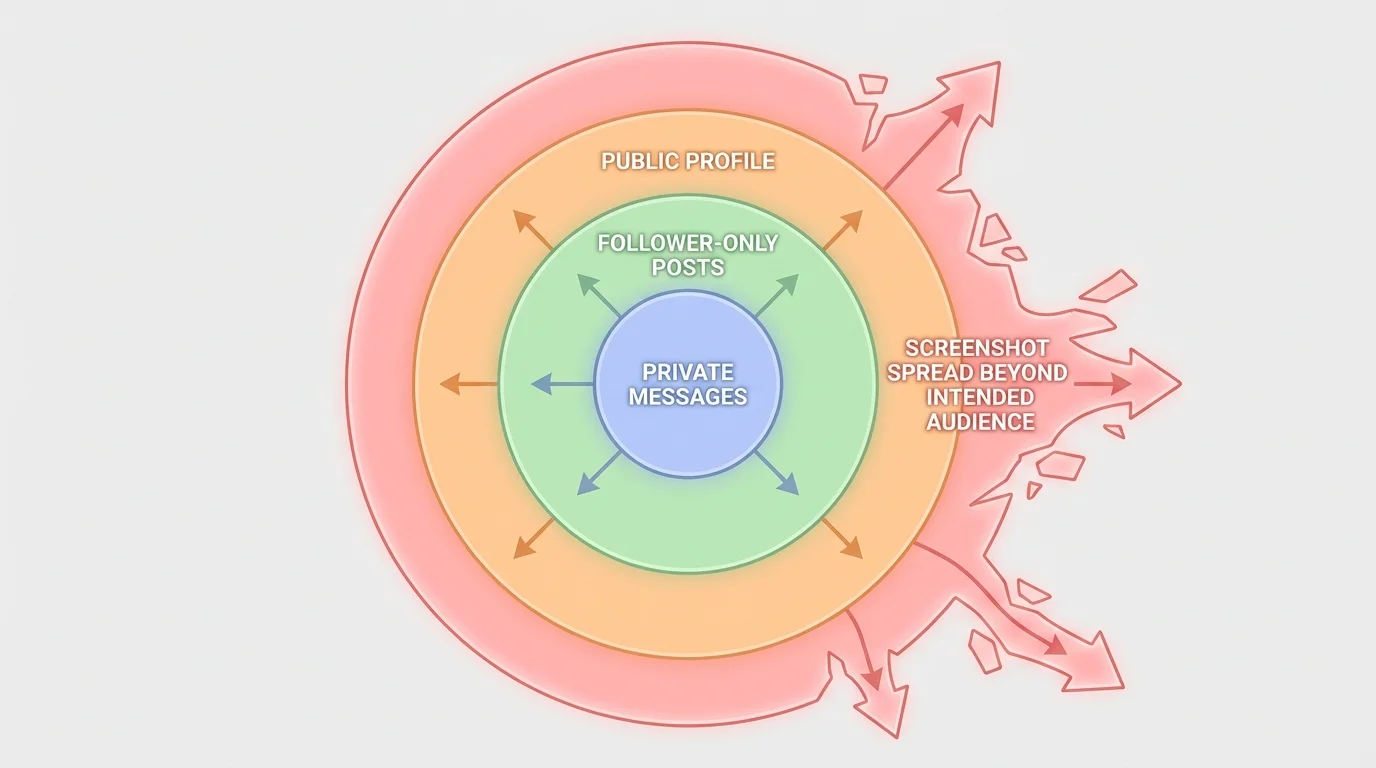
[Figure 3] Your online reputation is shaped by more than your "main posts." Different spaces have different visibility: some things are public, some are limited to followers, and some feel private but can still spread through screenshots or forwarding. Responsible habits come from understanding that privacy settings reduce risk but do not remove it.
Ask yourself three questions before posting: Would I be okay with this being seen later? Does this match how I want to be known? Could this hurt me or someone else? If the answer to the third question is yes, do not post it. If the answer to the first two is no, pause and reconsider.
Watch for reputation traps that seem small in the moment: posting when angry, joining pile-ons against someone, using offensive humor "ironically," sharing risky challenges, insulting people in comments for attention, and keeping usernames or profile pictures that might seem funny now but immature later. These things can make others question your judgment.
Your profile also communicates. A bio, username, display photo, and recent public comments all create a first impression. You do not need a perfectly polished image, but you do want consistency between how you see yourself and what others can observe. If you want to be seen as thoughtful, creative, dependable, or kind, your visible online behavior should support that.
It is smart to check your privacy settings regularly, remove old content that no longer represents you, and search your own name occasionally if you have any public presence. Think of this as digital housekeeping. You are not being vain; you are being responsible.
Deleted content is not always gone. Other people may have saved it, platforms may keep records, and archived pages can sometimes remain searchable for a while.
Reputation management is not about pretending to be perfect. It is about reducing preventable damage and increasing trust. The visibility layers in [Figure 3] remind you that "private" often means "less visible," not "impossible to spread."
Try This: Review your top public profile details today: username, profile picture, bio, and last five public comments. Ask whether they reflect the person you want others to meet.
[Figure 4] Responsible response is a sequence of actions, not panic. Problems online can include being targeted, seeing harmful content, having an account imitated, getting pressured to share personal images, being excluded from a group in a cruel way, or realizing that you posted something you should not have.
First, separate embarrassment from danger. An awkward comment may need an apology. Repeated harassment, threats, blackmail, stalking, impersonation, or sharing private images is more serious and may require immediate help from a trusted adult, the platform, and sometimes law enforcement. You do not have to handle serious digital harm alone.
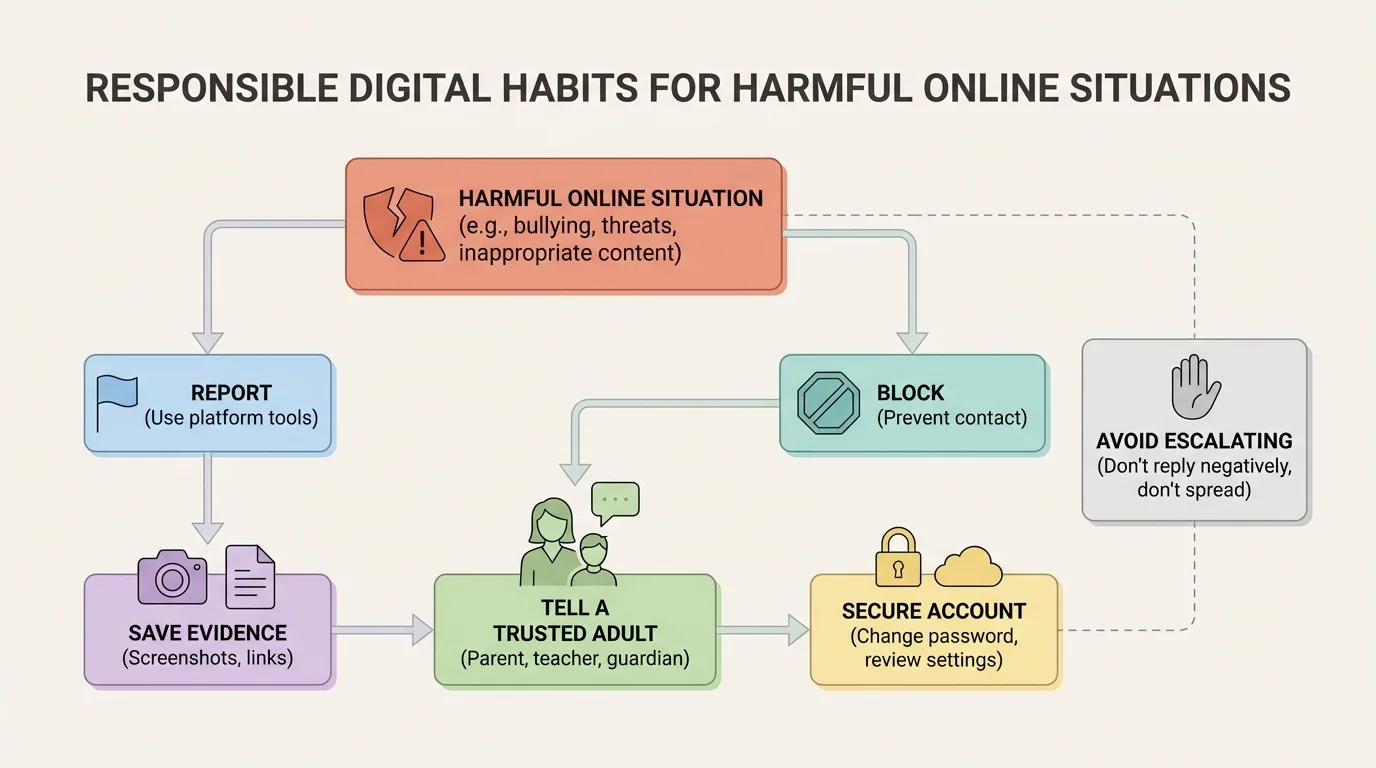
If someone is harassing you, do not fuel the situation by trying to win publicly. Save evidence with screenshots, report the account, block when appropriate, and tell a trusted adult. If an account may be compromised, change the password, enable two-factor authentication, and review login activity.
If you made the mistake, take responsibility quickly. Delete the harmful post if possible, apologize directly without making excuses, and correct any misinformation you spread. A responsible apology is specific: "I shared that screenshot without permission. That was wrong, and I deleted it." Vague apologies like "Sorry if anyone got offended" sound like avoiding responsibility.
Sometimes the right move is to stop, document, and get help. If someone pressures you for private photos, threatens to leak something, or pretends to be you, treat it as a safety issue, not gossip. The response steps in [Figure 4] matter because they keep you focused on protection instead of panic.
Real-world safety example: fake account using your name
You discover an account using your photo and username style to message other people.
Step 1: Do not argue with the impersonator publicly.
Public fights often create more attention and more screenshots.
Step 2: Collect evidence.
Save screenshots of the profile, messages, and username.
Step 3: Report and secure your real account.
Use the platform reporting tool, change your password, and turn on two-factor authentication.
Step 4: Tell a trusted adult.
Especially if the account is contacting people, requesting personal information, or harming your reputation.
Quick, calm action usually works better than public confrontation.
Try This: Turn on two-factor authentication for your main accounts and update any weak passwords you still use.
The strongest digital choices usually come from routines, not from last-second willpower. If you always pause before posting, double-check privacy, credit other people's work, and avoid reacting while angry, you need less effort each time. Habits make good judgment easier.
Here is a simple routine you can use every week:
Check communication: Did I leave any important message unanswered? Did I send anything that needs clarification or apology?
Check collaboration: Am I up to date on shared tasks, deadlines, and files? Did I give credit fairly?
Check reputation: Does my visible profile still represent me well? Are my privacy settings current?
Check safety: Are my passwords strong and unique? Is two-factor authentication on? Have I reported anything harmful I should not ignore?
"Character is what you do when people are not watching. Digital character is what you do when people may be watching later."
You do not need to become silent online. You do not need to be perfect. You do need to be intentional. Responsible digital habits help you communicate with respect, collaborate with trust, and build a reputation that opens doors instead of closing them.
Every post, message, comment, and shared file is a chance to practice. Small choices repeated over time become your pattern. And your pattern becomes your reputation.
